How to Sell Sweet Italian White Wines Abroad: The Complete Guide
Wines Export Editorial · Last updated:
Exporting Italian sweet white wine requires strategic preparation and in-depth knowledge of market and documentation requirements. This article provides an essential guide for wineries aiming to expand their international presence, covering necessary documentation, key markets, and positioning strategies. Understanding the specifics of the segment and foreign regulations is crucial to ensure a successful entry into the global wine trade. Further information: OIV — International Organisation of Vine and Wine.
What Documents are Essential for Exporting Wine?
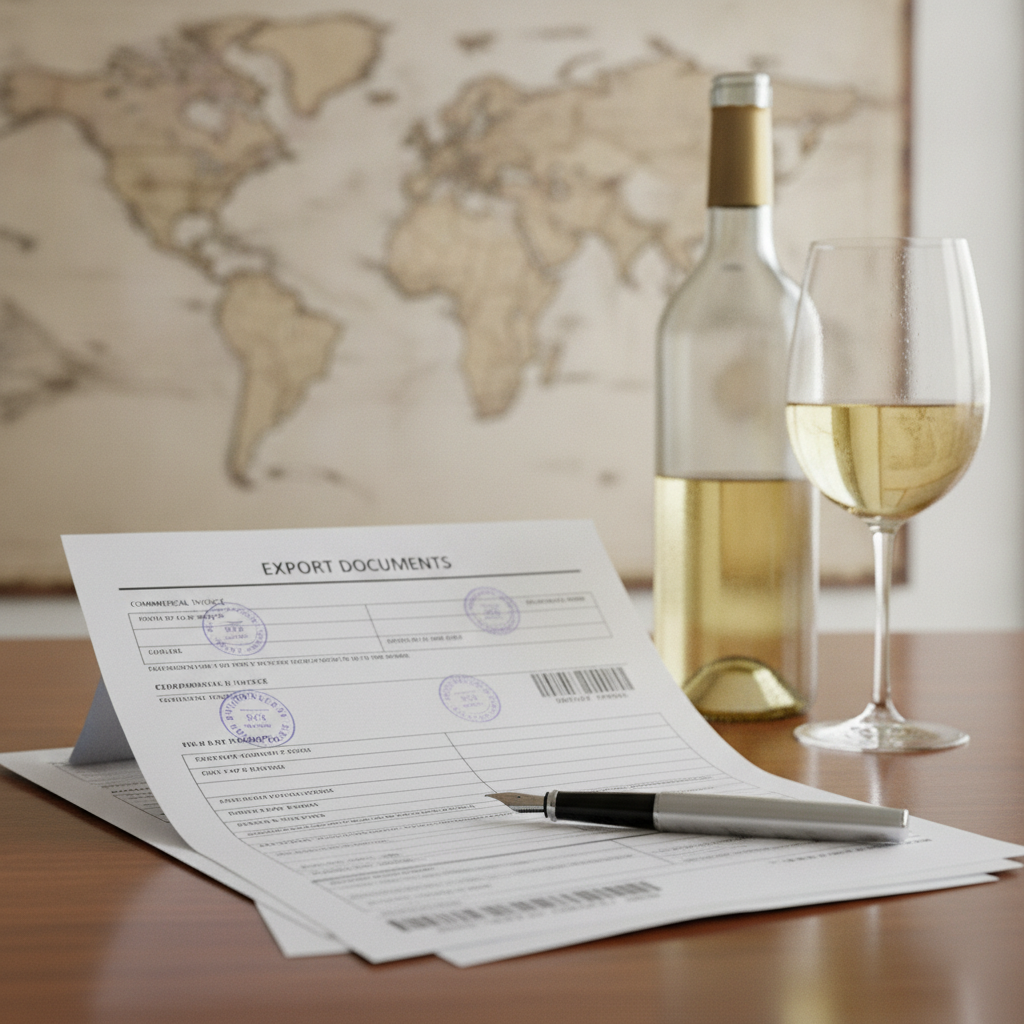
Before initiating any international shipment, having a solid documentary foundation is crucial. These universal documents are the backbone of every export transaction, ensuring compliance and preventing customs delays.
Universal Documents for Every Shipment
Every Italian winery that exports must have a set of standard documents required globally. These are fundamental for customs declarations and to avoid disputes.
- EORI Registration (for EU Exporters): Mandatory for shipments outside the EU, it identifies the economic operator to EU customs. It is obtained for free online from the Italian Customs Agency and is valid in all member states. Without this code, goods risk being blocked.
- Proforma Invoice: Anticipates the terms of the order before final confirmation. Useful for preliminary negotiations and for the buyer to obtain licenses or credit lines. It details product descriptions, MOQ, price, currency, and Incoterm.
- Commercial Invoice: A mandatory document that details the product, quantity, value, Incoterm, and HS code (for wine: chapter 2204). Customs uses it to calculate duties and taxes.
- Packing List: Details the contents of each package: number, type, gross/net weight, and volume. It must exactly match the commercial invoice.
Specific Export Certifications
In addition to commercial documents, certifications attesting to quality and origin are often required.
- Certificate of Origin: Issued by the Chamber of Commerce, it attests to the Italian origin of the goods for customs purposes.
- Chemical-Physical Analysis Certificates: Required from accredited laboratories, they include data such as alcohol content and residual sugars.
- VI-1 (and VI-2) Certificate: Required for EU imports from non-EU countries, it certifies compliance with authorized enological practices. Exemptions exist for countries with equivalence agreements (e.g., USA, Australia), where self-certification is sufficient.
What Are the Key Markets for Sweet White Wine and Their Requirements?
Each foreign market presents regulatory and commercial peculiarities that influence export strategy. Understanding these differences is essential for effective positioning.
How to Export Sweet White Wine to the United States?
For the USA, it is essential to prepare materials in English: technical sheets, winery presentations, FCA/FOB price lists, and high-resolution label images. Verifying label compatibility with TTB (Alcohol and Tobacco Tax and Trade Bureau) requirements is crucial before confirming availability. Clarity on MOQ, formats, and production times is important. Dedicated platforms for Italian wine in the USA can aggregate smaller wineries. Italy has historical leadership in sparkling wines (39% value share in 2019/2020), suggesting a medium-to-high-end positioning with growing demand.
What are the Specifics for Exporting to Ukraine?
In the Ukrainian market, it is essential to identify an importer with an active wholesale license and proven presence in the Horeca channel. Before reactivating suspended relationships, verify the importer's operational status and updated license.
What Trends Do Other Emerging and Traditional Markets Show?
The analysis of Italian wine exports to 13 emerging markets monitored in 2025 exceeded 400 million euros, with a 4.3% growth over 2024. This data highlights a sector trend of diversification, with Italian producers intensifying their search for new commercial outlets beyond historical markets.
How to Effectively Position Sweet White Wine Abroad?
Sweet white wine, while a broad category, requires targeted positioning to stand out in the international market.
How to Identify the Right Target Buyers for Sweet White Wine?
It is fundamental to distinguish between wholesale and retail sales channels, as the latter are often prohibited by law. Finding an importer with an active wholesale license and proven presence in the Horeca channel is a crucial first step.
How to Differentiate My Sweet White Wine in the International Market?
The presentation of Italian sweet white wine must emphasize its uniqueness. Elements such as the denomination, vintage, bottle format, and intrinsic quality are key. Referrals, such as presence in other markets or recognition from guides, are particularly relevant for the US audience.
How to Adapt My Sweet White Wine to the Needs of a Specific Market?
Understanding the specific needs of the target market is vital. For example, in South Africa, the country of origin indication is mandatory for wines intended for export. The wording "contains sulphites" is mandatory if the wine contains more than 10 mg/l of sulfur dioxide. Documentary logistics, including specific certificates and pre-notifications to authorities, must be carefully organized.

Frequently Asked Questions About Exporting Sweet White Wine
What are the labeling requirements for exporting sweet white wine to the United States?
It is crucial to verify label compatibility with TTB (Alcohol and Tobacco Tax and Trade Bureau) requirements before promising availability. Furthermore, in some markets like South Africa, the country of origin indication is mandatory for wines intended for export, and the wording "contains sulphites" is required if the wine exceeds 10 mg/l of sulfur dioxide.
Is a Certificate of Origin necessary to export sweet white wine to all markets?
The Certificate of Origin, issued by the Chamber of Commerce, attests to the Italian origin of the goods for customs purposes. While not explicitly mentioned as mandatory for all markets in the article, it is a standard document required in many international transactions to determine the application of duties and trade agreements.
What are the benefits of using platforms or logistics-commercial hubs for exporting sweet white wine?
Dedicated platforms and logistics-commercial hubs for Italian wine in the USA can serve as aggregators for smaller wineries seeking an initial importer. This can simplify market access and the management of initial exports.
The export of Italian sweet white wine represents a significant growth opportunity, requiring meticulous preparation, market knowledge, and impeccable documentation management. Every detail, from regulatory compliance to the choice of commercial partner, is fundamental for success.
Request a personalized demo and discover how we can help you expand your presence in international markets.