Sparkling Red Wine: How to Successfully Bring It to Foreign Markets
Wines Export Editorial · Last updated:
Exporting Italian sparkling red wine represents a strategic growth opportunity for wineries, offering a market segment with interesting potential and growing demand from international consumers. To successfully enter foreign markets, it is crucial to understand the specific characteristics of this product, from its enological nature to documentary and regulatory requirements. This article provides a comprehensive guide for Italian wineries, analyzing the key aspects for successful export, from product qualification to positioning strategies. In-depth: OIV — International Organisation of Vine and Wine.
What is Sparkling Red Wine and Why Enhance Its Value?
Sparkling red wine is distinguished by its effervescence, which makes it versatile and appreciated in convivial settings. Italy holds a leading position in the sparkling wine market, and red sparkling wine, while a less explored segment, offers an interesting alternative to still wines for consumers seeking new taste experiences.
Production can occur through natural refermentation (Martinotti/Charmat method) or carbonation. It is important to note that the term "frizzante" should ideally be reserved for naturally sparkling wines, while for carbonated ones, the term "vino gassificato" (gaseous wine) should be considered for transparency. The naturalness and intrinsic quality of the product, with the possibility of sweetening only with grape-derived raw materials in demi-sec sparkling wines, contribute to a mid-to-high price positioning, a growing segment.
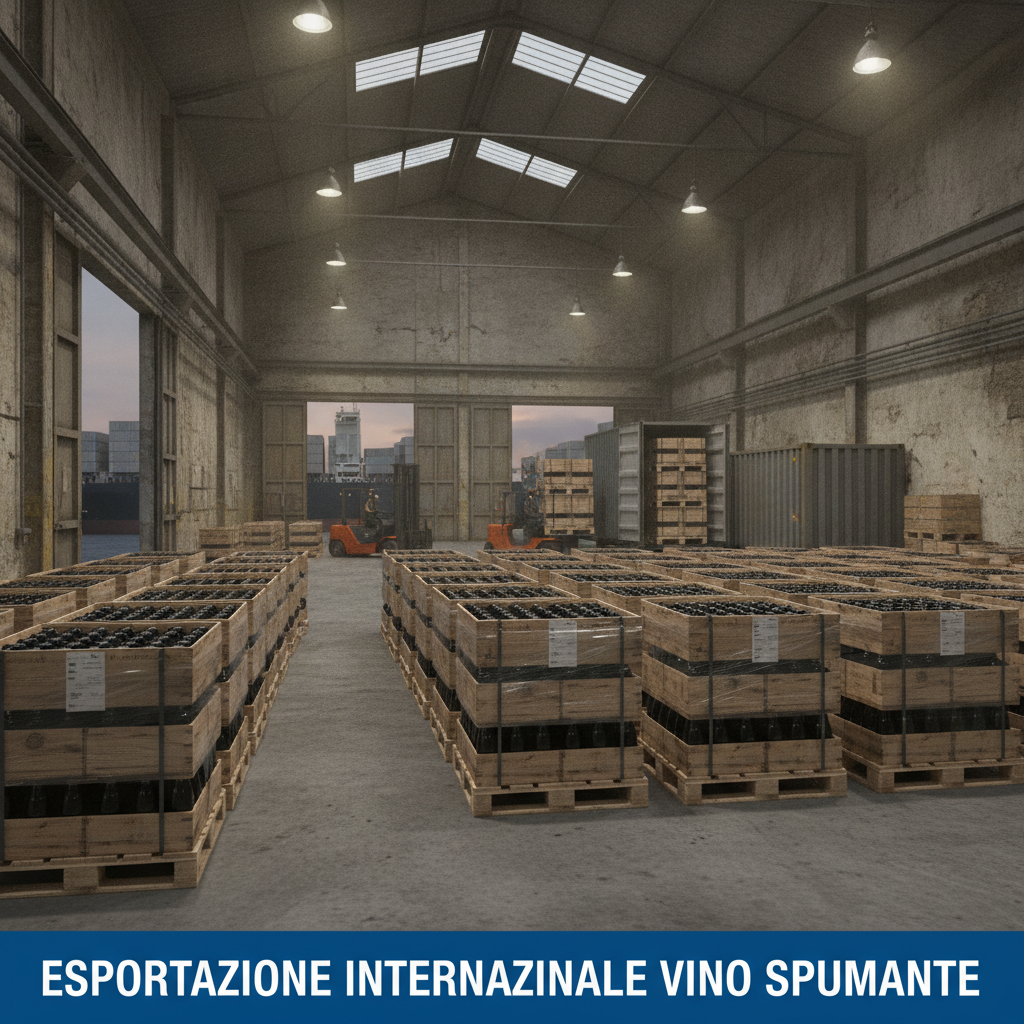
What Documents Are Needed to Export Sparkling Red Wine?
Exporting wine, especially a product with specific characteristics like sparkling red wine, requires meticulous documentary preparation and a thorough understanding of the destination countries' regulations.
Essential Documents for Export
Before any shipment, a set of universal documents is necessary. Among these, the EORI (Economic Operators Registration and Identification) number is mandatory for shipments outside the EU and can be requested online through the Italian Customs Agency. The proforma invoice, which details products, quantities, prices, and Incoterms, is the basis of the negotiation.
Shipping and Customs Documents
Depending on the destination country, documents such as the standard import customs declaration, commercial invoice, customs value declaration, and transport insurance will be required. It is crucial that these documents are consistent with the data reported on the label, such as lot number, producer, and volume.
Specifics of Sparkling Wine and Excise Duties
Correct product qualification (still, semi-sparkling, sparkling) and packaging are critical for excise duty assessment and the obligation of procedures like EMCS (Excise Movement and Control System). The excise duty amount, especially for markets like Germany, must be requested directly from customs authorities or a specialized consultant before finalizing pricing.
Labeling and Language Compliance
Labeling is subject to specific regulations for each country. Generally, the nutritional label and the statement on sulfites/allergens (mandatory if the wine contains more than 10 mg/l of sulfur dioxide) are required. It is necessary to verify linguistic compliance with the official languages of the destination country (e.g., French and Dutch for Belgium). The lot number, volume, and alcohol content must be legible and compliant on every bottle size. For markets like South Africa, indication of the country of origin is mandatory for wines intended for export.
Stability and Quality Control
For batches destined for long transit and uncontrolled temperatures, a pre-shipment microbiological stability check is recommended. This, along with the volatile acidity data, helps prevent degradation during transport in suboptimal conditions.
How to Position Sparkling Red Wine in Foreign Markets?
Italy's leading position in the sparkling wine segment offers a competitive advantage to leverage for sparkling red wine as well.
Identifying the Right Importer
Seeking an importer with an active wholesale license and a proven presence in the HORECA channel is fundamental. It is important to verify the absence of state monopolies requiring specific procedures, by consulting with the distributor or the relevant ICE office.
Mid-to-High Price Positioning Strategy
Evaluating a mid-to-high price positioning is a winning strategy, as this market segment sees structurally growing demand. This allows for differentiation from competitors and highlights the quality of Italian products.
Online Sales Activities and Graphic Adaptation
In the absence of specific regulations, it is advisable to contractually clarify any online sales activities with the importer. Aligning graphics and labeling with the importer, especially for requirements such as indicating the country of origin, is a necessary step.
Operational Verification and Licenses
Before reactivating suspended commercial relationships, it is imperative to verify the importer's operational status and updated license.
Operational Examples for Specific Markets
- Belgium: Verify the draft label for linguistic compliance (French/Dutch) and always include the nutritional label and the statement on sulfites/allergens. Confirm with the importer any health warnings or compliance marks not covered by the ICE guide.
- Germany: Correct product and packaging qualification is critical for excise duty assessment and the obligation of the EMCS procedure. The excise duty amount must be requested from the German customs authorities or a specialized consultant.
- Ukraine: It is important to verify the importer's operational status and updated license, especially in contexts of instability.
- Cyprus: Contact the importer or a local customs consultant for a precise verification of specific nutritional requirements and health warnings before the first commercial shipment.
- South Africa: Indication of the country of origin is mandatory for wines intended for export. It is necessary to organize documentary logistics, including certificates such as EUR1, and to calculate the tax impact (VAT, duty, excise) upstream.

Conclusion: A Strategic Approach to Success
Exporting Italian sparkling red wine requires a strategic approach that combines in-depth product knowledge, rigorous documentary preparation, and a clear vision of market dynamics. Collaboration with reliable local partners, understanding specific regulations, and targeted positioning are key elements to ensure success.
Frequently Asked Questions
What are the essential documents required to export Italian sparkling red wine outside the European Union?
For shipments outside the EU, possessing an EORI number is mandatory, obtainable online through the Italian Customs Agency. Furthermore, a detailed proforma invoice including products, quantities, prices, and Incoterms is required.
How is sparkling red wine labeling handled for foreign markets, considering different linguistic and content regulations?
Labeling must comply with the specific regulations of each country, including the nutritional label and the statement on sulfites/allergens if the wine contains them in quantities exceeding 10 mg/l. It is crucial to verify linguistic compliance with the official languages of the destination country and ensure that the lot number, volume, and alcohol content are legible and compliant.
What is the recommended positioning strategy for Italian sparkling red wine in foreign markets, and how does it differ from still wines?
A mid-to-high price positioning is recommended, as this market segment exhibits structurally growing demand. This allows for highlighting the quality of Italian products and differentiating from the competition, leveraging Italy's leadership in the sparkling wine market.