How to Sell Your Italian Dry Wine Abroad: The Definitive Guide
Wines Export Editorial · Last updated:
Exporting Italian dry wine represents a strategic opportunity for wineries aiming to expand their presence in international markets. Understanding document requirements, market dynamics, and country-specific nuances is crucial for successfully navigating the complex world of wine exports. This article aims to provide a comprehensive overview of the key elements that Italian wineries should consider when exporting their dry wine. In-depth information: OIV — International Organisation of Vine and Wine.
What Documents Are Essential for Exporting Wine?
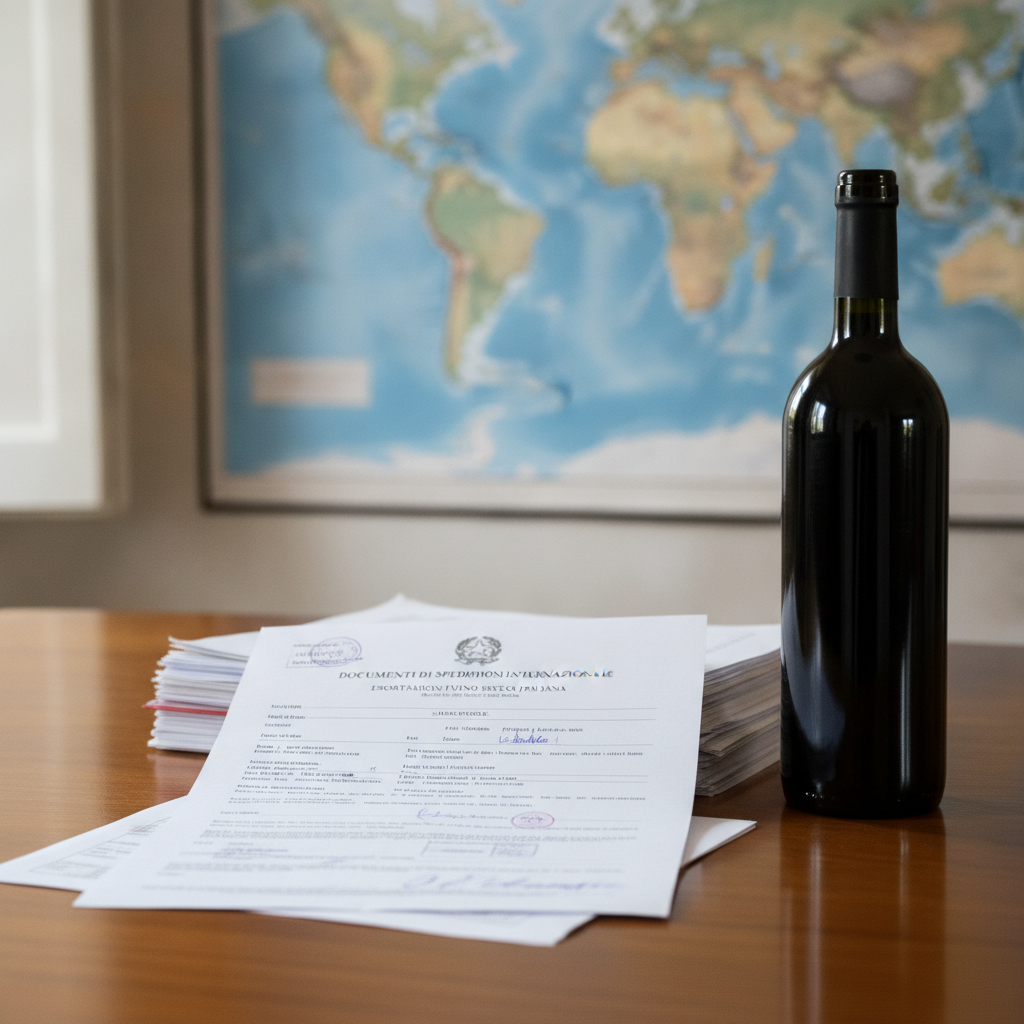
Every international wine shipment requires a fundamental set of documents to certify the transport contract, facilitate customs procedures, and ensure regulatory compliance. Accurate and complete documentation is the first step to avoid delays, disputes, and additional costs, forming the basis for any export operation.
What Are the Universal Documents Required for Every Wine Shipment?
Before delving into the specifics of each market, it is crucial to have a core set of universally recognized standard documents. These include EORI registration for EU exporters, a detailed commercial invoice with HS code, a proforma invoice for preliminary negotiations, and a packing list describing the physical contents of each package shipped.
- EORI Registration (for EU exporters): Mandatory for shipments outside the EU, it identifies the economic operator to EU customs authorities. Registration is free and can be done online through the Italian Customs Agency. Without EORI, goods risk being held up.
- Commercial Invoice: A mandatory document that includes product description, quantity, value, Incoterms, and HS code (chapter 2204 for wine). Used by customs to calculate duties and taxes.
- Proforma Invoice: Outlines the terms of the order and sales conditions, useful in preliminary negotiations and for obtaining import licenses.
- Packing List: Describes the physical contents of each package (number, type, weight, volume) and must match the commercial invoice.
What Specific Documents Are Necessary for Exporting Wine to Spain?
When exporting wine to Spain, an EU market, customs procedures are simplified. A commercial invoice, transport documents, and a packing list are mandatory. The key document for the movement of wine under excise duty suspension is EMCS (Excise Movement and Control System) with the ARC (Administrative Reference Code) generated by the Italian Revenue Agency, which must accompany the goods.
What Documents Are Required for Wine Exports to the Netherlands?
For the Netherlands, also an EU market, documentation is simplified. The export invoice must include complete details of the exporter and buyer, product type, HS code, and Incoterms. A DAA/e-AD (accompanying document for wine under excise duty suspension) via EMCS is required, along with the CMR transport document. The packing list must be detailed.
What Are the Documentary Requirements for Exporting Wine to Hong Kong?
For exports to Hong Kong, in addition to the commercial invoice and packing list, a complete and accurate shipping document must be submitted within 14 days of importation. There are no customs quotas or obligations related to the Bioterrorism Act. For labeling, wines with an alcohol content of 10% or higher are exempt from general requirements, except for the indication of shelf-life.
What Documents Are Necessary for Exporting Wine to South Africa?
Exporting to South Africa requires a commercial invoice, packing list, certificate of origin, a certificate of analysis issued by the National Department of Agriculture, and a 48-hour prior notification to the Quality Audit Division with a 750ml sample. The indication of the country of origin is mandatory, as is the statement "contains sulphites" if the wine exceeds 10 mg/l of sulfur dioxide.
What Are the Requirements for Exporting Wine to Ukraine?
For Ukraine, it is important to identify an importer with an active wholesale license and a proven presence in the Horeca channel. An export invoice is mandatory, as are transport documents and a packing list. No certificates of origin or analysis are required.
What Are the Requirements for Exporting Wine to the United States?
To export to the USA, it is essential to have materials in English (technical data sheet, winery presentation, price list, label images). You must verify the compatibility of the label with TTB (Alcohol and Tobacco Tax and Trade Bureau) requirements and have clarity on MOQs, available formats, and production times.
What Market Strategies Are Effective for Italian Dry Wine?
Italian dry wine enjoys a well-established reputation, but to succeed in exports, targeted strategies that consider the specifics of each market are necessary.
How Should Italian Dry Wine Be Positioned, and Which Distribution Channels Should Be Prioritized?
In many markets, the demand for mid-to-high-end Italian wines is showing structural growth, offering more attractive margins and highlighting the product's quality. It is essential to understand the coverage of the Horeca channel (Hotels, Restaurants, Catering) versus retail, as the presence of large supermarket chains, e-commerce platforms, and specialized distributors will influence market penetration strategy.
What Are the Most Promising Emerging Markets for Italian Wine?
The diversification of Italian wine exports towards emerging markets such as Angola, Bulgaria, Colombia, India, Mexico, Poland, the Czech Republic, and Thailand represents a significant trend. These markets offer considerable growth potential, with exports to these monitored emerging markets exceeding 400 million euros in 2025, representing a 4.3% increase over 2024.
What Are the Competitive Advantages of Italian Wine, and How Can You Differentiate?
Italian wine holds a historical leadership position in various markets, as demonstrated by its value share in Spain around 39% in 2019/2020 for the sparkling wine segment. This advantage must be defended with strategic positioning and rigorous selection of commercial partners. Preparing informative material in English and mentioning awards can strengthen credibility.
Final Considerations for Dry Wine Exports
Exporting Italian dry wine requires preparation, attention to detail, and a clear strategy. In-depth understanding of documentation, adaptation to specific regulations, and a proactive market approach are crucial for success. Diversification to new markets and maintaining a quality positioning in established markets are the keys to ensuring sustainable long-term growth.
Start with four questions: we will write back →

Frequently Asked Questions
What are the main documents required for exporting wine to non-EU countries?
For exports to non-EU countries, EORI registration, a detailed commercial invoice, a proforma invoice, and a packing list are generally required. Depending on the destination country, additional specific certificates or documents may be necessary.
Is an origin certificate mandatory for exporting wine to South Africa?
Yes, for export to South Africa, it is mandatory to present a certificate of origin, in addition to other documents such as the commercial invoice, packing list, and a certificate of analysis.
What are the labeling requirements for wine exported to Hong Kong?
For Hong Kong, wines with an alcohol content of 10% or higher are exempt from general labeling requirements, except for the indication of shelf-life (expiry date/best before date).