Selling Italian Dry White Wine Abroad: Strategies and Documents for Success
Wines Export Editorial · Last updated:
Exporting Italian dry white wine presents a significant growth opportunity for wineries aiming to expand their global presence. A thorough understanding of documentary requirements, specific regulations, and market dynamics is essential for successfully navigating the complex landscape of wine export. This article provides a comprehensive guide to the fundamental aspects to consider, from preparing documentation to selecting the most effective distribution channels, with a particular focus on the most receptive international markets and strategies to reach them. Further insight: OIV — International Organisation of Vine and Wine.
What Documents Are Essential for Exporting Wine?
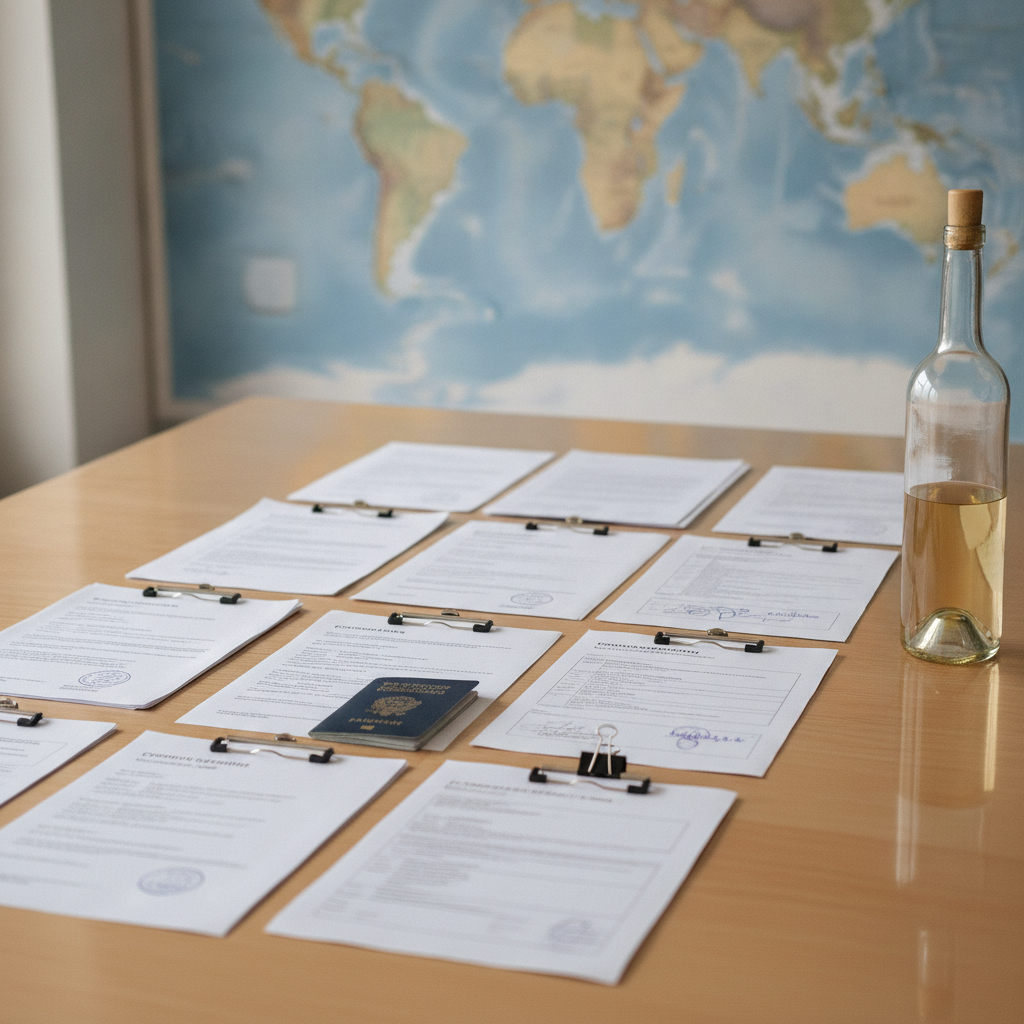
Every international wine shipment requires a package of essential documents. These documents serve as proof of the transport contract, support import and export customs procedures, and ensure product regulatory compliance, forming the basis for any export operation.
What Are the Universal Documents for International Wine Shipments?
There is a set of fundamental documents required for most international shipments, regardless of the destination. These include EORI registration for EU exporters, a detailed commercial invoice, a proforma invoice for preliminary negotiations, and a packing list describing the contents of each package.
EORI (Economic Operators Registration and Identification) registration is mandatory for Italian wineries shipping outside the European Union. This code uniquely identifies the economic operator in dealings with customs authorities. The application is free and made through the Italian Customs Agency. Without EORI, goods risk being blocked.
The Commercial Invoice is a mandatory document issued by the exporter. It details the product, quantity, value, delivery term (Incoterm), and the HS customs classification code (Chapter 2204 for wine). Customs authorities use it to calculate duties and taxes.
The Proforma Invoice anticipates order terms and facilitates preliminary negotiations. It is sometimes required by the buyer to obtain import licenses or credit lines before shipment.
The Packing List describes the physical contents of each package, including number, type, weight, and volume. It must precisely match what is stated on the commercial invoice.
What Specific Documents Are Required for Certain Markets?
In addition to universal documents, each destination market may require additional documentation. For example, for the Netherlands, the DAA/e-AD (excise duty suspension accompanied transport document for wine) managed through the EMCS system, and the CMR transport document for road transport are necessary. In Spain, customs procedures are simplified but the electronic accompanying document EMCS (ARC) is always required. For non-EU markets like the United States, it is crucial to verify label compliance with TTB (Alcohol and Tobacco Tax and Trade Bureau) requirements.
How to Qualify a Foreign Buyer for Wine Export?
Qualifying a foreign buyer is a crucial step before proceeding with negotiations. It is essential to verify that the counterparty is a real and solvent operator by checking their business registration, alcoholic beverage import license (if applicable), bank or commercial references, and import history.
A credit risk assessment, including through specialized services or credit insurance like SACE, can prevent unpleasant surprises related to buyer insolvency. The negotiation phase is based on the proforma invoice, where details such as the Minimum Order Quantity (MOQ), prices, Incoterms, and payment terms are defined.
What Are the Distribution Channels and Market Strategies for Italian Dry White Wine?
The choice of distribution channel is fundamental to export success. For Italian dry white wine, various markets present specific opportunities that require targeted strategies.
How to Export Dry White Wine to the United States?
The American market is vast and diversified. Platforms and logistical-commercial hubs dedicated to Italian wine are emerging, acting as aggregators for smaller wineries. It is essential to have material in English (technical data sheet, winery presentation, FCA/FOB price list, high-resolution label images) and verify label compliance with TTB requirements. Presence in other export markets or accolades (guides, scores) are significant advantages.
What Are the Market Opportunities for Dry White Wine in Ukraine?
Despite current challenges, the Ukrainian market holds potential. It is advisable to identify importers with an active wholesale license and proven presence in the Horeca channel. Italian wine already enjoys a historically leading position in the sparkling wine segment (value share around 39% in 2019/2020), suggesting a mid-to-high-end positioning where demand is growing.
How to Approach the Albanian Market for Wine Export?
In Albania, it is important to contractually clarify online sales activities and verify the potential existence of a state monopoly. Selecting a rigorous distributor is crucial to defend Italy's leading position.
What Are the Specifics for Exporting Dry White Wine to Belgium?
For export to Belgium, attention must be paid to packaging materials (safe, recyclable, resistant, with mandatory symbols) and always include the nutritional label and the indication on sulfites/allergens. It is advisable to have a draft label reviewed by a local consultant for linguistic compliance.
What Are the Procedures for Exporting Dry White Wine to Spain?
As an EU market, customs procedures are simplified but require attention to the harmonized excise system and the electronic accompanying document EMCS (ARC).

What Characteristics of Dry White Wine Are Important for Export?
The term "dry white wine" covers a wide range of types. For export, it is useful to consider certain aspects that can influence perception and demand in foreign markets, such as designations, organoleptic characteristics, and sustainability.
How to Highlight the Designations and Territories of Italian Dry White Wine Abroad?
The recognition of specific designations (e.g., Prosecco DOC, Soave Classico, Pinot Grigio dell'Alto Adige) can be a strong leverage point. Emphasizing the origin and unique characteristics of Italian territory can attract buyers seeking authenticity and distinctive quality.
What Organoleptic Characteristics of Dry White Wine Are Most in Demand in Foreign Markets?
Preferences for certain aromatic profiles (fruity, floral, mineral) or structures (freshness, body) vary from market to market. Understanding these preferences can help select the most suitable wines for specific destinations, optimizing marketing and sales strategies.
What Is the Importance of Vintage Years and Maturation for Dry White Wine in Export?
The availability of older vintages or wines with aging potential can be a differentiating factor, especially in markets with a more developed enological culture. These elements can attract consumers and professionals seeking superior quality products with a story to tell.
How Do Sustainability and Organic Practices Influence Dry White Wine Exports?
Consumers' growing attention to sustainable practices and organic products makes it increasingly important to communicate any certifications or eco-compatible production approaches. This aspect can represent a significant competitive advantage in international markets.
Frequently Asked Questions
What is the first step for an Italian company wanting to export dry white wine?
The first step is to ensure solid preparation in terms of essential export documentation, such as EORI registration, commercial invoice, and packing list.
How can I verify the solvency of a potential foreign buyer for my dry white wine?
It is advisable to check their business registration, alcoholic beverage import license (if applicable), request bank or commercial references, and verify their import history.
What are the most promising European markets for exporting Italian dry white wine?
Markets like Spain and Belgium offer opportunities but require attention to specific customs and labeling regulations.
Exporting Italian dry white wine requires a combination of meticulous preparation, market knowledge, and a clear positioning strategy. From proper documentation management to the careful selection of business partners, every phase is crucial for success. Wineries that invest time in understanding these aspects will be better positioned to conquer new markets and strengthen their international presence, leveraging the renowned quality and authenticity of Italian wine.
For wineries considering export or foreign buyers seeking quality Italian dry white wines, Wines Export offers a dedicated B2B service to facilitate these connections.