Selected vs. Native Yeasts: What the Science Says About Wine Fermentation
Wines Export Editorial · Last updated:
Ask two winemakers whether they inoculate with a selected yeast strain or let fermentation happen spontaneously with the must's native microbiota, and you'll likely get two very different, strongly held answers. For an importer evaluating a new Italian supplier, though, the more useful question is what actually changes in the finished wine — measurably, not anecdotally. Recent peer-reviewed research gives a clearer picture than the debate usually allows, and it matters directly for buyers who need a wine's aromatic profile to be consistent, lot after lot.
Photo: Magda Ehlers on Pexels
Two fermentation strategies, two microbial communities
In spontaneous fermentation, the must is colonized by a mixed community of native yeasts naturally present on the grapes and in the winery — genera such as Hanseniaspora, Metschnikowia, Candida, Pichia, and eventually Saccharomyces cerevisiae, which tends to dominate toward the end of the process. In inoculated fermentation, a selected S. cerevisiae strain is added in a large enough dose to rapidly outcompete the native population and drive a more predictable fermentation.
This isn't just theory. A 2021 study published in PLOS ONE by a research group based in Klosterneuburg, Austria and Stellenbosch University, South Africa directly compared the two strategies on the same must — same grapes, same winery, three varieties (Grüner Veltliner, Zweigelt, Pinot noir) — tracking both the fungal community dynamics and the finished wine's chemical profile.
What actually changes: the ester data
The most robust finding concerns esters, the compounds responsible for much of a wine's fruity and floral character. Across 43 different esters analyzed in the study, spontaneously fermented wines showed a more diverse chemical profile than wines produced by inoculating a single selected yeast strain into the same must.
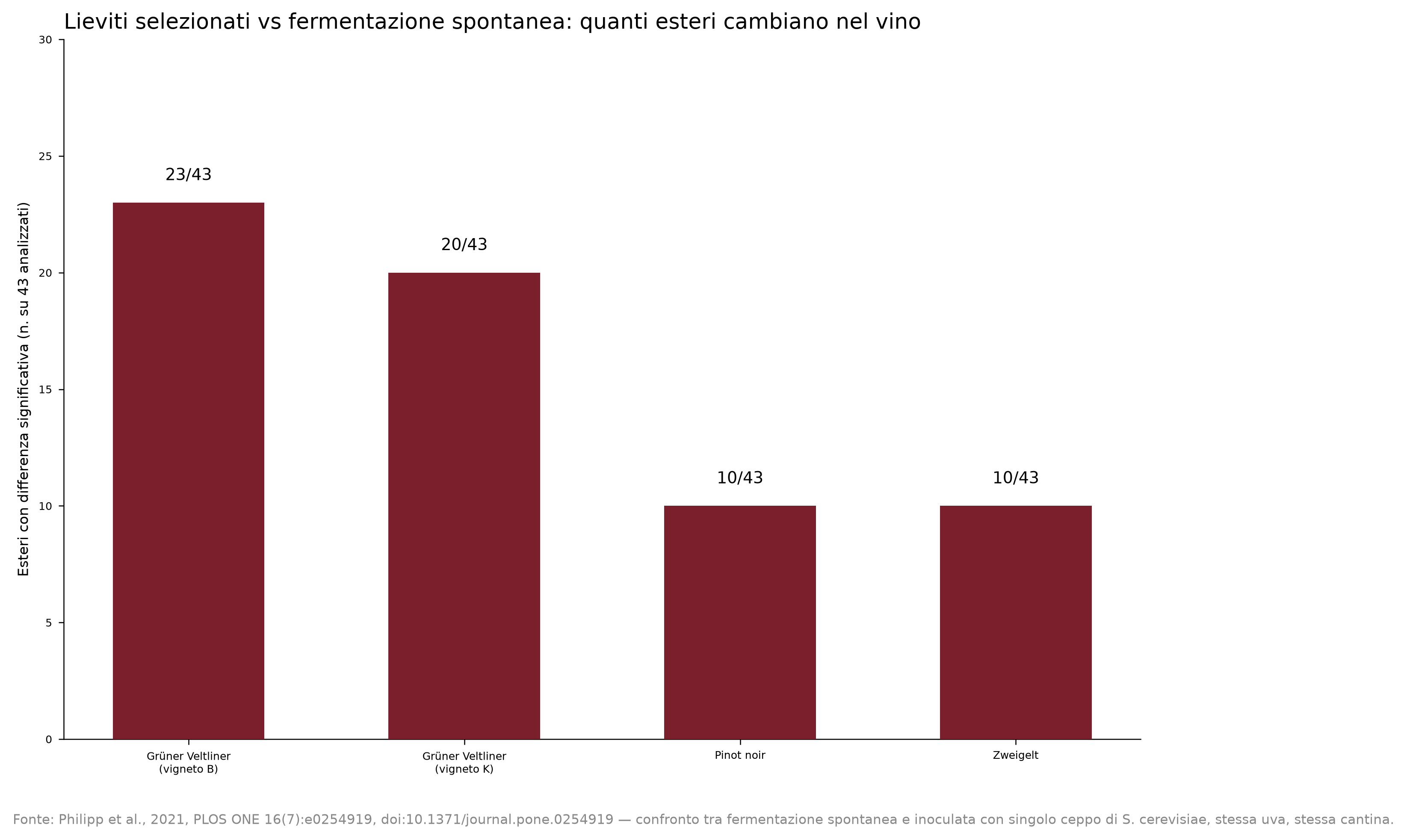
The number of esters showing a statistically significant difference between the two strategies, however, varied considerably by grape variety and must origin: twenty-three out of 43 for the Grüner Veltliner from the Andau vineyard (Burgenland), twenty for the Grüner Veltliner from Klosterneuburg, and ten each for Pinot noir and Zweigelt.
Source: Philipp C, Bagheri B, Horacek M, Eder P, Bauer FF, Setati ME (2021), "Inoculation of grape musts with single strains of Saccharomyces cerevisiae yeast reduces the diversity of chemical profiles of wines," PLOS ONE 16(7):e0254919, published July 22, 2021.
Spontaneously fermented wines showed on average higher concentrations of isoamyl acetate, isobutyl acetate, and several ethyl esters, while inoculated wines showed higher concentrations of diethyl succinate and ethyl isovalerate. Based on principal-component analysis of the full chemical dataset, the authors' overall conclusion is that chemical profiles were more similar to one another in inoculated wines than in spontaneously fermented ones — a quantitative basis for an assumption long held in the industry but rarely measured at this level of detail.
It's worth reading that finding with the caution the authors themselves apply in their conclusions: reduced chemical diversity does not automatically mean reduced perceived sensory diversity, since the perceptual interactions between aroma compounds are non-linear.
The hidden risk: spontaneous fermentation can get stuck
The same Austrian study also documents the flip side of spontaneous fermentation. For the Grüner Veltliner must with insufficient yeast-assimilable nitrogen (YAN), the spontaneous fermentation became stuck, finishing with high residual sugar, while the inoculated version of the same must fermented normally to dryness. This is a textbook case of "stuck fermentation," a phenomenon well documented in the enology literature: nitrogen deficiency and yeast stress conditions are among the most common causes of arrested fermentation — a risk that is more frequent, though not exclusive, in spontaneous fermentations run without a selected starter culture.
A stuck fermentation carries concrete microbiological risks — proliferation of undesirable bacteria, oxidative notes, aromatic deviations — and requires corrective interventions in the cellar that add time and cost. It's one of the technical reasons many wineries, especially those supplying export markets with strict consistency expectations (the United States, Germany, and the UK among them), lean toward inoculation, or at minimum very close monitoring of any spontaneous fermentation.
The role of microbial terroir
A related line of research concerns so-called "microbial terroir": the idea that yeast and bacterial communities on grapes and in wineries are not random but follow recognizable geographic patterns. A widely cited 2014 study in PNAS showed that grape and must microbial communities follow regional distribution patterns correlated with the finished wine's chemical composition, with measurable differences among the wine-growing regions analyzed.
That means spontaneous fermentation doesn't produce "random" outcomes: to a meaningful extent it reflects the specific combination of variety, soil, climate, and cellar practice of a given place — the scientific underpinning of the "typicity" argument often invoked to justify spontaneous fermentation in commercial wine storytelling.
It's also worth noting, per the same Austrian study cited above, that two Grüner Veltliner batches inoculated with the identical selected yeast strain still produced chemically distinct wines — evidence that must origin and the native fungal community present at the outset continue to shape the outcome even when the same strain is used.
A middle path: selected native yeasts
Between the two extremes — fully spontaneous fermentation and inoculation with a generic commercial strain — a third, increasingly studied approach exists: isolating and selecting yeast strains native to a specific vineyard or region, then using them as a controlled starter culture. A 2023 study in Foods, working with Verdejo grapes (Rueda designation of origin, Spain), selected and characterized native Saccharomyces cerevisiae strains specifically to preserve the typical enological character of spontaneous fermentation while avoiding the risks of stuck or sluggish fermentations. The results showed significant differences in aromatic profile among the tested strains, with strong fermentative performance compared to uncontrolled spontaneous fermentation.
This approach — isolating yeasts from one's own vineyard or cellar, characterizing them, and then deploying them as a controlled starter — is now one of the more concrete ways to reconcile regional typicity with fermentation reliability, and it's a strategy an increasing number of export-oriented Italian wineries are beginning to build into their product identity.
Why it matters for export
For a winery selling internationally, the choice between selected and native yeasts isn't just a production-sheet detail — it's part of the story that can be told to an importer. Being able to explain, with data, why a wine has a particular aromatic profile — and why that profile is either reproducible or intentionally variable from vintage to vintage — is a form of technical credibility that experienced buyers notice, particularly in mature markets like the United States, Germany, and the UK, where lot-to-lot consistency is often a supplier-selection criterion.
Want to see the real buyers for your wine?
The science explains why your wine has the profile it does. But growing in export also means knowing who, in those markets, is already looking for a wine with those characteristics. Wines Export works with a proprietary pool of verified, real buyers and importers across the most relevant export markets, checked lot by lot.