Tokaj/Tokaji: What Changes in the 2026 PDO Specification
Wines Export Editorial · Last updated:

Molnár Tamás Photography on Pexels
On 2 July 2026 the European Commission approved an amendment to the production specification of the Protected Designation of Origin "Tokaj/Tokaji," through Commission Implementing Regulation (EU) 2026/1556, published in the Official Journal of the European Union (L series) on 6 July 2026. For a buyer or importer, tracking this kind of regulatory update in a foreign designation isn't idle curiosity: decisions taken by a regulator on a historic specification — Tokaj was the world's first wine region to receive an appellation classification, back in 1730 — offer a useful precedent for how European designations are navigating the tension between tradition and market adaptation.
The procedural path: how a PDO specification amendment works
The process leading to approval of a specification amendment follows a defined path under Regulation (EU) 2024/1143 on geographical indications for wine, spirit drinks and agricultural products:
Source: Commission Implementing Regulation (EU) 2026/1556.
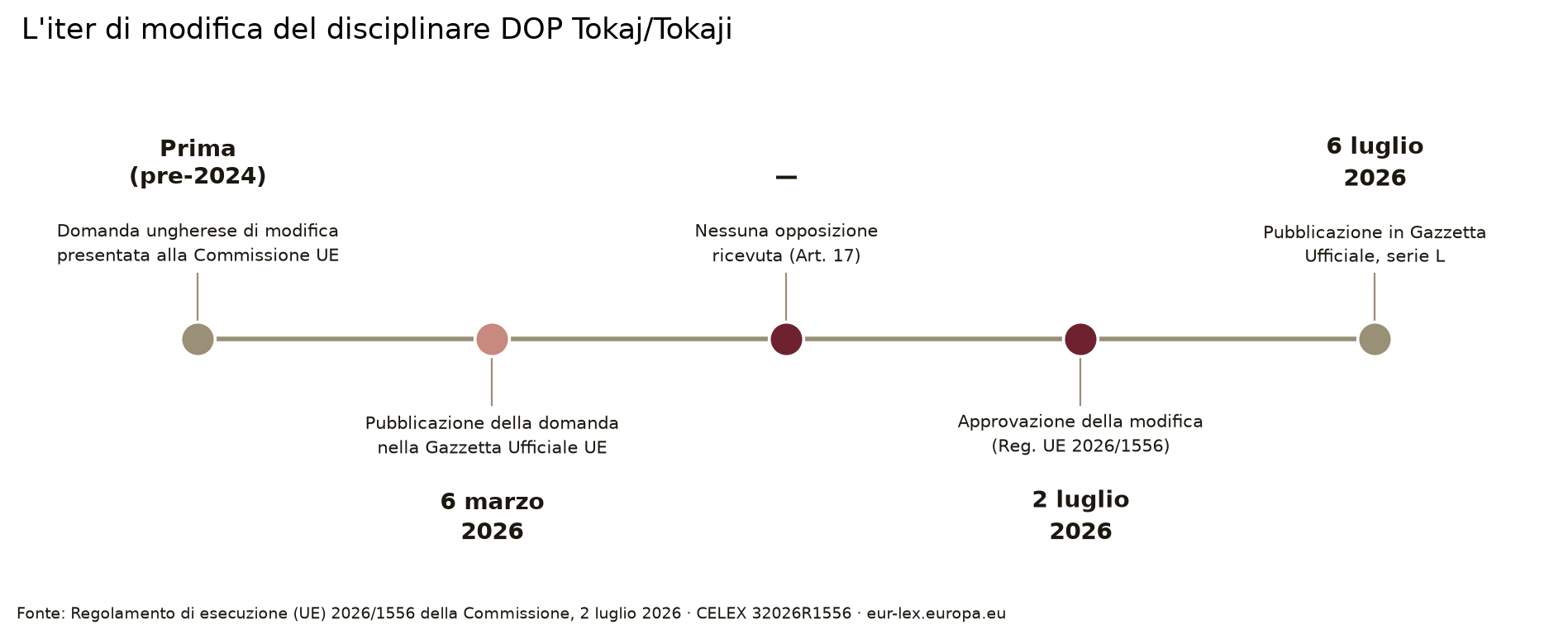
- Hungary submits an application to the European Commission for a specification amendment, filed before the new Regulation (EU) 2024/1143 entered into force.
- The application is published in the Official Journal of the European Union on 6 March 2026 (C series, C/2026/1380), opening the period for any third-party objections.
- With no statement of opposition received under Article 17 of Regulation (EU) 2024/1143 within the deadline, the Commission proceeds to approval.
- On 2 July 2026, the Commission adopts the approval regulation.
- The regulation is published in the Official Journal (L series) on 6 July 2026, entering into force on the twentieth day following publication.
This sequence — application publication, objection window, approval absent objections, final publication — is the same procedural template applied to any PDO/PGI specification amendment across the EU, including Italian designations. Understanding it helps in correctly reading official communications concerning one's own reference designations.
What the Tokaj specification amendment actually changes
The approval regulation's text doesn't go into the technical detail of the changes (it refers to the full specification published separately), but public information on the revision confirms a substantial impact on the designation's structure. Among the most relevant changes reported:
- Category simplification: the designations Aszúeszencia, Fordítás Sec and Máslás Sec are abolished, while Fordítás and Máslás remain authorised as sweet wines within the designation.
- Szamorodni reorganisation: the category, which previously covered both dry and sweet styles under a single heading, is now split into two distinct wines — dry Szamorodni and sweet Szamorodni — each with its own specific analytical requirements.
- Tokaji Aszú analytical parameters: the wine must have a minimum actual alcoholic strength of 9%, a minimum total potential alcoholic strength of 19%, a minimum acidity of 6 g/l and a maximum total sulphur dioxide content of 400 mg/l.
- Ageing requirements: Tokaji Aszú must now mature for at least 18 months in barrel; Szamorodni requires a minimum of six months in barrel.
- Stricter sparkling wine rules: Tokaj sparkling wines must now be produced through bottle fermentation followed by bottle ageing, for at least nine months total, including a minimum of 90 days on lees — fermentation in sealed containers generating carbon dioxide is no longer permitted.
- Planting density: minimum planting density is now set at 4,000 vines per hectare, with a maximum row spacing of 3.1 metres.
- Mechanical harvesting: now authorised for basic white wines and sparkling wines — a change with limited practical impact, since few producers in the region already use it.
Why this matters for an international buyer
There are at least three reasons this kind of regulatory update, despite concerning a foreign designation, is relevant to an international buyer or importer.
First, Tokaj is often cited as a historical precedent for the European appellation system itself: vineyard classification dates back to 1730, and the designation has weathered centuries of change — from the Habsburg monarchy, through the Soviet period, to the re-establishment of independent producers after 1990. Watching how such an ancient rule system keeps updating itself (simplifying obsolete categories, tightening ageing requirements, opening the door to mechanical harvest where it makes sense) offers a signal of how historic European designations more broadly might evolve their own rules in coming years — useful context when evaluating the regulatory trajectory of an Italian supplier's own DOP/DOCG.
Second, the Tokaj case touches Italy directly on a specific point: since March 2007, French and Italian producers have no longer been allowed to use the names "Tokay" or "Tocai" for their wines, since these were made from varieties unrelated to the Hungarian ones — an episode of conflict between geographical indications that directly involved Italian wine (the historical reference is to Tocai Friulano, now marketed as Friulano). Following the evolution of the Tokaj specification helps clarify the logic the European Commission applies when managing overlaps between designation names — relevant background for any buyer sourcing wines under a designation name that has faced or could face a similar naming dispute.
Third, the growing strictness on parameters like minimum ageing and sparkling wine production methods reflects a trend visible across several European designations: tightening technical rules as a premium-positioning strategy, at a time when — as the most recent OIV data shows — competition in export markets increasingly hinges on perceived value rather than volume.
Historical context: why Tokaj is a reference case
Tokaj/Tokaji is not just another designation in the landscape of European appellation rules. Vineyard classification in the area began in 1730, dividing vineyards into three categories based on soil, sun exposure and potential for developing noble rot (botrytis cinerea) — a classification system that predates Port's by several decades and Bordeaux's by more than 120 years. A royal decree in 1757 established a closed production district in Tokaj, and the classification system was completed by national censuses in 1765 and 1772: Tokaji is commonly regarded as the world's first appellation control system.
The designation has weathered centuries of significant political and ownership change: from the finest eszencia vintages being reserved for the Habsburg imperial cellars before 1918, through the region's division between Hungary and Czechoslovakia after the Treaty of Trianon (1920), to post-war nationalisation of production under Soviet influence — when production continued with thousands of small growers but bottling and distribution were monopolised by the state. Only after the collapse of communist regimes in 1990 did independent wineries re-establish themselves, while a state-owned producer continues to handle a significant share of regional output.
This long historical arc makes Tokaj a particularly instructive case for observing how an "ancient" specification keeps updating itself through targeted technical amendments — product categories, ageing requirements, harvest methods — rather than remaining frozen in time. It's the same kind of process, with their own specific histories, that Italian designations are subject to.
A niche market, but with transferable lessons
It should be said plainly: Tokaj remains a relatively small market on an international scale, with a vineyard area of roughly 5,700-5,900 hectares (depending on source and reference year) and exports concentrated mainly in China, France, the UK and the United States. It is not, therefore, a direct competitor for most Italian wineries or a major sourcing category for most international buyers. The value of this case study lies instead in the transparency and traceability of the European regulatory process — a process that any wine designation under PDO/DOCG rules goes through (or will go through) when its own specification needs updating, for example to include disease-resistant varieties or to adapt cultivation practices to climate change.
Data drawn from Commission Implementing Regulation (EU) 2026/1556, published in the Official Journal (L series) on 6 July 2026 — public-domain text (EU law, Commission Decision 2011/833/EU on the reuse of Commission documents). Technical detail on the revision's content supplemented from trade press (The Drinks Business, March 2026), cited as a secondary reference.
- Wine: Trends, Data, and Export Opportunities
- Selected vs. Native Yeasts: What the Science Says About Wine Fermentation
- Wine Brazil: Trends and Export Opportunities
- Italian Wine Prices in Hungary: Export Analysis
- Ecuador Wine Market: Data and Opportunities for Italian Wineries
- Italian Wine in Ukraine: Pricing and Positioning