Customs documents for exporting Italian wine to Hungary: the operational guide
Wines Export Editorial · Last updated:
 Photo: Bruno Cantuária / Pexels
The practical problem: "customs clearance" is the wrong word
An Italian winery preparing its first shipment to Budapest usually expects clearance forms, import duties, maybe a hold at the border. That is not how it works, and understanding this early saves time chasing the wrong paperwork: Hungary has been an EU member since 2004, so a wine shipment from Italy is an intra-Community movement of goods already in free circulation within the EU, not an import from a third country. EORI, commercial invoice, packing list and certificate of origin remain necessary for commercial traceability, but they do not trigger an import customs declaration.
The real point of attention is different, and it is the one many wineries underestimate precisely because it does not look like "customs" in the traditional sense: wine is an excise good, and its movement between Italy and Hungary must run through a dedicated European electronic system, with obligations split between the exporter and the Hungarian importer. Getting this wrong does not stop the goods at a border checkpoint — because there is effectively no customs border to cross — but it can stall delivery, or trigger tax disputes months later.
EMCS and AHK: the real "customs document" for Hungary
The core Hungary-specific requirement is EMCS, the Excise Movement and Control System: the European electronic system that tracks the movement of excise goods, including wine, under duty-suspension arrangements. Both the Italian authorised warehousekeeper/consignor and the Hungarian importer must be registered in this system; when the goods leave, the exporter enters the shipment data and an electronic accompanying document is generated, the e-AD, identified by an ARC code. The system also generates an identification code that the Italian Trade Agency's guide refers to as "AHK", which must travel with the goods for the entire journey.
The step most often overlooked is the fourth one: on arrival, the Hungarian importer must confirm receipt of the goods through the EMCS system. Without this electronic closure, the excise file stays open and can generate disputes even when the goods have physically been at destination for some time. Before signing a distribution agreement, it is therefore worth asking the importer for evidence of their authorisation to receive goods under duty suspension and of a registered warehouse with the NAV (Nemzeti Adó- és Vámhivatal, the Hungarian tax and customs authority) for this type of goods; the precise technical warehouse requirements need to be verified case by case with the importer or a local tax advisor, since the detailed implementing regulation could not be located in full during this research.
One last checklist item worth keeping handy: if the winery (or the importer) also sells through direct e-commerce to Hungarian consumers, that activity must be registered separately in the excise system; a health/food-conformity certificate is not normally required to accompany an intra-Community shipment, but it should be kept ready at the winery since it can be requested during a check by NÉBIH, the Hungarian food safety authority.
Zero excise, but 27% VAT: the two faces of Hungarian taxation
Here is the figure that surprises anyone unfamiliar with this market: Hungary applies zero excise duty on still wine. The official PwC Worldwide Tax Summaries table explicitly lists an excise rate of HUF 0 per hectolitre on still wine, while distilled spirits are taxed at HUF 614,370 per hectolitre of pure alcohol — a choice consistent with EU Directive 92/83/EEC, which allows member states to apply reduced rates down to zero on still wine. One caveat: the zero rate does not remove the EMCS obligations described above, it only removes the cash cost tied to the excise duty itself.
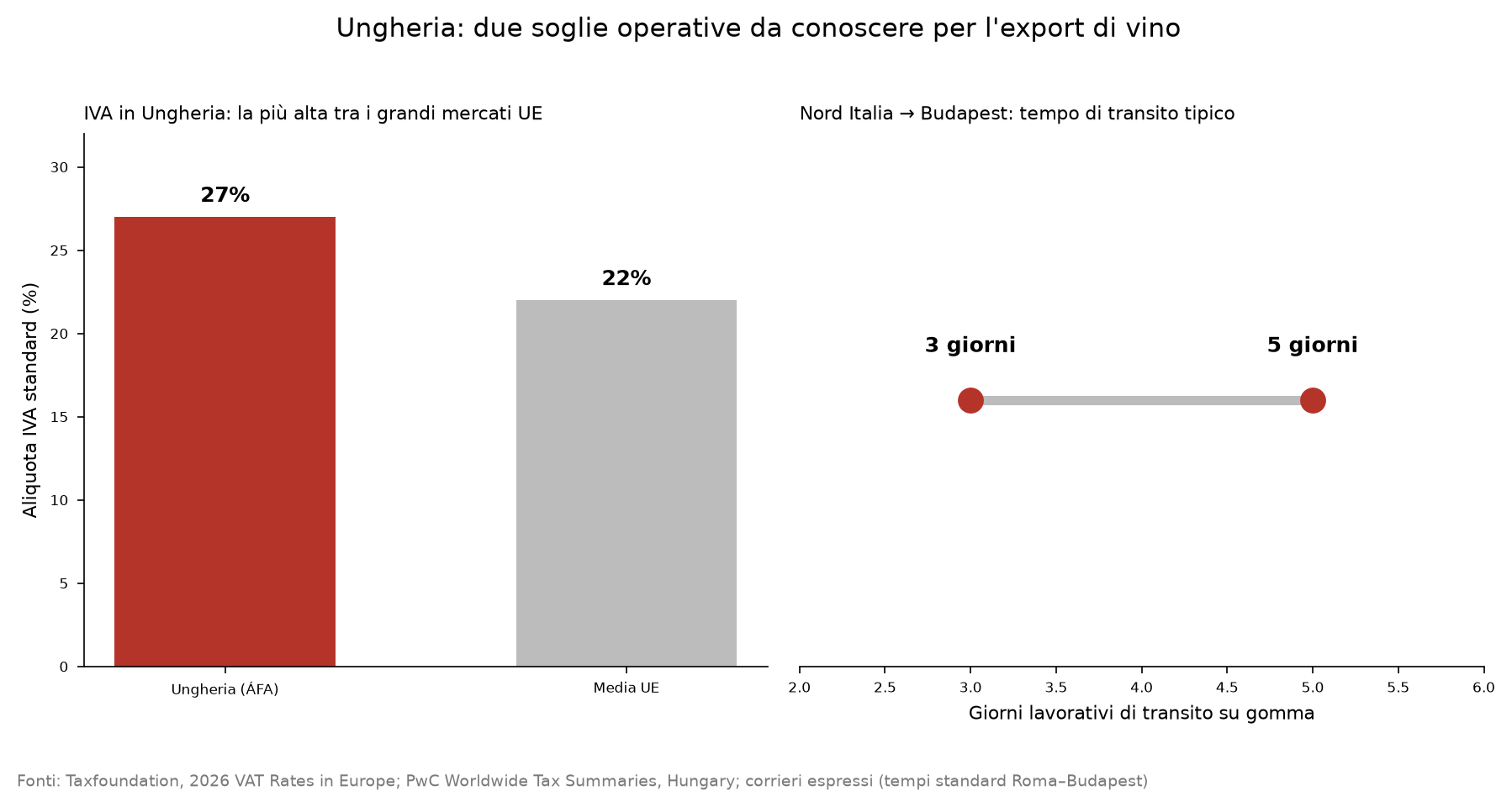
On the VAT side the picture flips: since 2012, Hungary has applied a standard VAT rate of 27%, the highest in the EU, well above the roughly 22% European average. For a B2B intra-Community sale from Italy to Hungary, the reverse-charge mechanism applies: the Italian winery invoices without Italian VAT, and the obligation to self-assess Hungarian VAT falls on the importer, not on the exporter. The Italian winery's only responsibility is correct intra-Community invoicing and verifying the buyer's Hungarian VAT number in advance through the VIES system.
One local requirement worth knowing during partner due diligence is Real-Time Invoice Reporting (RTIR): Hungary requires VAT-registered businesses to electronically transmit data for nearly every invoice to the NAV in real time. This does not directly concern an Italian winery selling under pure reverse charge, but the importer's ability to manage it correctly is a useful signal of their organisational solidity.
The chart below summarises the two most operationally relevant thresholds to keep in mind:
 Sources: Taxfoundation, 2026 VAT Rates in Europe; PwC Worldwide Tax Summaries, Hungary; express carriers (standard Rome-Budapest transit times)
Hungarian-language labelling and logistics: two details that can stop a ready shipment
Even though wine does not go through classic customs clearance, two practical details can still hold up a shipment or get it rejected during a commercial check. The first is labelling: the USDA's FAIRS guide dedicated to Hungary confirms that consumer product information must be in Hungarian, typically achieved through an adhesive back-label applied over or next to the original Italian label, without needing to reprint the entire label. The Hungarian text must cover the sales denomination, ingredients, alcohol content, allergens (in particular the sulphite statement when sulphur dioxide concentration exceeds 10 mg/l, mandatory on the physical label under EU Regulation 2021/2117), net quantity in litres/millilitres, and producer or distributor details. Bottled wine of foreign origin must remain in its original container, with no decanting or relabelling that alters the original packaging.
The second detail is logistics: Hungary is landlocked, so wine almost always travels by direct road transport from Italy, with no intermediate customs stops since this is intra-EU transport. For a pallet or groupage shipment, a realistic transit time to plan for is in the order of 3-5 working days from Northern Italy to Budapest — consistent with the times quoted by general express carriers for comparable routes into Central-Eastern Europe. A customs corridor between Trieste and Budapest, signed in March 2026 by the Italian and Hungarian customs authorities, mainly concerns non-EU container flows and is not relevant for Italian DOP/IGP wine, which is EU goods.
Bottom line: where the real risk sits
The real operational risk for a winery exporting to Hungary is not a missing customs form, but correctly managing the EMCS/AHK flow end to end: registration, data submission at departure, and above all the importer's receipt confirmation on arrival. Add to that a preliminary check that the commercial partner holds a valid excise licence and registered warehouse, correct handling of the VAT reverse charge, and a Hungarian back-label compliant with EU Regulation 2021/2117. These are manageable requirements for an export manager who follows the file from opening to electronic closure — not an insurmountable obstacle, but a process that needs attention from the very first shipment.
Want to see the real buyers for your wine?
Wines Export supports Italian wineries with the operational side of exporting, from selecting importers to verifying the documentary and tax requirements of each market. Try the free demo to see how it works: Try the free demo
- Customs and excise documents for shipping Italian wine to Ireland
- Customs Documents for Exporting Wine to Finland: e-AD, Excise Duty and 25.5% VAT
- Importing Italian Wine into New Zealand: Customs Documents, Duties and MPI Biosecurity
- Customs Documents for Exporting Italian Wine to Ecuador: A 2026 Operational Guide
- Customs Documents for Shipping Italian Wine to Norway: An Operating Guide
- Customs Documents and Excise Duty for Exporting Italian Wine to the Czech Republic