Customs Documents for Shipping Italian Wine to Norway: An Operating Guide
Wines Export Editorial · Last updated:
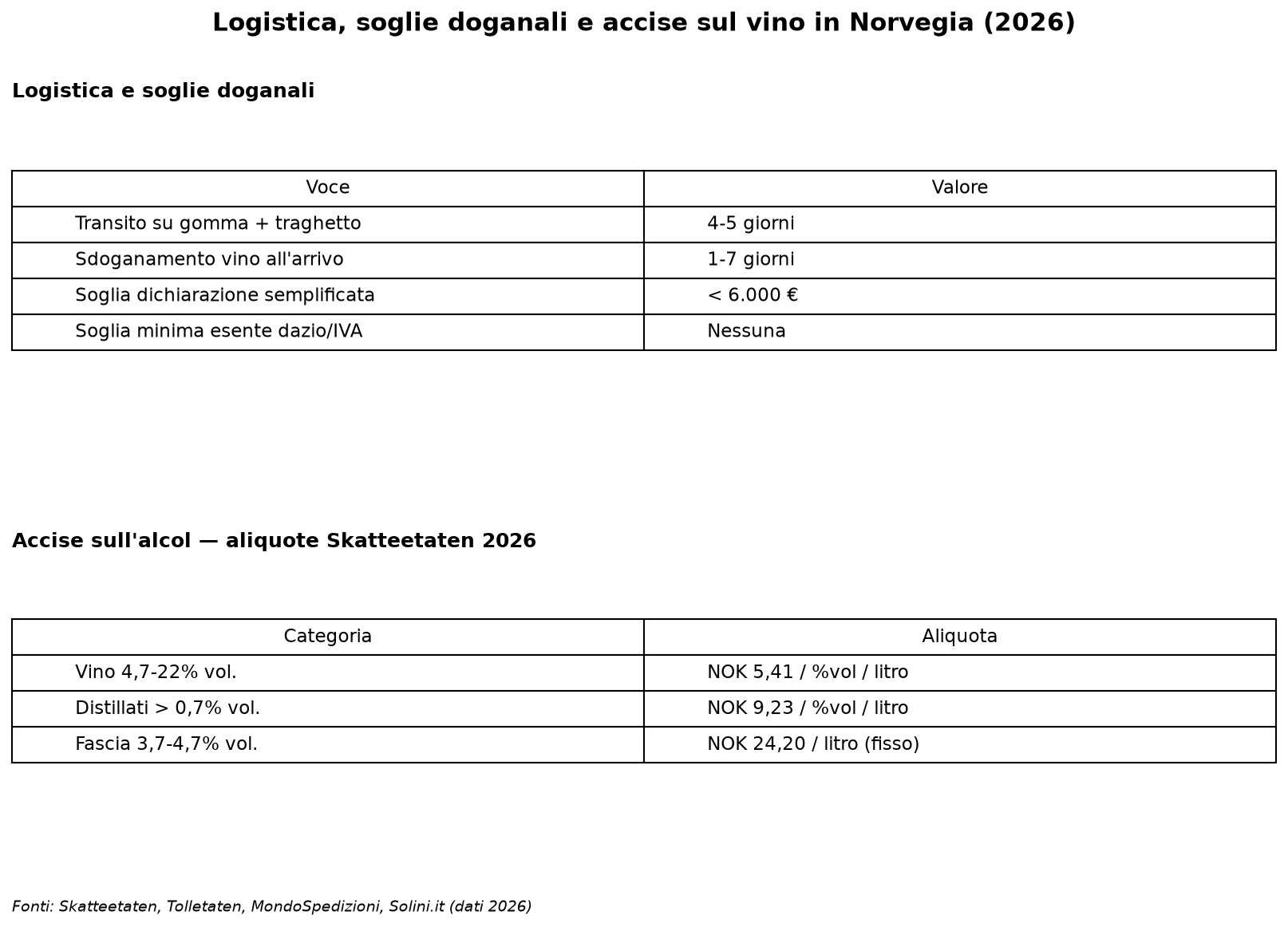 Norwegian customs clearance times, thresholds and 2026 excise rates for imported wine. Sources: Skatteetaten, Tolletaten, MondoSpedizioni, Solini.it — full source list at the end of this article.
The practical problem: Norway is not an EU market
For an importer used to sourcing wine from Italy through Germany or the US with straightforward EU paperwork, Norway is a different animal. The country belongs to the European Economic Area through EFTA, but it sits outside the EU customs union: every shipment is, legally, an extra-EU export, with customs clearance, potential duty, and alcohol excise to handle at the border.
The risk is not abstract. An invoice missing proof of origin, or a Norwegian buyer not yet registered for excise purposes, can hold a shipment at customs for days, with demurrage costs falling on whoever got the paperwork wrong. Here is exactly what is required, point by point, with primary sources behind each claim.
Four wine-specific requirements beyond the standard export paperwork
Beyond the universal documentation for any export shipment (commercial invoice, packing list, EORI number), wine bound for Norway requires four additional, wine-specific steps.
1. Preferential origin proof: EUR.1 or EUR-MED certificate. To benefit from the reduced or zero customs duty available under the EEA agreement between the EU and EFTA, EU-origin goods must travel with a EUR.1 movement certificate, issued by the Chamber of Commerce or the Italian customs authority. Below a specific value threshold the procedure simplifies: for shipments valued under 6,000 euros, or when the exporter is registered as an "authorised exporter"/REX, a simple origin declaration on the invoice is enough — no certificate needed. Without either, the wine clears customs at the full, non-preferential tariff.
2. Norwegian importer registration for alcohol excise duty with Skatteetaten. Anyone importing alcoholic beverages commercially into Norway must be registered as liable for excise duties before they can submit the electronic customs declaration and pay the alcohol excise. This is the buyer's obligation, not the Italian exporter's — but it must be verified before shipping: without an active registration on the Norwegian side, the goods stay stuck at customs regardless of how correct the Italian paperwork is.
3. Excise Movement Guarantee Document (EMCS/DAA equivalent). Required when the shipment moves under excise-duty suspension between an Italian tax warehouse and a registered Norwegian operator: it precedes delivery and records the key details of the transaction, particularly when the consignee has no excise code of its own, or the sender uses a fiscal representative.
4. Food importer registration with Mattilsynet. Wine, as a food product, falls under the Norwegian Food Safety Authority: anyone importing food into Norway must have a registered responsible party/consignee with Mattilsynet, who carries out the checks needed to confirm the shipment complies with Norwegian food regulations. One reassuring detail confirmed directly by the same official source: shipments from EU/EEA countries are not subject to any pre-notification requirement; the one-business-day advance notice rule applies only to goods arriving from non-EEA third countries.
Who pays what: duty, excise, and Norwegian VAT
Once the paperwork is in order, the next question is who actually pays what — because in Norway, fiscal liability sits almost entirely with the importer, not the Italian exporter.
The preferential customs duty, where applicable thanks to EEA origin proof, is owed by the Norwegian importer at customs; the exact rate depends on the tariff heading and should always be checked against the current Tolletaten tariff schedule. The alcohol excise duty, calculated by Skatteetaten based on alcohol strength and volume, applies to all beverages above 0.7% alcohol by volume. For 2026, the published rates show, for the 4.7%-22% vol band where most still wines fall, NOK 5.41 per percentage point of alcohol per litre; for spirit-based beverages above 0.7% vol, the rate rises to NOK 9.23; for the lower 3.7%-4.7% vol band, a fixed rate of NOK 24.20 per litre applies. A separate packaging tax, calculated per packaging unit, is added on top. Finally, Norwegian import VAT (merverdiavgift) is due at customs, payable by the Norwegian operator registered for VAT purposes.
One detail that regularly surprises importers used to EU thresholds: for wine, there is no minimum de minimis exemption from duty or VAT. While most goods categories benefit from a value threshold below which no import tax applies, alcoholic beverages are taxed from the very first krone of value.
Logistics and timing: what to budget for
The dominant logistics route from Italy is road transport with ferry crossing from Denmark (Hirtshals, Hanstholm, or Frederikshavn routes) into Oslo. International carriers typically quote 4-5 working days for pure transit time; on top of that comes customs clearance, which for wine — subject to excise and therefore to more frequent documentary or physical inspection — can take anywhere from 1 to 7 working days, a wider range than for goods not subject to excise duty.
The electronic customs declaration runs through Norway's TVINN import system, filed by the importer or their customs broker: it should always be clarified in the freight contract whether Norwegian customs clearance is included in the freight rate or billed separately. For first orders with a new importer, a pilot shipment of limited volume is the safest way to test real clearance times before committing to larger volumes.
Labelling: an often-underestimated requirement
A label in Italian or English only is not sufficient for commercialisation in Norway. National regulation — which transposes EU Regulation 1169/2011 on food information to consumers via the EEA agreement — requires products to be labelled in Norwegian or a closely related language (Swedish, Danish). In practice, many exporters solve this by applying a Norwegian-language sticker label onto a batch already labelled for the EU market — stick-on labels are explicitly accepted under local regulation, avoiding the need to reprint the original label.
Why Norwegian customs is (almost always) the buyer's problem
One detail that helps frame all of this paperwork: in Norway, only licensed, registered importers are allowed to clear customs, hold stock, and distribute wine — the state monopoly Vinmonopolet itself owns no warehouses and does not import directly, buying instead through roughly 800 registered wholesalers. This structure naturally shifts customs responsibility onto the Norwegian buyer, which is why Italian wine most often travels on FCA terms (Free Carrier, at the winery or Italian consolidation warehouse) rather than DDP: the Norwegian importer arranges transport, files the customs declaration through its own broker, and pays duty, excise, and VAT.
For an Italian exporter, that translates into one very concrete responsibility: not paying Norwegian taxes, but supplying paperwork solid enough (correct invoice, origin proof, tariff code) that it never costs the buyer time or money at the border. An importer who loses days at Oslo customs over an incomplete Italian document is an importer who picks a more reliable supplier for the next tender round.
Final checklist before shipping
- Confirm the Norwegian buyer is registered with Skatteetaten for alcohol excise and with Mattilsynet as a food importer/consignee.
- Issue the invoice with an origin declaration if the shipment is under 6,000 euros, or request a EUR.1 certificate from the Chamber of Commerce otherwise.
- State the correct tariff heading on the invoice (heading 22.04 for wine).
- Agree with the freight forwarder whether Norwegian customs clearance is included in the freight rate, and budget a 5-7 working-day buffer beyond pure transit time.
- Prepare a Norwegian-language sticker label ahead of the first commercial shipment.
These requirements are additional to — not a replacement for — the standard documentation required for any extra-EU export. Getting them right before the first order is what separates a shipment that clears in a few days from a container stuck at Oslo customs.
Want to see the real buyers for your wine?
Knowing the customs paperwork is the first step. The second is knowing which Norwegian importers — or importers in any other export market — are actually worth approaching, backed by verified data on distribution channel, licensing, and purchasing history.
Sources cited in this article:
- Tolletaten (Norwegian Customs) — Information on the Norwegian Customs Tariff / EFTA-EEA: https://www.toll.no/en/corporate/norwegian-customs-tariff/about-the-customs-tariff/information
- Skatteetaten — Alcoholic beverage tax, 2026 rates: https://www.skatteetaten.no/en/business-and-organisation/vat-and-duties/excise-duties/about-the-excise-duties/alcoholic-beverage-tax/
- Mattilsynet — Commercial import of foodstuff to Norway: https://www.mattilsynet.no/en/food-and-beverages/commercial-import-of-foodstuff-to-norway
- Access2Markets (European Commission) — European Economic Area (EEA) Agreement: https://trade.ec.europa.eu/access-to-markets/en/content/european-economic-area-eea-agreement
- MondoSpedizioni — Spedire in Norvegia (clearance and transit times): https://www.mondospedizioni.com/spedizioni-internazionali/Norvegia
- USDA FAS GAIN Report — Food and Agricultural Import Regulations and Standards, Norway (stick-on labels accepted): https://apps.fas.usda.gov/newgainapi/api/Report/DownloadReportByFileName?fileName=Food+and+Agricultural+Import+Regulations+and+Standards+Country+Report_The+Hague_Norway_06-18-2021
- Solini.it — Documentazione doganale Norvegia (EUR.1/EUR-MED certificate): https://www.solini.it/index.php/utilita/documentazione-doganale/237-norvegia
- Importing Italian Wine into Poland: Customs Documents, Excise Duty and Tax Stamps
- Importing Italian Wine into New Zealand: Customs Documents, Duties and MPI Biosecurity
- Customs Documents for Shipping Italian Wine to Sweden: A Practical Guide
- Customs and excise documents for shipping Italian wine to Ireland
- Customs Documents and Duties for Exporting Wine to Ukraine: An Operational Guide
- Customs documents for exporting Italian wine to Hungary: the operational guide