Sforzato di Valtellina: Discover Market Opportunities for Your Business
Wines Export Editorial · Last updated:
Sforzato di Valtellina is a PDO red wine that embodies the tradition and alpine terroir of Lombardy. Its production, tied to rigorous regulations, guarantees its uniqueness and quality—essential elements for conquering international markets. This article explores the designation, production rules, and export prospects, analyzing foreign buyers' expectations and strategies for Italian wineries. Understanding these aspects is crucial for anyone wishing to import or distribute this prized Italian wine. Learn more: Federdoc — National Confederation of Italian Wine Protection Consortia.
What is the Sforzato di Valtellina Designation?
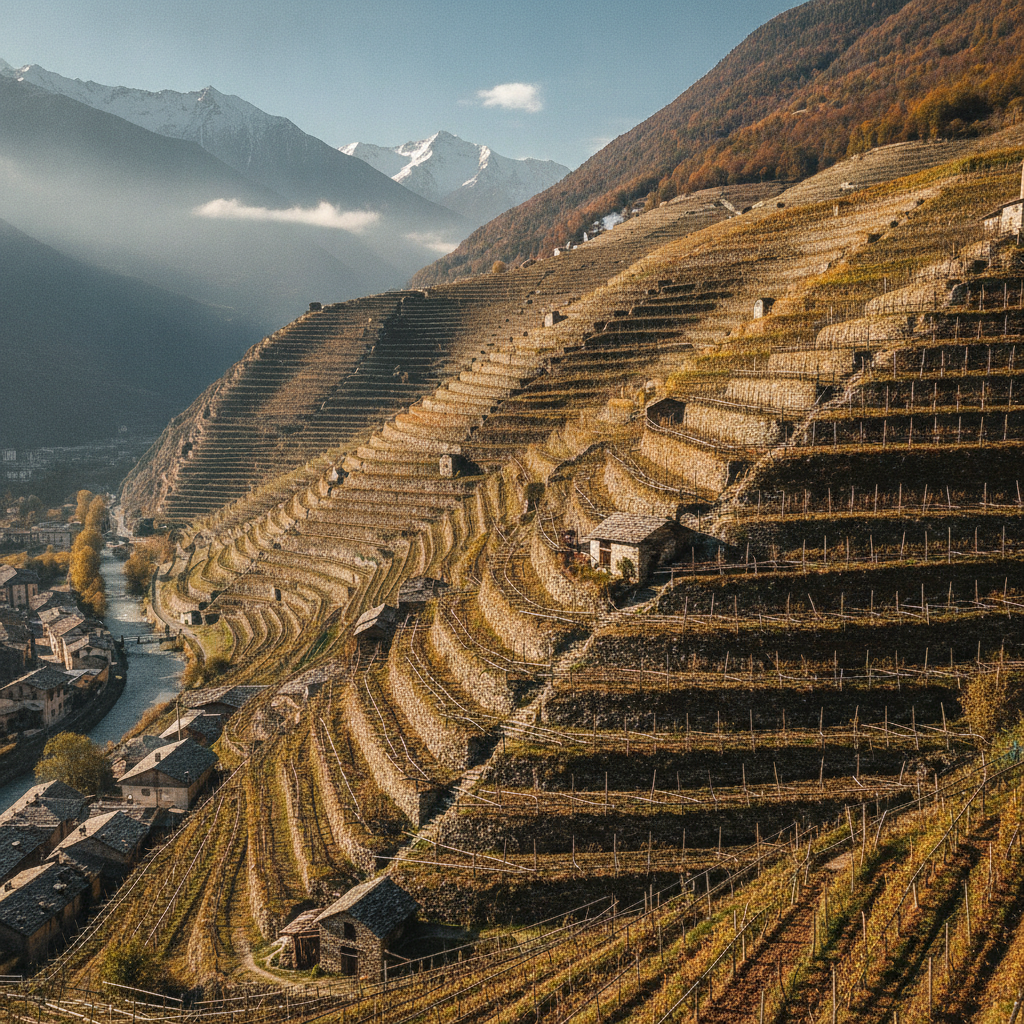
The Protected Designation of Origin (PDO) inextricably links this wine to its place of origin: Valtellina, an alpine valley in the province of Sondrio. The unique landscape, dominated by terraced vineyards and a continental climate, along with indigenous grape varietals, gives Sforzato its distinctive characteristics.
The production regulations, an essential tool for protecting and enhancing designations, define the rules that producers must follow. This document is not only a guarantee of authenticity for the consumer but also a crucial element for exports, assuring foreign importers of the product's compliance with European and Italian standards.
Under the European regulatory framework, a production regulation allows for verification of the production conditions related to a designation of origin. It includes fundamental elements such as the product's name, wine categories, type of geographical indication (PDO or PGI), and a detailed description of the wine's analytical and organoleptic characteristics. Specific winemaking practices and their associated restrictions are also an integral part of the regulation, ensuring that every stage of production is carefully monitored.
What are the Rules of the Sforzato di Valtellina Production Regulation?
The production regulation is the cornerstone upon which the reputation of Sforzato di Valtellina is built, establishing precise rules concerning grape varietals, production area, and production methods.
Sforzato di Valtellina is produced exclusively from Nebbiolo grapes, locally known as Chiavennasca. The grapes must come from the terraced vineyards of Valtellina, in the province of Sondrio. A distinctive characteristic is the drying of the Nebbiolo grapes, which are harvested and left to dry for a defined period, concentrating sugars, aromas, and phenolic compounds. This process gives the wine its structure, complexity, and aging potential.
The winemaking and aging of the dried grapes then follow specific rules, with a minimum aging period, often in wooden barrels, before being released on the market. Compliance with the regulation is subject to rigorous controls carried out by public authorities or designated certification bodies, ensuring that every bottle meets the qualitative standards and production traditions. The European Union, through regulations such as (EU) No 1151/2012 and (EU) No 664/2014, defines the procedures for managing and amending production regulations.
The regulation not only protects the wine from imitations but also provides valuable information to foreign buyers regarding the product's unique characteristics. The description of analytical and organoleptic characteristics, for example, helps importers understand the wine's taste and olfactory profile, facilitating their purchasing decisions.
What Do Foreign Buyers Look for in a Wine Like Sforzato di Valtellina?
In the global wine market, foreign buyers are increasingly seeking products that offer not only excellent quality but also authenticity, history, and a strong connection to the land. Sforzato di Valtellina possesses all these attributes.
Buyers appreciate wines that tell a story, that are an expression of a specific place and traditional agricultural practices. The strong territorial identity of Valtellina, with its heroic vineyards and alpine climate, is a great attraction for international markets.
Sforzato, thanks to the drying process and aging, is a structured, complex wine with significant aging potential. This characteristic makes it attractive to market segments looking for collectible wines or those to be paired with important dishes. The use of Nebbiolo (Chiavennasca) and the grape drying method are distinguishing elements that set Sforzato apart from other red wines, piquing the interest of buyers seeking uniqueness.
Protection as a Protected Designation of Origin (PDO) under EU regulations is a seal of guarantee that reassures importers about the product's quality and origin. The transparency of the production regulation and associated controls is a key factor in building trust.
What are the Export Opportunities for Italian Wineries Producing Sforzato di Valtellina?
Wineries producing Sforzato di Valtellina have significant opportunities for expansion in foreign markets. To capitalize on these opportunities, a targeted export strategy is essential.
It is important to identify target markets where there is a greater demand for high-quality Italian wines, with particular attention to markets that value designations of origin and wines with a strong territorial identity. It's not just about selling a wine, but about telling the story of Valtellina, the effort involved in its heroic vineyards, the grape drying process, and the passion of the producers.
Ensuring that all necessary documentation for export is in order, including certificates of origin and compliance with the regulations of importing countries, is essential. Product traceability, from vineyard to bottle, is increasingly in demand. For wineries looking to expand their international presence, Wines Export offers privileged access to a network of foreign buyers interested in quality Italian wines.
In conclusion, Sforzato di Valtellina is a wine with considerable export potential, thanks to its intrinsic quality, its history linked to the territory, and the solid regulatory framework that protects it. For Italian wineries, it represents a concrete opportunity to establish themselves in international markets, offering an authentic product of great value.
- Commission Delegated Regulation (EU) 2024/1143 of 10 April 2024 (eur-lex)
- Council Regulation (EC) No 479/2008 of 26 May 2008 (eur-lex)
- Council Regulation (EC) No 479/2008 (eur-lex)
- Regulation (EU) 2021/2117 of the European Parliament and of the Council (eur-lex)
- Commission Regulation (EU) 2024/1143 (eur-lex)
- Commission Delegated Regulation (EU) 2019/34 (eur-lex)
Frequently Asked Questions
How does the production regulation protect Sforzato di Valtellina for export?
The production regulation defines precise rules on grape varietals, production area, and methods, guaranteeing authenticity and quality. This assures foreign importers of the product's compliance with European and Italian standards, facilitating access to international markets.
What characteristics make Sforzato di Valtellina attractive to foreign buyers?
Foreign buyers seek authenticity, history, and a strong connection to the land. Sforzato, with its alpine identity, grape drying process, and aging potential, meets these needs, standing out for its uniqueness.
What grape varietals are permitted for producing Sforzato di Valtellina?
Sforzato di Valtellina is produced exclusively from Nebbiolo grapes, known locally as Chiavennasca.
Are you an Italian winery looking to bring your Sforzato di Valtellina to international markets? Discover how Wines Export can help you reach new buyers and expand your global presence.