Food and Wine Sales Abroad: How Italy's Export Market Is Moving
Wines Export Editorial · Last updated:

Photo: Bruno Cantuária / Pexels
Anyone tracking food and wine sales abroad knows 2025 was a two-speed year for Italy: the broader agri-food sector posted a record, while wine — on its own — closed in decline. Understanding that divergence, and knowing where the softness is concentrated versus where demand is holding, is the first step to setting a realistic strategy for the year ahead. This piece pulls together the most recent aggregate data, all from verifiable sources, to give a real picture of the market.
The agri-food picture: a record, but not everywhere
Multiple observers have called 2025 a record year for Italian agri-food exports overall. Per Coldiretti's analysis of Istat data, Italian agri-food exports reached 73 billion euros in 2025, up 5% on 2024 — an all-time high for the sector. Other estimates, using slightly different statistical scopes, put the 2025 figure closer to 72.4 billion euros, a reminder that aggregate estimates vary depending on methodology and the exact reporting date used.
That number reflects a genuinely solid underlying trend for the food side of the sector as a whole — driven by categories like pasta, PDO cheeses, extra virgin olive oil, and baked goods — but it does not describe every category evenly. And that's precisely where wine, one of the flagship categories of Made in Italy, stands out negatively against the general trend.
For anyone working in food and wine sales abroad, this gap between food (growing) and wine (declining) is arguably the single most operationally useful data point in the whole 2025 picture. It means a foreign buyer interested in the Italian agri-food sector as a whole is probably evaluating very different categories — pasta, preserves, cheese, cured meats — under a different commercial logic than the one now required for wine, where competitive pressure and price sensitivity have risen specifically. That's not a minor detail for anyone building a multi-category export catalog: the levers that work for extra virgin olive oil aren't automatically the same ones needed to position a bottle of wine in a mature market like the United States.
Italian wine: the negative exception in the broader picture
While agri-food celebrated a record, the wine sector had a different 2025. According to the Wine Observatory of the Italian Wine Union (UIV), based on Istat data, Italian wine exports fell to 7.78 billion euros in 2025, down 3.7% versus 2024 — an estimated loss of around 300 million euros compared to the prior year.
The country-level detail helps explain where the softness concentrated. Looking at the three markets most relevant to Italian wine export strategy:
- United States: the sharpest slowdown. Per Istat data compiled by the UIV Observatory and WineNews, Italian wine exports to the US in 2025 came to 1.75 billion euros, down 9.2% versus 2024, with volumes falling more moderately (-6.2%) — a market that remains firmly Italy's top wine export destination but is clearly slowing. US tariffs weighed heavily on the picture: per industry analysis, a full year of tariffs cost Italian wine exports over 340 million euros in aggregate.
- Germany: the steadiest of the three. Istat data compiled by WineNews for 2025 show an export value that held up notably better, indicating that Italy's top EU wine partner weathered the year better than the US did.
- United Kingdom: also softer, though less sharply than the US, within a broader context in which — per WineNews — UK wine imports fell 4.6% in value and 6% in volume in 2025, pointing to a structural slowdown in British wine demand that affected every supplier country, not just Italy.
The chart below summarizes the three markets side by side on the available data.
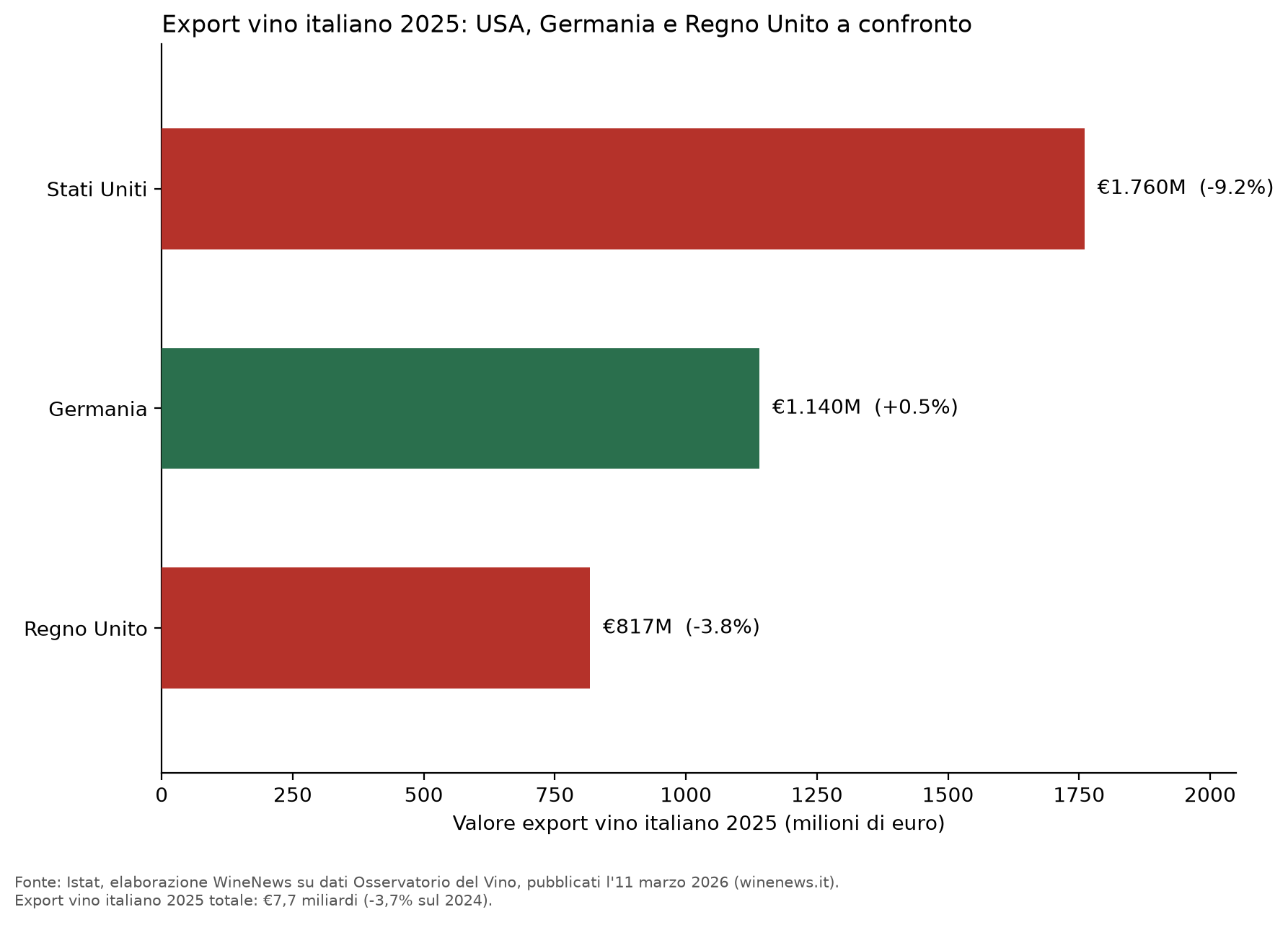
Own elaboration on Istat/WineNews data, published March 11, 2026 (winenews.it). Total Italian wine exports 2025: €7.7 billion (-3.7% vs. 2024).
Why the trend hasn't reversed yet in 2026
Early 2026 data confirms the softness wasn't a one-off 2025 event. Per the UIV Observatory, Italian wine export value fell 6.8% in the first four months of 2026, with the US, UK, and Switzerland worsening while China and Brazil grew — confirming that the geographic reshuffling of demand is already underway and that legacy markets (US, UK) remain under pressure into the current year.
That backdrop carries two practical implications for anyone in food and wine sales abroad:
- Defending mature markets now requires more margin discipline and more service, not just competitive pricing. If US volumes hold steady while value collapses, the issue lies in positioning and negotiating leverage with importers, not in underlying demand.
- Geographic diversification isn't optional anymore — it's a medium-term necessity. Markets growing today (beyond the traditional big three) need to be pursued with the same energy historically reserved for the US, Germany, and the UK.
What this means for an Italian winery selling abroad
Aggregate data tells a macro story, but the practical question for every winery stays the same: where, concretely, are buyers willing to purchase right now, on what terms, and through which channel? OIV, Istat, and UIV figures capture the national trend, but they don't substitute for direct knowledge of buyer demand in each specific market — information that's rarely public and that no aggregate statistic can supply.
That's where a pool of proprietary data on real buyers and importers, verified market by market, makes the difference compared to relying solely on sector-wide statistics: it lets you understand not just how much a country imports, but who is actually buying right now.
It's also worth keeping a second point in mind, one that's easy to miss when looking only at the headline export total: the gap between the more moderate US volume decline (-6.2%) and the sharper value decline (-9.2%) signals that a big part of today's commercial challenge is about defending the average price per bottle, not just holding shipped quantities steady. A winery weighing entry into — or consolidation within — a mature market should therefore ask two separate questions: how much can I sell (volume), and at what price can I sell it without eroding margin (value). Aggregate statistics answer the first question well; the second requires granular knowledge of how individual buyers are positioned in the destination market — who pays full price, who negotiates structural discounts, who's after territorial exclusivity.
Want to see the real buyers for your wine?
Macro data tells you where the market is moving. Only a direct look at verified buyers tells you whether your winery already has a foothold in that market — or where you need to build one.
Sources
- WineNews — Italian wine closes 2025 in negative in exports: 7.7 billion euros (-3.7% on 2024) — March 11, 2026 (Istat data, US/Germany/UK markets and total wine export)
- Unione Italiana Vini (UIV) — Italian wine exports 2025: down to €7.78 billion (-3.7%) — March 11, 2026
- WineNews — UK wine imports slow in 2025: -4.6% in value and -6% in volume — March 18, 2026
- ANSA — Coldiretti: agri-food exports up 5%, 73 billion euros, an all-time high — February 17, 2026
- Vinonews24 — UIV: wine exports down 6.8% in the four-month period. US, UK, Switzerland down; China, Brazil up — July 20, 2026
- How to Find Italian Wine Suppliers in Belgium (English)
- A Small Italian Winery's First Export Market: An Anonymized Case Study
- How to Find Italian Wine Suppliers in Canada (English)
- Exporting Wine to Hungary: A Guide for Wineries
- How to find Italian wine suppliers in China (English)
- Exporting Wine to Ukraine: A Guide for Wineries