A Small Italian Winery's First Export Market: An Anonymized Case Study
Wines Export Editorial · Last updated:
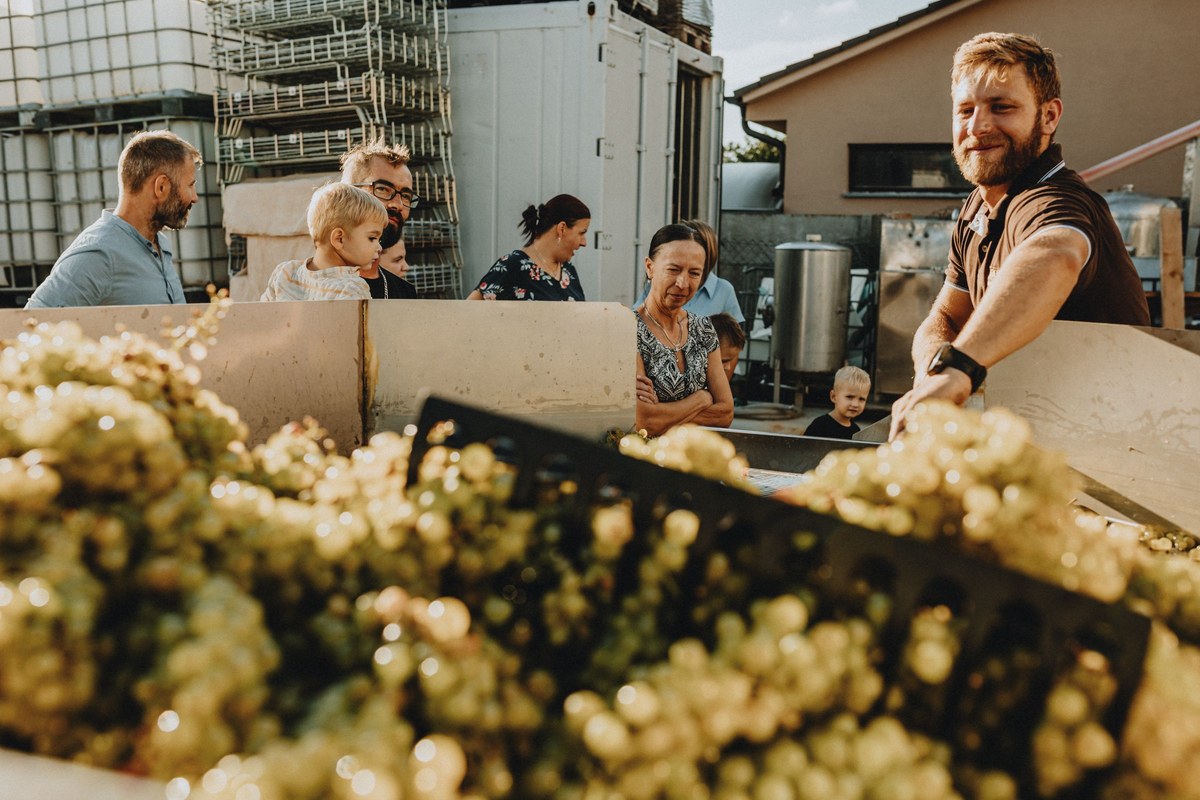
Helena Jankovičová Kováčová on Pexels
Buyers and importers evaluating new Italian wine suppliers often ask the same question: what does export readiness actually look like before the first shipment? The pattern below is anonymized — no real winery, no identifying detail — and reflects a recurring structure observed across small, family-run Italian wineries approaching Wines Export's buyer pool for their first structured attempt at a foreign market.
Why the first move matters more this year
Understanding this pattern matters because 2025 was not an easy year for Italian wine exports. The United States, Germany and the United Kingdom remain the three reference markets and together account for nearly 50% of Italian wine exports (source: Ansa/Sace, April 2026), but the year brought a broad slowdown. Over the same period, the Area Studi Mediobanca survey of the wine sector — based on a panel of 255 Italian corporations with 2024 revenue above €20 million — found that smaller companies, with revenue below €30 million, recorded a 3.5% drop in sales in 2025, steeper than the sector average (-2.8%).
That figure doesn't describe artisan micro-wineries specifically — the Mediobanca panel covers structured corporate entities — but the direction is telling: when a market contracts, the smallest, least internationally established producers tend to feel it first. At the same time, the same survey found that 64% of companies point to developing new markets as their main response to softening domestic demand. The takeaway cuts both ways: entering a foreign market is more selective than it was a few years ago, but it's also the direction most of the sector is choosing.
The sector also remains deeply family-owned: according to the same Mediobanca survey, 66% of the sector's net equity is still held by families, rising to 82% once cooperatives are included. That's the operating context for the winery in this case study — a family structure, decisions made by a handful of people, limited resources for an expansion attempt that has to be targeted from the first move, because there's no room for scattershot outreach.
Where the first attempt usually stalls
Across the pool of wineries approaching Wines Export for the first time, one pattern recurs with striking regularity. The problem is almost never wine quality or willingness to export — it's the sequence of decisions that precedes the first real commercial contact.
A small, family-owned winery with modest annual production and historically marginal export activity typically approaches its first foreign market in one of two ways: either it picks a market by instinct — often because "someone once asked about it" or because of a personal connection — or it tries to cover several markets at once with commercial resources that only stretch to one. Either way, the typical outcome is scattered effort on generic contacts — cold emails to addresses found online, trade fair attendance with no pre-scheduled meetings — instead of a targeted approach to the type of buyer that actually fits the winery's product and production capacity.
The second recurring bottleneck is about counterpart type. Many first-time exporting wineries don't clearly distinguish between a retailer, an importer, a distributor and the Ho.Re.Ca. channel — yet these counterparts differ sharply in volume expectations, payment terms and service level. A common mistake is approaching a large, structured importer with micro-producer volumes, or offering to supply a retail chain directly without the logistics to support it.
Why the right channel mix shifts by market
One finding from Wines Export's proprietary buyer pool — verified contacts segmented by country and business type — is that the commercial channel mix shifts meaningfully across the three markets that matter most for Italian export.
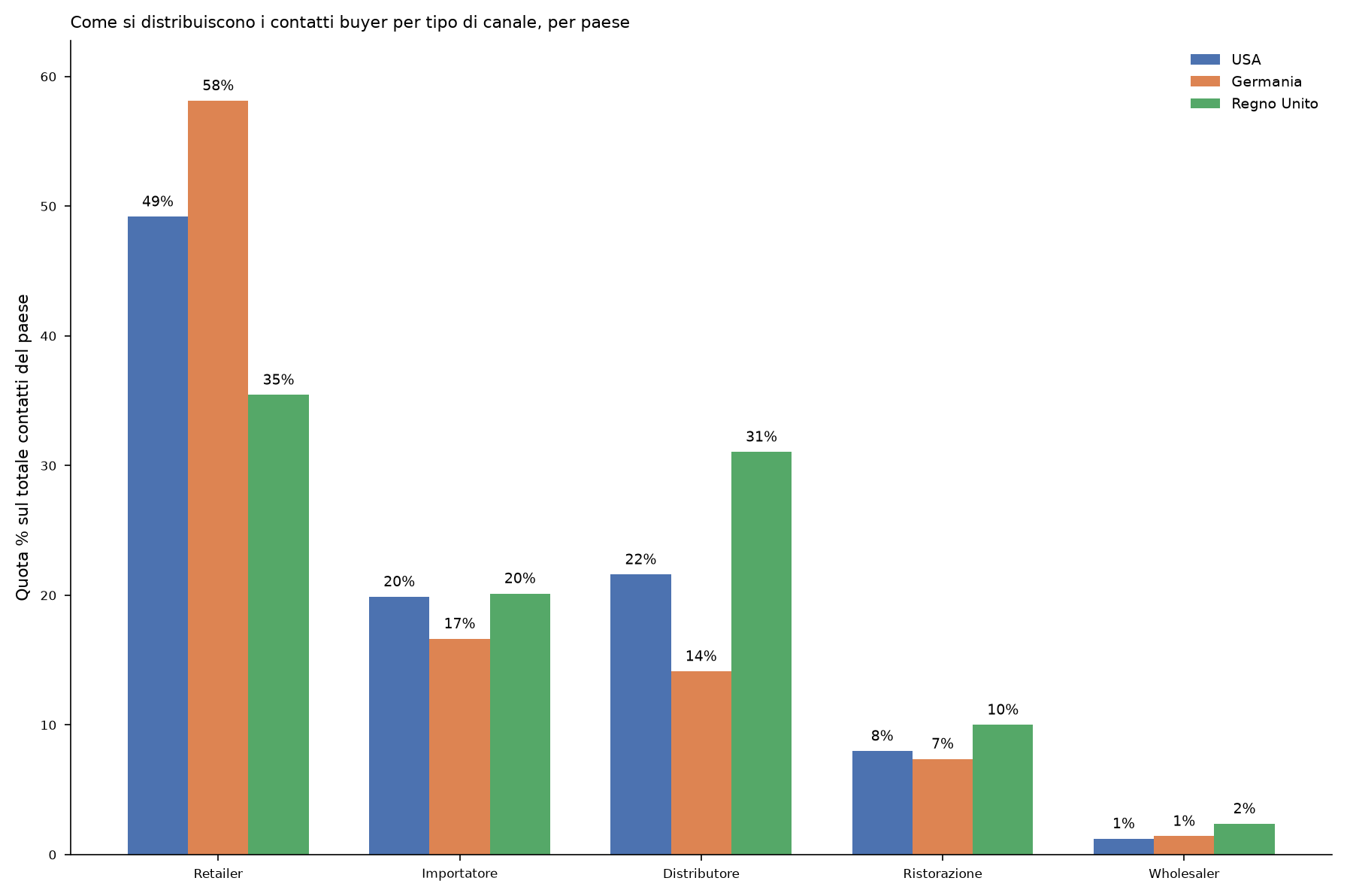
Own elaboration on Wines Export's proprietary buyer pool data (57,581 registered contacts, July 2026).
In the verified pool, retail accounts for roughly half of listed contacts in the United States and for over half in Germany, while in the United Kingdom the distributor channel carries a relatively larger share than in the other two markets. This is an operational difference, not just a statistical one: a winery that builds the identical commercial pitch for the US, Germany and the UK — same message, same type of counterpart, same follow-up sequence — is ignoring the fact that the natural entry channel isn't the same across the three. It's one reason why, in the pattern observed, the wineries that get real traction are the ones that narrow their first attempt to one market and one type of counterpart consistent with their production scale, rather than spreading the same message thin.
What a structured first approach actually looks like
The pattern that works best in the observed pool follows four sequential steps, not parallel ones:
- A single target market, chosen on objective grounds. Not instinct, but the combination of price positioning, real production capacity, and actual demand for that wine style in the chosen market. Between the US, Germany and the UK, the right choice depends on concrete factors — pricing structure, product type, logistics capacity — not a chance contact.
- A consistent counterpart type, not "as many contacts as possible." A small winery with limited volumes more often finds an entry point through a niche importer specialized in regional Italian wines than through a major retail chain or a generalist distributor carrying hundreds of labels.
- Preliminary verification of the contact, not just an email address found online. A genuinely active buyer, with a verifiable trading history — reviews, physical presence, ongoing activity — responds differently than a generic, unfiltered contact.
- Structured follow-up, not a single cold outreach. The first contact almost never closes a deal: the pattern that produces results is a scheduled follow-up sequence, with consistent materials — technical sheet, clear commercial terms, sample availability — ready at the right moment.
What ties these four steps together is that they reduce dispersion. A small family winery doesn't have a large group's resources to "try on multiple fronts" — it needs to concentrate its first attempt where the odds of a real response are highest.
What buyers and importers can take from this
This case study doesn't describe an overnight success, and it doesn't promise guaranteed outcomes — no real winery is involved, and every export path has its own timeline and variables. What the aggregated pattern suggests is simpler and more useful: small wineries that structure their first approach to a foreign market — one market at a time, one counterpart type at a time, with preliminary verification of the contact — reach a real commercial conversation faster than those spreading the same generic message across multiple fronts at once.
For a buyer or importer sourcing from Italy, this also matters as a screening signal: a small producer that shows this kind of discipline in its first export attempt is generally a more reliable long-term supplier than one approaching the market opportunistically.
Want to see the real buyers for your wine?
Wines Export's verified buyer pool — segmented by country, business type and market — is the tool a winery can use to narrow its first export attempt to one market and one counterpart that genuinely fits its production, instead of proceeding by trial and error.
Try the free demo and see which verified buyers are active today in the market you're evaluating.
- Food and Wine Sales Abroad: How Italy's Export Market Is Moving
- Exporting Wine to Hungary: A Guide for Wineries
- How to Find Italian Wine Suppliers in Belgium (English)
- Exporting Wine to Ukraine: A Guide for Wineries
- How to Find Italian Wine Suppliers in Canada (English)
- Exporting Wine to Sweden: A Guide for Italian Wineries