Wine Business Marketing Strategies: Getting Found by International Buyers
Wines Export Editorial · Last updated:

Luca Istrate on Pexels
For years, marketing for an Italian winery meant one thing above all: showing up at the right trade fairs, shaking hands, leaving a printed catalog behind. That work still matters, but it's no longer enough on its own. A buyer or importer evaluating a new supplier today almost always takes a preliminary step before any direct contact: they search the winery online, check the website, see what surfaces. If nothing useful shows up at that stage — or nothing at all — the commercial conversation frequently never starts.
This article looks at wine business marketing from a specific angle: not consumer-facing communication, but the marketing that needs to reach a professional buyer — an importer, distributor, or Ho.Re.Ca. buyer — at the point where they're still deciding who to talk to.
How international buyers search today
B2B buying behavior has shifted measurably in recent years, and wine is no exception. Across two Gartner surveys of B2B buyers, the share who say they prefer a buying experience free of direct contact with a sales rep — at least for part of the journey — rose from 61% (survey published June 25, 2025, based on 632 buyers surveyed between August and September 2024) to 67% (survey published March 9, 2026, based on 646 buyers surveyed between August and September 2025). That's a six-percentage-point year-over-year jump.
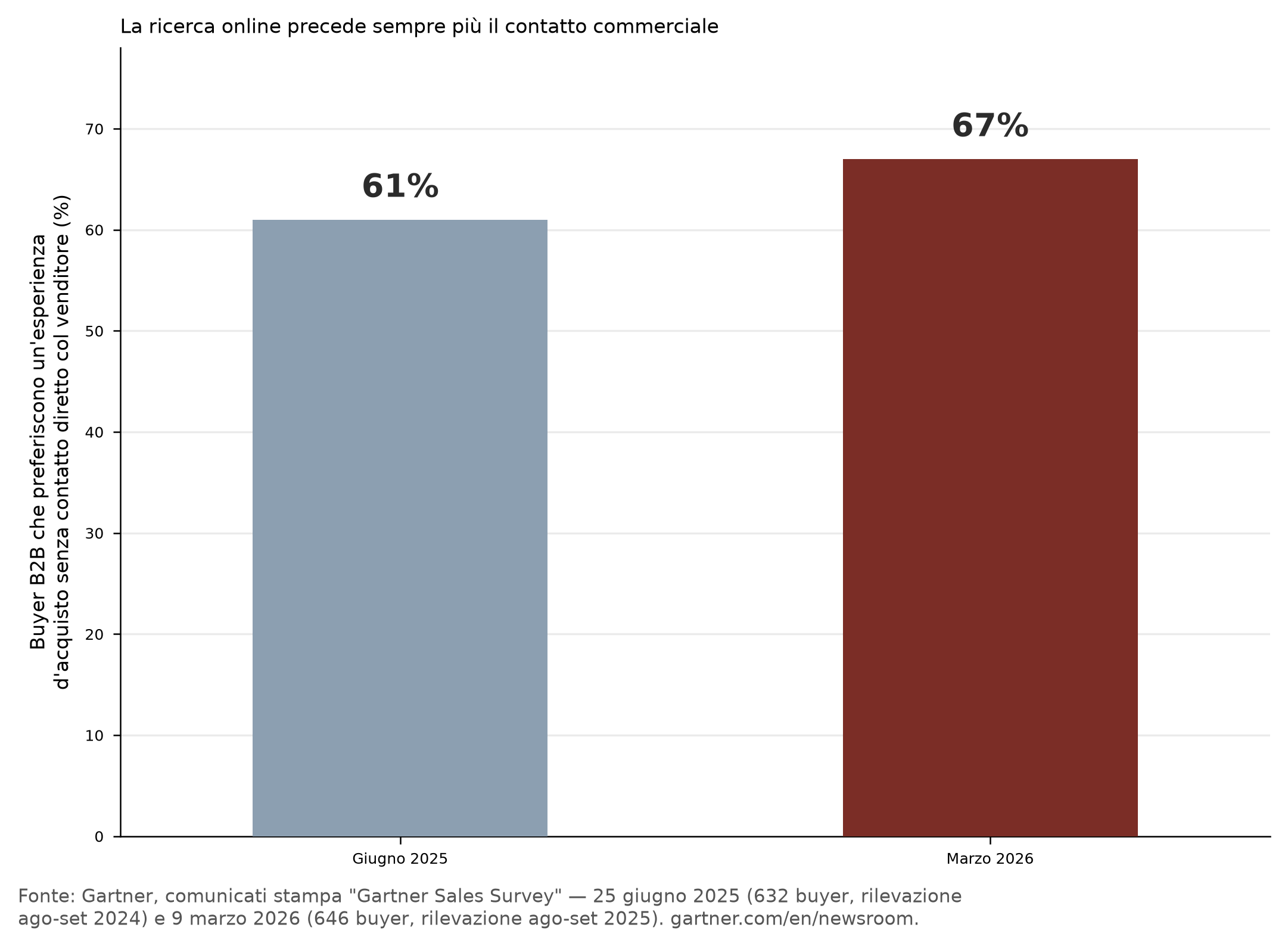
Source: Gartner, "Gartner Sales Survey" press releases — June 25, 2025 (survey fielded Aug–Sept 2024) and March 9, 2026 (survey fielded Aug–Sept 2025).
The beverage alcohol sector confirms the same direction. According to IWSR data reported by Wine Meridian in March 2025, 63% of online alcohol buyers carry out in-depth research before purchasing, and — the analysis notes — this behavior is spreading to purchases that are ultimately completed offline too. In other words: even when a deal closes verbally or at a trade fair, the shortlist of who gets contacted has, in most cases, already been shaped by digital research upstream.
For a winery, the practical takeaway is straightforward: being physically present at Vinitaly or a foreign trade show still matters, but if a buyer finds nothing useful when searching the winery's name before or after the meeting, that trade-show investment returns less than it could.
The sector's paradox: many wineries exist online, few are actually findable
Looking at our proprietary buyer pool — importers, distributors, and wholesalers mapped in Germany, the United States and the United Kingdom, three of the most relevant markets for Italian wine exports — one data point stands out about the buy side itself, not wineries, but it's still instructive: the large majority of these operators have an active website (between 91% and 96% depending on the market), but only a minority maintain a regular social media presence, and the share with an active LinkedIn profile stays in the single digits or just above it across all three markets.
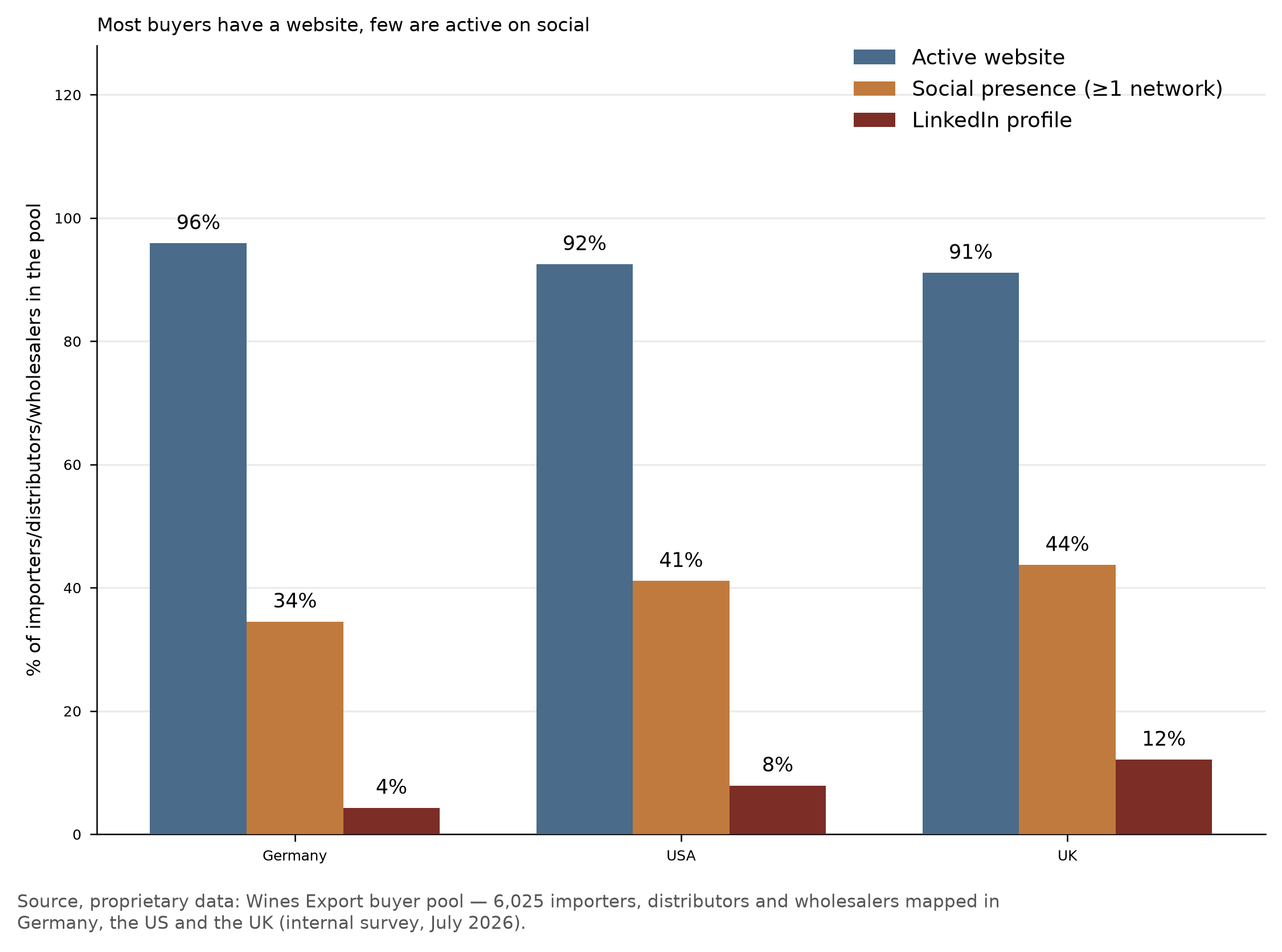
Source, proprietary data: Wines Export buyer pool — 6,025 importers, distributors and wholesalers mapped in Germany, the US and the UK (internal survey, July 2026).
This tells anyone doing wine business marketing two useful things. First: the channel that matters most for being found by a professional buyer is the website, not social media — that's where the majority of industry operators actually have a verifiable presence. Second: LinkedIn remains a low-saturation channel even among buyers themselves, which means a winery that's present and active on LinkedIn within its own industry faces less competition there today than it would elsewhere — a visibility gap still worth exploiting before the channel gets as crowded as Instagram or Facebook already are for consumer-facing wine content.
The digital marketing levers that matter for a buyer, not a consumer
Marketing aimed at a professional buyer follows different rules than marketing aimed at an end consumer, and needs to be built accordingly.
A website optimized to be found, not just to look good. A showcase site with vineyard photos and grape-variety descriptions tells the winery's story, but rarely answers the concrete question an importer types into Google: who produces this style of wine, at this price point, with this kind of volume availability. Content written around the informational queries a buyer is actually searching for — not just product pages — is what gets a site to surface at the moment of search.
Content written for the target market's language, not translated word-for-word. A German, American or British buyer reads content built for them, with the references and vocabulary of their own market — not a mechanical translation of a text written for an Italian audience. That applies to the website and to any material used in a negotiation.
LinkedIn as an organic channel, not a static showcase. Given how limited LinkedIn presence still is among buyers themselves, regularly publishing content about production, appellation, and real commercial results builds visibility in a still relatively uncrowded space, unlike the visual social platforms already saturated with winery content.
Product storytelling anchored to verifiable facts. Appellation, production specification, vintage, third-party scores where available: a professional buyer also evaluates a supplier based on how concrete and verifiable the published information is, not just how evocative it sounds.
Common mistakes to avoid
The first mistake is treating digital marketing as a branding exercise rather than a buyer-acquisition channel: publishing evocative photography without useful commercial information (indicative price tier, channels served, markets already covered) leaves a nice-looking but ineffective site. The second is publishing only in Italian on a site that also targets foreign markets, assuming a German or American importer will make the effort to translate it themselves. The third is putting all effort into visual social media while neglecting LinkedIn, the channel where competition among wineries is currently lowest and where a professional buyer is more accustomed to looking for industry information.
What this actually means for your winery
The Gartner and IWSR data point to an underlying trend: commercial contact increasingly happens after, not before, a buyer's own digital research. The data from our pool adds a practical piece: knowing that a buyer almost certainly has a website but probably isn't very active on social media helps decide where to put marketing budget first — the website and SEO content, ahead of social presence.
But knowing how buyers behave in general isn't enough to know which buyers, in a specific market, are actually interested in your wine style, your price tier, your sales channel. That's where good marketing hits its limit unless it's paired with direct knowledge of demand: a well-built content strategy drives traffic and visibility, but turning that into actual deals requires knowing exactly who to direct that visibility toward.
Want to see the real buyers for your wine?
Behavioral data tells you how buyers search in general. Only direct access to a pool of verified importers and distributors tells you who, specifically, is buying your type of wine today in the markets you care about.
Sources
- Gartner Newsroom — Gartner Sales Survey Finds 61% of B2B Buyers Prefer a Rep-Free Buying Experience — June 25, 2025
- Gartner Newsroom — Gartner Sales Survey Finds 67% of B2B Buyers Prefer a Rep-Free Experience — March 9, 2026
- Wine Meridian — Mercato alcolici 2025: le 5 tendenze chiave (IWSR data) — March 9, 2025
- Customs Documents and Excise Duty for Exporting Italian Wine to the Czech Republic
- Zibibbo: A Guide to Exporting the Grape Variety
- Customs Documents for Exporting Italian Wine to Ecuador: A 2026 Operational Guide
- Visciola Grape Variety: Exporting Unique Italian Wines
- Customs Documents for Exporting Wine to Finland: e-AD, Excise Duty and 25.5% VAT
- Vespolina: Export Guide for Wineries