Importing Italian Wine into Poland: Customs Documents, Excise Duty and Tax Stamps
Wines Export Editorial · Last updated:
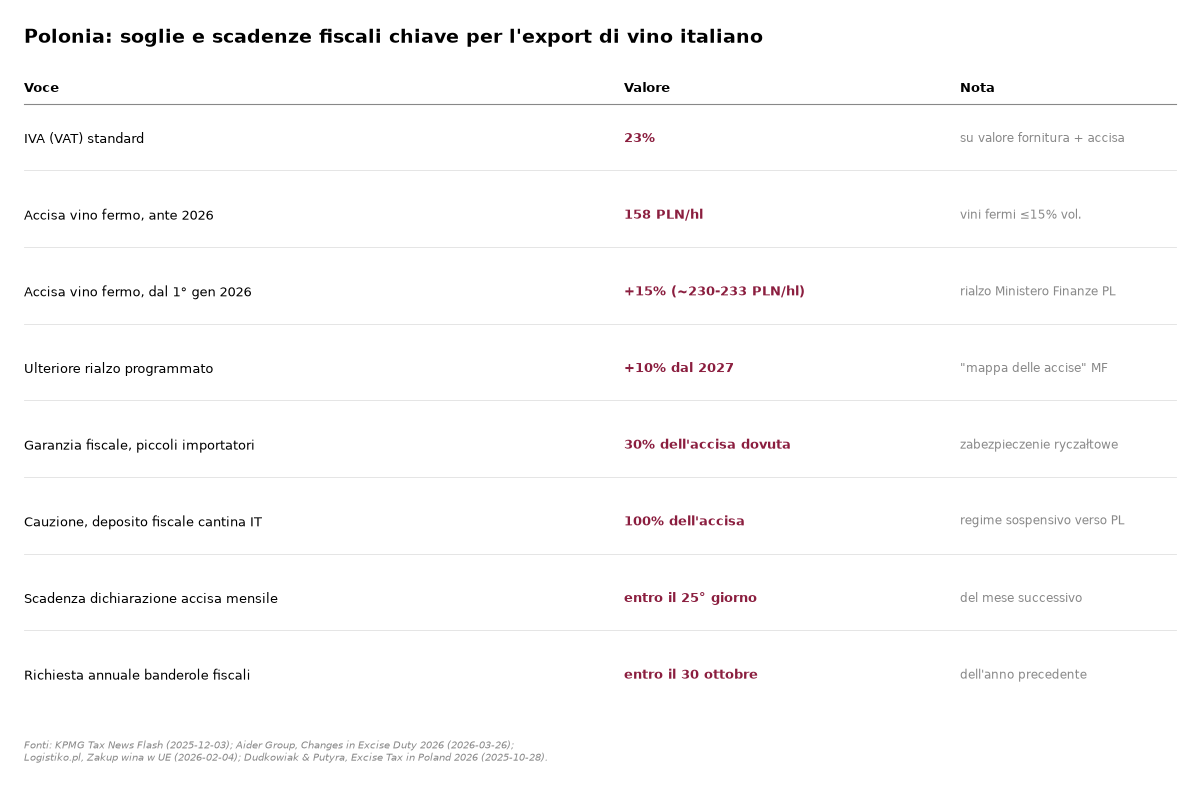
Sources: KPMG Tax News Flash (December 3, 2025); Aider Group, Changes in Excise Duty on Alcoholic and Tobacco Products in 2026 (March 26, 2026); Logistiko.pl, Zakup wina w UE (February 4, 2026); Dudkowiak & Putyra, Excise Tax in Poland 2026 (October 28, 2025).
The problem: "no customs" does not mean "no paperwork"
An importer sourcing wine from Italy for the Polish market often starts from the same wrong assumption an Italian winery does: because Poland is an EU member state, moving wine across the border should be as simple as any other intra-EU shipment. It is not. There is no customs declaration between Italy and Poland — but wine is an excise good, and Poland runs one of the more demanding fiscal-control regimes in the EU, built around physical tax stamps that must be affixed to every bottle before it reaches its destination. Getting this wrong means shipments held at inspection, financial penalties, and in the worst case, seizure of the goods.
This guide sets out, in practical terms, the documents and fiscal obligations that sit on top of the standard intra-EU paperwork (EORI number, commercial invoice, packing list, certificate of origin) when importing Italian wine into Poland — useful both for a Polish importer structuring the process for the first time and for the Italian winery on the other end of the relationship.
Beyond standard EU paperwork: EMCS, SEED PL and tax stamps
The first requirement, to confirm before the first order is even placed, is that the Polish importer is registered in the excise-control systems. According to Poland's official tax portal, the buyer must be registered in the SEED PL and EMCS PL2 systems as a "zarejestrowany odbiorca" (registered consignee), or hold its own tax warehouse (skład podatkowy); without this registration, wine cannot move under excise-duty suspension.
The second element is the electronic administrative document, the e-AD (or e-SAD, if excise duty has already been settled in the country of origin), generated inside the EMCS system. The Italian winery — if it operates a tax warehouse or works through an authorized shipper — must issue this document before the truck departs and provide the carrier with the ARC (Administrative Reference Code), which must appear on the CMR transport document. The European Commission's Your Europe portal describes this exact mechanism as the EU standard for moving excise goods under duty suspension.
The third element, and the one most distinctive to the Polish market, is the tax stamp (znak akcyzy). Every bottle of wine sold in Poland must carry a stamp purchased by the Polish importer from the Ministry of Finance: the importer buys the stamps and sends them to the Italian winery (or to its own tax warehouse in Poland), which must affix them to the back of the bottle before shipment. As the logistics blog Logistiko.pl notes, this needs to be planned well in advance — the annual stamp request must be filed by the importer by October 30 of the preceding year, and manual application at the winery can add several days to lead times for small, split lots.
Completing the picture is the fiscal guarantee (zabezpieczenie akcyzowe): the importer must lodge a guarantee with the competent tax-customs office to cover potential excise liability on goods in transit. Smaller importers can use a simplified flat-rate guarantee, the "zabezpieczenie ryczałtowe", equal to 30% of the excise duty due. When the Italian winery itself operates a tax warehouse or ships under a suspension regime toward Poland, the required guarantee rises to 100% of the excise duty applicable in the destination country, released only once the electronic receipt confirmation is logged in the EMCS system.
Excise duty and VAT: who pays what, and why the rate keeps rising
Since there is no customs duty between Italy and Poland, imported wine is subject to just two indirect taxes: excise duty (akcyza) and VAT, both applied when the goods are released for consumption on Polish territory. Excise duty is charged per hectolitre of finished product and rose 15% from January 1, 2026, as confirmed by KPMG following the Polish parliament's approval of the tax reform, with a further 10% increase already scheduled for 2027 according to Aider Group's analysis of the 2026 changes to alcohol and tobacco excise duty. Logistiko.pl, updated in February 2026, places the rate at roughly 233 PLN per hectolitre. Because Poland is outside the euro area, the rate is also reviewed annually against the EUR/PLN exchange rate to keep pace with the EU's minimum taxation floor.
VAT applies at the standard rate of 23% on the value of the supply, inclusive of excise duty. For B2B intra-Community supplies to a Polish importer holding an active EU VAT number, the Italian winery applies the VAT exemption for intra-Community transactions — provided the buyer's VAT-EU status is verified via VIES ahead of every invoice.
One point that trips up new importers: the tax liability for excise duty and VAT on the intra-Community acquisition falls on the Polish buyer, not the Italian winery. The importer must be registered in the Centralny Rejestr Podmiotów Akcyzowych (CRPA) through the PUESC platform and file the periodic excise return by the 25th day of the month following the one in which the liability arises, as described in Dudkowiak & Putyra's 2026 excise tax guide. That doesn't mean the Italian side can ignore it: confirming in writing which operating model the importer uses — own tax warehouse, registered consignee, or a third-party intermediary — is worth doing before the first shipment moves.
Polish-language labeling and coordinating with the tax stamp
Wine labeling in Poland follows the common EU framework, with one specific language requirement: allergen information — sulfites above all ("zawiera siarczyny") — must appear in Polish and be physically present on the product; it cannot be delegated to an electronic reference or QR code. It's common practice for the Polish importer to apply a Polish-language back-label with the required information, but this needs to be agreed in writing before the first shipment. Since December 8, 2023, under Regulation (EU) 2021/2117, all wines must also show energy value physically on the label, while the full ingredient list and nutrition table can be provided via QR code, provided the linked page carries no marketing content.
One practical detail worth flagging early: the tax stamp occupies part of the capsule or neck of the bottle and must be positioned according to the technical instructions issued by the importer or Poland's Ministry of Finance. This needs to be factored into label design from the start, so that shrink capsules or other markings don't overlap the stamp and block its legibility during a roadside check.
Logistics: timing matters as much as paperwork
Nearly all Italian wine bound for Poland travels by road — FTL, LTL, or groupage — given the roughly 1,300-1,700 km distance and the availability of carriers specialized in wine consolidation. The practical constraint is not customs but fiscal-administrative: before the truck leaves, a valid e-AD with an active ARC code must exist in the EMCS system, and the Polish consignee must be authorized to receive it. The driver must be able to produce the e-AD copy or the commercial document showing the ARC code if stopped for inspection. As a result, a realistic lead time from winery to importer's warehouse runs 4-7 working days for groupage shipments and 2-4 days for a planned direct FTL — time that stacks on top of, not instead of, the time needed to issue the e-AD and affix the tax stamps.
Want to see the real buyers for your wine?
Understanding excise duty, tax stamps and EMCS deadlines is the procedural half of the job — the real bottleneck for many Italian wineries is finding the right Polish importer in the first place, one already registered and structured to handle excise and stamping correctly. Wines Export works daily with export managers navigating exactly this step, with direct access to a pool of verified buyers.
Try the free demo and see how it works for your wine.
- Customs Documents for Shipping Italian Wine to Sweden: A Practical Guide
- Customs Documents for Shipping Italian Wine to Norway: An Operating Guide
- Customs Documents and Duties for Exporting Wine to Ukraine: An Operational Guide
- Importing Italian Wine into New Zealand: Customs Documents, Duties and MPI Biosecurity
- Wine Distributors Germany: How to Find the Right Ones
- Customs and excise documents for shipping Italian wine to Ireland