Customs Documents and Duties for Exporting Wine to Ukraine: An Operational Guide
Wines Export Editorial · Last updated:
 Photo: Tima Miroshnichenko / Pexels
The practical problem behind the first shipment to Ukraine
An Italian winery that receives its first order from a Ukrainian importer runs into a very concrete question: beyond the invoice and packing list, which documents actually determine whether the shipment clears customs or gets stuck at the border? The answer is not straightforward, because Ukrainian alcohol regulation is described by the Italian trade agency's Kyiv network as "highly complex and variable," and it is updated frequently through new laws and rulings — which makes relying on outdated information genuinely risky.
The picture is complicated further by the fact that, unlike in many other markets, customs clearance in Ukraine is not something the Italian exporter handles directly: it is the Ukrainian importer, as the local legal entity, who submits the documentation to customs. That means the Italian producer still needs a working knowledge of the documentary and tax framework — both to price correctly and to avoid a shipment stalled at the border because the local partner's licence was not in order.
Documents and licences required on the importer's side
Beyond the core document set common to every export shipment — EORI, commercial invoice, packing list, certificate of origin — importing wine into Ukraine requires a few country-specific steps tied to local alcohol regulation.
The starting point is the importer's wholesale trading licence. Under Ukrainian law, it is the importer, as a Ukrainian legal entity, who presents the documentation, including certificates, to customs; it is standard practice for the Italian producer to send the available certificate in advance while the importer contacts the relevant regional customs office to resolve any interpretive questions before the shipment moves. Wholesale trade in alcoholic beverages in Ukraine requires a specific licence valid for 5 years, issued under the law "On State Control over the Production and Circulation of Ethyl Alcohol, Cognac and Fruit Alcohol, Alcoholic Beverages and Tobacco Products": requirements include a storage location registered in the Unified State Register, product-sample display cases on site, dedicated negotiation areas, and certified cash registers, with an annual fee ranging from UAH 30,000 (beer) to UAH 500,000 for alcoholic beverages generally. A separate wholesale licence is not required for operators who already hold a production licence for wine made from their own grapes.
The framework was updated by the 2024 legislative reform: Ukrainian law No. 3817-IX of 18 June 2024 requires, under Chapter VII, Article 42, that the Ukrainian economic operator obtain a licence from the territorial body responsible for state fiscal policy in order to carry out production, wholesale and retail trade of alcoholic beverages. Given how frequently the regulation is revised, it is always advisable to request written confirmation from the importer on the status of their licence before every shipment.
On the contractual side, Article 6 of the Ukrainian Law on Foreign Economic Activity requires the sales contract to be executed in a form determined by the Ukrainian Ministry of Economy, and it is good practice to always attach it to the shipping documentation alongside the invoice. The import customs declaration, in turn, is filled in by the importer under Order No. 651 of the Ukrainian Ministry of Finance, dated 30 May 2012. On the transport side, the official Italian trade agency guide for wine export lists the Air Way Bill, the CMR (international road consignment note) and the TIR carnet as accepted transport documents, depending on the mode chosen — a relevant detail today, since traffic has shifted almost entirely to road transport, with Black Sea ports exposed to direct war risk.
Zero duty, excise by wine type, and VAT: what changes in your pricing
The good news for the Italian exporter concerns customs duty: as of 1 January 2021, the customs duty on EU-origin wine imported into Ukraine was eliminated, under the EU-Ukraine DCFTA (Deep and Comprehensive Free Trade Area) agreement and a ruling of the Ukrainian State Fiscal Service dated 6 January 2016. This is a concrete competitive advantage over non-EU suppliers and should always be mentioned in the commercial proposal as a pricing argument toward the importer — provided the preferential origin is correctly demonstrated in the customs paperwork.
Excise duty and VAT, however, remain payable, both borne by the importer at customs. According to the official Italian trade agency guide, based on Article 215.3.1 of the Ukrainian Tax Code, excise duty on wine (HS heading 2204) varies significantly by type: UAH 0.01 per litre for natural, non-fortified wine, versus UAH 12.23 per litre for fortified wine and for sparkling or carbonated wine. That gap has a direct impact on the margin for Italian sparkling wine producers, far more than for still wine, and should be factored into pricing from the outset. On top of this, VAT applies at 20%, under Title V of the Ukrainian Tax Law (Code No. 2755-17); one international legal source also notes that wine distribution in Ukraine, wholesale and retail, is subject to corporate income tax of up to 18%.
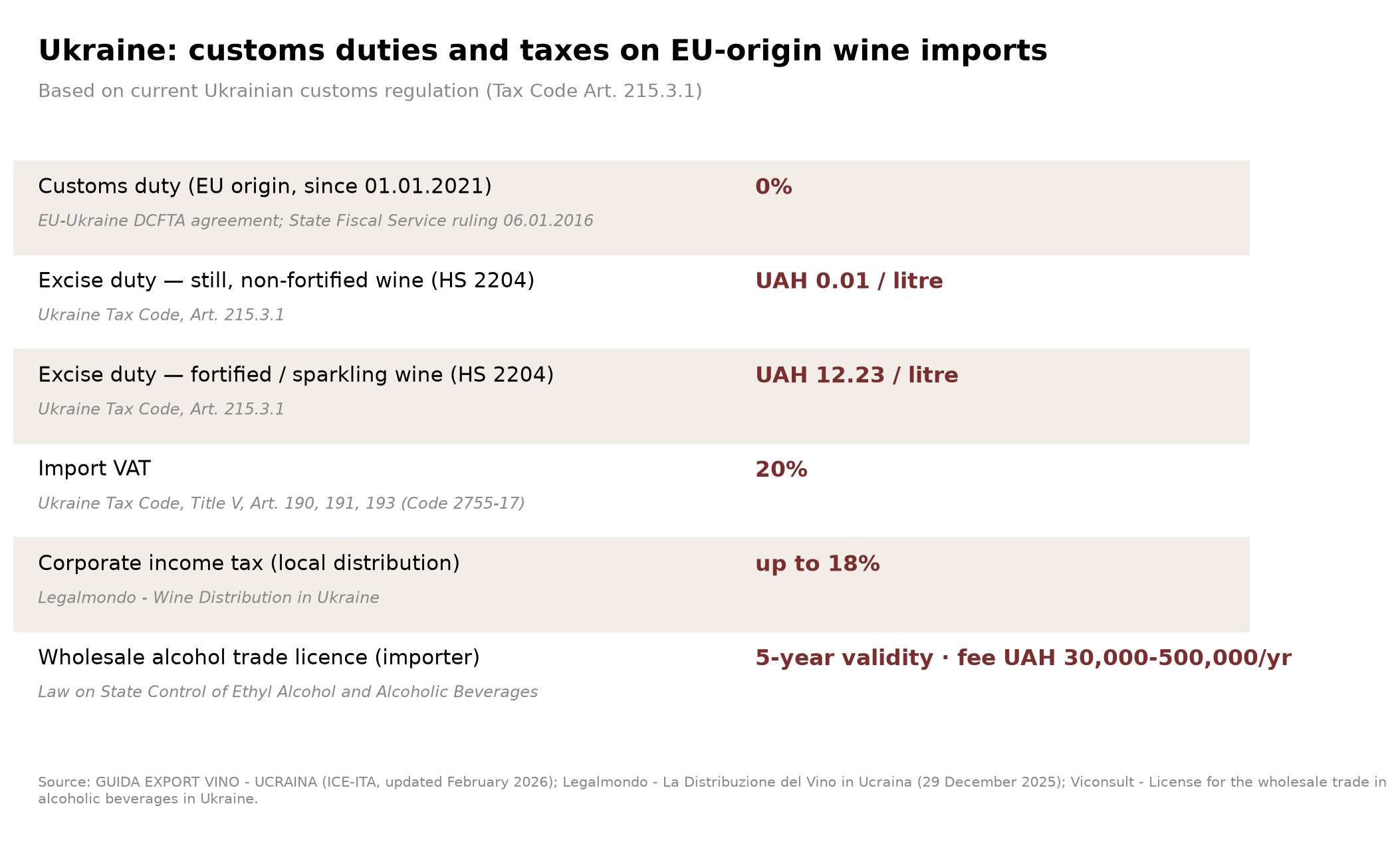 Infographic: Wines Export analysis based on GUIDA EXPORT VINO - UCRAINA (ICE-ITA, updated February 2026) and Legalmondo - La Distribuzione del Vino in Ucraina (29 December 2025).
All of these charges are due from the Ukrainian importer at the point of customs clearance, in local currency: the Italian exporter has no direct tax obligations in Ukraine under the importer-based sales model, which remains the dominant route to market, given that the sector has an oligopolistic structure in which a small number of firms control imports.
Ukrainian-language labels and currency exposure: two constraints not to overlook
Beyond customs paperwork, two practical points deserve attention before a first shipment. The first is labelling: labels must be written in Ukrainian, under the law "On Consumer Information about Food Products" (No. 2639-VIII of 6 December 2018) and law No. 3817-IX of 2024 (Chapter IX, Article 62); a label only in Italian or English is not accepted, and wineries need a back-label or an integrated label covering country of origin, product name, brand, alcohol content, sugar content, and the name and location of the importer, plus a barcode.
The second concerns currency: Ukraine does not use the euro, and the hryvnia (UAH) has shown structural depreciation — at the end of December 2024 the exchange rate stood at UAH 43.93 per EUR, a 4.6% annual depreciation, in a context of tightened currency controls imposed by the National Bank of Ukraine under martial law in force since 2022. For this reason, the official US Commercial Service guide for Ukraine recommends advance payment or an irrevocable letter of credit for new trading relationships, reserving less protective terms such as documentary collection for already-established partnerships.
Despite the wartime context, Ukrainian demand for Italian wine has proven resilient: according to the Prosecco DOC Consortium, exports of the appellation to Ukraine grew 32.2% in 2025, among the highest growth rates the appellation recorded in any market — confirming that getting customs documentation right is not a bureaucratic hurdle for its own sake, but the precondition for capturing real, growing demand.
Want to see the real buyers for your wine?
Knowing the duties, excise rates and customs documents is only the first step: the real bottleneck for an Italian winery exporting to Ukraine is finding a reliable importer who already holds the necessary licences and is established in the Horeca channel, where Italian wines are already a recognised category. Wines Export supports Italian wineries through the full export management process, from buyer selection to documentation management.
Try the free demo and see how it works: wines-export.it/demo?k=documenti-dogana-vino-ucraina
- Wine Distributors Germany: How to Find the Right Ones
- Customs Documents for Shipping Italian Wine to Sweden: A Practical Guide
- Optimizing Wine Exports with Wines Export CRM | Pricing Strategies for International Markets
- Importing Italian Wine into Poland: Customs Documents, Excise Duty and Tax Stamps
- Wine Exports in 2025: Who Held, Who Lost
- Customs Documents for Shipping Italian Wine to Norway: An Operating Guide