Wine Freight Forwarders: Choosing the Right Logistics Partner for Export
Wines Export Editorial · Last updated:
zs Lin on Pexels
For an importer sourcing wine from Italy, the choice of freight forwarder and shipping mode on the supplier's side matters just as much as the commercial terms of the deal. A mistake at this stage — the wrong container type, a route with no temperature control, a missing document — can undo months of sourcing work through physical damage or a customs hold. This guide breaks down the practical logistics decisions a serious Italian winery (and by extension, its buyer) should be getting right, with real data on timing where available.
FCL or LCL: it starts with volume
The first logistics decision concerns container type. A Full Container Load (FCL) is the most cost-efficient option per unit when volume fills an entire container: a 20-foot container typically holds around 9,000-10,000 bottles at 0.75L, a 40-foot roughly double that. For a winery with still-modest export volumes, or for a first test shipment into a new market, Less than Container Load (LCL) shipping lets the cargo share container space with other shipments — more expensive per unit of product, but essential when volume doesn't yet justify a dedicated container. For an importer, this matters directly: a supplier only able to offer LCL may mean smaller, more frequent shipments with correspondingly higher per-bottle freight cost until volumes scale up.
Established international freight operators structure both services formally. Transmec Group, a logistics operator with over 170 years in the sector, runs an integrated network of ocean freight, groupage, and full-container services out of Italy — exactly the kind of choice a winery shipping its first pallets to a new market has to make.
Real transit times: distance changes everything
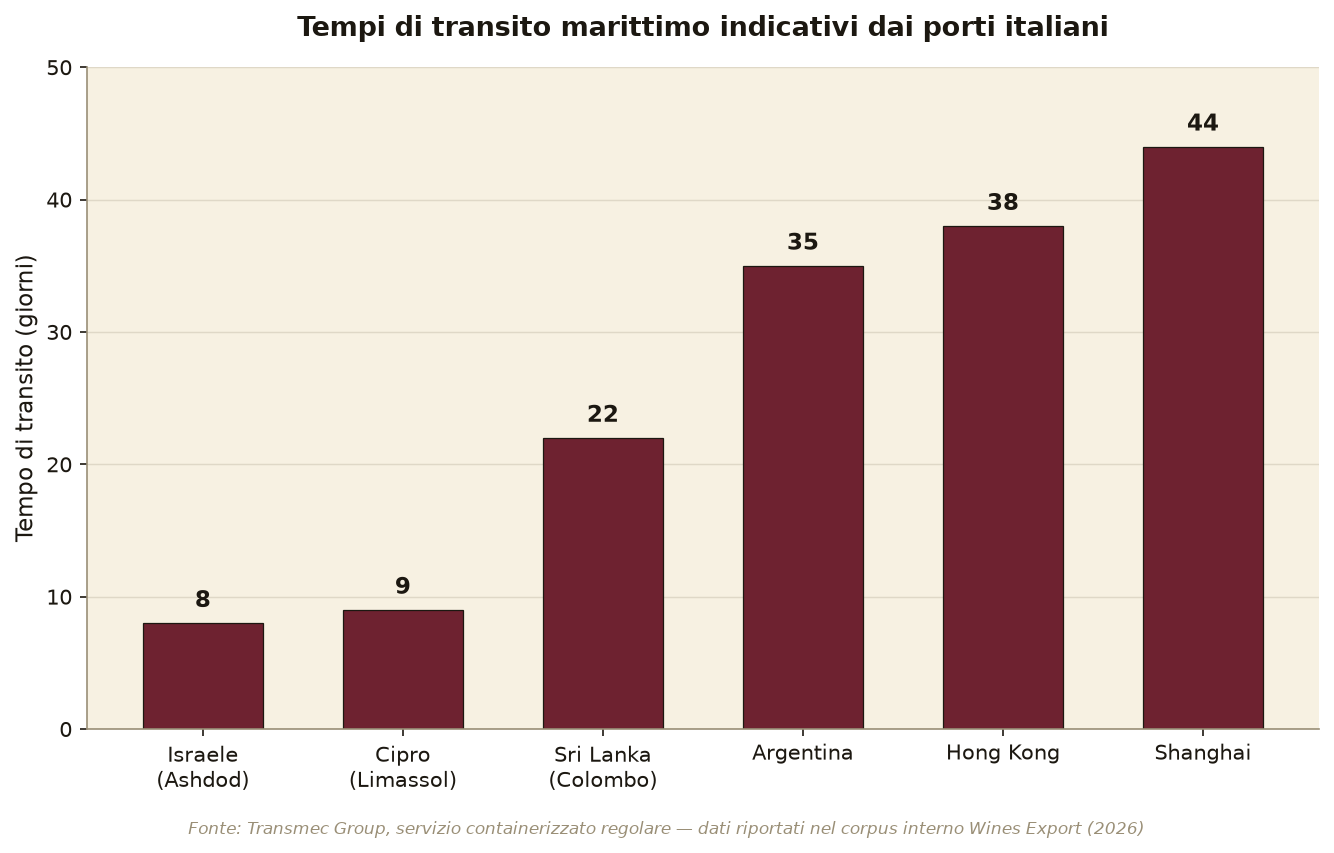
Ocean transit times vary enormously by route, and need to be planned well ahead of the delivery date an importer requires — particularly when the shipment includes documents with a tight validity window, such as analysis certificates. Based on published data from specialized logistics operators (regular containerized service via Transmec Group), indicative transit times from Italian ports to a sample of destinations are:
Source: Transmec Group, regular containerized service
As the chart shows, the gap between the fastest route (Israel, Ashdod, roughly 8 days) and the longest (Shanghai, roughly 44 days) is substantial — a factor that matters not just for order planning on the buyer's side, but also for whether the shipment should be insured and whether a refrigerated container is warranted, since a six-week transit exposes wine to a far greater thermal-degradation risk than a route of just over a week. Actual timing remains subject to carrier, seasonality, and port congestion.
Reefer containers: when they actually matter
For routes crossing warm climate zones, or for shipments made during summer months, using a refrigerated (reefer) container prevents wine from being exposed to high temperatures during transits that, as shown above, can exceed a month for the most distant destinations. The added cost of a reefer should be weighed against cargo value: for premium wines headed to distant markets, it is nearly always justified; for smaller volumes on short European or Mediterranean routes, often not necessary.
It's worth noting that the main risk in refrigerated transport isn't only excessive heat but equipment failure itself: the most common causes of damage in perishable cargo transport include human error, refrigeration unit breakdown, improper stowage, and loss of power to the reefer unit during stops — which is why, for high-value shipments, dedicated cargo insurance remains the most solid protection regardless of the transport mode chosen.
Air freight: only for specific cases
Air freight, while significantly more expensive per unit of weight than ocean shipping, makes sense in specific situations: urgent samples for a prospective importer, rush restocking to avoid a stockout at a strategic distributor, or shipments of very high unit value where freight cost has only marginal impact on the final price. For an importer's regular ordering volumes, ocean freight remains the economically sustainable choice.
The customs broker's role
Relying on a professional customs broker isn't technically mandatory, but it is strongly recommended for a winery without direct experience navigating the destination country's regulations: a documentation error can result in a container being held at customs, with additional demurrage costs until the issue is resolved. The average cost of a customs clearance service typically runs between €100 and €500 per operation, depending on the complexity of the case — a cost importers should factor into landed-cost calculations when comparing suppliers.
Insuring the cargo: an often-underestimated cost
A common mistake among first-time exporters (and one worth an importer flagging with a new supplier) is assuming carrier liability offers sufficient protection. In reality, carriers and forwarders have legally limited liability: in Italy, for road transport, the cap is just one euro per kilogram of cargo — far below the real value of a quality wine shipment — and the carrier is only liable where fault can be demonstrated, not for generic events like bad weather or damage not attributable to its own error. For this reason, dedicated marine cargo insurance is standard practice for valuable shipments, not the exception: it covers bottle breakage, temperature swings, theft, and — under fuller clauses — general average risk, where all cargo owners aboard a vessel must contribute to salvage costs even if their own cargo suffered no direct damage.
Evaluating a logistics partner for wine export
Not every freight forwarder is equally equipped for wine. When evaluating a supplier's logistics arrangements, an importer should look for: documented experience with perishable, temperature-sensitive goods; reefer containers with cold-chain monitoring; a network of bonded warehouses in relevant destination markets; the ability to handle wine-specific documentation (analysis certificates, VI-1 forms where required outside the EU, phytosanitary certificates for untreated wood pallets); and verifiable references from other Italian wineries already shipping through the same forwarder. A proper freight quote should separately itemize ocean freight, port handling charges, any reefer surcharge, and customs clearance fees — line items too often bundled into a single number that makes comparing forwarders difficult.
Minimum documents for shipment
Beyond the commercial invoice and packing list, every ocean shipment requires a Bill of Lading, which serves as proof the carrier has taken custody of the goods and, in negotiable form, as a title document during transit — essential also for payment purposes when the transaction is settled via documentary letter of credit. For a full breakdown of documents required by destination market, see our related guide on how to export wine abroad.
What this means in a supplier conversation
For an importer vetting a new Italian winery, logistics questions are a useful proxy for how operationally mature the supplier actually is. A winery that can answer clearly — which forwarder it uses, whether it ships FCL or LCL at current volumes, what transit time to expect on the buyer's specific route, and whether cargo insurance is standard practice or an afterthought — is signaling a level of export experience that a newer or smaller producer may not yet have. Conversely, a winery unable to speak to any of these points beyond "we'll figure it out once we have an order" is a signal worth weighing before committing to a first shipment, particularly for markets with long transit times where a documentation error is expensive to unwind.
The practical checklist
Before every new export shipment, both winery and importer should confirm: shipping mode (FCL/LCL) matched to actual volume, transit time for the specific route and its compatibility with agreed delivery deadlines, whether a reefer container is warranted given route and season, cargo insurance coverage, and the documentary reliability of the forwarder chosen for that specific destination market.
Sources
- Transmec Group — International Transport (transit time data, 2026)
- Shipping Italy — Perishable goods transport and insurance (reefer transport risks, July 2024)
- Access2Markets, European Commission — Customs clearance documents
To explore more of the export journey — from buyer negotiation to letters of credit — visit our access section or browse other articles on our blog.
- Wine Importer vs Distributor vs Broker: Who Buys What?
- Wine Exports in 2025: Who Held, Who Lost
- Wine Marketplace: How B2B Platforms for Selling Wine Abroad Really Work
- Optimizing Wine Exports with Wines Export CRM | Pricing Strategies for International Markets
- Wine Marketplace Guide: Retail, B2B and Direct Sourcing for Italian Wine
- Wine Distributors Germany: How to Find the Right Ones