Wine Marketplace: How B2B Platforms for Selling Wine Abroad Really Work
Wines Export Editorial · Last updated:
 Photo: Davide Comunian / Pexels
If you import or distribute wine and have spent any time researching Italian suppliers online, you've likely come across B2B wine marketplaces: platforms that promise to connect you directly with wineries, cutting out some of the friction of trade fairs and agent networks. This article looks at how these platforms actually work, what they're good for, and where they fall short — particularly if you're sourcing from Italy for the US, German, or UK market.
What a B2B wine marketplace actually does
At its core, a B2B wine marketplace is a digital catalogue: producers upload product sheets (label, vintage, ex-cellar price, available volume, certifications), and registered buyers search, filter, and request quotes or samples. More developed platforms add RFQ (request for quotation) management, automated freight and duty estimates, export documentation support (DOP/IGP status, health certificates, proforma invoices), and internal messaging to negotiate terms.
The business model is almost always a transaction fee or a subscription charged to the producer for visibility in search results. Some platforms are generalist food & beverage marketplaces; others are wine-only verticals. Either way, the marketplace acts as an intermediary for visibility and process — but, as many buyers discover after registering, it does not verify that listed producers are export-ready, correctly certified for your market, or capable of the volumes their profile suggests.
Why this matters now: Italian export performance in the US, Germany and the UK
The topic has become more relevant because 2025 was a difficult year for Italian wine exports. According to a SACE report on the wine sector, published on April 9, 2026 based on Istat data, the value of Italian wine exports came in at €7.8 billion in 2025. The United States, Italy's top export market with a 23% share, took the biggest hit: down 9.2% in value to €1.8 billion, a decline driven largely by US tariffs and dollar weakness in the second half of the year. Germany, Italy's leading European market with a 15% share, held up better, closing at €1.1 billion (+0.6%), while the UK, accounting for 11% of exports, closed at €817 million, down 3.9%.
These three markets together account for close to half of all Italian wine exports by value — which is exactly why any tool, marketplace platforms included, that claims to open or strengthen commercial relationships in the US, Germany and the UK gets attention from hundreds of small and mid-sized Italian producers that don't have a dedicated export office.
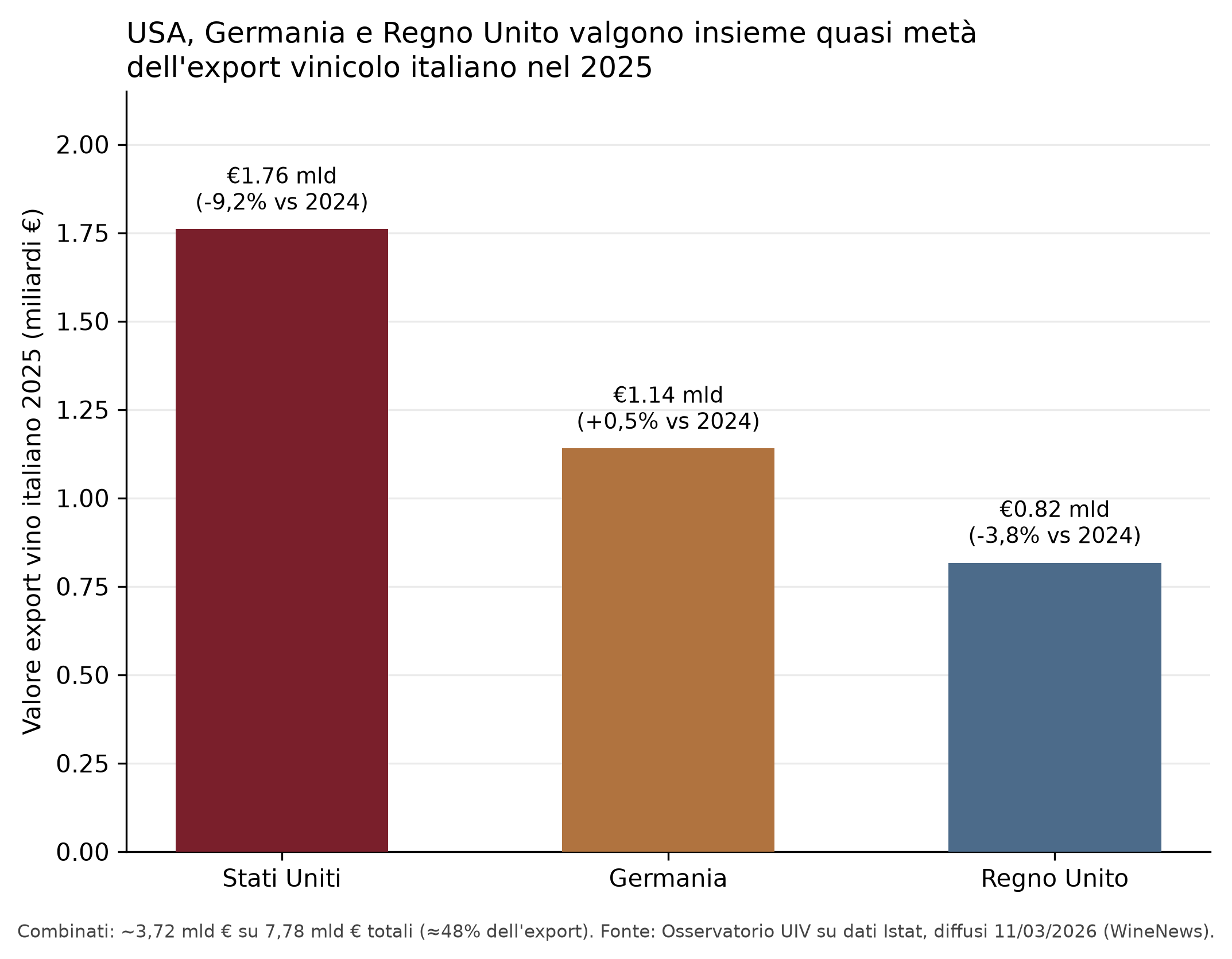 Source: SACE, "Focus ON – Vino", published April 9, 2026, based on Istat data. US 23% of exports, Germany 15%, UK 11%.
The overlooked role of re-export hubs
One thing rarely explained when people discuss B2B marketplaces is the real geography of international wine trade. According to OIV's 2025 thematic report on re-exportation, international wine trade now represents 47% of global consumption, and a meaningful share of that flow — around 13% of global exports, equal to 14 million hectolitres and €4.6 billion over 2018-2023 — passes through re-export hubs: countries that import wine and then bottle, store, or redistribute it toward third markets. The UK, alongside Belgium, the Netherlands and other European centres, is identified by the OIV as one of the more established redistribution platforms.
For a buyer or a producer negotiating through a marketplace, this has a very concrete implication: a contact that appears "British" may in fact be sourcing or redistributing product toward third markets through re-export logistics, which changes contract terms, payment timing, and volume expectations. Understanding who is actually on the other side of a listing — before signing — is still work that no generalist marketplace does for you.
Digital adoption in wine: a reality check
It's worth looking at actual digital-adoption data, because it tempers expectations. According to the Special Report from the 2024 ProWein Business Survey, conducted by Geisenheim University among more than 2,000 wine industry professionals worldwide, more than two-thirds of wine businesses already use email marketing and social media to sell their wines, yet only 15% were planning to invest in new CRM and digital marketing tools by 2025 — even though 72% of the experts surveyed recognised the need for ongoing digital-skills training. That gap between awareness and actual investment says a lot about how cautiously the sector is approaching digital transformation compared with other parts of food & beverage.
In other words, B2B marketplaces, however much they're growing, operate in a sector where most players still treat them as a secondary channel next to trade fairs, agents and direct relationships — not a replacement for them.
Generalist marketplaces vs. direct buyer intelligence
Generalist B2B marketplaces have a real advantage: they lower the entry barrier for a producer that has never exported, offering a first low-cost channel of international visibility. Their equally real limitation is that a marketplace only knows its own registered users, not the market: it can't tell an Italian producer which German importers are actively buying still red wines in a given price band this quarter, or which UK buyers have pulled back after a 3.8% market contraction.
This is where an export management service built around a proprietary pool of verified buyer data — collected and checked market by market — offers a level of intelligence no generalist catalogue can replicate: not "who signed up on the platform," but who is actually buying, at what volumes, and under what terms.
A short checklist before joining a platform
Before committing time and budget to a B2B marketplace, a producer or buyer should check at least four things: how long registered counterparts have actually been active on the platform; whether there's any verification of creditworthiness or historical purchase volumes; the real cost structure (per-transaction fees, flat subscription, paid visibility boosts); and whether the platform provides current market intelligence on target countries, not just a list of names. Without these, it's easy to mistake digital visibility for an actual sales pipeline — two things that, in wine export, rarely line up automatically.
What happens after the first contact: the part marketplaces don't cover
Even when a B2B marketplace works well and produces a genuine lead, the harder part of the process still lies ahead: commercial due diligence. Verifying that an importer's purchase history matches its stated volumes, understanding standard payment terms in the destination country, handling customs documentation and labelling requirements specific to the US, Germany or the UK, and negotiating logistics (Incoterms, delivery times, returns handling) are all tasks that stay with the producer — or with whoever supports its export activity — regardless of which channel produced the initial contact.
That's why many producers, after a first experience with generalist marketplaces, look for a more structured support service — not to replace the marketplace, but to close the gap between "we have a lead" and "we have a commercial relationship generating recurring revenue." A flat, transparent pricing model (a one-time fee, with no recurring commission on sales) also lets a producer know the investment upfront, unlike many platforms that charge variable percentages on every transaction.
Want to see the real buyers for your wine?
A marketplace shows you who signed up. A pool of verified data on active importers and distributors in the United States, Germany and the UK shows you who is actually buying, at what price points and in what volumes — intelligence no generalist platform holds, because no competitor collects it the same way.
Try the free demo and see for yourself the difference between a list of registered users and a pool of verified buyers.
- Wine Marketplace Guide: Retail, B2B and Direct Sourcing for Italian Wine
- Wine Importer vs Distributor vs Broker: Who Buys What?
- Wine Wholesalers: How to Choose a Reliable Partner for Export
- Wine Freight Forwarders: Choosing the Right Logistics Partner for Export
- 1,085 European Wine Regions Under the Climate Change Lens
- Wine Exports in 2025: Who Held, Who Lost