Wine Wholesalers: How to Choose a Reliable Partner for Export
Wines Export Editorial · Last updated:

Valeriya Boltneva on Pexels
For an Italian winery entering a new export market, the wholesaler is often the real gatekeeper between the bottle and the shelf. Unlike a direct relationship with a wine bar or restaurant, a wholesaler in a regulated market — the United States, the United Kingdom, or Germany — has to operate under specific licenses before it can legally handle alcohol on behalf of other businesses. Choosing a partner without checking those licenses exposes a producer to a very real risk: working with an intermediary that cannot legally operate, or one caught in an increasingly unstable corner of the trade. As the data below shows, that instability isn't hypothetical — the U.S. wholesale tier in particular has consolidated sharply over the past two decades.
Wholesaler, distributor, importer: not the same license
In practice the three roles often sit inside the same company, but they remain distinct on the regulatory and contractual side. A wholesaler buys product outright (or on consignment) and resells it to other wholesalers or retailers; a distributor typically holds exclusive territory rights with brand-promotion obligations; an importer is the entity that physically brings the product into the country and answers to customs for it. Many large operators combine importer and wholesaler roles under one license, while smaller players specialize in just one. Before any negotiation, a producer should establish exactly which role — or combination of roles — a prospective partner actually holds, since that determines which license needs to be checked.
United States: the TTB Basic Permit is the first thing to verify
In the U.S., anyone purchasing alcohol at wholesale for resale must first secure approval from the Alcohol and Tobacco Tax and Trade Bureau (TTB). As the TTB states directly, anyone planning to purchase and sell alcohol at wholesale, or to import alcohol beverages, must first obtain a Basic Permit, and that permit must already be approved and in hand before the business starts operating — a pending application isn't enough. The permit is specific to the wholesaling activity and must be amended in the event of material ownership or business-name changes. For an exporter, the practical takeaway is simple: before a container ships to a prospective U.S. wholesaler, it is worth asking for the Basic Permit number and confirming it is active — the same instinct that would lead you to verify a tax ID before invoicing an unfamiliar buyer.
United Kingdom: the AWRS check is not optional
In the UK, HMRC introduced the Alcohol Wholesaler Registration Scheme (AWRS) specifically to fight excise fraud. The mechanism cuts both ways: a business that wants to wholesale alcohol must register and wait for approval — it must apply at least 45 days before it intends to start trading — and any business buying from a UK wholesaler is required to confirm that supplier is actually approved, repeating the check at regular intervals as part of its own due diligence. The check runs on the wholesaler's Unique Reference Number (URN), which must appear on its invoices; HMRC provides a public online lookup service that needs no login. For a producer working through a UK distributor, asking for and verifying the URN before signing a distribution agreement is a five-minute check that heads off a documented legal risk — being caught in the supply chain of an unapproved wholesaler.
Germany: the excise warehouse permit for anyone storing alcohol
In Germany the relevant checkpoint sits on the storage and duty-suspension side. Any operator planning to store or process alcohol before excise duty (Verbrauchsteuer) is paid must hold authorization as an excise-warehouse holder (Steuerlagerinhaber), granted by the competent main customs office (Hauptzollamt). As one legal analysis of the German framework puts it, if a client plans to store or process alcohol under excise suspension in Germany, a corresponding permit is required, issued by the responsible main customs office after review of the applicant's premises, record-keeping, and financial standing. For an exporter, a German wholesaler or importer running high volumes through a bonded excise warehouse can, in principle, offer better payment terms and logistical flexibility — but it is worth confirming the authorization is genuinely in place and how long it has held it, since the approval process itself involves a detailed customs review.
The U.S. market has consolidated sharply — fewer wholesalers, more selective
Licensing is only half the picture; the other half is the structural health of the channel, and in the U.S. it has changed dramatically. According to an analysis published in Forbes, the number of U.S. wine wholesalers has dropped from roughly 3,000 in the mid-1990s to approximately 1,000 in 2023, with Southern Glazer's and Republic National Distributing Company (RNDC) as by far the two largest players. A separate estimate cited by USA Wine Ratings, drawing on Shanken's Impact Databank Report, projects these two groups will control 53% of the market in 2024, with the top ten reaching 81.5%. For a small-to-midsized producer, that means the largest national wholesalers are increasingly uninterested in a portfolio without volume already attached — while a smaller, properly licensed regional wholesaler can be a more realistic point of entry than a national giant with no room left on the shelf.
What our proprietary buyer pool shows across the three markets
Across our proprietary contact pool for these three markets, wholesalers remain a minority relative to retailers, importers, and distributors — consistent with a channel that keeps concentrating into fewer hands. What differs sharply between markets is how directly those wholesalers can actually be reached:
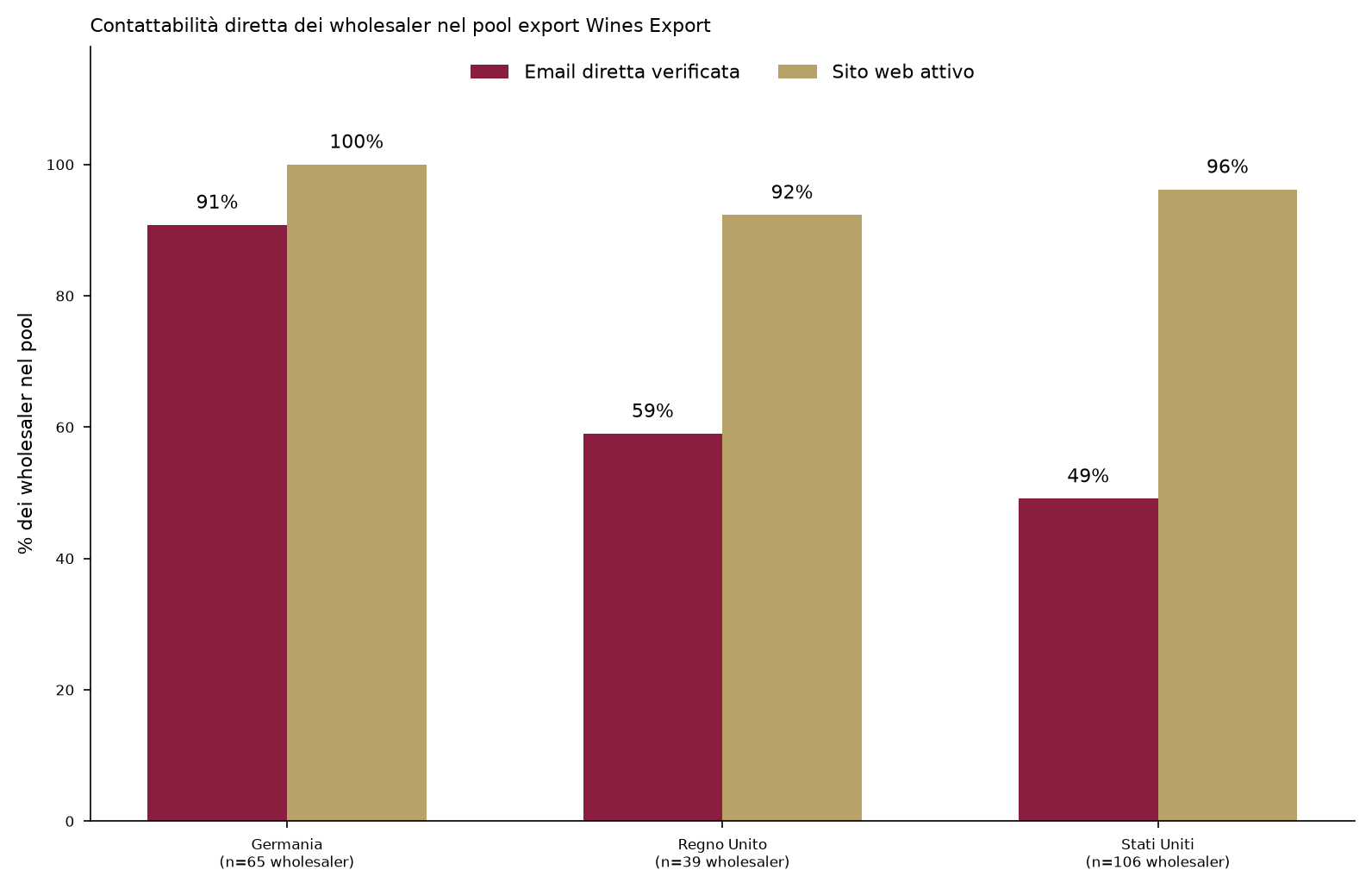
Source: proprietary Wines Export buyer pool, internal aggregation by market
German wholesalers in the pool are reachable by direct email in 91% of cases and almost always have an active website, while in the United States that figure drops to 49%. That gap tracks with the U.S. consolidation described above: large, consolidated groups tend to route commercial contact through forms and switchboards rather than publicly listed direct emails. For a producer, the practical implication is that in a more concentrated market like the U.S., finding the right contact — not just the right company name — matters as much as checking the license.
A practical checklist before signing with a wholesaler
Before entering a commercial relationship with a foreign wholesaler, a producer should verify: the market-specific license number (TTB Basic Permit for the U.S., AWRS URN for the UK, Hauptzollamt authorization for Germany) and its current validity; how long the company has held that license; the size of the portfolio it already carries, to gauge whether a new Italian label would get real attention or get lost among hundreds of others; a verifiable direct contact channel beyond the corporate website; and references from other Italian wineries already working with the same wholesaler. None of these checks takes more than a few days, and each one substantially cuts the risk of signing with an unstable or non-compliant partner.
Sources
- TTB — Applying for a Permit (Wholesaler) (November 2025)
- GOV.UK — Alcohol Wholesaler Registration Scheme (AWRS) (March 2025)
- Lexology — Excise Warehouse Permit for Alcohol in Germany (April 2025)
- Forbes — Why Global Wineries Must Rethink U.S. Distribution In The Era Of Consolidation (June 2025)
- USA Wine Ratings — Future of U.S. Wholesale Wine Distribution
Want to see the real buyers for your wine?
Checking a wholesaler's license is the first step. The second is knowing which wholesalers, importers, and distributors are actually active and reachable in your target market — with real contacts, not just company names off a directory. Book a direct call with the Wines Export team: try the free demo and see the buyer pool data applied to your own winery's profile.
- 1,085 European Wine Regions Under the Climate Change Lens
- Wine Marketplace Guide: Retail, B2B and Direct Sourcing for Italian Wine
- Australian Wine Importers: Finding and Understanding Them
- Wine Marketplace: How B2B Platforms for Selling Wine Abroad Really Work
- Brazilian Wine Importers: Finding Them and What They Seek
- Wine Importer vs Distributor vs Broker: Who Buys What?