1,085 European Wine Regions Under the Climate Change Lens
Wines Export Editorial · Last updated:
Joerg Hartmann on Pexels
Which European wine regions are most exposed to climate change, and which have the tools to adapt? That question is answered by one of the broadest studies published on the topic: a 2024 paper in Nature Communications, authored by researchers from Eurac Research (Bolzano), Ca' Foscari University of Venice, and the University of Trás-os-Montes e Alto Douro (Portugal), analysing 1,085 European Protected Designation of Origin (PDO) wine regions. For a buyer building a long-term sourcing strategy, this is not an academic exercise: the geography of climate vulnerability across Europe will determine, over the coming decades, which regions hold their production profile and which will need to transform.
What the researchers measured
The study combines three dimensions for each of the 1,085 PDO regions analysed: exposure to projected climate change (0 = minimal exposure, 1 = maximum exposure), the sensitivity of cultivated varieties to changing conditions, and the adaptive capacity of the local production system — built on five dimensions (financial, physical, natural, human, social) and 15 separate indicators.
This is a more nuanced approach than simple climate-suitability modelling: it doesn't just say "it will get hotter here" — it estimates whether a territory has the resources — financial, infrastructural, knowledge-based — to adapt to that change.
Which regions carry the highest exposure
Regions with the highest exposure level — above 0.7 on a 0-1 scale — cluster in Romania, Croatia, Bulgaria, Italy, and Hungary, often in mountainous terrain (the Apennines, the Alps, the Carpathians). At the opposite end, lower exposure is found in areas with strong oceanic influence, such as Portugal or the Canary Islands, and at higher latitudes such as Belgium and the Netherlands, where average exposure stays below 0.4.
The overall trend confirms what's expected: rising temperatures across most regions, reflected in an increasing Huglin Index and Cool Night Index, paired with a decreasing Dryness Index — that is, progressively drier conditions.
Adaptive capacity: where the picture shifts
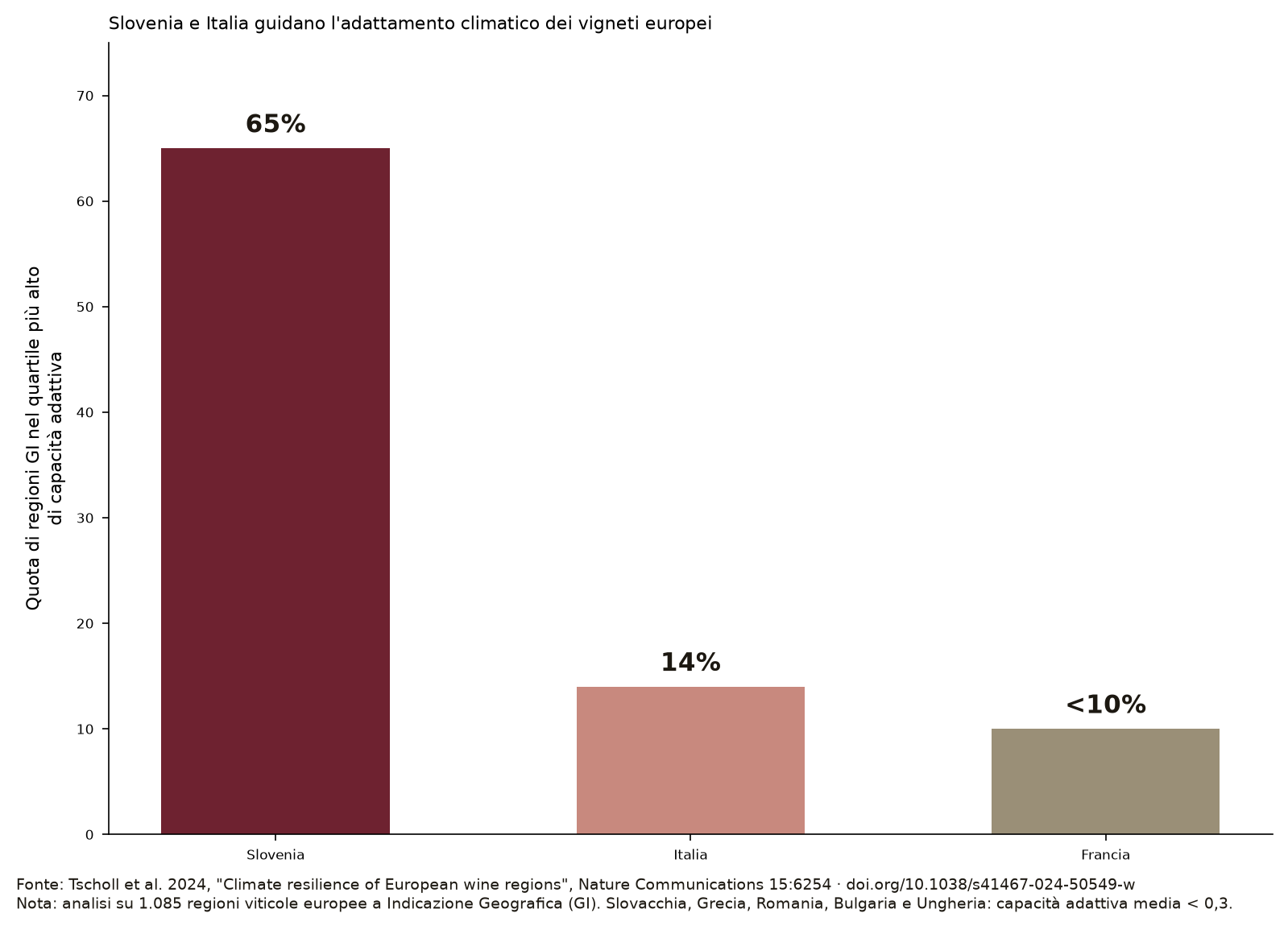
The most useful data point for a buyer weighing a long-term sourcing relationship is adaptive capacity, because it does not track exposure at all. The chart below summarises the study's actual figures:
Source: Tscholl et al. 2024, Nature Communications 15:6254.
Slovenia and Italy have the highest share of regions in the top quartile of adaptive capacity (65% and 14% of regions respectively), followed by France at under 10%. At the other end, regions in central Spain and Eastern Europe — Slovakia, Greece, Romania, Bulgaria, Hungary — show average adaptive capacity levels below 0.3.
One detail the study flags specifically: Spanish regions tend to have high financial capacity but low scores on every other dimension — particularly physical and natural capacity — resulting in low overall adaptive capacity. La Mancha is cited as an example. Wine regions at higher latitudes — parts of France, Germany, Denmark, Belgium, the Netherlands — sit at intermediate adaptive-capacity levels, around 0.5 (examples: Rheinhessen in Germany, Alsace in France).
Where European PDO grapes actually come from
Another figure worth noting for context: among the 1,085 PDO regions analysed, the majority are located in Italy (35%) and France (31%), followed by Spain (8%), Bulgaria (4%), Romania (3%), Hungary (3%) and Portugal (3%). This concentration confirms how much weight the two largest European PDO footprints — Italian and French — carry in shaping the sector's overall adaptation trajectory: a shift in resilience in either of these two areas affects a proportionally larger share of continental PDO production than in countries with smaller shares.
The highest-risk regions: concrete examples
The study classifies the 1,085 regions into six integrated vulnerability groups, combining exposure, sensitivity and adaptive capacity. Five percent of European wine regions fall into the very-high integrated vulnerability group — the one researchers expect to face the most severe negative impacts over coming decades, due to the combination of high exposure, high sensitivity and limited adaptive resources. Cited examples include areas in Bulgaria (e.g., Southern Black Sea), Romania (e.g., Oltina), Hungary (e.g., Hajós-Baja), and, for Italy, the Trebbiano d'Abruzzo and Lambrusco Mantovano zones, alongside one Spanish area (Sierra de Salamanca).
One tier down — high integrated vulnerability but with better response margins than the top group — the study places examples such as southeast France (Côtes de Provence), northern Italy's Conegliano Valdobbiadene Prosecco, eastern Slovakia, Portugal's Alentejo and Spain's Rioja. This is a notable data point: it shows that even commercially significant Italian appellations — not just marginal areas — appear among the high-vulnerability regions, albeit with a different risk profile than the top group.
Some of these regions have already begun acting on the regulatory front: Hungary redefined certain product categories in the Kunság specification, while Spain updated the analytical parameters allowed for Cebreros wines. These are useful precedents showing that targeted amendments to production specifications — not just vineyard-level agronomic interventions — are already part of the adaptation toolkit in use across Europe.
Why the Geographical Indication system is a constraint, not just a guarantee
The study highlights a structural point that's often underappreciated: the PDO/DOC system, which rigidly ties variety and cultivation practice to a specific territory, makes a fast response to climate change difficult. Unlike a producer operating outside a strict specification, a PDO winery cannot simply swap its cultivated variety for one better suited to the changing climate without risking the designation itself. Regions known for varieties like Pinot Noir face a real dilemma if the climate shifts enough to make that variety less viable: fidelity to the specification versus long-term production sustainability.
For a buyer, this means the relevant question isn't just "how much hotter will this region get in 20 years," but how much room a given specification leaves for adaptation — and whether regional or national institutions are already working on flexibility mechanisms (secondary varieties, tolerance thresholds, amendment procedures) before the issue becomes urgent.
Practical implications for sourcing decisions
For a buyer evaluating long-term partnerships or supply commitments tied to a specific production area, three signals from this study deserve attention:
- Climate exposure alone doesn't tell you the risk. A highly exposed region with strong adaptive capacity (part of Italy fits this profile) sits in a very different position than an equally exposed region with weak adaptive capacity (Eastern Europe, per this study).
- Production concentration matters. With over a third of the European PDO regions analysed located in Italy, the adaptation dynamics of the Italian PDO system carry disproportionate weight for the stability of overall European supply — an argument for geographic diversification within a buyer's own supplier portfolio.
- Regulatory rigidity is a risk factor in its own right. It's not only climate that determines a designation's resilience, but also how quickly the local regulatory framework can adapt.
The limits of this study
The authors explicitly note that local data on adaptive capacity in viticulture remains scarce at the European level, and that the analysis assumes equal weighting for the 15 indicators used, absent sufficient data to weight them region-specifically. This is a high-level continental comparison useful for prioritisation, not a substitute for a climate risk assessment specific to an individual producer or vineyard.
Data drawn from Tscholl, S., Candiago, S., Marsoner, T., Fraga, H., Giupponi, C. & Egarter Vigl, L. (2024). Climate resilience of European wine regions. Nature Communications, 15, 6254. Open access, CC BY 4.0.
- Australian Wine Importers: Finding and Understanding Them
- Wine Wholesalers: How to Choose a Reliable Partner for Export
- Brazilian Wine Importers: Finding Them and What They Seek
- Wine Marketplace Guide: Retail, B2B and Direct Sourcing for Italian Wine
- Ecuador Wine Importers: A Guide for Italian Wineries
- Wine Marketplace: How B2B Platforms for Selling Wine Abroad Really Work