Winery equipment for 20,000–100,000 bottles: what to buy now, what to buy later, what to rent (destemmer, press, tanks, pumps, filter, bottling line, cooling)
Wines Export Editorial · Last updated:
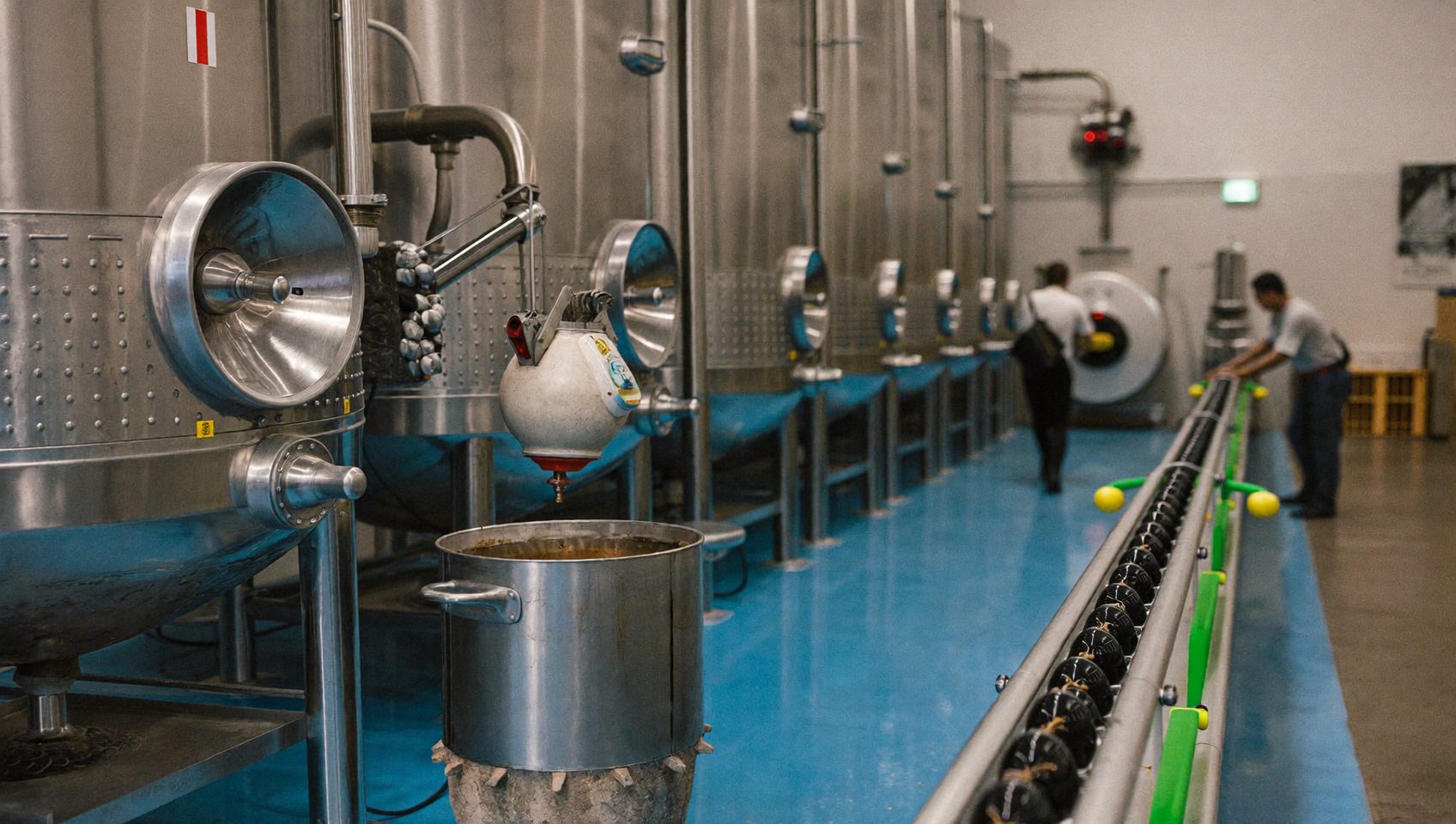
Setting up or renewing a winery in the 20,000 to 100,000 bottle range means separating the machines that work all year from those that sit idle for eleven months. Owners who start or expand a facility of this size often tie up capital in oversized bottling lines or filters, while overlooking staged storage capacity and temperature control. Top priority should go to temperature-controlled tanks, transfer pumps and the cooling unit, while short seasonal operations can be handled through operating leases or mobile contract services. This guide sets out a rational purchase sequence for each department, based on the real workflows of small and medium-sized wineries.
Before you buy: volumes, space and safety
Sizing winery equipment does not start from the total number of bottles produced in a year, but from the daily peak during harvest and the number of separate lots that must be vinified apart. A winery producing 50,000 bottles from just two wines has far simpler storage and handling needs than a facility of the same volume working eight distinct parcels of white, rosé and ageing red wines.
Before requesting quotes for machinery, check three structural parameters of the building:
- Usable height and floor load capacity: these determine whether you can install stackable tanks or vertical fermenters with gravity discharge of pomace, and whether forklifts can move safely.
- Floor slopes and drainage network: every machine that needs washing (presses, filters, piping) requires grated channels placed strategically to prevent water pooling in the processing area.
- Committed electrical power: the simultaneous operation of the cooling unit, pneumatic press, compressor and pumps during the central days of harvest creates the year's maximum energy demand.
The layout of the machines must also comply with occupational health and safety rules monitored by INAIL, with particular attention to forced extraction systems for the carbon dioxide produced during alcoholic fermentation, and to the guarding of moving parts and pressure vessels. For a descriptive overview of how each machine works, see the page on winery equipment and process machinery.
Grape reception: destemmer, sorting table and press
Crushing, destemming and pressing operations are codified in Part II of the OIV (International Organisation of Vine and Wine) International Code of Oenological Practices, which defines the physical and mechanical treatments applicable to fresh grapes and crushed material. The reception area concentrates its work over a few weeks, but it irreversibly affects the phenolic and aromatic profile of the must.
If you work in the 20,000 to 40,000 bottle range, buying a vibrating or belt sorting table is justified only if you harvest in crates and produce wines positioned in the upper price range. Otherwise, manual selection directly in the vineyard frees resources for a gentler destemmer. Cage-type rotating destemmers with a beater whose speed can be continuously varied allow you to adapt the process to stem ripeness and variety. The roller crusher underneath should be removable or adjustable in gap, so that whole-berry processing is also possible.
The closed or semi-closed membrane pneumatic press is one of the department's major investments. If a significant share of your production is white wine or sparkling base wine, you need your own press to manage gentle pressing cycles without depending on external contractors' schedules, especially when grapes arrive at the winery already chilled or need protection under inert atmosphere. If, on the other hand, your production is largely red and you vinify only small lots of white, in the early years you can consider seasonal press rental or modern hydraulic vertical basket presses for draining fermented pomace only.
Tanks and temperature control
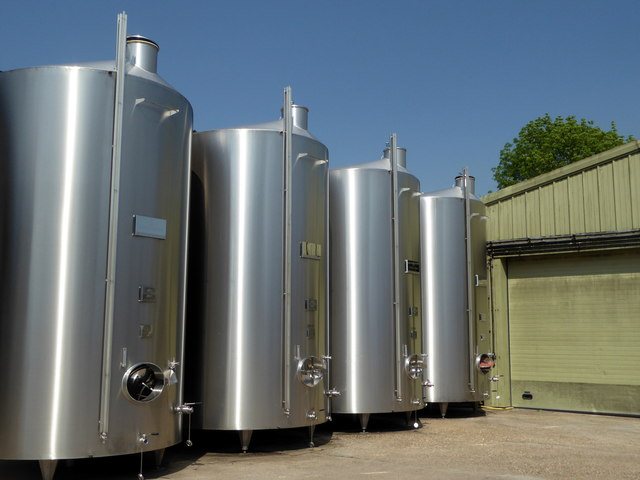
Fermentation and storage vessels make up the fixed infrastructure of the winery and are the first item of expenditure to address structurally. All pre-fermentation cold maceration, controlled alcoholic fermentation and preservation of must or wine require a set of stainless steel tanks (AISI 304 for fermentation and AISI 316 for parts in contact with atmospheres saturated with sulphur dioxide, such as the tank roof).
The key criterion for a winery in the 20,000 to 100,000 bottle range is splitting volumes into smaller units. The total capacity of the wine vessels should exceed the volume of a single harvest, so that racking, blending and the simultaneous management of wines in ageing alongside new wine are possible. Rather than buying a few large tanks, it is wiser to design a modular tank park made up of:
- Red wine fermenters fitted with a temperature-control jacket, a wide rectangular lower manway for easy pomace removal and a programmable automatic pump-over system.
- Pneumatic floating-lid topping tanks (a minority share but essential) to manage topping up, pressing fractions and bottling tails without leaving oxidative headspace.
- Insulated storage tanks for cold tartaric stabilisation and for holding wine ready for packaging.
All tanks used for fermentation must be connected to a hydraulic network fed by the cooling unit and, for red wines or for starting malolactic fermentation in late autumn, also to a hot water generator.
Pumps, filters and cold management
If presses and destemmers work only a few weeks a year, oenological pumps and the cooling system run every day. Economising on the cellar pump means introducing unwanted oxygen, subjecting the wine to mechanical shear stress and slowing down every racking, filtration and loading operation.
The priority equipment should include at least two types of pump:
- A pump for crushed material and dense musts (progressive cavity/eccentric screw, peristaltic or elliptical piston type), placed under the destemmer to transfer destemmed grapes to the fermenters or the press without crushing seeds and skins.
- A trolley-mounted transfer pump with inverter (flexible food-grade rubber impeller, lobe or lower-flow peristaltic) for clean racking, filling barrels, feeding filters and preparing blends for bottling. The electronic flow inverter is essential for adjusting the speed of the flow to the diameter of the piping and to the operation in progress.
As regards separation techniques, Commission Delegated Regulation (EU) 2019/934 governs the oenological practices authorised in the European Union, including filter aids and the use of membranes. You can explore the EU regulatory framework in the guide to authorised oenological practices and legal limits. From the equipment point of view, a small winery should buy a plate-and-pad filter right away for the coarse and polishing filtration of small lots. Automatic tangential filters or continuous flotation systems for must clarification, also described on the page about innovative winemaking technologies, are instead a second-phase investment or a service to be obtained through day rental.
Alongside the handling machinery, do not forget to set up an in-house control bench with a pH meter, optical or digital refractometer, ebulliometer and basic glassware, to monitor fermentation progress and free and total sulphur dioxide without waiting for external laboratory turnaround times for daily checks.
Bottling: own line or contract service
The packaging area (rinser, isobaric or gravity filler, corker, capsuler and labeller) is where the most frequent investment errors occur. A fully automatic monoblock bottling line, equipped with a membrane microfiltration unit for final microbiological stabilisation, requires not only a high initial outlay but above all an operator experienced in mechanical maintenance, format changeovers and sterile sanitisation of the lines.
Before deciding whether to buy or outsource, assess the technical parameters set out on the page about wine filtration and bottling. In the operational practice of Italian wineries:
- For still wines up to 40,000 to 50,000 bottles, if you bottle in two or three concentrated sessions a year, using a mobile contract bottler (a truck fitted with an automatic line, microfiltration unit, nitrogen generator and labeller) ensures dissolved oxygen and sterility standards that are hard to match with small, inexpensive semi-automatic machines.
- If, instead, you split bottling into many small lots made to order for foreign importers, or if your winery cannot be reached by the heavy vehicles of mobile bottlers, purchasing a small filling and corking monoblock with pre-evacuation of air and inert gas injection becomes a priority, combined with a semi-automatic or linear labeller.
- For sparkling and semi-sparkling wines, isobaric bottling requires even more complex equipment: at this production scale, outsourcing through a mobile isobaric line or an authorised bottling centre remains almost always the more economically sustainable choice.
Decision table by volume band
The table below summarises the order of priority between immediate purchase, deferred purchase (second development phase) and rental or contract services for three size bands.
| Machine / System | 20,000 - 35,000 bottles band | 35,000 - 65,000 bottles band | 65,000 - 100,000 bottles band |
|---|---|---|---|
| Temperature-controlled stainless tanks and floating lids | Immediate purchase (owned) | Immediate purchase (owned) | Immediate purchase (owned) |
| Cooling unit and glycol/water network | Immediate purchase (owned) | Immediate purchase (owned) | Immediate purchase (owned) |
| Transfer pump with inverter and piping | Immediate purchase (owned) | Immediate purchase (owned, 2 units) | Immediate purchase (owned, 2-3 units) |
| Destemmer and crushed-material pump | Immediate purchase (or seasonal rental) | Immediate purchase (owned) | Immediate purchase (owned) |
| Membrane pneumatic press | Purchase if white-dominant / Rental | Immediate purchase (owned) | Immediate purchase (owned) |
| Plate / pad filter | Immediate purchase (owned) | Immediate purchase (owned) | Immediate purchase (owned) |
| Tangential filter / flotation unit | Contract service by the day | Contract service or purchase in second phase | Purchase in second phase |
| Complete bottling line | Contract service (mobile line) | Contract service or compact monoblock | Evaluate owned monoblock purchase |
| Labelling and packaging | Own semi-automatic or contract service | Own linear labeller (for split export orders) | Own automatic linear or rotary labeller |
To finance new machinery for winery modernisation, check every year the regional calls linked to the OCM Wine investment measure published by the Ministry of Agriculture, Food Sovereignty and Forestry (MASAF), and the ISI calls promoted by INAIL to improve health and safety in workplaces through the replacement of obsolete machinery.
Frequently asked questions
Is it worth buying second-hand winemaking equipment to start a small winery?
Buying used equipment pays off for stainless steel tanks (after checking the condition of welds, valves and the tightness of the cooling jackets) and for plate filters. It calls for much more caution with pneumatic presses, cooling units and bottling lines, where wear on membranes, control electronics and the availability of gaskets can cause machine stoppages during harvest.
When is it better to hire a mobile contract bottler instead of buying a line?
The mobile bottling service makes sense as long as the contractor's annual cost remains lower than the sum of the depreciation of an owned plant of equivalent quality, routine maintenance costs and the time of staff dedicated to format changes and sanitisation. Below 50,000 bottles, if you can group packaging into a few days a year, the equipped truck offers oxygen control technologies superior to those of small manual or semi-automatic fillers.
Which machine should I buy first to improve the quality of white wines?
After temperature-controlled tanks and the cooling unit, the most decisive investment for white wines is a closed-membrane pneumatic press combined with an inert gas management system. Controlling must temperature from the moment of drainage and protecting it from contact with oxygen preserves the primary aromatic character far more than any corrective intervention later on.
Can I obtain non-repayable grants for winery equipment?
Yes, wine businesses can access European and national funds managed by MASAF and the Regions through the OCM Wine Investment measure and the Rural Development Complements (CSR), which cover part of the purchase of new wine vessels, cooling plants and winemaking machinery. There are also INAIL incentives (ISI Call) for equipment that reduces the risk of accidents, noise or manual handling of loads in the winery.
Sources
- OIV — International Code of Oenological Practices
- EUR-Lex — Commission Delegated Regulation (EU) 2019/934 on authorised oenological practices
- MASAF — Ministry of Agriculture, Food Sovereignty and Forestry (Regulations and OCM Wine decrees)
- INAIL — Italian National Institute for Insurance against Accidents at Work (Prevention, safety and ISI Call)
- CREA — Council for Agricultural Research and Economics
- Wine lab analysis tools: what a winery really needs
- Winemaking Additives Allowed in EU, Not in USA, Japan, China
- Yeast nutrients for wine: nitrogen, thiamine and EU limits
- Wine team building Rome: corporate tastings for groups
- Yeast for Sparkling Wine Base and Second Fermentation
- Wine stabilisers: CMC, gum arabic, mannoproteins