Common Mistakes in a Winery's First Negotiation With a Foreign Importer
Wines Export Editorial · Last updated:
Photo: Bruno Cantuária / Pexels
The first negotiation between an Italian winery and a foreign importer is where most export relationships are won or lost — not because the wine falls short, but because one side or the other misreads the deal in front of them. Nothing below describes a specific negotiation; no winery or buyer is named or identifiable in this article. What follows is a pattern synthesis, checked against guidance from official export bodies (Wine Australia, the U.S. Department of Commerce's trade.gov, the TTB) and against the latest data on the Italian wine sector.
The backdrop: a market with less room for error
2025 was not an easy year for Italian wine exports. According to Area Studi Mediobanca's survey of the wine sector, published in May 2026, the sample of major Italian wine companies closed the year with a revenue decline, driven in large part by falling sales abroad. Not every market slowed at the same pace — the chart below shows the 2025-versus-2024 change by area, with the United States showing the steepest contraction relative to the UK and the rest of the EU.
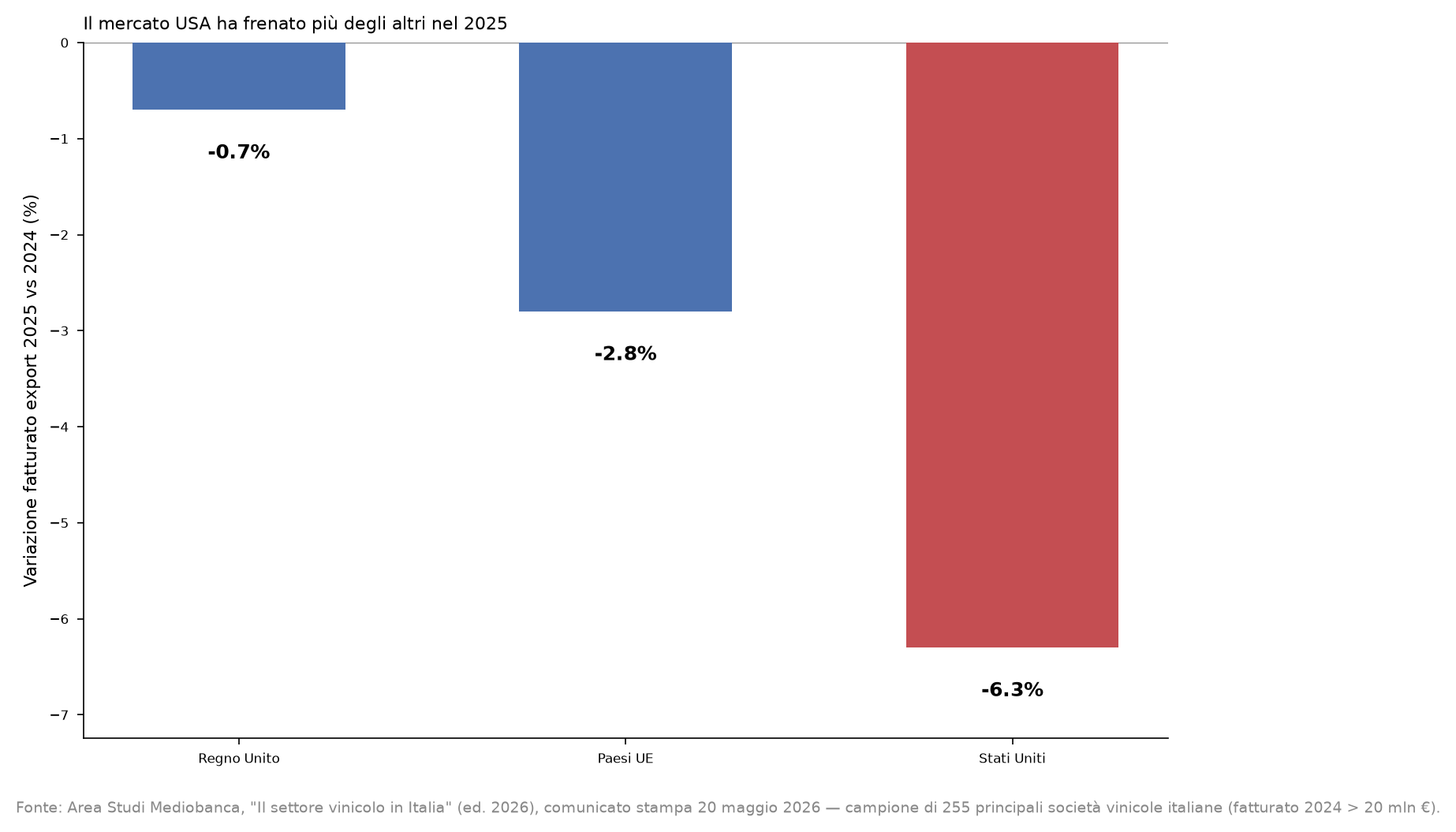
Source: Area Studi Mediobanca, "Il settore vinicolo in Italia" (2026 edition), press release dated 20 May 2026, based on a sample of 255 leading Italian wine companies with 2024 revenue above €20 million.
In a market like this, a buyer in the US, Germany, or the UK negotiates more cautiously and with more alternatives on the table. A poorly handled first contact no longer just costs a missed order — it can burn a winery's credibility with an entire market segment, since importers talk to each other and compare notes on suppliers.
Mistake 1: Showing up with a price, not a market strategy
The most common pattern: a winery arrives with a single price list, built for the domestic market, and offers it unchanged to a foreign importer. The issue isn't the number itself — it's that the number leaves no room for the commercial chain that has to move the wine downstream. As Wine Australia's guide to negotiating terms with export partners points out, most of what gets discussed in a negotiation — volume discounts, incentives, territorial exclusivity — only makes sense if the starting price was built with every link in the chain's margin in mind, not just the winery's own.
The typical outcome: an importer who quietly drops the conversation after the first proposal — not because the wine wasn't appealing, but because that price left no workable margin for the importer and their own downstream customers (distributors, restaurants, retail).
Mistake 2: Granting territorial exclusivity before checking anything
A second recurring pattern is agreeing to exclusive rights for an entire country to the first partner who asks for it, often to close what looks like a promising deal quickly. Wine Australia is explicit about this in its guide to partner evaluation and due diligence: before signing anything, a winery should verify financial references, sales history with other producers, the distributor's actual geographic reach, and portfolio fit — checks that take time and that get skipped precisely when a deal feels like it's going well.
Granting exclusivity to a partner who can't actually cover the market means being locked out of that country for years, stuck with a channel that isn't selling and no freedom to look for a better one.
Mistake 3: Shipping before payment terms and delivery conditions are settled
Trade.gov, the U.S. government's international trade agency, devotes an entire guide to negotiating export sales precisely because this is where deals most often stall: who pays for freight, at what point title to the goods transfers, which payment instrument applies (wire in advance, letter of credit, documentary collection), and on what timeline. A pattern observed often enough to be worth naming: a winery accepts 60- or 90-day payment terms just to close a first order with a new importer, without ever having verified that importer's reliability.
Incoterms® (EXW, FOB, DDP, and the other standard terms) exist specifically to make explicit, before the goods ship, who carries each risk and cost along the route — leaving them vague, or skipping the conversation entirely, is a mistake that shows up the moment something goes wrong with the first shipment.
Mistake 4: Underestimating the destination market's regulatory requirements
Every market has its own labeling and import rules, and finding out about them only after the shipment has left is expensive. The most documented case is the United States: the Alcohol and Tobacco Tax and Trade Bureau (TTB) requires any wine at 7% ABV or above to carry a Certificate of Label Approval (COLA) before it can clear customs for commercial sale, and the importer of record must hold that certificate at the time of import — not after the fact.
A typical pattern: the winery sends samples and a catalog, the U.S. importer expresses interest, but neither side has checked whether the existing label meets TTB requirements (mandatory statements, health warning, format) before moving forward. The result is a delay of weeks at exactly the moment when the relationship should be consolidating around a first, on-time delivery.
Mistake 5: Treating the first "yes" as a closed deal
The last pattern is arguably the most deceptive, because it looks like success: a winery reads an importer's initial interest — a friendly reply, a request for samples, a "let's talk" at the end of a trade fair — as a done deal, and lets follow-up slide. Wine Australia's guide to pitching trade partners notes that distributors are constantly fielding proposals from competing wineries, and the attention won in a first meeting fades quickly unless it's followed by prompt, specific contact with clear next steps.
In practice, the difference between a negotiation that closes and one that quietly dies almost always comes down to follow-up discipline — who replied, when, and what each side actually committed to — not the quality of the wine on offer.
The common thread: qualify before you negotiate
All five mistakes share the same root cause: negotiating before qualifying the counterpart and the context — who this importer actually is, what margin their chain needs, what their market requires by law, and what they're actually willing to commit to. That work has to happen before sitting down at the table, not during.
Having access to buyer profiles already organized by country and channel — with sales history, coverage area, and business type — is what lets a winery walk into a first negotiation already asking the right questions, instead of discovering them after the shipment has left.
Want to see the real buyers for your wine?
Try the free Wines Export demo and see what a qualified buyer profile actually looks like, before you write a single first-contact email.
Sources
- Area Studi Mediobanca — "Il settore vinicolo in Italia" (2026 edition), press release, 20 May 2026
- Wine Australia — Negotiating terms with export partners
- Wine Australia — Partner evaluation and due diligence
- Wine Australia — How to pitch to trade partners
- Trade.gov — Negotiate an Export Sale
- TTB — Certificate of Label Approval (COLA), Alcohol and Tobacco Tax and Trade Bureau
- Wine Bottle Height: Italian Export Regulations
- Italian Wine Export: A Practical Guide to Markets, Buyers, and Logistics
- Exporting Italian Semi-Sweet Wines to the USA: A B2B Guide
- How to Craft a Persuasive Cold Email for Wine Importers
- Grape Drying: A Guide to Wine Export
- Hungarian Wine Importers: How to Find Them and What They Look For