Salice Salentino DOC: Market Opportunities and Characteristics for International Expansion
Wines Export Editorial · Last updated:
Salice Salentino, one of the most representative designations in the Apulian wine landscape, embodies the region's tradition and innovation. A thorough understanding of its production regulations and the expectations of the international market is crucial for wineries aiming to expand their global presence. This article explores the unique characteristics of Salice Salentino, the regulations governing its production, and the trends guiding international buyers' choices, offering a strategic perspective for export. Learn more: Federdoc — Confederazione Nazionale Consorzi Tutela Denominazioni Vini Italiani.
What is the Production Regulation for a Wine Like Salice Salentino?
The production regulation is the normative cornerstone that defines the identity of a Protected Designation of Origin (PDO) or Protected Geographical Indication (PGI). As established by European legislation, specifically Regulation (EU) No 1308/2013 and Regulation (EC) No 479/2008, the production regulation aims to allow interested parties to verify the production conditions of a wine.
It comprises essential elements that guarantee its authenticity and quality, including the designation's name, the permitted product categories (e.g., Rosso, Rosato, Bianco, Riserva, Aleatico), a description of the analytical and organoleptic characteristics, specific winemaking practices, the geographical area's boundaries, maximum yields per hectare, and varietal composition. Compliance is rigorously monitored by public authorities or independent certification bodies, as stipulated by Regulation (EC) No 479/2008.
What are the Main Grape Varieties of Salice Salentino and How Do They Influence the Blend?
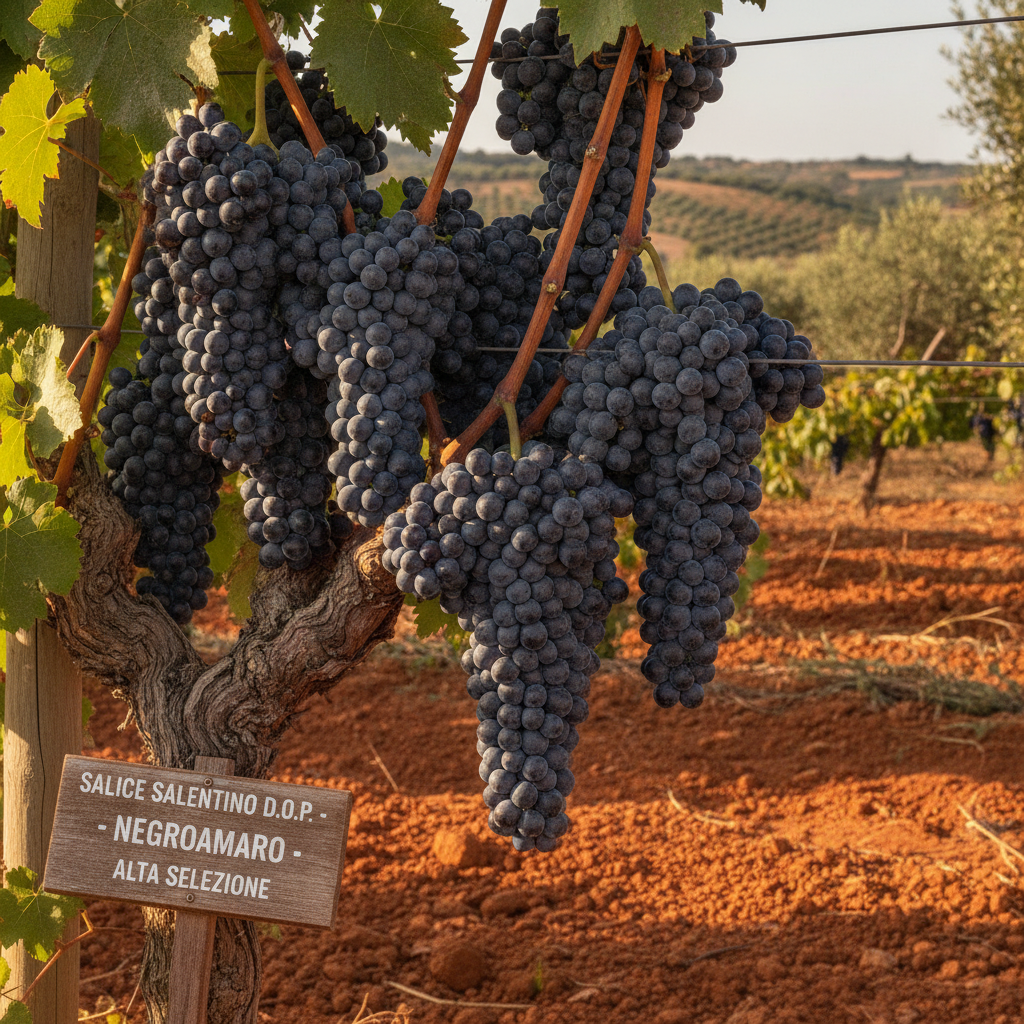
The heart of Salice Salentino lies in its native grape varieties, primarily Negroamaro and Malvasia Nera, with the addition of other varieties for different wine types. Negroamaro constitutes at least 75% of the blend for the Rosso (Red) version, imparting structure and aging potential. Malvasia Nera adds color, alcohol content, and fruity softness, balancing Negroamaro's tannins and making the wine more approachable, especially in its youth.
The Rosato (Rosé) also relies on the combination of Negroamaro and Malvasia Nera, with the possibility of a Negroamaro Rosato if this grape represents at least 90%. White varietals are generally based on Chardonnay, Fiano, and Pinot Bianco, while Salice Salentino Aleatico highlights the aromatic characteristics of its namesake grape.
What are the Different Wine Types Produced Under the Salice Salentino Designation?
The Salice Salentino designation offers a versatile range of wine types. Salice Salentino Rosso is characterized by a beautiful violet-ruby red color, rich in tannins but with high acidity and aging potential, thanks to the predominance of Negroamaro and the presence of Malvasia Nera. Salice Salentino Rosato, also based on Negroamaro and Malvasia Nera, offers freshness and fruitiness.
There are also white types, generally based on Chardonnay, Fiano, and Pinot Bianco. A sweet type is Salice Salentino Aleatico, which enhances the aromatic qualities of the grape. Finally, Salice Salentino Rosso Riserva requires prolonged aging, further refining its complexity and structure.
What Do International Buyers Look for When Purchasing Wines Like Salice Salentino?
International buyers are increasingly seeking wines that offer authenticity, a strong connection to their territory, and good value for money. Salice Salentino meets these demands thanks to its history, its native grapes like Negroamaro and Malvasia Nera, and its ability to tell a distinctive territorial story.
They appreciate the designation's versatility, which ranges from intense and long-lived reds to vibrant rosés and traditional sweet wines, catering to diverse preferences and consumption occasions. The Riserva versions and more structured reds attract market segments interested in higher quality and more age-worthy wines, thanks to their complexity and aging potential.
How Does Wines Export Support Italian Wineries in Exporting Salice Salentino?
Wines Export actively works to support Italian wineries in exporting their wines, including the Salice Salentino designation. Our network comprises selected producers known for their ability to offer wines that adhere to regulations, stand out for their quality, and possess strong export potential.
We support international buyers for Red wines (classic and Riserva), fresh and fruity Rosés, and Sweet wines like Aleatico. Our network is ready to explore new market opportunities, connecting producers with qualified buyers and offering products that combine tradition, quality, and a strong link to the Apulian territory.
Frequently Asked Questions
What are the main grape varieties used for Salice Salentino Rosso?
The main grape varieties used for Salice Salentino Rosso are Negroamaro, which must constitute at least 75% of the blend, and Malvasia Nera.
Is Salice Salentino suitable for aging?
Yes, particularly the Rosso and Rosso Riserva versions, thanks to their structure and complexity derived from native grape varieties and winemaking practices, have good aging potential.
What are the typical organoleptic characteristics of a Salice Salentino Rosato?
A Salice Salentino Rosato is generally fresh, fruity, and versatile, ideal for various culinary pairings.
Salice Salentino represents an excellent opportunity for Italian wineries looking to establish themselves in international markets. The combination of strict regulations, high-quality native grape varieties, and an organoleptic profile appreciated globally creates a solid foundation for export.