Sangue di Giuda dell'Oltrepò Pavese DOC explained: grapes, zone, still, frizzante and spumante, production rules and export
Wines Export Editorial · Last updated:
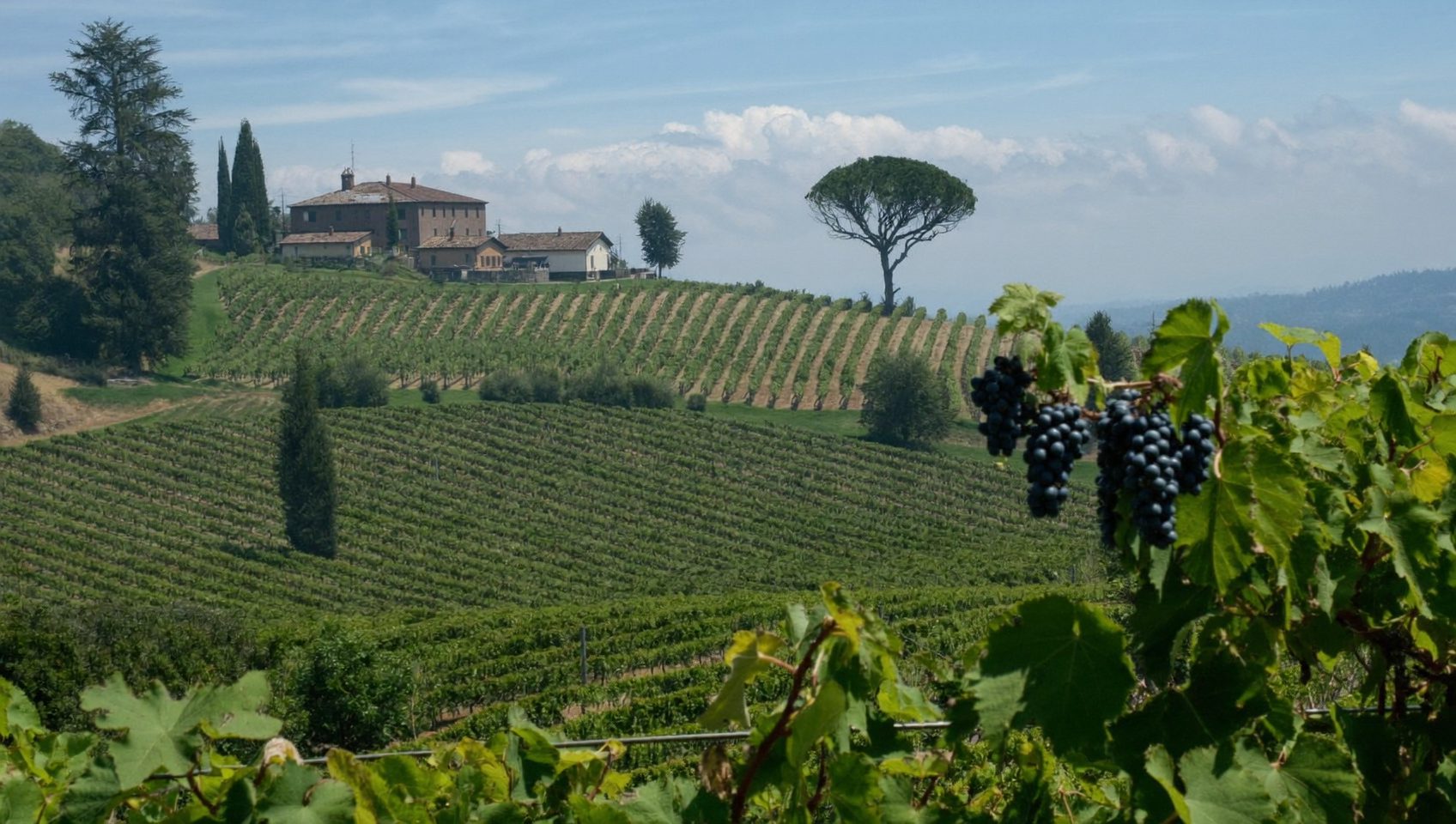
Sangue di Giuda dell'Oltrepò Pavese DOC, which may also appear on the label simply as "Sangue di Giuda", is a sweet red wine made in a small hill area of the Oltrepò Pavese, in the province of Pavia. It is made from Barbera and Croatina, each from 25 to 65 per cent, plus Uva Rara, Ughetta (Vespolina) and Pinot Nero up to 45 per cent, and comes in three versions: still (which may be lightly prickly), frizzante and sweet spumante; the still and frizzante versions must have at least 80 g/l of residual sugar (Sangue di Giuda dell'Oltrepò Pavese production rules, art. 1, 2 and 6). It was created in 1970 as a type within the Oltrepò Pavese DOC (Presidential Decree of 6 August 1970) and became a DOC in its own right with the Ministerial Decree of 3 August 2010 (Gazzetta Ufficiale no. 191 of 17 August 2010); the text in force was last amended by the decree of 7 March 2014 (production rules, heading). In the United Kingdom the name is also protected as an Italian traditional term for wine, registered on 10 March 2021 under the agreement with the European Union (GOV.UK register of protected names).
This page is the complete guide to the denomination. The area's whole system of denominations, with the Metodo Classico DOCG and the other DOCs, is covered in Oltrepò Pavese: denominations, rules and Consorzio; the dry red made largely from the same grapes and the same villages is covered in Buttafuoco dell'Oltrepò Pavese. The grape varieties have their own guides: Croatina, Barbera, Vespolina and Pinot Nero; the province as a whole is covered in exporting wine from Pavia.
What Sangue di Giuda is and where the name comes from
Sangue di Giuda is the sweet red of the Oltrepò Pavese. The production rules themselves call it "a particular dessert version of Oltrepò Pavese Rosso", the traditional blend of local grape varieties (production rules, art. 9).
The official text gives two explanations for the name, which means "Judas' blood". The first is the deep ruby colour with violet highlights. The second is a legend set in Broni: Judas, brought back to life and recognised by the locals, is said to have saved himself by curing the vines of a disease, and the grateful growers named their sweet wine after him (production rules, art. 9). The same article quotes the ampelographer Arturo Marescalchi, who in 1924 placed the Sangue di Giuda made in Broni and Canneto Pavese among "the best red wines of Italy", and notes that the wine was originally made in the hamlet of Colombarone in Canneto Pavese and was often "ammandorlato", bitterish and sweet at the same time. The village's wines are covered in wine from Canneto Pavese.
Annual inspections are carried out by the control body Valoritalia (production rules, art. 10). The denomination's collective mark is managed by the Consorzio Tutela Vini Oltrepò Pavese, which must also supply it to non-members on the same terms (production rules, art. 7.4); on its website the Consorzio presents Sangue di Giuda as a "sweet and aromatic wine, produced in a limited area", still, frizzante or spumante.
Where it is made: the Sangue di Giuda zone
The zone is a small part of the eastern Oltrepò, in the first band of hills between 150 and 350 metres above sea level. Article 3 does not list villages but draws a boundary: from state road 10 towards Bosnasco, Costamontefedele and Santa Maria della Versa, then along the Scuropasso stream, taking in the whole of Pietra de' Giorgi and the part of Cigognola south of state road 10 (production rules, art. 3).
In its description of the climate the text names as Sangue di Giuda villages Cigognola, Broni, Pietra de' Giorgi, Canneto Pavese, Montescano, Castana, Santa Maria della Versa, Stradella, Montù Beccaria, Zenevredo and, in part, Bosnasco and San Damiano al Colle (production rules, art. 9).
| Element | What the production rules say | Source |
|---|---|---|
| Soils | calcareous or calcareous-clay, on sunny hill slopes; valley floors and plains excluded | art. 4.1 |
| Geology | pale yellow Messinian marls with limestone lenses, in Montù Beccaria, Rovescala, Montescano, Castana, Canneto Pavese, Pietra de' Giorgi and Cigognola | art. 9 |
| Altitude and slopes | 150 to 350 m; slopes reaching close to 35% | art. 9 |
| Rainfall | 800 to 900 mm a year, rising with altitude and falling from east to west; highest in November, lowest in July | art. 9 |
| Temperatures | about 12 °C annual mean between the foot of the hills and 400 m; January about 1 °C; July-August 22-24 °C | art. 9 |
| Solar radiation | 2,250 to 3,000 MJ/m² a year | art. 9 |
The wine can also be made outside the grape-growing zone: vinification is allowed throughout the province of Pavia and in the hamlets of Vicobarone and Casa Bella in Ziano Piacentino, in the province of Piacenza (production rules, art. 5.1).
Which grapes, in what proportions
The proportions are calculated on the estate's vineyards, not on the individual bottle (production rules, art. 2).
| Variety | Share allowed | Source |
|---|---|---|
| Barbera | 25 to 65% | art. 2 |
| Croatina | 25 to 65% | art. 2 |
| Uva Rara, Ughetta (Vespolina) and Pinot Nero | together or alone, up to 45% | art. 2 |
New vineyards must have at least 4,000 vines per hectare, 3,200 for Croatina plots; the training system is the vertical trellis (controspalliera), expanded training systems are excluded and only emergency irrigation is allowed (production rules, art. 4.2-4.4). Vespolina appears under its local name Ughetta: it is the same variety, as explained in the Vespolina guide.
The three styles: still, frizzante and sweet spumante
All three are sweet; what changes is the sparkle, the alcohol already fermented and the closure.
| Sangue di Giuda (still) | Sangue di Giuda frizzante | Sangue di Giuda sweet spumante | |
|---|---|---|---|
| Minimum residual sugar | 80 g/l | 80 g/l | no figure given; the type is "dolce" (sweet) |
| Alcohol | total at least 12.00%, of which at least 5.50% actual | total at least 12.00%, of which at least 7.00% actual | actual 9.00% |
| Sparkle | may contain carbon dioxide from fermentation, with overpressure no higher than 1.7 bar at 20 °C | lively, fleeting mousse | lively, persistent mousse |
| Minimum total acidity | 4.50 g/l | 4.50 g/l | 4.50 g/l |
| Minimum sugar-free extract | 22.00 g/l | 22.00 g/l | 22.00 g/l |
| Closure | those allowed by law | the cork mushroom stopper with wire cage is also allowed, capsule no taller than 7 cm | cork mushroom stopper with wire cage compulsory, except for sizes up to 200 ml |
Sources: production rules, art. 6 and 8.
For all versions the rules describe a deep ruby colour, an intense vinous nose and a full, bodied, sweet palate; for the still wine they add "sometimes lively and slightly tannic" (art. 6). Article 9 describes the wine with violet highlights, a fragrance of fresh fruit and spicy and floral notes.
Production requirements
| Rule | Value | Source |
|---|---|---|
| Maximum grape yield | 10.5 t/ha, the same for all three styles | art. 4.5 |
| Minimum natural alcohol of the grapes | 11.50% | art. 4.5 |
| Exceptional vintages | the yield may be exceeded by up to 20% if production is brought back within the limit; beyond 20% the whole lot loses the DOC | art. 4.5 |
| Maximum grape-to-wine yield | 70%; any excess up to 5% is not entitled to the DOC, beyond that the whole lot loses it | art. 5.2 |
| Cellar practices | only local, fair and constant ones; wines vinified separately must be blended before certification or sale | art. 5.3 |
| Ageing or minimum release date | none: the rules do not set them | art. 5 and 6 |
The Lombardy Region, after consulting the Consorzio, may lower the maximum yield per hectare each year (production rules, art. 4.5).
The label and the bottle
- Vintage: compulsory for all three styles, frizzante and spumante included (art. 7.2).
- Banned terms: any term not provided for in the rules, including superiore, extra, fine, scelto, selezionato, vecchio and riserva. Names, company names and private brands are allowed if they have no laudatory meaning and do not mislead the consumer (art. 7.1).
- How the name is written: the denomination must be shown in full and consecutively, possibly over several lines, with "denominazione di origine controllata" immediately below; optional terms may not be printed in larger or more prominent type than the name of the denomination (art. 7.3).
- Collective mark: compulsory, inseparably combined with the denomination (art. 7.4).
- Containers: glass bottles of up to 5 litres only (art. 8).
Sangue di Giuda, Buttafuoco, Oltrepò Pavese Rosso and Bonarda compared
Four Oltrepò reds use largely the same grape varieties but give very different wines. For a buyer the main difference is sugar.
| Sangue di Giuda | Buttafuoco | Oltrepò Pavese Rosso | Bonarda dell'Oltrepò Pavese | |
|---|---|---|---|---|
| Grapes | Barbera 25-65%, Croatina 25-65%, Uva Rara, Ughetta and Pinot Nero up to 45% | Barbera 25-65%, Croatina 25-65%, Uva Rara and Ughetta up to 45% | Barbera 25-65%, Croatina 25-65%, Uva Rara, Ughetta and Pinot Nero up to 45%, other red grapes up to 15% | Croatina 85-100%, Barbera, Ughetta and Uva Rara up to 15% |
| Zone | small area between the Scuropasso, Santa Maria della Versa and Bosnasco | seven villages, south of the Via Emilia | Oltrepò Pavese DOC zone | Oltrepò Pavese DOC zone |
| Palate | sweet, at least 80 g/l of sugar (still and frizzante) | dry, full-bodied | full, slightly tannic, bodied | dry, off-dry or medium-sweet (secco, abboccato or amabile) |
| Minimum alcohol at release | 12.00%, of which 5.50% actual (still) | 12.00% | 11.50% | 12.00%; frizzante 11.00% |
| Release | no minimum | not before 30 April after the harvest | no minimum | no minimum |
| Versions | still, frizzante, spumante | still, frizzante | also riserva | still, frizzante |
Sources: Sangue di Giuda, Buttafuoco, Oltrepò Pavese and Bonarda dell'Oltrepò Pavese production rules, art. 2, 3, 5 and 6.
Two differences worth knowing when talking to a supplier. Bonarda amabile can taste sweet, but it is a different denomination, almost entirely Croatina; why the name "Bonarda" covers different wines is explained in Bonarda: three wines with the same name. And unlike sweet reds from dried grapes such as Recioto della Valpolicella, whose rules regulate the drying of the grapes, the Sangue di Giuda rules make no provision for drying (Recioto della Valpolicella production rules, art. 5; Sangue di Giuda production rules, art. 4 and 5); Recioto has its own guide in Recioto della Valpolicella.
Selling Sangue di Giuda abroad: what to know
This is a small denomination. Italian Wine Central, in a profile consulted in November 2026, gives 505 hectares of vineyard in 2021 and an average output of 20,590 hectolitres over the last five years, without naming the source of the data. We found no official figures from the Consorzio or Valoritalia on certified bottles or on the destination countries of Sangue di Giuda; figures on wine exports from the province of Pavia as a whole are in the Oltrepò Pavese guide.
Before listing a Sangue di Giuda:
- Ask which of the three styles it is. The still wine may have up to 1.7 bar of overpressure, the frizzante has a lively mousse, the spumante is a sparkling wine in every sense, with mushroom cork and wire cage. The style changes the customs classification and, in many countries, the duty: check it with the importer before quoting.
- Look at the frizzante's closure. The rules also allow the mushroom cork with wire cage for the frizzante (art. 8); in several tax systems this closure counts as much as pressure in deciding whether a wine is treated as sparkling.
- Ask for the analysis sheet. Residual sugar, actual alcohol and total alcohol: for still and frizzante the rules require at least 80 g/l of sugar, for the sweet spumante they give no figure.
- Check the vintage. It is compulsory on the label for all styles, and it also tells you how young the wine on offer is.
- Prepare an explanation of the name. "Sangue di Giuda" translates literally as "Judas' blood"; the story of the colour and of the Broni legend is written in the production rules and can be used as it is in material for the importer.
- Be wary of "Riserva" or "Superiore". These terms are banned for this DOC (art. 7.1).
Frequently asked questions
Is Sangue di Giuda always sweet?
Yes. The still and frizzante versions must have at least 80 g/l of residual sugar, and the third style provided for is the sweet spumante (Sangue di Giuda dell'Oltrepò Pavese production rules, art. 6). There is no dry version of the denomination.
Which grapes is Sangue di Giuda made from?
Barbera from 25 to 65 per cent, Croatina from 25 to 65 per cent and, together or alone, Uva Rara, Ughetta (Vespolina) and Pinot Nero up to 45 per cent, calculated on the estate's vineyards (production rules, art. 2).
What is the difference between Sangue di Giuda and Buttafuoco?
The grapes are almost the same, but Buttafuoco does not allow Pinot Nero, comes only from seven villages south of the Via Emilia, is dry and cannot be released before 30 April after the harvest; Sangue di Giuda is sweet and has no minimum time before sale (Buttafuoco and Sangue di Giuda production rules, art. 2, 3, 5 and 6).
Is there a Sangue di Giuda Riserva or Superiore?
No. The rules ban riserva, superiore, extra, fine, scelto, selezionato, vecchio and any other term they do not provide for (art. 7.1).
Is Sangue di Giuda sparkling?
It can be. The rules provide for three styles: still, which may have a light natural sparkle of up to 1.7 bar, frizzante and sweet spumante (art. 1 and 6).
Since when has Sangue di Giuda been a DOC in its own right?
Since the Ministerial Decree of 3 August 2010. From 1970 it had been a type within the Oltrepò Pavese DOC; the current text was last amended by the decree of 7 March 2014 (production rules, heading and art. 9).
Sources
- Sangue di Giuda dell'Oltrepò Pavese DOC production rules, text with amendments up to the Ministerial Decree of 7 March 2014, published by the Consorzio Tutela Vini Oltrepò Pavese and copy hosted by AIS
- Italian Ministry of Agriculture, list of production rules for PDO and PGI wines: Sangue di Giuda dell'Oltrepò Pavese, Buttafuoco dell'Oltrepò Pavese, Oltrepò Pavese, Bonarda dell'Oltrepò Pavese and Recioto della Valpolicella
- Consorzio Tutela Vini Oltrepò Pavese, the wines and the denominations
- GOV.UK, protected food and drink names: Sangue di Giuda, traditional term for wine
- Italian Wine Central, Sangue di Giuda dell'Oltrepò Pavese DOC profile
Who produces Oltrepò Pavese?
The towns where the wineries declaring Oltrepò Pavese are concentrated, with a few names for each.
Montù Beccaria (Lombardia)
Piccolo Bacco dei Quaroni · Vigna Alta · Il Poggiolo · Azienda Agricola Belcredi Luigi · Tenute Tonalini 1865
Casteggio (Lombardia)
Sartieri · Tenuta le Fracce · Tenuta Frecciarossa · Terre d'Oltrepò · Az. agr. Davide Rovatti
Montalto Pavese (Lombardia)
I Doria di Montalto Vini e Spumanti Bio ...Dal 1800 · Azienda Agricola Pavese Luigi · Lefiole · Azienda agricola Ca' del Santo · Cantina Finigeto
Canneto Pavese (Lombardia)
Bruno Verdi · Giorgi · Tenuta Malpaga · Azienda Agricola Maggi Francesco · Azienda Agricola Piovani Massimo-Piccola Cantina in Monteveneroso
Borgo Priolo (Lombardia)
Torrazzetta Vini · Azienda vitivinicola a Borgo Priolo (PV) · Viticoltore Cesare Forlino · Brunelli - Riva del Borgo · Bruggia
Santa Maria della Versa (Lombardia)
Azienda agricola Manuelina · Azienda Vinicola Ruinello · Bosco Longhino · Alberto Fiori - Valdamonte Vini · Azienda Agricola Villa Antica
Zenevredo (Lombardia)
Azienda Agricola Cordini Enrico · Azienda Verdi F.lli · Tenuta Il Bosco · Ernesto Rovati
Broni (Lombardia)
Corte Fabbri · Cantine Francesco Montagna · Bertè & Cordini · Ca' Montebello
Where is Oltrepò Pavese sold around the world?
Retailers and online shops with at least one Oltrepò Pavese on their list, in the countries where we find the most, in order. A snapshot of the price lists read from the database on 23 November 2026: it changes every week.
Italy
ENOTECA MAGGIOLINI · Tannico · winekissyou.com · enotecagambi.com · saywine.it · vinodalproduttore.it
The United States
Biondivino · Bottle of Italy · distilroute · finespiritmarket · Letstalkvinowineshop · Flatiron Wines & Spirits
The Netherlands
Tannico · Wijnwinkel De Wijntoren · bevino.nl · grandivini.nl · Bottle Hero · brandwijn.nl
The United Kingdom
Tannico · True Terroir Ltd. · INFINITY WINES LIMITED · COLONIAL SPIRITS LTD · Svinando · giordanowines.co.uk
Germany
Bottle Hero · Jarminobeef · WirWinzer GmbH · Casale Wein Shop · San Giorgio Weinimport · winetory
Belgium
Tannico · Stappiamo · Vinovita · Baeten Vinopolis · VenaVino · Vini Fratelli Ranft
Switzerland
Tannico · DELEA Angelo SA · SALVI`S Vinoteca Basel · Cave chez Nathalie Sàrl · Tivinum Enoteca Minusio - Canetti SA Vini e Shop Online · Weinvogel SA
France
Tannico · Mervinonline · circavinum · Giordano Vins · Azienda Agricola Sabaghina · Beau Co. Wine LLC
Names read from the Wines Export database (company registers, websites, customs data, retailers' price lists). No contacts on this page.
- Vin Santo: What It Is, DOC Rules, Drying and Caratelli
- Salice Salentino Riserva: Rules, Aging & Buyer Guide
- Sardinian Wines: Appellations and Export for Buyers
- Salice Salentino DOC: Negroamaro, Zone, Riserva, Superiore
- Sciacchetrà Wine and Cinque Terre DOC: Grapes, Rules
- Rosso Veronese IGT: Grapes, Yields, Labelling and Export