How to Sell Your Italian Wine in Poland: Requirements and Procedures
Wines Export Editorial · Last updated:
The Polish market offers a significant growth opportunity for Italian wineries aiming for international expansion. With a growing interest in quality food and wine products, Poland represents fertile ground for wine exports. However, it is crucial to be prepared for the country's specific regulatory, fiscal, and logistical requirements. This guide provides a clear and operational framework for approaching wine exports to Poland, covering crucial aspects from regulations to distribution dynamics, with a pool of diverse foreign buyers already active in the Polish market. In-depth: ICE Agency — Wines and Alcoholic Beverages.
What are the fiscal and bureaucratic requirements for exporting wine to Poland?
Exporting wine to Poland requires the affixing of "banderoles" (excise stamps or fiscal marks) on each bottle intended for sale. The Polish importer purchases these stamps from the Ministry of Finance and provides them to the foreign producer for application before shipment, or they are affixed in an authorized fiscal warehouse in Poland.
How does the affixing of fiscal stamps work?
The Polish importer is responsible for purchasing the fiscal stamps from the Ministry of Finance. Subsequently, they are sent to the Italian winery for application on the back of each bottle before shipment, or the stamps are affixed in an authorized fiscal warehouse in Poland managed by the importer. Failure to comply with this regulation can result in the seizure of goods and penalties.
What is the tax structure for wines in Poland?
The excise duty on wines in Poland is 191 PLN (approximately 41 euros) per hectoliter. In addition to this, VAT is applied to all types of wine at a rate of 23%.
What is "Zabezpieczenie Akcyzowe"?
"Zabezpieczenie Akcyzowe" is a fiscal guarantee (escrow) that the Polish importer must establish with the competent Customs-Fiscal Office. This guarantee covers the potential excise duty on goods in transit. For small importers, a "zabezpieczenie ryczałtowe" (lump-sum guarantee) is available, amounting to 30% of the excise duty due.
What operational checks should be performed before exporting?
Before finalizing an order, it is essential to verify that the Polish buyer has an active excise number and is duly registered in the EMCS/SEED PL system, requesting their registration certificate. It is crucial to define in writing who purchases and sends the stamps and their delivery times. Furthermore, plan for the issuance of the e-AD (or e-SAD) document in advance and confirm the importer's receiving capacity and availability of the fiscal guarantee. It is common practice to set sales prices in EUR, leaving the EUR/PLN exchange rate risk with the importer.
What are the logistical options and transport times for Italian wine to Poland?
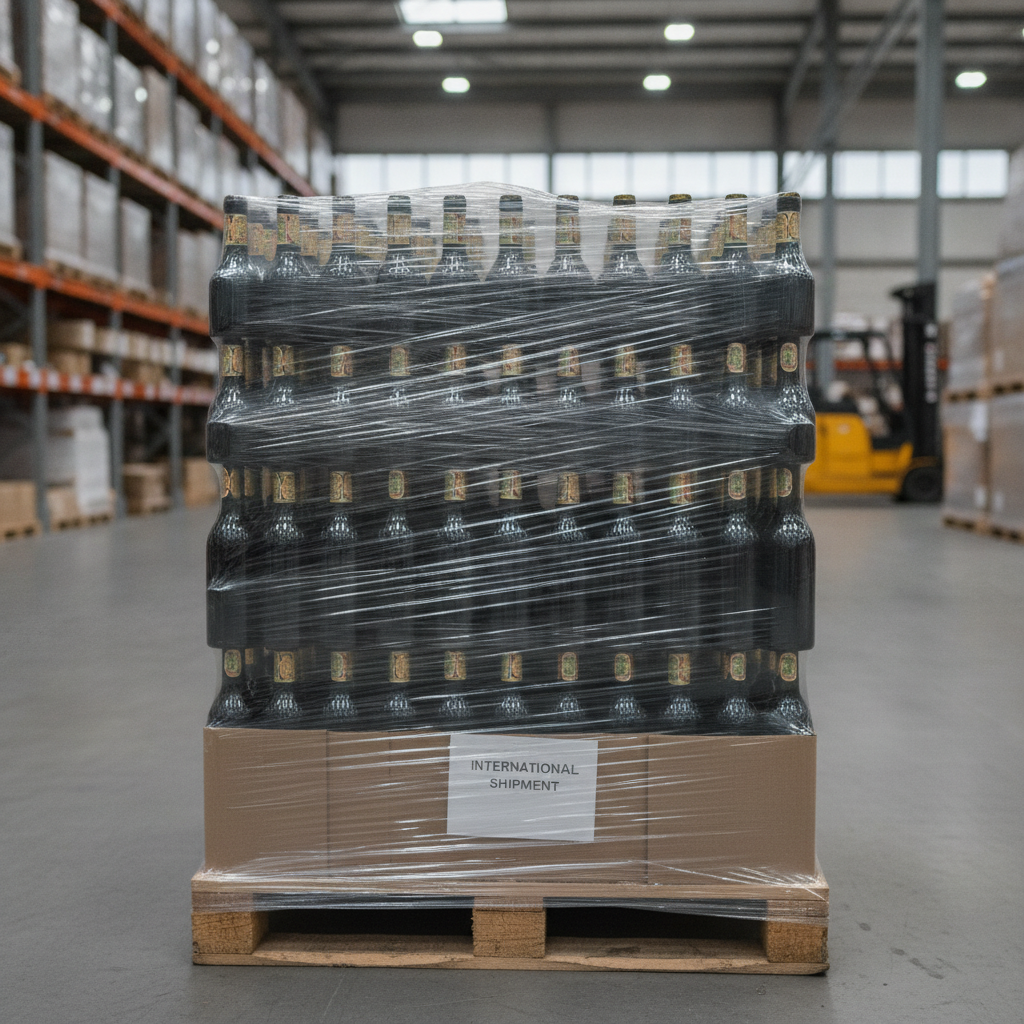
Almost all Italian wine destined for Poland travels by road, primarily via full truck loads (FTL) or groupage (LTL). Sea or multimodal transport is reserved for very large volumes.
What are the transit times for groupage and FTL shipments?
Logistics operators specializing in the Italy-Poland route declare guaranteed delivery times of up to 48 hours for international groupage to Polish warehouses. Considering collection and consolidation times in Italy, a realistic lead time from the winery to the Polish importer ranges from 4 to 7 working days for groupage shipments, and from 2 to 4 days for direct FTL.
What are the customs and administrative constraints for EU shipments?
As both countries are members of the European Union, no physical customs clearance or border controls are required. The primary constraint is administrative-fiscal: before the transport departs, an e-AD (or e-SAD) document must be active in the EMCS system with a valid ARC code. The Polish recipient must be authorized to receive it (registered SEED PL/EMCS PL2). The driver must be able to present the printed copy of the e-AD or the commercial document with the ARC code.
How to manage consolidation for small wine lots?
For mixed lots from multiple wineries, managing fiscal stamps can become complex. In such cases, it is often necessary to use a logistics partner that offers wine-specific consolidation services, allowing for the affixing of fiscal stamps at a single logistics hub before shipment.
Where are the main destination logistics hubs in Poland?
The main destination logistics hubs in Poland are the Warsaw area and Upper Silesia/Southern Poland (Katowice/Krakow). From these centers, a network of regional warehouses handles redistribution throughout the country, with delivery times ranging between 48 and 72 hours.
What are the main distribution channels for wine in Poland?
The Polish wine market is entirely private, fragmented, and highly competitive, with an estimated 800-1,000 active importers. The primary sales channels are Ho.Re.Ca., specialized wine shops, and large-scale retail (GDO).
What is the importance of the Ho.Re.Ca. channel in Poland?
The Ho.Re.Ca. (Hotel, Restaurant, Catering) channel represents 70% of a typical importer-distributor's turnover in Poland. Both large, structured groups and smaller distributors operate here. Access to this channel is almost always through a local importer-distributor with a warehouse, wholesale license, and a network of agents.
What is the role of specialized wine shops?
Specialized wine shops (Sklepy Specjalistyczne) represent a medium-to-high-end off-trade channel, ideal for positioning premium wines and building brand image, preparing the ground for negotiations with GDO.
How to access the GDO and discount channels?
Access to the GDO and discount channels, though higher in volume, requires substantial volumes and strong negotiation capabilities, with generally lower margins compared to other channels.
What are the labeling rules and information required for consumers in Poland?
Wine labeling in Poland follows the European regulatory framework but with specific linguistic and practical requirements. Mandatory information must be provided in Polish.
What information must be present on the label in Poland?
Mandatory information for consumers must be provided in Polish. While the original label can remain in Italian or another EU language, it is common and accepted practice for the importer to affix a back label or sticker in Polish with the required information.
How are allergens and new EU labeling rules handled?
The indication of the presence of allergenic substances, such as sulfites ("zawiera siarczyny" / "contains sulfites"), must be mandatory in Polish and physically present on the product. Since December 2023, wines must also display the energy value on the label and, optionally, the list of ingredients. This information must be in Polish or provided via an electronic link (QR code) leading to a webpage with full details.
What commercial and cultural logic should be considered for the Polish market?
Understanding commercial dynamics and cultural nuances is crucial for building strong relationships with Polish partners, who value solidity and clarity in negotiations.
How to build trust with Polish partners?
Polish partners tend to value solidity and clarity in negotiations. It is advisable to present concrete data rather than relying solely on emotional narratives. An initial in-person meeting, at a trade fair or through reciprocal visits, is often crucial for accelerating trust-building.
What are the preferences in payment management and order frequency?
Many Polish importers prefer frequent restocking with medium-to-small size orders. For credit calculation and payment terms, it is useful to think in terms of overall revolving exposure over time rather than negotiating separate terms for each individual shipment.
How is "gift-giving" perceived in the Polish business context?
Offering a bottle of your own production as a courtesy gift at the first meeting or upon closing a deal is generally well-received and consistent with local "gift-giving" practices, valuing the sincerity of the relationship.
Frequently Asked Questions
What are the specific labeling requirements for wines in Poland?
Mandatory information on the label must be in Polish. The presence of allergens, such as sulfites, must be indicated mandatorily in Polish on the product. Since December 2023, energy value and, optionally, the ingredient list are also required, provided in Polish or via a QR code.
Is the use of fiscal stamps mandatory for exporting wine to Poland?
Yes, the affixing of fiscal stamps (excise stamps or fiscal marks) is a mandatory requirement for every bottle of wine intended for sale in Poland.
What are the main distribution channels for wine in Poland?
The main distribution channels are the Ho.Re.Ca. sector (Hotel, Restaurants, Catering), which accounts for the majority of turnover, specialized wine shops for premium wines, and large-scale retail (GDO) and discount stores for larger volumes.
Wines Export is the ideal partner for Italian wineries wishing to successfully navigate the Polish market. Our B2B service is designed to simplify the export process, providing strategic and operational support. With a pool of diverse qualified buyers in Poland, we can facilitate targeted connections and accelerate market entry.
Are you an Italian winery ready to explore the potential of the Polish market?
Request a personalized demo and discover how we can support your export strategy.
- Exporting Wine to the Czech Republic: A Guide for Italian Wineries
- Exporting Wine to New Zealand: A Guide for Wineries
- Exporting Wine to Sweden: A Guide for Italian Wineries
- Exporting Wine to Norway: A Guide for Wineries
- Exporting Wine to Ukraine: A Guide for Wineries
- Exporting Wine to Ireland: A Guide for Wineries