Wine fermentation temperature for white, rosé and red wines: control and risks
Wines Export Editorial · Last updated:
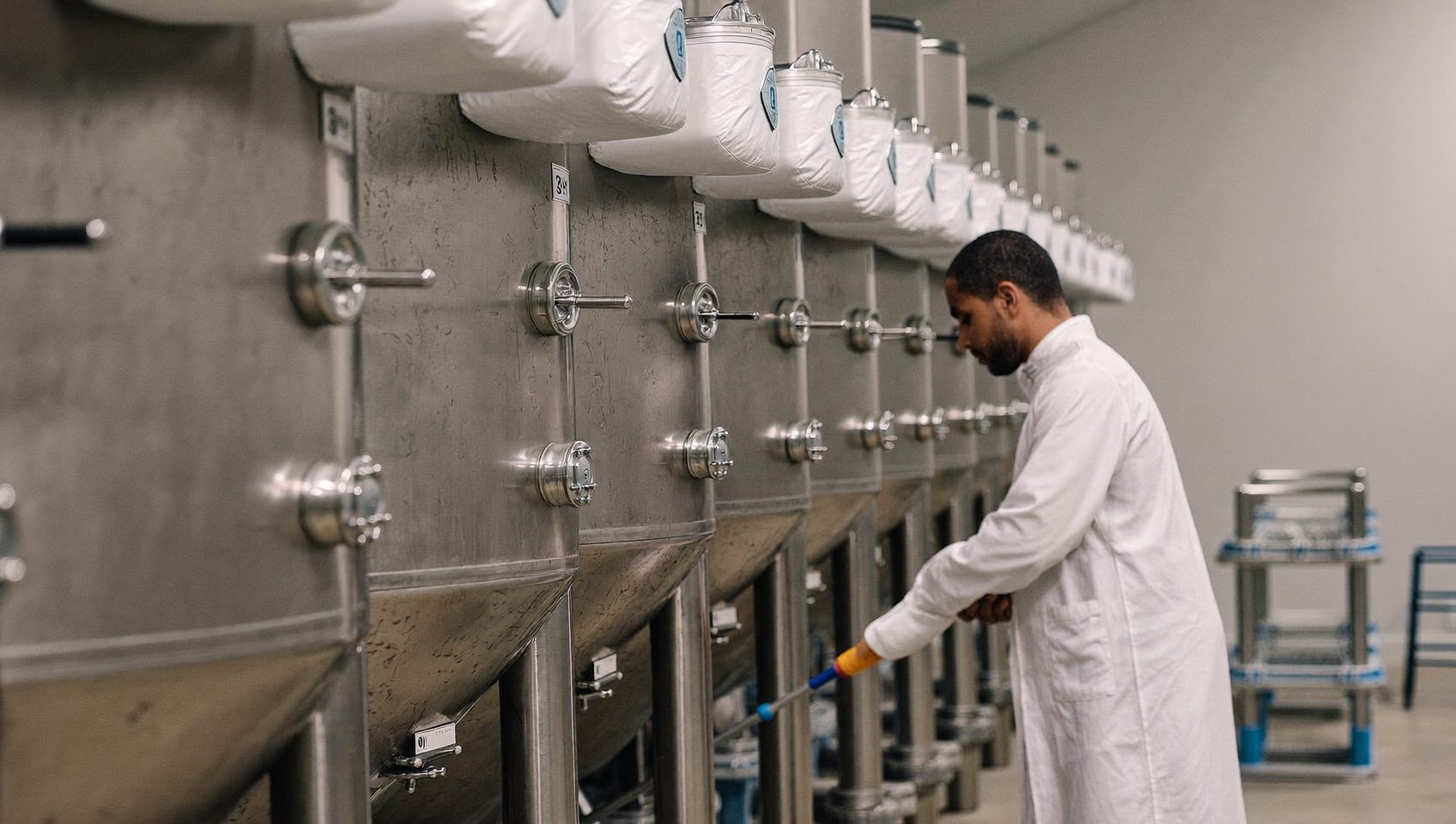
Fermentation temperature determines how many aromas remain in the wine, how quickly sugar turns into alcohol, and how likely it is that the tank stalls halfway through. White and rosé wines are generally fermented at cooler values, while red wines tolerate more heat because it helps extract colour and tannins from the skins. Temperature control rests on three things: knowing the real temperature of the must, removing heat with jackets, half-coils or plate exchangers, and recording the values on a tank log. When heat exceeds what the yeast can tolerate, fermentation slows down and may stop, as explained in the guide on causes of stuck fermentation and how to restart it.
Why temperature determines aromas, alcohol and the risk of stalling
Yeast works most effectively within a temperature range. Above that range its activity accelerates, but the yeast becomes stressed, produces more by-products and loses vitality before it has consumed all the sugar. Below that range fermentation becomes slower and may not start evenly. In both cases the result is a wine different from the one you had in mind.
Volatile aromas are the most sensitive part. Esters and fruity and floral compounds are partly carried away by the carbon dioxide released during vigorous fermentation, and the amount carried away increases with heat. For this reason, cool and slow fermentations better preserve the varietal profile, while warm ones tend to produce a flatter wine on the nose, from the same grapes.
The link with alcohol is less intuitive. The amount of sugar converted into alcohol depends on the yeast strain, the nutrients available and whether fermentation reaches completion. A temperature that is too high increases the risk that the yeast dies before finishing the job, leaving residual sugar. A temperature that is too low also extends the timeline until the culture's vitality is exhausted.
The OIV International Code of Oenological Practices lists the practices permitted in winemaking, and among those for alcoholic fermentation it also includes interruption by physical means. Temperature management therefore falls within the technical levers a winery can use in a documented way. The AWRI, the Australian Wine Research Institute, provides winemaking calculators and a fermentation simulator, useful for estimating timelines before you decide.
White and rosé: fermenting cool without stalling
For white wines the practical rule is to keep the must at a low and stable level throughout fermentation, without fluctuations. An aromatic white wine fermented with temperature swings loses the finest part of its profile, even if fermentation reaches dryness. Strain selection matters as much as temperature, because some yeasts tolerate cold better than others and retain a fruity profile. The notes on yeasts for aromatic white grapes help narrow the choice.
The typical risk with cold white fermentations is a slow start. If the must is cold and low in nutrients, the yeast takes days to become active, and in the meantime undesirable microorganisms can develop. Cold management should therefore be assessed together with nutrition.
Rosé wines largely follow the logic of whites, since skin contact is brief or absent. Here temperature mainly serves to preserve fruit and keep fermentation regular.
Reds: extraction, peaks and the risk at high temperatures
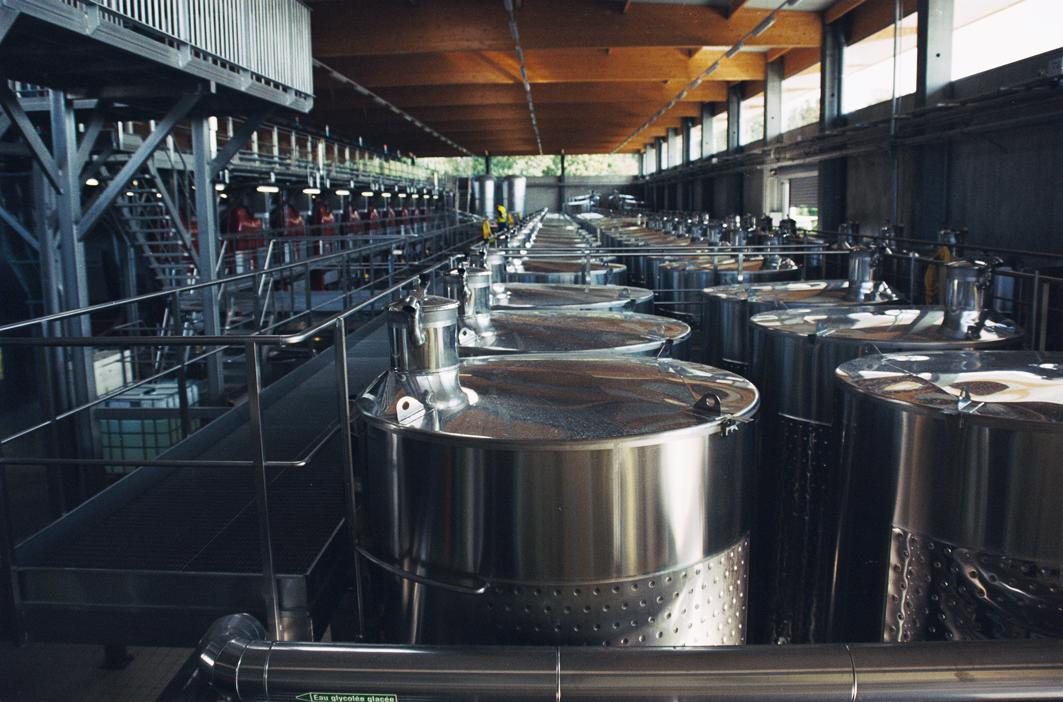
In red wine fermentation takes place in contact with the skins, which rise to form the cap under the effect of carbon dioxide. The heat generated in the upper part of the tank helps extract anthocyanins and tannins, but if the temperature rises too much the wine loses part of its fruity compounds and the yeast weakens. Management consists of keeping the cap within a useful range, without allowing heat spikes to form.
Peaks are the most frequent problem. During vigorous fermentation heat production is at its highest, and in a large tank the heat remains concentrated in the upper part and near the exposed walls. Control must be carried out on the mass and not only on the air in the room, and the probe should be placed where the cap forms.
Yeast selection and maceration profoundly change thermal behaviour. The guidance on yeasts for red grapes with long macerations and barrique explains how to choose when maceration lasts longer. In that case prolonged heat extracts more, and temperature becomes a tool for shaping the structure of the finished wine, not only a safety parameter.
In 2026 the issue is more pressing than usual. The IFV, the French technical institute for vine and wine, lists temperature among the levers for adapting winemaking to the cellar, alongside harvesting in the cool hours, nitrogen management and bioprotection. In its note on heatwaves and drought the site reports very rapid ripening, with smaller bunches and berries.
How much cooling is needed: calculating the load per tank
The calculation follows four steps. The first is the volume of must in hectolitres, which you should measure on the full tank and not on its nominal capacity. The second is the amount of heat that fermentation produces at peak, per hectolitre and per hour. This figure depends on how much sugar the yeast consumes in each unit of time, so it is highest in the first days of vigorous fermentation. The third is the heat the tank loses to the outside through its walls, which depends on the material, thickness, insulation and the difference between the mass and the room. The fourth is the total: the refrigeration unit must remove the heat produced minus the heat lost, with a margin for peaks.
In simple form, the load equals the amount of heat to be removed, obtained by multiplying the mass by the specific heat of the must and by the temperature change you want to avoid, plus the heat produced by the yeast over the period considered. The specific heat is taken from a technical table, because it varies with the composition of the must. The part that wineries most often underestimate is the peak: a large tank fermenting alongside others can exceed the capacity of a refrigeration unit sized on the average.
For a small winery, verification can be done practically. Measure the tank volume, note the fermentation rate over two or three vinifications, and mark the moment when the temperature starts to rise relative to the cold room. With these data you can estimate the cooling capacity needed for the largest tank and for those fermenting at the same time.
| Data | How to obtain it | Why it matters |
|---|---|---|
| Full tank volume | Measure by dipstick or level gauge | Basis of the whole calculation |
| Heat produced at peak | Estimate from the rate of sugar decline | Determines refrigeration capacity |
| Heat lost | Material, thickness, insulation | Reduces the load to be removed |
| Specific heat of the must | Technical table | Converts heat into temperature change |
| Peak margin | Winery's choice | Avoids overshoot on peak days |
Jackets, half-coils, plate exchangers and refrigeration units: solutions by size
The solutions for cooling a tank depend on its size. Cooling jackets, meaning the double shell through which refrigerated fluid circulates, are the most widely used system on stainless steel tanks and allow you to control the mass without touching the wine. Half-coils are external elements wrapped around the body of the tank that cool the walls, suitable when the tank has no jacket. Plate exchangers have flat-surface heat transfer and are useful when the must needs to be cooled before entering the tank.
The larger the tank, the smaller its heat-exchange surface relative to its volume, so external cooling becomes insufficient. In large tanks a jacket alone is often not enough, and a refrigeration unit with refrigerated liquid circulation is added. In small tanks a half-coil or a jacket is enough for most vintages, provided you have an adjustable circuit and a reliable probe.
For a small winery, low-cost options exist and should be prioritised. The first is to make use of natural cold: vinify during the cooler hours, keep the cold room at a low and stable temperature, insulate the tanks and shade those exposed to the sun. The second is harvesting in the cool hours, which brings the must into the tank already at a lower temperature. The third is a cold water or refrigerated liquid circuit on one tank at a time, moved as needed. The equipment for a small winery, in order of priority sets out these choices in sequence.
Monitoring and recording: probes and tank logs
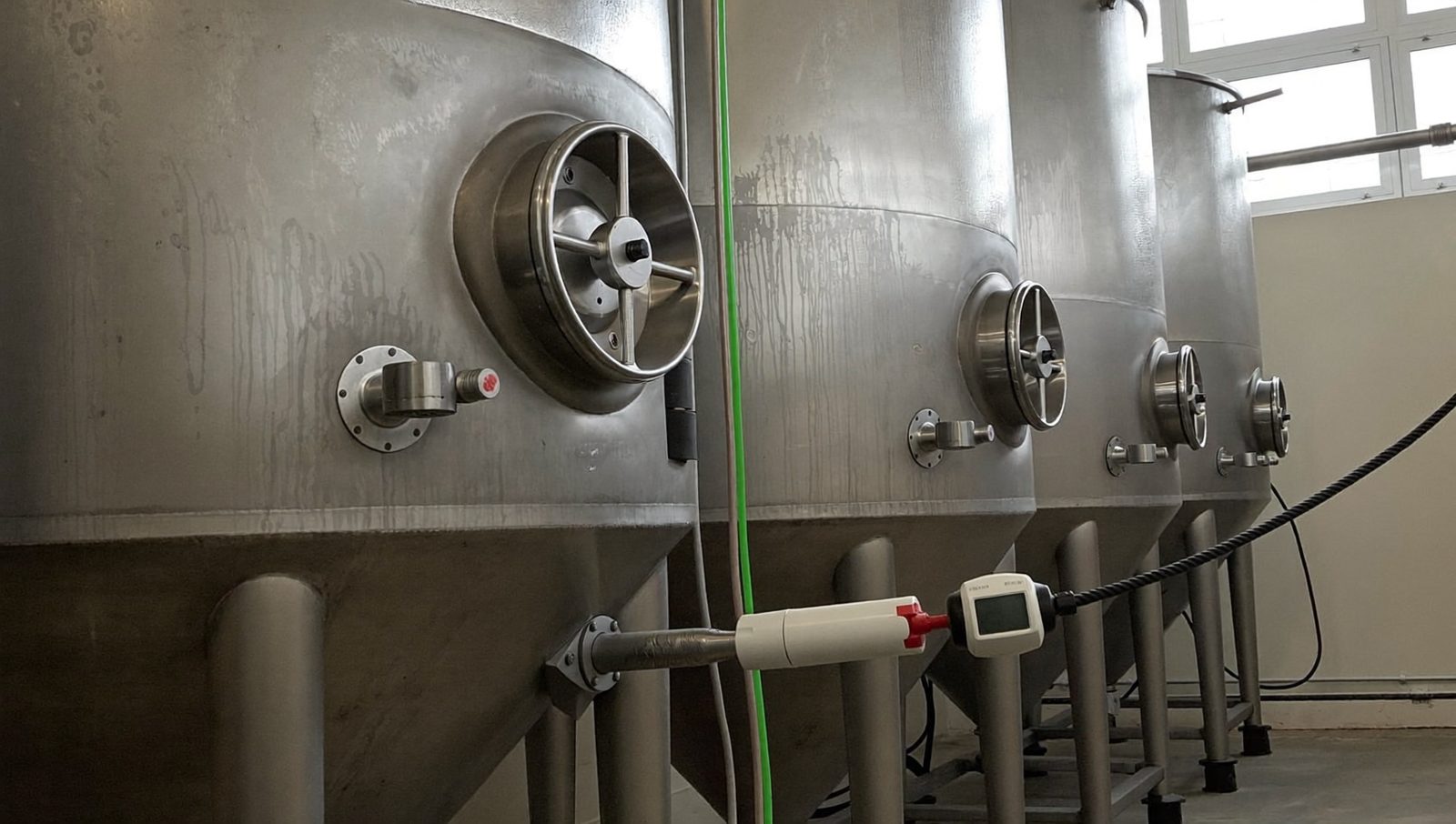
Thermal control only works if it is recorded. A probe connected to a data logger or an alarm tells you the temperature of the mass at any moment, but it does not tell you what happened overnight. For this reason each tank should have a log with date, time, temperature, density or residual sugar, and the interventions carried out, such as pump-overs. With these data the winery can reconstruct the trend and understand why a fermentation stopped.
Probe placement matters. On stainless steel tanks it should be positioned at mid-height and away from the cold wall, because a reading near the jacket does not represent the mass. In reds with a cap, a probe in the upper part measures the most intense heat of fermentation and should be complemented by a reading in the lower part. Comparing the two readings is the simplest way to know whether the tank is warming evenly.
Frequently asked questions
At what temperature should a white wine be fermented?
There is no single value valid for all whites. The temperature is chosen based on the yeast strain, the aromatic profile you want to preserve and the cooling capacity of the winery. The practical criterion is to keep the mass stable, without fluctuations, throughout fermentation.
What is the difference in temperature between white and red wines?
White wines are generally fermented at cooler values to protect volatile aromas. Red wines tolerate more heat in the cap, because heat promotes the extraction of colour and tannins from the skins. In both cases the limit is the point at which the yeast becomes stressed and fermentation slows.
What happens if fermentation exceeds the right temperature?
The yeast becomes stressed, produces more by-products and may lose vitality before consuming all the sugar. The resulting wine may have fewer fruity aromas and may retain residual sugar. If fermentation stops, causes and restart are covered in the guide on stuck fermentation.
Is a refrigeration unit needed for every tank?
Not always. In small tanks an adjustable jacket or half-coil is often enough, while large tanks, or several tanks fermenting vigorously at once, require a unit sized for peak load. The per-tank load calculation indicates when the system becomes necessary.
Sources
- Fiscal warehouse for wine: when you need one, alternatives
- FCA wine export vs EXW: who clears customs and loads
- GACC Registration for Wine to China: Chinese Label Guide
- Exporting Wine to Japan: Zero Duty, Documents and Labelling
- How many bottles per case, pallet and container
- Export Declaration, MRN and Proof of Exit for Wine VAT