Grapevine Water Stress: How Climate Change Is Reshaping Vineyard Irrigation
Wines Export Editorial · Last updated:
Helena Lopes on Pexels
For centuries, quality viticulture has rested on a near counter-intuitive principle: a certain amount of thirst is good for the vine. The most celebrated vintages in temperate wine regions have historically been the driest ones, and for at least two thousand years — Columella already wrote about it in De Re Rustica — some degree of water deficit has been considered functional to vigor control and to grape and wine quality. But what happens when the "right" thirst turns into prolonged drought, when the summer rain that once supplemented the vine's needs becomes increasingly rare? Climate change is forcing viticulture to rethink irrigation practices from the ground up, and recent scientific research offers increasingly precise guidance on how to do it.
What happens physiologically when a grapevine is water-stressed
To understand why water management has become so central, it helps to start with how grapevines physiologically respond to water scarcity. A review published in the Journal of Experimental Botany in 2020 (Gambetta et al.) proposed an integrative definition of drought stress in grapevine, moving past the older simplification that treated water deficit as a single seasonal average. A central point emerging from this line of research is the phenological distinction: water stress does not have the same effect depending on whether it's applied before or after veraison, the point at which the berry begins to color and accumulate sugar.
That distinction was developed further in a 2026 synopsis published in the American Journal of Enology and Viticulture by Markus Keller (Washington State University), delivered as the 2025 ASEV Honorary Research Lecture. The paper clarifies a technical point directly relevant to irrigation management: contrary to a long-held belief, ripening grape berries do not become hydraulically isolated from the vine. Instead, the research shows that the berries' high demand for sugar leads to a massive increase in phloem inflow, which requires discharge of surplus water via berry transpiration and xylem backflow to the leaves. The practical consequence is that ripening berries become progressively less responsive to short-term changes in soil moisture, yet they will still shrink gradually when the vine remains under prolonged water stress.
This leads to one of the synopsis's most operationally relevant recommendations: preveraison water deficit has a far greater impact on berry size than postveraison deficit, and errors in irrigation management made before veraison cannot be corrected by adjusting irrigation during ripening. This overturns a widespread practice: many growers still focus irrigation attention on the period immediately before harvest, when berry physiology suggests the truly critical window comes earlier in the season.
Deficit irrigation: how much water can be saved, and at what cost
On the agronomic side, the most studied strategy for adapting irrigation to reduced water availability is "deficit irrigation": supplying the vine with less than 100% of its theoretical water requirement, in a targeted and monitored way.
A study published in April 2026 in Scientific Reports (El-Salhy et al., Assiut and Aswan Universities, Egypt) precisely quantified this trade-off on table grapevines of the Flame Seedless cultivar, grown in an arid area of the Nile Valley across the 2024 and 2025 seasons, under drip irrigation. The experimental design compared three irrigation levels — 100%, 80%, and 60% of crop water requirements (CWR) — measuring both yield and cluster quality parameters.
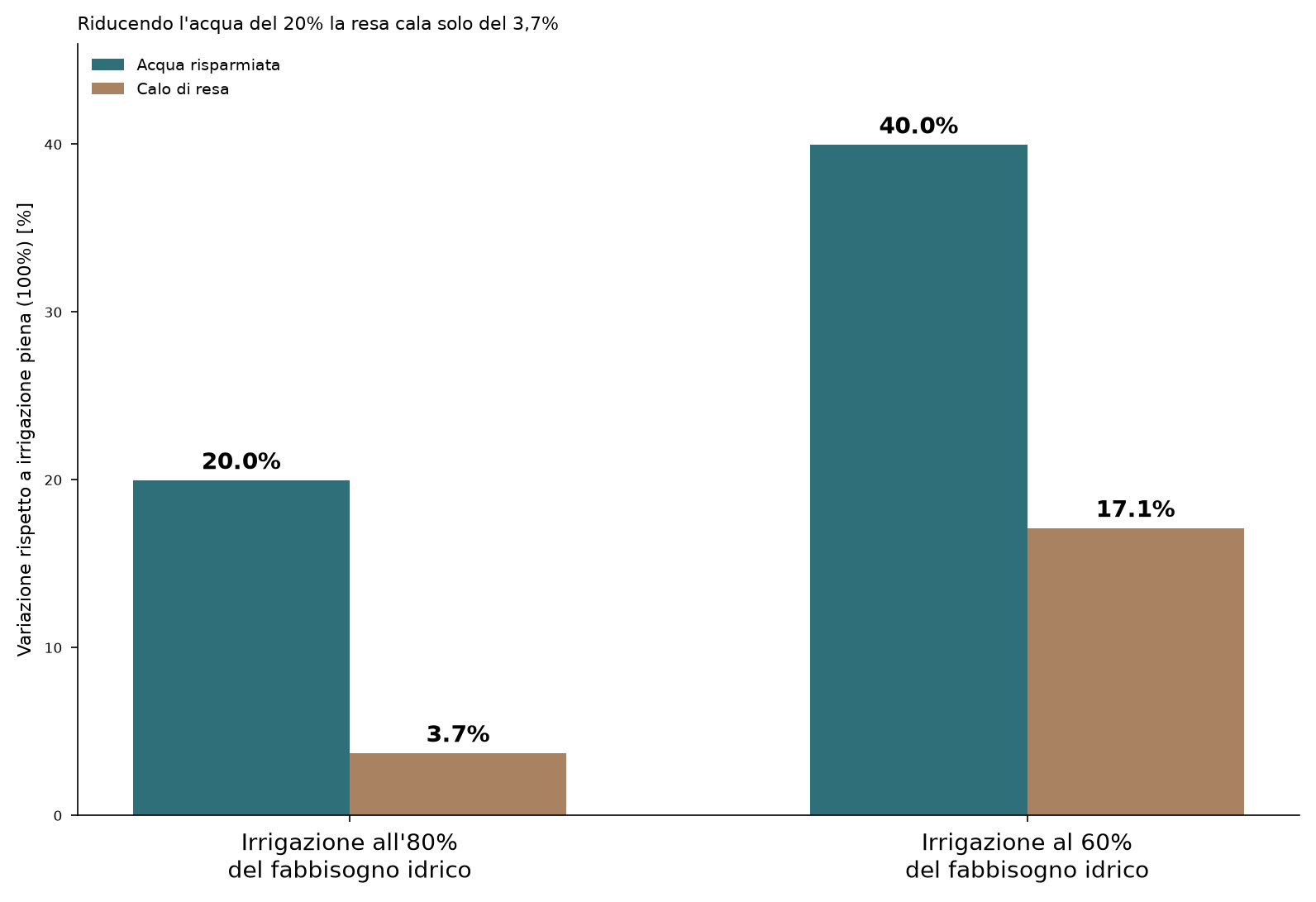
The results, summarized in the chart below, show an asymmetric trade-off between water saved and yield lost:
Source: El-Salhy, A.M. et al. (2026), Deficit-irrigation management for sustainable grape production, Scientific Reports 16:503847, DOI: 10.1038/s41598-026-47407-8. Data: total seasonal water use, 2024-2025 mean (Flame Seedless, drip irrigation).
Reducing water supply from 100% to 80% of crop water requirements decreased yield per vine by only 3.70%, against a water saving of roughly 20%. Pushing the deficit to 60% raised the yield decrease to 17.11%, though the water saving nearly doubled, to roughly 40%. The authors also measured a rise in irrigation water productivity of 20.33% at the 80% CWR level and 37.34% at the 60% CWR level compared with full irrigation — a finding that confirms moderate deficit irrigation can improve overall water-use efficiency.
A notable detail from the same study is that the 80% CWR treatment showed no statistically significant difference from 100% CWR across several vegetative parameters (pruning wood weight, leaf area, chlorophyll content), while only the more severe 60% CWR treatment produced marked differences — suggesting a tolerance threshold beyond which deficit begins to affect the vine more substantially, not just its immediate yield.
It's worth noting that this study concerns table grapes under extreme arid conditions, not wine varieties in a Mediterranean climate: the exact numerical coefficients don't transfer directly to an Italian vineyard, but the underlying principle — a moderate, well-calibrated deficit produces contained yield losses against significant water savings — is consistent with what the Keller 2026 synopsis cited above documents for wine grapes more broadly.
How irrigation is changing in Italian vineyards
An infographic published in July 2025 by CREA through the SIGRIAN system (Italy's national information system for agricultural water resource management), based on 2020 Istat Census data and presented at a conference in Benevento, offers an up-to-date picture of irrigation techniques used in Italian vineyards.
Source: CREA — SIGRIAN, "Viticoltura, irrigazione e cambiamenti climatici: infografica sul caso della Campania" (July 7, 2025), sigrian.crea.gov.it, based on 2020 Istat Census data.
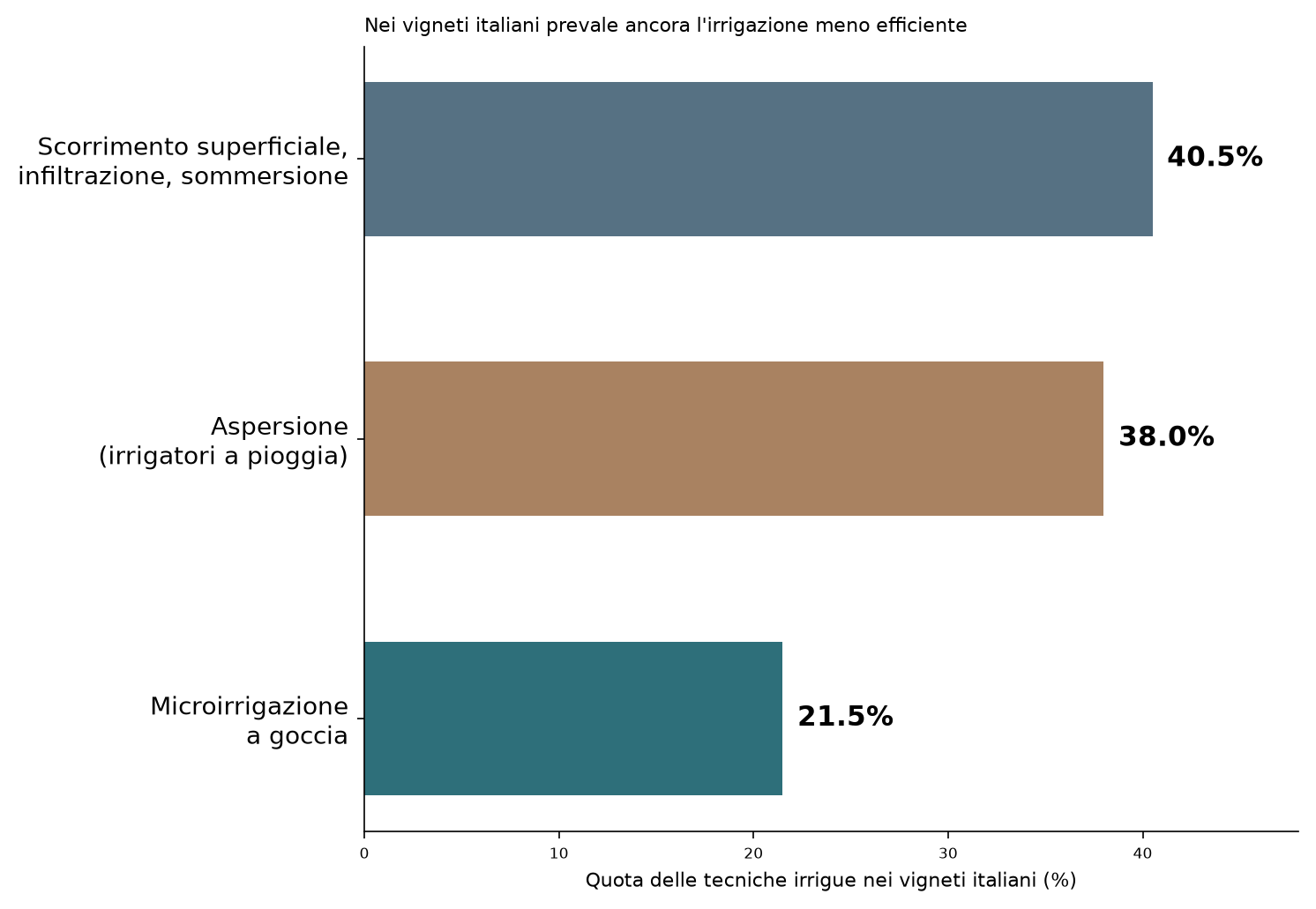
What emerges is that, although drip micro-irrigation is generally considered the most water-efficient technique, it still accounts for only 21.5% of irrigation techniques used across surveyed Italian vineyards. Surface-flow, lateral infiltration, and flood irrigation — generally less water-efficient — still cover 40.5%, while sprinkler irrigation covers the remaining 38%. This gap between the most efficient technique available and its actual adoption points to substantial room for conversion toward higher-efficiency irrigation systems, a theme CREA explicitly links to the challenges posed by climate change.
What this means for a winery evaluating its own approach
The available scientific evidence converges on a few practical takeaways, with the caveat that every vineyard has site-specific soil and climate conditions requiring local validation:
- The preveraison period is the critical window for managing water deficit. Decisions made in this phase affect berry size and yield in ways that cannot be corrected later, per the Keller 2026 synopsis.
- A moderate, well-calibrated deficit does not necessarily compromise quality. The available data, including the 2026 Egyptian study cited here, show that moderate reductions in water supply can produce contained yield losses against substantial water savings, though the exact coefficients depend heavily on variety, soil, and local climate.
- Irrigation technology matters as much as strategy. CREA-SIGRIAN data show there is still substantial room in Italy for conversion toward drip systems, which are more efficient in managing an increasingly scarce resource.
- Rain and irrigation are not equivalent for grape composition. The Keller 2026 synopsis clarifies that, unlike rainfall — which can dilute berry composition through surface-water absorption and berry splitting — drip or surface irrigation does not produce the same dilution effect, unless supplied via overhead sprinklers.
For export markets most attuned to science and supply-chain sustainability — the United States, Germany, and the United Kingdom in particular — the ability to document informed water-management practices is becoming a credibility factor when communicating with buyers focused on climate resilience.
Want to see the real buyers for your wine?
Scientific topics like water-stress management speak to a winery's technical rigor, but bringing that work to export markets also requires knowing who the real importers and buyers interested in your product profile actually are. Wines Export gives Italian wineries access to a pool of verified buyer and distributor contacts across export markets, turning the quality of vineyard work into concrete commercial relationships.
Data and citations drawn from: Keller, M. (2026). Vineyard Irrigation: A Balancing Act with Consequences. American Journal of Enology and Viticulture 77:0770005. DOI: 10.5344/ajev.2025.25035. Open access, CC BY 4.0 license. El-Salhy, A.M. et al. (2026). Deficit-irrigation management for sustainable grape production. Scientific Reports 16:503847. DOI: 10.1038/s41598-026-47407-8. Open access, CC BY 4.0 license. Gambetta, G.A. et al. (2020). The physiology of drought stress in grapevine. Journal of Experimental Botany 71(16):4658-4676. DOI: 10.1093/jxb/eraa245. CREA — SIGRIAN (2025). Viticoltura, irrigazione e cambiamenti climatici: infografica sul caso della Campania.
- Hottone: the Malavasi sparkling wine aged on the bottom of a lake
- Finding Italian Wine Suppliers in Switzerland: A Guide for Importers
- How Long Does a Reliable Rootstock Trial Need to Run?
- How to Find Italian Wine Suppliers in Sweden (English)
- How to Export Wine Abroad: An Operational Guide to the First Shipment
- Finding Italian Wine Suppliers in the United States: A Guide for Importers and Retailers