How Long Does a Reliable Rootstock Trial Need to Run?
Wines Export Editorial · Last updated:
DΛVΞ GΛRCIΛ on Pexels
Anyone replanting a vineyard eventually faces the same question: which rootstock to choose, and on what evidence base? Until recently, the honest answer was: "it depends how many years of trial data you have — and you can never be fully sure it's enough." A July 2026 paper in OENO One, from a Spanish research group (Public University of Navarre and Vitis Navarra), finally puts hard numbers behind that question: how many years does it actually take before a rootstock ranking stops changing meaningfully?
The problem: trials are expensive, but how long should they run?
Multi-year rootstock and variety trials are costly and require years of management once the vineyard reaches production. The practical problem is that nobody knows with certainty how many years are needed to reach robust conclusions — and the temptation to cut a trial short, for budget or publication-timeline reasons, is real. The risk is basing commercial decisions (which rootstock to adopt at scale) on data that, with more years of observation, might have told a different story.
The authors cite an instructive precedent: in Shiraz and Cabernet Sauvignon trials, yield measured at 3-6 years of vine age did not match what was observed at 22-25 years, when some rootstocks showed age-related performance declines while others remained stable long-term.
The method: a ten-year Tempranillo trial
To answer the question, the researchers analysed ten years of data (from 2014, the first harvest, to 2023) from an experimental Tempranillo vineyard planted in 2011 at Miranda de Arga, Navarre (Spain), combining 12 commercial rootstocks and 9 newly developed selections (the RG series, from a hybridisation programme crossing rootstocks 41 B and 110 R). For every possible trial duration — from 2 to 10 years — they compared the rootstock ranking obtained against the ranking from the full ten-year series, using Kendall's rank correlation coefficient (tau) as the stability measure: a value close to 1 indicates nearly identical rankings, a value close to 0 indicates poor agreement.
Four agronomic variables were analysed: cluster number, pruning weight, yield, and the Ravaz index (the ratio between yield and pruning weight, a composite indicator of the vine's vegetative-productive balance).
The results: not all variables stabilise at the same speed
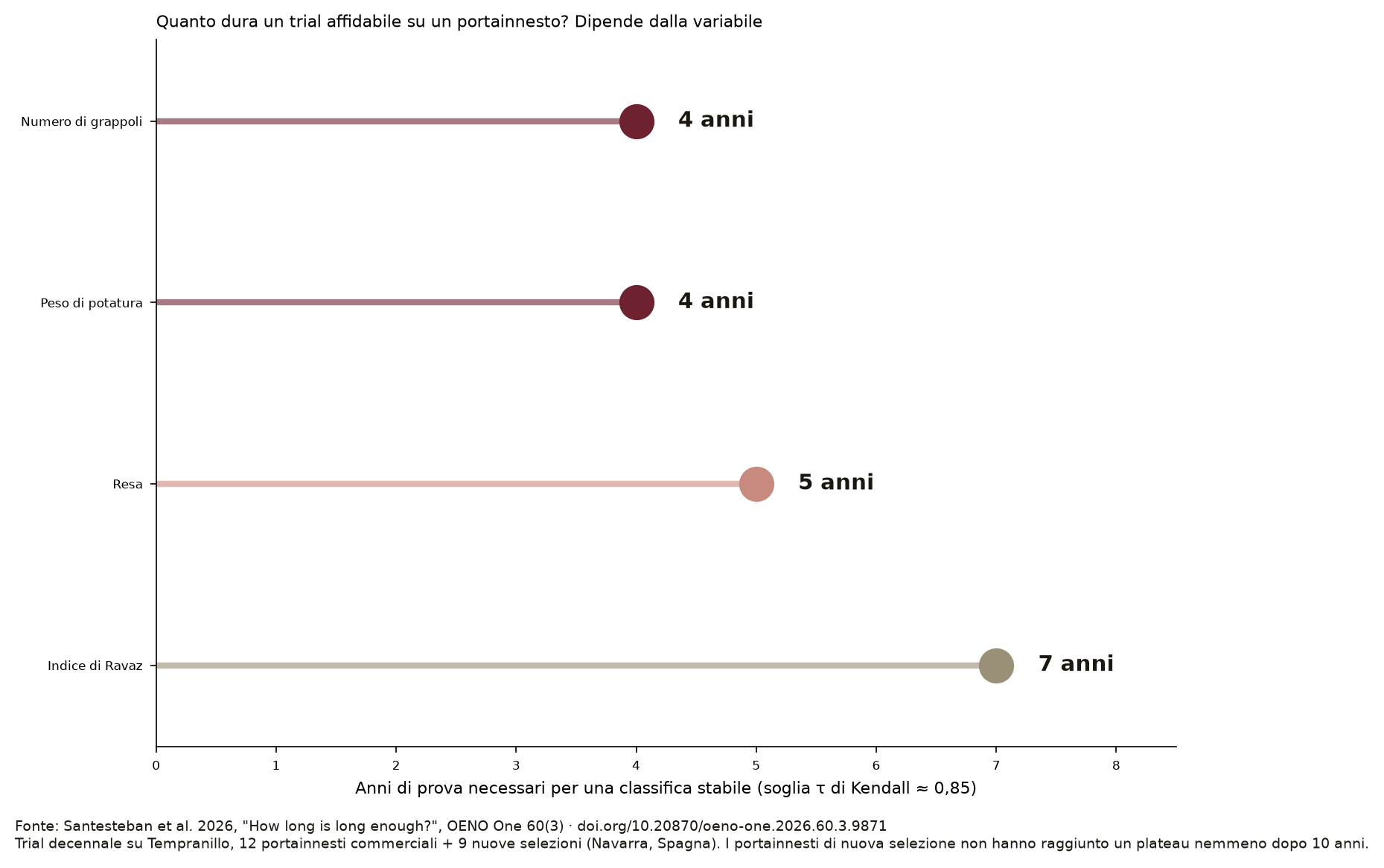
Using an indicative threshold of tau ≈ 0.85 as a marker of high ranking stability, the time needed to reach it varies substantially depending on the variable measured:
Source: Santesteban et al. 2026, OENO One 60(3).
- Cluster number and pruning weight: threshold reached after 4 years.
- Yield: threshold reached after 5 years.
- Ravaz index: threshold reached only after 7 years — the slowest variable to stabilise.
The most plausible explanation, according to the authors, concerns the differential sensitivity of these variables to year-to-year climatic conditions: under Mediterranean conditions, yield is more sensitive than cluster number or pruning weight to the vine's water status, and therefore more exposed to rainfall variation between seasons. The Ravaz index, being a ratio between two quantities, further amplifies short-term variability.
A second stability measure: the pairwise inversion rate
Alongside Kendall's tau, the authors calculated a second stability metric: the pairwise inversion rate, which quantifies the probability that the relative order of two rootstocks is misclassified when using a reduced number of observation years instead of the full series. A value of 0 means no inversions (perfectly preserved order); a value of 1 means complete order reversal.
The results confirm the same pattern seen with Kendall's tau: cluster number and pruning weight show a faster drop in inversion rate, yield an intermediate behaviour, and the Ravaz index the highest inversion rates — i.e., the greatest instability. Commercial rootstocks again tend to show lower inversion rates than the RG series for every variable except the Ravaz index, where the two groups show similar values — a detail reinforcing the hypothesis that age-related performance decline, where present, affects yield and vegetative vigour comparably, making the Ravaz index less sensitive to this between-group difference.
Commercial rootstocks vs. new selections: a critical difference
Perhaps the most relevant finding for anyone deciding between an established commercial rootstock and a newly bred selection concerns exactly this distinction. For nearly every variable (except the Ravaz index), commercial rootstocks showed more stable rankings that consolidated faster than the new RG-series selections, which needed more years to stabilise and showed greater dispersion at short or intermediate trial lengths. In this dataset, Kendall's tau values for the RG rootstocks did not reach a clear plateau even after 10 years of evaluation.
The authors offer a plausible explanation: commercial rootstocks are, by definition, the product of a selection process that has already taken place over time — rootstocks with unstable or declining long-term performance tend to be abandoned and never become "commercial" in the first place. New selections, by contrast, haven't yet gone through that historical filter, and therefore require more years of observation before they can be assessed with the same confidence.
What this means in practice for anyone replanting a vineyard
The practical implications the authors themselves draw are direct:
- For established commercial rootstocks, an evaluation of roughly 5 years can be sufficiently informative for operational decisions — though it won't capture performance declines that only emerge after 20+ years.
- For lesser-known or newly selected materials, longer evaluations are needed, because behavioural changes can appear relatively early in the vineyard's life and rankings remain unstable well beyond five years.
- The variable chosen to evaluate rootstocks matters: basing a decision on cluster number alone after 4 years gives a different — and potentially less complete — picture than waiting for the Ravaz index to stabilise at 7 years.
For a business planning a replant across significant acreage, this translates into a concrete operational recommendation: when evaluating new-generation rootstocks marketed as more drought-tolerant or resistant to other stresses, a nursery's 2-3 year demonstration trial is not enough to guarantee the result is stable — especially if the material is not yet an established commercial rootstock.
Why this matters beyond Tempranillo
While the trial itself was conducted on Tempranillo in a specific Spanish growing region, the underlying statistical framework — comparing partial-year rankings against a full reference series using rank-correlation methods — is variety-agnostic. The core finding that stands out for international buyers and consultants advising on vineyard investment: rootstock evaluation timelines are not one-size-fits-all, and the "right" trial duration depends both on which agronomic trait is being tracked and on whether the material under evaluation is already commercially established or still pre-commercial. A recommendation based on a short trial for a new selection carries meaningfully more uncertainty than the same recommendation for an established commercial rootstock.
The limits of this study
The authors themselves note that the analysis is based on a single long-term dataset, under specific environmental and management conditions (the continental-Mediterranean climate of the Ebro Valley, supplementary drip irrigation, a planting density of 3,333 vines/hectare). Extending the analysis to more datasets, environments and genetic backgrounds — work the authors themselves call for — would help verify how generalisable these findings are to other wine-growing areas, including Italian ones with different soil and climate conditions.
Data drawn from Santesteban, L.G. et al. (2026). How long is long enough? Robust ranking of commercial grapevine rootstocks and insights for pre-commercial selections from multi-year data. OENO One, 60(3). Open access, CC BY 4.0.
- How to Export Wine Abroad: An Operational Guide to the First Shipment
- Hottone: the Malavasi sparkling wine aged on the bottom of a lake
- Italian Wine Exports 2025: Which Markets Are Growing, Which Are Shrinking
- Grapevine Water Stress: How Climate Change Is Reshaping Vineyard Irrigation
- Malolactic Fermentation: What It Is and Why It's Critical for Red Wine Quality
- Finding Italian Wine Suppliers in Switzerland: A Guide for Importers