How to Export Wine Abroad: An Operational Guide to the First Shipment
Wines Export Editorial · Last updated:
For an importer sourcing from a new Italian winery, the first shipment is where operational maturity actually shows. It is not about whether the wine is good — by the time a supplier reaches this stage, that question is usually settled. It is about whether the winery understands what documents its own country requires for a clean export, whether it can hold a coherent position on Incoterms instead of deferring every decision to the buyer, and whether it chose this specific market deliberately rather than opportunistically. This guide covers the three practical blocks that separate a smooth first shipment from a delayed one: the paperwork, who bears which cost and risk, and how a serious producer actually narrows down a target market.
1. Minimum documents for a first shipment
Regardless of destination, every wine export out of Italy requires a fixed core of documents: commercial invoice, transport document (CMR for road, Bill of Lading for sea freight), and packing list. On top of that baseline, market- and excise-specific documents apply — and a winery shipping for the first time often only discovers which ones it needs once the shipment is already packed.
For exports outside the EU, a customs export declaration is required, typically handled by a customs broker on the winery's behalf. Wine is an excise good, so it moves under the electronic administrative document (e-AD), which tracks the transfer between bonded warehouses and suspends excise duty until the goods reach their destination. Where the destination market has a trade agreement with the EU, a EUR.1 certificate — issued and stamped by the Italian customs authority (Agenzia delle Dogane e dei Monopoli) — lets the importer apply a reduced preferential duty rate; where no such agreement exists, some markets instead require a non-preferential certificate of origin issued by the local Chamber of Commerce.
| Document | Purpose | When required |
|---|---|---|
| Commercial invoice | Proof of transaction value | Always |
| Transport document (CMR / Bill of Lading) | Accompanies the physical shipment | Always |
| Packing list | Details of packages, weights, volumes | Always |
| e-AD (excise document) | Movement of an excise good | Always, for wine |
| Customs export declaration | Export clearance out of the EU | Non-EU exports |
| EUR.1 certificate | Preferential duty in a country with an EU trade agreement | Where a trade agreement applies |
| Non-preferential certificate of origin | Confirms origin regardless of trade agreements | Markets that specifically require it |
| VI-1 / VI-2 | Chemical/organoleptic analysis for non-EU imports | Certain non-EU markets, for specific flows |
An importer working with a new supplier should ask directly for the exact document list required by their own country's import regulations, rather than assuming a generic "export documents" set covers it — requirements change over time and differ even between markets that otherwise look similar.
2. Incoterms: who pays for what, and from where
Incoterms (International Commercial Terms), published by the International Chamber of Commerce (ICC) and currently in the Incoterms® 2020 version, define precisely at which point in the shipment costs and risk transfer from seller to buyer. They govern neither ownership of the goods nor payment terms — only logistics, cost allocation, and risk. That distinction matters in practice: a supplier that misunderstands its own Incoterm exposure can end up disputing who pays for damage that occurred well past the point where its liability actually ended.
Three terms cover most real first-shipment scenarios:
- EXW (Ex Works) — the seller makes the goods available at its own premises; from that point, transport, export clearance, and risk are entirely the buyer's responsibility. It requires the least operational effort from the winery, but places the full logistics burden — including origin-side customs — on the importer, which is not always a workable ask for a first-time buyer relationship.
- FCA (Free Carrier) — the seller delivers the goods to a carrier nominated by the buyer at an agreed location (the winery itself, or a terminal), and handles export clearance. This is often the most workable compromise for a first shipment: the winery's responsibility ends once goods are handed to the carrier.
- DDP (Delivered Duty Paid) — the seller bears all costs and risk through to delivery at destination, including import duties and taxes. It offers the buyer the highest level of service, but exposes the winery to customs and regulatory risk in the destination country that is difficult to manage without an experienced logistics partner familiar with that specific market.
Which term makes sense depends on the winery's export experience, the importer's own capacity to handle customs clearance and transport domestically, and the level of service the exporter wants to offer as a differentiator. There is no universally "correct" Incoterm — only the one that matches which party, between the two, is actually better positioned to manage that leg of the supply chain.
3. Choosing the first market: start from the market, not the contact
The most common mistake in a first export attempt is reversing the order of decisions — starting from a random contact (a trade fair encounter, an inbound email, a personal connection) instead of from the market itself. A market makes sense for a given winery when three conditions align: local purchasing power and wine consumption patterns match the producer's price positioning, entry barriers (duties, excise, certifications) are manageable given available resources, and the wine's style has genuine affinity with local taste and consumption habits.
Among mature destinations for Italian wine exports, the United States, Germany, and the United Kingdom remain three reference markets by overall trade volume, even though each followed a distinctly different trajectory over the past year.
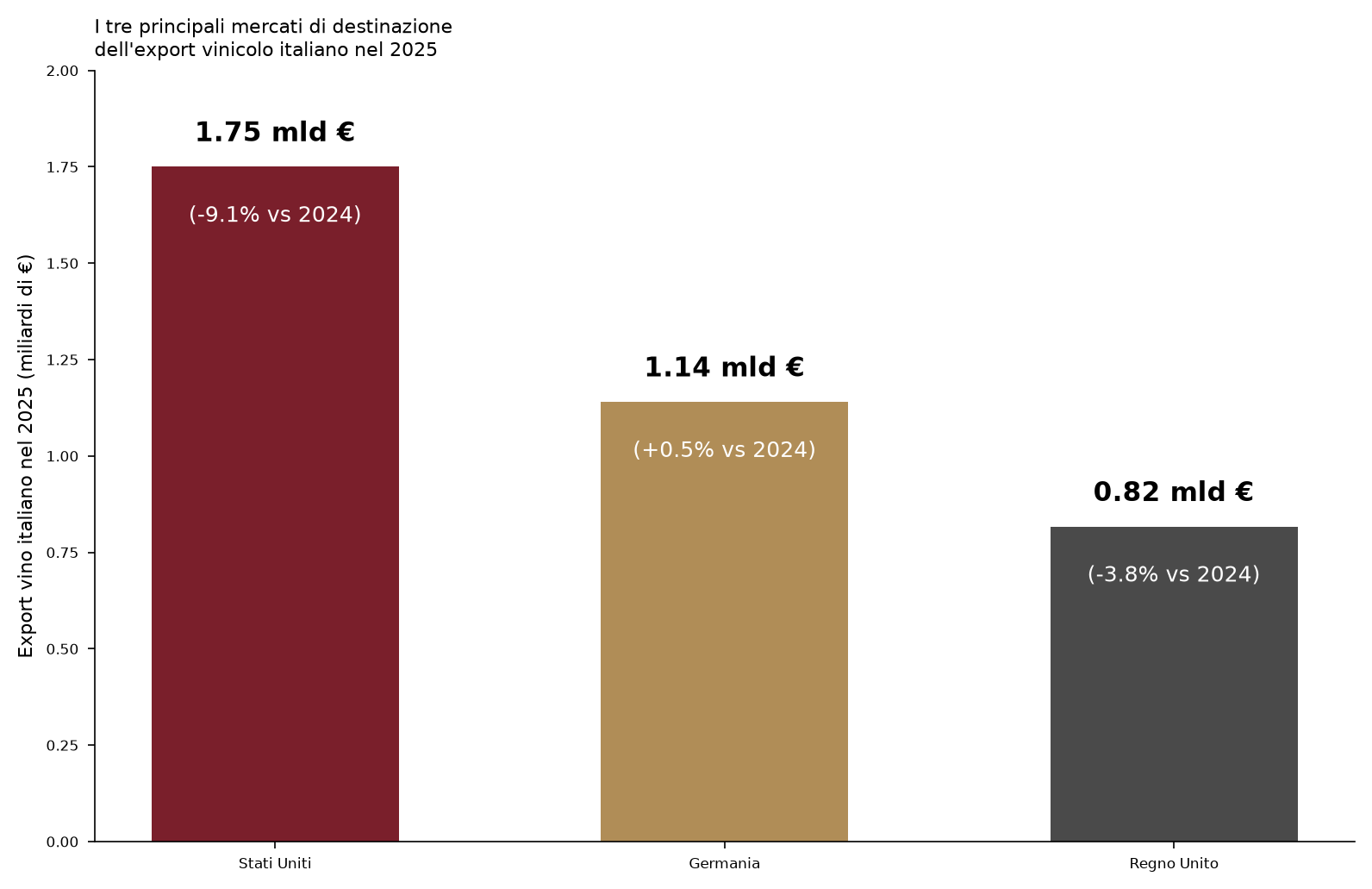
According to Istat data analyzed by WineNews, Italian wine exports to the United States totaled €1.75 billion in 2025, down 9.1% from 2024 — a market heavily affected by new U.S. tariffs and dollar depreciation. Germany held steadier, closing at €1.14 billion (+0.5% year-on-year) and remaining Italy's top EU destination for wine. The United Kingdom, the third market considered here, closed at €816.8 million, down 3.8% from 2024, in a year where Italy's total wine exports worldwide fell to €7.7 billion (-3.7%).
These three markets should not be read as a uniform priority list for every winery. A producer of accessibly-priced table wine and one making a structured, age-worthy red face very different pricing and channel dynamics even within the same country. The underlying discipline is the same regardless of market: verify genuine product-market fit first, then look for the buyer — not the reverse.
Checklist before the first shipment
Before confirming a first export shipment, both winery and importer should have clarity on: which documents the specific destination country requires (not a generic "export documents" list), which Incoterm reflects the cost-and-risk split actually agreed between the parties, and on what concrete basis — not just an opportunistic contact — that market was chosen over the alternatives.
Want to see the real buyers for this wine?
Documents and Incoterms are prepared once and reused; the right market, on the other hand, needs to be verified case by case — starting from the buyers actually purchasing this wine style today, not a generic importer list. Try the free demo of Wines Export and check which real contacts are already active in the markets relevant to this shipment before committing.
Sources
- Italian Wine Exports 2025: Which Markets Are Growing, Which Are Shrinking
- How Long Does a Reliable Rootstock Trial Need to Run?
- Malolactic Fermentation: What It Is and Why It's Critical for Red Wine Quality
- Hottone: the Malavasi sparkling wine aged on the bottom of a lake
- Massal Selection for Resilient Vineyards
- Grapevine Water Stress: How Climate Change Is Reshaping Vineyard Irrigation