Shipping wine to the UK after Brexit: customs, pallets, courier and transit times
Wines Export Editorial · Last updated:

When you ship wine to the UK after Brexit, a pallet always goes through British customs, and the declaration is filed by a party registered to do so, usually the importer or a freight forwarder acting on its behalf. Wine becomes subject to UK excise duty when it enters the country, unless it is delivered directly to an approved excise warehouse, where payment can be deferred. Express courier suits samples and small lots, while road freight carries pallets, and actual transit times depend on documents and inspections, since the official sources do not give a fixed time for Dover or Calais. For the wider trade framework, see exporting wine to the United Kingdom, and for the rules on excise by strength, see UK excise duty by strength from 2025.
What has changed since 2021: customs is always there
HM Revenue & Customs' guidance on importing alcoholic products was updated on 26 January 2021, when the Brexit transition period had ended. Since then, wine arriving from Italy enters a country with its own customs and tax rules, separate from those of the European Union. For a winery, the practical point is simple: customs clearance is not a formality to handle at the border, but a stage that requires correct documents before the truck leaves.
This also means that an error on the declaration holds up the goods, not just the invoice. Anyone preparing a shipment from Italy needs to know in advance who declares, where the pallet ends up and which duty applies. The following sections cover these three points in the order they arise in practice.
Who declares: importer, freight forwarder, courier
The winery in Italy does not file the customs declaration as the exporter. Usually it is the UK importer, or a freight forwarder or courier acting for them under an authorisation. The name on the declaration must match the party that owns the goods and is liable for the duty, so the sales contract should be clarified before loading.
Excise Notice 197 from HM Revenue & Customs sets out the requirements for holding and moving goods under duty suspension within the United Kingdom and the European Union. The same guidance refers to the Customs Declaration Service (CDS) in the sections on exporting excise goods, updated in August 2024. A winery does not need to know every form, but it does need to know that the declarant changes depending on whether the goods go into a warehouse or are released for consumption straight away.
The freight forwarder's role is often decisive for small consignments. The forwarder collects the documents from the winery, prepares the declaration and coordinates the carrier, so the winery must give them data that is consistent with the invoice and the packing list.

Duty deferment and excise warehouse: where the pallet ends up
This choice changes both the financial cost and the logistics. The import guidance says that, for alcoholic products coming from countries outside the EU, duty becomes payable when the goods arrive in the United Kingdom. It is not paid on arrival if the goods are delivered to an excise warehouse approved for that purpose. Payment can therefore be deferred until the wine leaves the warehouse for consumption.
The same official text also describes the APPA, meaning approval for producers of alcoholic products. From 1 February 2025, anyone who wants to import and hold alcoholic products under duty suspension can apply for this approval, whereas previously the option was reserved for beer producers only. For an Italian winery this changes the choice: either use a third-party warehouse, or check whether your importer already holds the approval.
When wine enters a warehouse, Excise Notice 197 explains how to receive goods and how to remove them. The section on removal for home consumption was updated on 27 April 2026 to clarify how to pay duty when goods leave the warehouse. Anyone using a warehouse must therefore keep the moment of entry and the moment of exit separate, because duty arises only on exit.
The text on the Northern Ireland regime describes three methods for those who import regularly from the EU, including the use of an authorised warehouse keeper. For Northern Ireland the guidance also notes an exception for wine: registration as an owner is not required for those who import only wine. This does not automatically apply to Great Britain, so it should be verified in the full text before you choose your route.
The other useful change concerns tax stamps. From 1 May 2025, the legal requirements on tax stamps for alcoholic products no longer apply, because the scheme has been discontinued. In practice, the pallet no longer has to carry the British tax stamp that many exporters remembered.
| Point | What the source says | Reference date |
|---|---|---|
| APPA approval | Allows importing and holding alcoholic products under duty suspension | 1 February 2025 |
| Tax stamps | The legal requirements no longer apply | 1 May 2025 |
| Post-transition update | The guidance was changed because the transition period had ended | 26 January 2021 |
| Samples outside the warehouse | A signed declaration to the warehouse keeper is required | 26 February 2026 |
| Payment on exit | Clarified how duty is paid for removal for consumption | 27 April 2026 |
| Deferment accounts | Clarified the use of the EORI number | 2 October 2026 |
Express courier for samples and small lots
Express courier is the simplest route when the lot is small and you need to get the wine quickly to an importer or a buyer evaluating it. The official sources do not treat courier as a specific channel, so this part is an operational assessment and not an official rule. The courier brings the parcel to the importer's door, but customs clearance still has to be managed.
For samples there is a precise rule, which Excise Notice 197 updated on 26 February 2026. If the owner of the goods wants to release samples from the warehouse free of excise duty, they must give the warehouse keeper a signed declaration, which the warehouse keeper retains for checks. In this case the winery must work with the warehouse keeper, not only with the courier.
A small lot shipped outside a warehouse with duty already paid requires the recipient to have the documentation in order. The courier does not replace the declaration, so the winery should ask in advance which party declares and which identification number must appear on the shipment.
Road freight: routes, times, checks
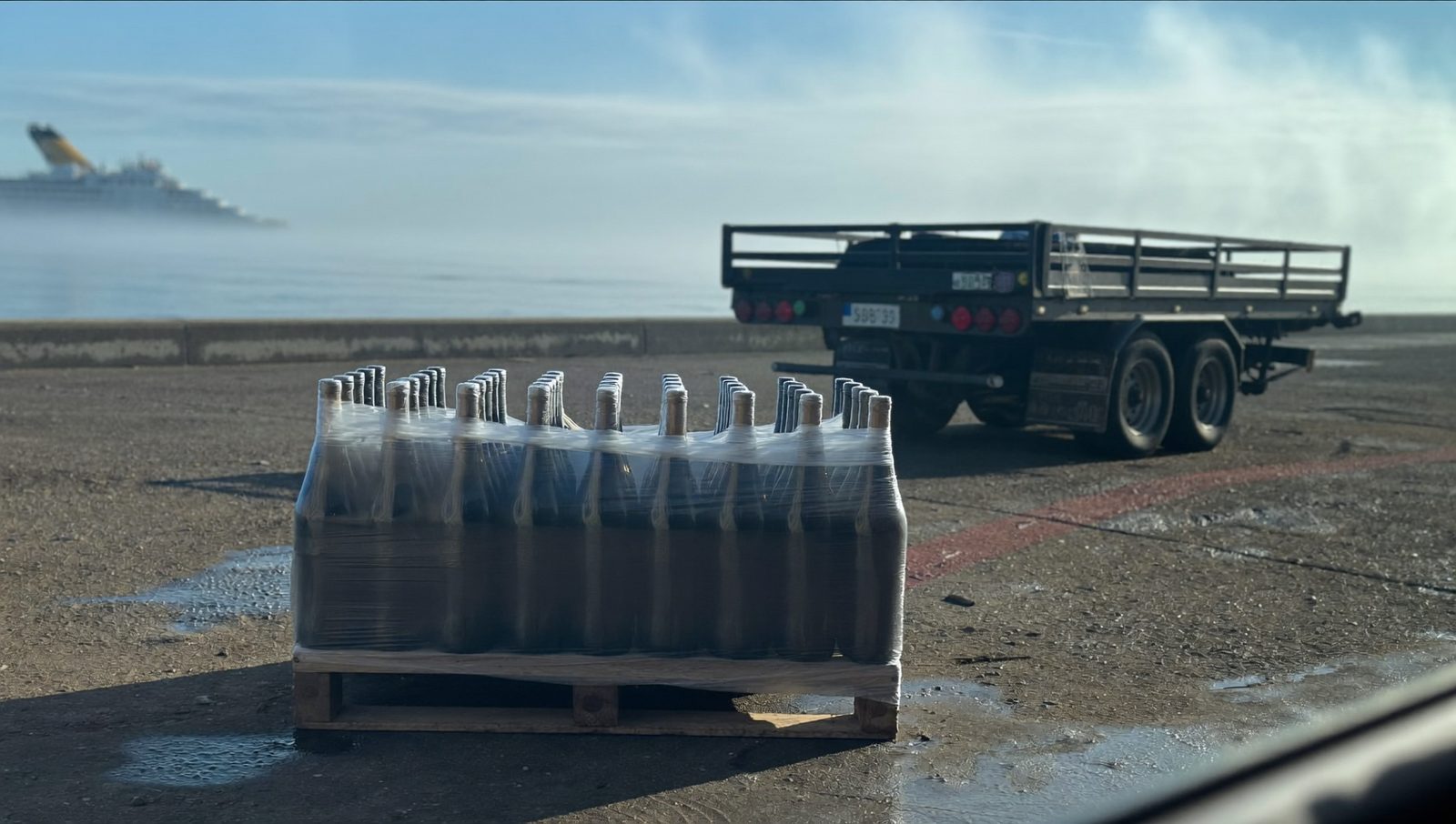
Road freight is the channel for pallets. The route crosses the Channel through Dover or Calais, but the official sources give no transit times for these crossings, and it would not be correct to state a figure. Actual time depends on how complete the documents are, on the availability of the warehouse and on the checks that customs decides to carry out on each load.
For movements under duty suspension, Excise Notice 197 refers to the Excise Movement and Control System (EMCS), which in the Great Britain version is attached to the notice itself. The system is used to track the movement of the goods and to record that duty has not yet been paid. For the truck, this means an electronic accompanying document that the carrier must have ready on arrival.
The practical advice is to fix the destination warehouse first and then the departure date. A load that arrives without a warehouse ready to receive it sits idle, and in that case the winery pays for the delay. Anyone planning several trips should also bear in mind that official guidance is updated often, so the date of each check should be confirmed on the official page on the day of shipment.
Documents the carrier asks the winery for
The exact list of documents depends on the regime chosen and on the declaring party, so you should ask your freight forwarder for it in writing before loading. In general, the carrier wants the commercial invoice made out to the correct consignee, the packing list with weight and number of bottles, and the identification details of the declaring party. When wine travels under duty suspension, the electronic movement references and the EORI number of the account holder are also required.
Excise Notice 197 was updated on 2 October 2026 to clarify the use of EORI numbers in duty deferment accounts. An incorrect number on the account risks stopping the process before departure. The winery should therefore have the freight forwarder check the number with the consignee, not only with the carrier.
If the wine is destined for a restaurant or a pub, the process changes again, because the end customer and the warehouse keeper may be different parties. For this reason we refer you to the pages dedicated to the on-trade channel, starting with restaurants, pubs and Italian wine in the UK.
To understand who buys and how importing is organised, the page on importers and sales channels in the UK is the starting point. If you are considering a second commercial step, for example a warehouse in the country, the topic is covered in re-exporting Italian wine from the UK after Brexit.
Frequently asked questions
Do I need an EORI number to ship wine to the UK?
The text of Excise Notice 197 links the EORI number to duty deferment accounts. Anyone who requests duty suspension must therefore have it available. Check the official page to see whether it is also needed for a single shipment without an account.
Does wine pay UK excise duty on arrival?
It depends on the route. The HM Revenue & Customs text says duty becomes payable on arrival, but it is not due at that moment if the goods are delivered to an approved excise warehouse. In the warehouse, payment moves to the time of exit for consumption.
How long does a pallet of wine take to get through Dover?
The official sources listed at the end do not give a transit time for Dover or Calais, so there is no reliable figure to report. Actual time depends on how complete the documents are, on the arrival warehouse and on checks on the load. Ask your freight forwarder for an estimate based on their history of crossings.
Are tax stamps still required on British wine?
From 1 May 2025, the legal requirements on tax stamps for alcoholic products no longer apply. The official guidance has removed the relevant section, so the pallet does not need to carry them.
Sources
Who buys wine in the United Kingdom? A few names
According to the Wines Export Observatory (November 2026), the Italian denomination most carried by wine buyers in the United Kingdom is Prosecco: 41% of those whose Italian range we know carry it, followed by Primitivo (22%) and Montepulciano (18%).
The Wines Export database covers the whole wine trade in the United Kingdom: importers, distributors, wholesalers, wine shops and online stores, city by city, updated continuously (23 November 2026). The Italian denominations most carried by buyers in the United Kingdom, in order: Prosecco, Primitivo, Montepulciano, Pinot Grigio and Barolo.
London
Matthew Clark Bibendum · Ops Wines Ltd · FARR VINTNERS LIMITED
Glasgow
Alchemy Drinks Wholesale · United Wholesale (Scotland) Ltd · The Wine Cru Ltd
Manchester
FOURTH WAVE WINE PARTNERS UK LTD · SKINNY CIDER LIMITED · GLAMORGAN BREWING COMPANY LIMITED
- Shipping Wine to the Netherlands: Excise and Documents
- Shipping Wine to Germany: Excise, Steuerlager, Documents
- South Korea wine importers: who buys Italian wine and how
- Shipping Wine to France: Excise, CRD and Documents
- Swiss wine importers: channels, cantons and buyers
- Shipping Wine to Denmark: Excise, Skat and Documents