Marzemino: Enhancing and Promoting Italian Wine in International Markets
Wines Export Editorial · Last updated:
Marzemino, an indigenous Italian grape variety with a millennia-old history, represents a significant growth opportunity for wineries focused on export. Its unique characteristics, from its fascinating history to its enological peculiarities, make it an ideal candidate for conquering new international markets. This article analyzes the potential of this grape, offering strategic insights for its enhancement and promotion in foreign markets, with a focus on the needs of international buyers. In-depth Look: MASAF — National Register of Vine Varieties.
What are the historical origins of the Marzemino grape?
The origins of Marzemino are ancient and debated, with theories suggesting links to locations like Marzamemi in Sicily or Marzemin in Croatia. It is hypothesized to have been introduced to Italy in ancient times, possibly related to Greek migrations or Venetian influences.
Historically, Marzemino was introduced to southern Trentino in the early 16th century, during Venetian rule. Despite difficult periods, it found its ideal habitat in Val Lagarina, where it is known as "Marzemino Gentile." Genetically, it belongs to a group of grape varieties that arose spontaneously on morainic deposits between Lake Garda and the Adige River. Its cultivation is mainly concentrated in lower Trentino, but it is also present in other areas such as Isonzo (Friulano Marzemino) and Istria, with various synonyms attesting to its long history.

How does the Marzemino grape present itself from an ampelographic point of view?
Marzemino is distinguished by specific ampelographic characteristics. The tip of the shoot is open and slightly pigmented, while the adult leaf is medium to large, pentagonal, and trilobed, with U-shaped petiole sinuses and slight tomentosity on the lower surface.
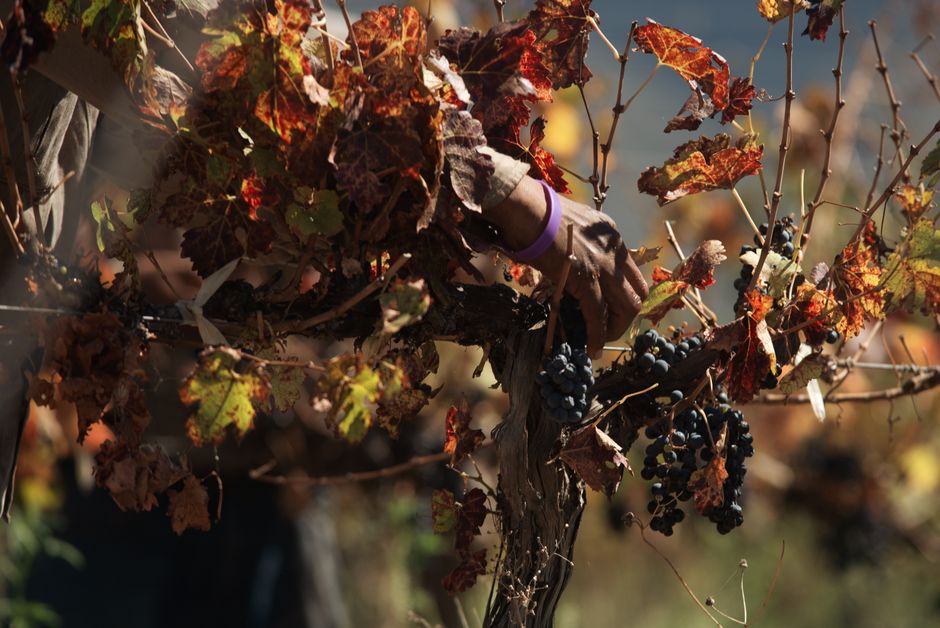
The bunch is large, elongated, and cylindrical, with medium compactness and a short peduncle. The berry is medium-sized, rounded, with an intense blue-black, pruinose color, and a juicy, soft pulp with thin skin. The plant sprouts early, making it potentially vulnerable to spring frosts, but it is generally resistant to winter cold and diseases, although it can suffer from downy mildew, powdery mildew, and phylloxera.
What are the environmental and cultural requirements of Marzemino?
Marzemino prefers cool, fertile, and deep soils, adapting to various types. It benefits from expanded training systems with long pruning; irrigation can increase production but at the expense of quality. The sub-Mediterranean climate of Val Lagarina is considered ideal for this grape variety.
The variety of soils, from basaltic ones rich in manganese to calcareous and gravelly soils along the Adige, contributes to significant organoleptic differences in the wines. Phenological stages indicate a rather early ripening: sprouting in the fourth week of April, flowering in mid-June, veraison at the end of August, and maturation in the first ten days of October.
What is the enological profile and characteristics of Marzemino wine?
Marzemino produces wines with a brilliant ruby red color, intense and persistent aromas. On the palate, the flavor is fine and delicate, characterized by notable freshness due to malic acid. Generally harmonious, slightly acidic, and fresh, some descriptions also indicate it as slightly effervescent, fresh, and dry.
The alcohol content ranges between 11.5% and 12.5%. Traditionally used as a blending wine, Marzemino has been increasingly valued as a single-varietal wine since the 1950s, with constant quality improvement. Although some sources suggest young consumption, others indicate that it lends itself to aging, which enhances its qualities, a potential contradiction linked to different winemaking styles. It is often vinified in blends for wines such as Casteller and Valdadige Rosso.
What is the export potential of Marzemino for Italian wineries?
Marzemino offers an interesting export opportunity thanks to its uniqueness and authenticity as an indigenous Italian grape variety, attractive to consumers seeking genuine experiences. Its enological versatility allows for the production of wines with diverse characteristics, from fresh to aged, satisfying various preferences.
Its fascinating history and debated origins offer powerful narrative angles for marketing. Although it is a niche product, it can captivate enthusiasts of lesser-known but high-quality Italian wines. The main challenge is low awareness.
Frequently Asked Questions
Question 1
What are the possible historical origins of the Marzemino grape variety and where was it introduced in Italy? The origins of Marzemino are ancient and debated, with theories suggesting links to locations like Marzamemi in Sicily or Marzemin in Croatia. It is hypothesized to have been introduced to Italy in ancient times, possibly related to Greek migrations or Venetian influences. Historically, Marzemino was introduced to southern Trentino in the early 16th century, during Venetian rule.
Question 2
What are the ampelographic characteristics and ideal environmental requirements for the cultivation of Marzemino? Marzemino is distinguished by an open and slightly pigmented shoot tip, medium to large adult leaves, pentagonal and trilobed. The bunch is large, elongated, and cylindrical, with medium-sized, rounded berries of intense blue-black, pruinose color. It prefers cool, fertile, and deep soils and benefits from a sub-Mediterranean climate, such as that of Val Lagarina.
Question 3
What type of wine does Marzemino produce and what are its market potentials for international buyers? Marzemino produces wines with a brilliant ruby red color, intense and persistent aromas, a fine and delicate flavor, and notable freshness. It offers an interesting export opportunity thanks to its uniqueness as an indigenous Italian grape variety, attractive to consumers seeking genuine experiences and high-quality wines. Its enological versatility allows for the production of wines with diverse characteristics, from fresh to aged.