Organic and natural wine fairs: Millésime Bio, VinNatur and who visits them
Wines Export Editorial · Last updated:
Only a few organic and natural wine fairs are useful for export, and they attract different audiences. Millésime Bio is the international fair dedicated to organic wine, held in Montpellier in January. The natural wine fairs organised in Italy by the VinNatur association are the national alternative. RAW Wine is another fair dedicated to natural wine, with stops in several cities, including Bologna in February 2027. A fair that focuses only on organic or natural wine brings together exhibitors and visitors who are already oriented toward that category, something a general wine fair does not guarantee. For an overview of importers, see natural wine importers abroad: who buys and organic wine importers abroad: who buys.
Certified organic and natural: two different fair circuits
Organic is a category defined by law. The European Commission explains that Regulation (EU) 2018/848 governs the production and labelling of organic products, covers every stage of the supply chain, and contains specific rules for wine as well. Natural wine, by contrast, has no legal definition on those pages. The natural wine fair circuit is built by associations such as VinNatur, which apply their own criteria to the producers they admit.
For an importer these are two separate filters. A wine can be certified organic without belonging to a natural wine association, and the reverse is also true. Before choosing a fair, it is therefore worth asking the producer which certification they hold and which circuit they belong to, and reading the regulations of the chosen fair.
Millésime Bio: entry requirements and buyers attending
Millésime Bio presents itself as the reference marketplace for professionals in organic wine, cider, beer and spirits. The next edition is set for 25 to 27 January 2027 at the Parc des Expositions in Montpellier, in Pérols. The official page refers to the 34th edition, with exhibitors from all French wine regions and from abroad, and a wide range of professional buyers.
The fair is organised by Sudvinbio, the interprofessional association that brings together organic wine producers and traders from Occitania. The venue includes four areas entirely dedicated to organic products (beer, cider, spirits and no and low alcohol drinks) and a tasting room with more than 1000 references. The wine shop is arranged by country, appellation and colour, a system that helps buyers compare offers quickly.
On exhibitor entry requirements, the home page says nothing specific. It describes the audience and the spaces, but does not state the criteria for obtaining a stand. These should be checked in the exhibitor documentation before booking, together with the registration deadlines, which the site already lists as open for the 2027 edition.
The opening hours given are Monday 25 January from 10:00 to 19:00, Tuesday 26 from 9:00 to 19:00, and Wednesday 27 from 9:00 to 17:00. Visitors arriving from the airport or the train station can use the fair shuttles, while tram line 3 connects central Montpellier with the exhibition park.
RAW Wine: international stops and regulations
On its website RAW WINE describes itself as an international community of low-intervention, organic, biodynamic and natural wine producers, with wines made with few if any additives from vineyards farmed without synthetic fertilisers, pesticides, herbicides or fungicides. The calendar published on the site in mid-October 2026 listed Montreal (14-15 November 2026), Berlin (29 November 2026), Paris (14-15 February 2027) and Bologna (21-23 February 2027); past editions also include Verona, New York, Tokyo and Copenhagen. Cities, dates and participation terms change from year to year, so check them again on the organiser's website before booking.
To decide whether a stop is worthwhile for export, the comparison should focus on two elements: the type of audience admitted (trade only or also the general public) and the participation fee per exhibitor. An import into a non-EU country also requires specific documents, which the page on the organic certificate for non-EU export describes in detail.
ViniVeri, VinNatur and the Italian fairs visited by importers
VinNatur is the Associazione Viticoltori Naturali. It states on its website that it has 300 producers from 12 countries, united by the aim of producing naturally good wine. Its 2026 calendar is the most useful information for anyone looking for buyers in Italy, because the same programme distinguishes between tastings open to the public and spaces reserved for trade operators.
In 2026, VinNatur Tasting took place from 11 to 13 April at the Margraf show-room in Gambellara, with 180 Italian and European producers. The event included a tasting room for press and trade and a new networking area, which is where an importer can meet producers directly. For the Milan edition, the website lists two days, 18 October and 8 November 2026, with 60 winegrowers. In Genoa, VinNatur returns to the Magazzini del Cotone with a new edition, again with masterclasses and meetings with producers. The date does not appear on the association's page.
On the rules of access, the association's communications ask producers not to bring faulty wines. This criterion directly concerns anyone who wants to exhibit to a foreign buyer. ViniVeri is the event of the Consorzio ViniVeri, whose rule aims at wines made without acceleration or stabilisation. The 2026 edition of "ViniVeri – Vino Secondo Natura" took place from 10 to 12 April at the Area Exp "La Fabbrica" in Cerea (Verona), and ViniVeri Assisi was held on 12 January 2026 at the Hotel Valle di Assisi in Santa Maria degli Angeli (Perugia); the 2027 dates do not yet appear on the consortium's website.
Costs and samples: what changes compared with a general fair
The organisers' public pages do not report stand prices, visitor fees or the cost of tastings. The exhibitor price list should be looked up in the documentation of each fair and compared with the budget the producer has already set for export promotion. The useful comparison is not only the stand price, but how many qualified buyers can be met in three days, compared with a fair where organic wine is a minor part of the offer.
On samples, the difference is practical. At an organic fair, tasting is the centre of the event. In Montpellier the tasting room holds more than 1000 references, and the wine shop is arranged by country, so a buyer looking for a wine from a specific region finds it more quickly. The producer also needs to prepare documentation in advance, because a professional buyer asks immediately for the certificate and the technical data sheet. For a comparison of export selling prices, the page on the organic wine price premium in export shows how organic wine is positioned in various markets.
Who buys at natural wine fairs: wine shops, restaurants, small importers
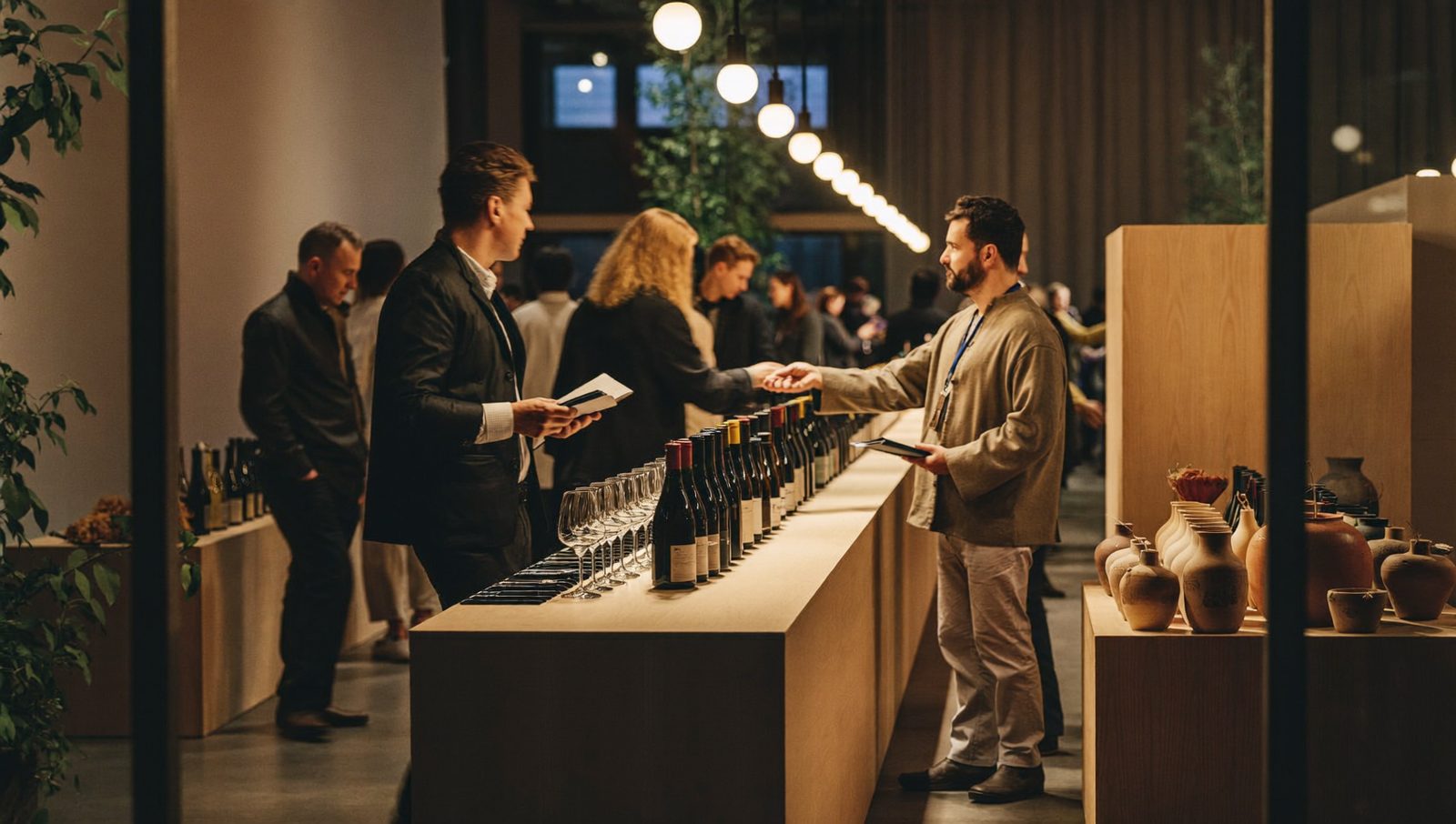
The profile of buyers can be inferred from the organisers' side activities. Sudvinbio runs a public event in spring that involves wine shops, restaurants and wine bars to promote organic wine. These are the channels the January fair seeks to reach, and they are where the wine of small producers finds space more easily than in mass retail.
The published data do not break down visitors by size, so the figure of the small importer is an interpretation of the format of these fairs, not a number. An importer working with a few independent wine shops and some restaurants looks for a selected and documented offer, and a natural wine fair provides exactly that. On domestic demand, ISMEA reports that in 2025 Italian households spent 4.4 billion euros on organic products. This is data on the domestic market, not on wine exports, but it shows how established the organic channel already is. For a broader look at buyer search, see organic and sustainable wine B2B market in export.
Frequently asked questions
Where is the international organic wine fair held?
Millésime Bio takes place at the Parc des Expositions in Montpellier, in Pérols, France. The next edition, the 34th, is listed for 25 to 27 January 2027. The fair brings together organic wine, cider, beer and spirits.
Is organic certification required to exhibit at a natural wine fair?
The fairs' public pages do not state this clearly. Organic certification and membership of a natural wine association are separate criteria, so it is worth checking the regulations of each fair to see which of the two is required.
How much does it cost to take part in an organic wine fair?
The fairs' public pages do not report stand prices or registration fees. The exhibitor price list should be looked up in the documentation of the individual fair, together with the booking deadlines.
Which natural wine fairs are held in Italy?
VinNatur organises VinNatur Tasting, which took place in Gambellara in 2026, as well as events in Milan and Genoa. The programme of editions is on the association's website, which should be consulted for the dates of future editions.
Sources
- Foreign online wine retailers: how to pitch Italian wine
- Bulk Wine Export Price: Where to Check Quotes and Trends
- How to Find Italian Wine Suppliers in Belgium (English)
- Bulk wine export: flexitank, prices and who buys it
- Italian Wine Suppliers in Germany: Guide for Importers
- 2027 Wine Fairs: Calendar, Dates and Cities for Exporters