Massal Selection for Resilient Vineyards
Wines Export Editorial · Last updated:
Gu Bra on Pexels
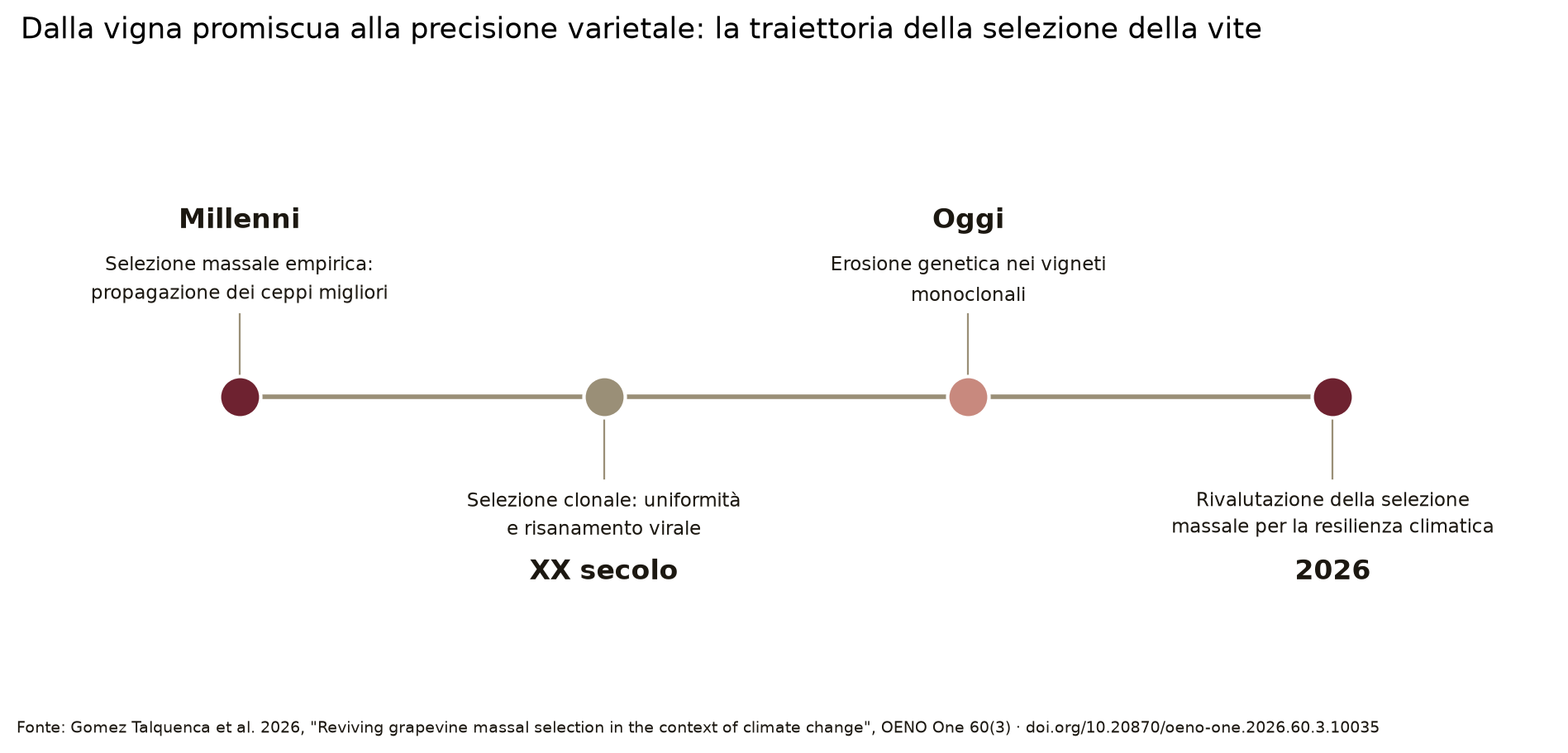
For centuries, grapevine improvement relied almost entirely on massal selection: growers identified and vegetatively propagated individuals with the desired phenotypic traits within their vineyard populations. Then, in the 20th century, clonal selection arrived — a genuine leap forward in uniformity and plant health, particularly against viral disease, but with an often-underestimated side effect: significant genetic erosion that reduced vineyards' capacity to buffer environmental fluctuations. A review published in July 2026 in OENO One (Gomez Talquenca et al.) traces this historical trajectory and argues why, in a climate-change context, massal selection deserves serious reconsideration — not as nostalgia, but as a complementary tool of precision viticulture.
A three-thousand-year trajectory
Source: Gomez Talquenca et al. 2026, OENO One 60(3).
The review draws on recent palaeogenomic evidence confirming that vegetative propagation (clonal in the broadest sense) was already widespread by the mid-Iron Age (roughly 625-500 BCE) and became a pillar of viticultural practice during the Roman period. One example cited by the authors is particularly telling: a genomic study of archaeological grape pips identified a Roman-period pip from Limoges (170-240 CE) genetically identical to a medieval sample from Valenciennes (1100-1200 CE), nearly 530 km away — and a Valenciennes pip dated to 1400-1500 CE genetically identical to modern Pinot Noir, establishing direct clonal continuity spanning roughly 600 years.
In practice: what we call a "variety" today is often the result of the long-term survival of clonal lineages propagated — in a massal, not strictly clonal, manner — over centuries. The key difference from modern clonal selection is that historical massal propagation vegetatively multiplied multiple elite individuals sharing a common phenotype, thereby preserving high levels of intra-varietal genetic diversity within the "variety."
The hidden cost of clonal standardisation
The central paradox the review focuses on is this: the widespread adoption of clonal selection in the mid-20th century successfully standardised production and eliminated major viral pathogens, but it unintentionally created a genetically simplified vineyard landscape. As climate pressures mount — heat waves, droughts, emerging diseases and pests — the limited adaptability of monoclonal vineyards has become a real vulnerability.
The review documents how, even within certified clonal collections, substantial exploitable variation persists. One example concerns Malbec: a large-scale analysis of 131 clones grown in a single vineyard demonstrated substantial variation in anthocyanin profiles, largely driven by differences in the expression of genes involved in anthocyanin hydroxylation, methylation, and transport — with direct implications for colour stability and phenolic balance under climate-change scenarios.
Phenology: the most concrete lever for climate adaptation
One of the review's most operationally relevant sections concerns phenology. Delayed phenology is an attractive adaptation lever because it shifts grape ripening later in the season, when temperatures are lower. One cited study analysed 14 years of data across eight clonal populations (including Pinot Noir and Riesling), revealing substantial phenotypic variation in agronomic (yield), quality (sugar), and disease-related traits, with moderate to high heritability.
One especially practical figure: a 7-10 day delay in veraison relative to the clonal population mean effectively shifts the ripening window away from peak heat stress — a significant advantage for regions like Mendoza or South Australia, and by extension for Italian zones most exposed to summer heat waves.
Late-budding clones: a hedge against frost
Another research thread cited concerns natural variation in budburst, flowering, and veraison timing among clones of the same variety. Clones with delayed budburst can evade late spring frosts, while vineyards with spread-out flowering times can be more tolerant of events like the Zonda wind (a South American hot, dry wind) which, over short periods, produces a dramatic temperature spike and drop in atmospheric humidity — conditions known to damage fruit set through stigma desiccation.
Aroma varies clone by clone, too
Another line of evidence the review cites concerns aromatic varieties, where variation in secondary metabolites is the defining quality parameter. Clonal differences in terpene profiles have been documented both at the molecular level — through variants in the DXS gene that determine Muscat flavour, including in the Chardonnay musqué clone — and at the oenological level, with clone-specific aroma profiles persisting from berry to finished sparkling wine. These examples also illustrate the difficulty of drawing a sharp line between varietal and clonal variation, since the same biosynthetic genes can harbour both inter-varietal polymorphisms and intra-varietal somatic mutations.
Beyond aromatics, clonal variation in phenolic composition is an equally relevant quality parameter. In Tempranillo, clonal evaluations revealed a wide range in colour intensity and anthocyanin content, with some clones showing stable expression across years and sites and others showing strong environmental dependence — a genotype-by-environment interaction that, combined with the Malbec evidence above, reinforces the hypothesis that some clones may perform differently under contrasting environmental conditions, making them particularly relevant for strategies targeting colour stability under climate-change scenarios.
What this means for sourcing decisions
The review does not propose abandoning clonal selection — quite the opposite, it explicitly argues that the strategic coexistence of clonal and massal selection represents the most mature expression of precision viticulture. For an international buyer evaluating supplier practices, this translates into a few practical considerations:
- Intra-varietal diversity is not a flaw to eliminate, but a resource to selectively preserve — especially for historic or autochthonous varieties, where old vineyards may host genetic variability that has not yet been catalogued or leveraged.
- Mixed (massal) vineyards or diversified clonal collections spread risk across genotypes, epigenotypes and viromes, with potential benefits for yield stability, stress tolerance and sustained terroir expression — without altering varietal identity, a point relevant to PDO/DOCG designations that legally tie production to a specific variety.
- Tools available today make revaluing massal selection far more practical than in the past: high-throughput genotyping, metagenomics and precision tools allow a much more rigorous characterisation of an old vineyard's diversity than was possible even a decade ago, reducing massal selection's historical risk (inadvertent propagation of virus-infected material).
A due-diligence angle for supply relationships
For a buyer conducting due diligence on a long-term Italian supplier relationship, the massal-vs-clonal question is worth raising directly, particularly for historic or single-vineyard bottlings marketed on terroir authenticity. A producer working an old, ungrafted or massal-propagated vineyard block is, per this review's argument, more likely to retain genetic buffering against emerging climate stress than one relying entirely on a narrow set of certified clones — a detail that can matter for supply continuity as much as for the marketing narrative around a wine's provenance.
A balance, not a return to the past
The review's central message is not nostalgic. The plant-health gains achieved through clonal selection remain a milestone not to be compromised — particularly on the viral front. But targeted conservation and genomic characterisation of existing massal populations, especially in old vineyards not yet grubbed up, can provide a valuable genetic reservoir for the climate-adaptation challenges of coming decades — a resource that, once lost through indiscriminate vine removal, cannot be recovered.
Data drawn from Gomez Talquenca, S. et al. (2026). Reviving grapevine massal selection in the context of climate change – A strategy for resilient vineyards in the 21st century. OENO One, 60(3). Open access, CC BY 4.0.
- Exporting Natural Wines and Cured Meats: A Winery Guide
- Malolactic Fermentation: What It Is and Why It's Critical for Red Wine Quality
- Exporting Italian Wine: A Guide for Wineries
- Italian Wine Exports 2025: Which Markets Are Growing, Which Are Shrinking
- Exporting Italian Wine: A B2B Winery Guide
- How to Export Wine Abroad: An Operational Guide to the First Shipment