Malolactic Fermentation: What It Is and Why It's Critical for Red Wine Quality
Wines Export Editorial · Last updated:
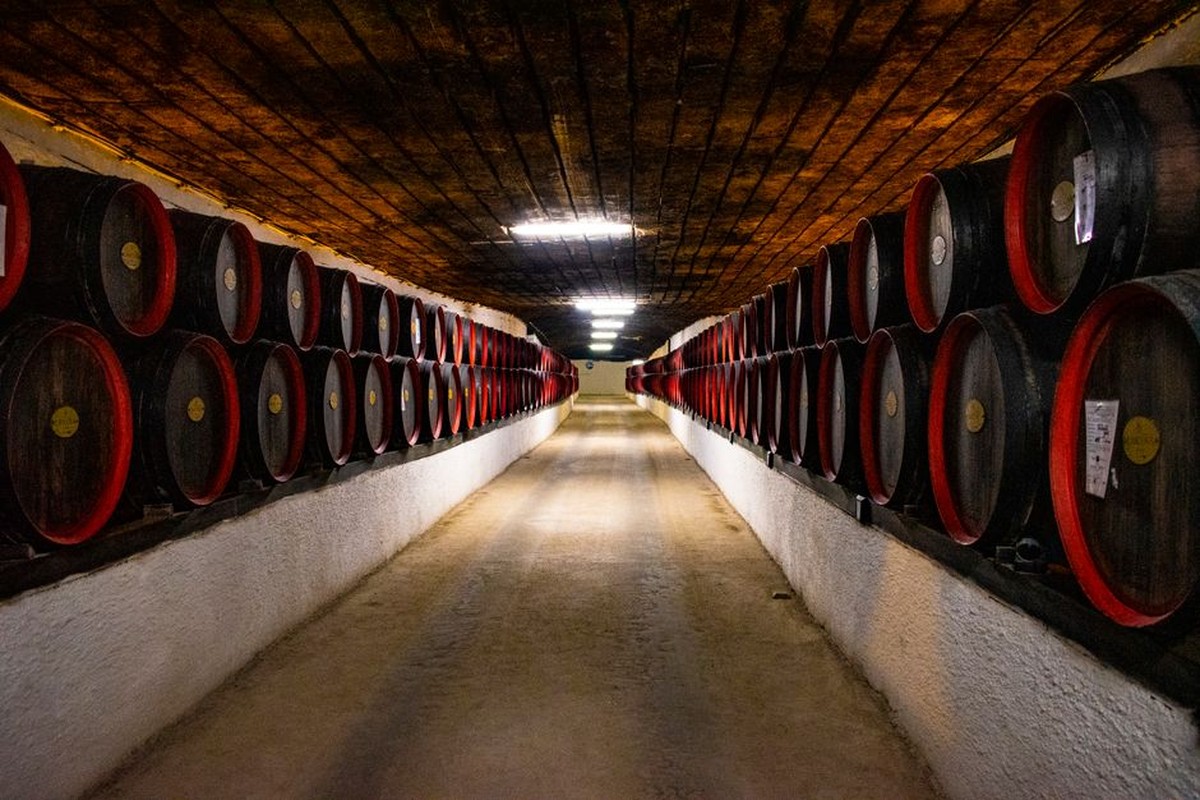 Photo: Ion Ceban, Pexels.
Anyone who has tasted a young red wine straight after bottling, then the same wine a year later, has already experienced malolactic fermentation without necessarily knowing it. It's the step that turns sharp acidity into roundness, and for the vast majority of red wines it isn't an optional stylistic detail — it's a near-mandatory stage between harvest and glass.
What malolactic fermentation actually is
Despite the name, malolactic fermentation (MLF) isn't a true alcoholic fermentation but a decarboxylation. As the Wikipedia entry on malolactic fermentation summarizes, the process "deacidifies the wine by converting the harsher diprotic malic acid to the softer monoprotic lactic acid."
The near-exclusive driver of this conversion in the cellar is a lactic acid bacterium, Oenococcus oeni. A review published in Frontiers in Microbiology describes most O. oeni strains as acidophilic, able to grow at pH 3.5 or lower, tolerant to the presence of ethanol, sulfur dioxide and polyphenols, as well as resistant to low temperature.
When it happens, and what it depends on
In most red winemaking protocols, MLF follows primary alcoholic fermentation, in an environment that is already hostile to many microorganisms. It's precisely in these conditions that O. oeni finds its ecological niche.
The parameters that determine success are well documented. A technical resource on managing MLF with selected bacteria notes that the optimal temperature range for malolactic bacteria is between 18°C and 22°C, while pH values lower than 3.2 may slow down or block the process, and free sulfur dioxide levels above 10-15 mg/L can inhibit the bacteria. A review of difficult malolactic fermentations from Penn State Extension adds that in the absence of SO2, the optimum temperature range for MLF is 23-25°C, with the process occurring faster at 20°C and above than at 15°C and below.
On pH, an Australian Wine Research Institute (AWRI) fact sheet recommends a range of 3.3-3.5 as a working compromise: at low pH there is a greater concentration of molecular SO2, which is toxic to MLF bacteria, while growth conditions that are more favourable for MLF bacteria at higher pH are also favourable for other spoilage microorganisms such as Pediococcus sp.
Free sulfur dioxide is another critical control lever, and it's where O. oeni shows its most fragile side. A study published in Microbiology Spectrum confirms that while O. oeni is tolerant to many of the wine stresses, including low pH and high ethanol concentrations, it has high sensitivity to SO2, an antiseptic and antioxidant compound regularly used in winemaking. This dual nature — resilient on some fronts, vulnerable on others — is what makes managing MLF a technical balancing act rather than a fixed recipe.
The chemical effect: what actually changes in the wine
The primary effect of MLF is chemical, measurable, and well quantified in the literature. Per Wikipedia, the different structures of malic and lactic acids lead to a reduction in titratable acidity of 1 to 3 g/L and an increase in pH of about 0.3 units, with the effect more pronounced the higher the starting malic acid concentration — typically in grapes from cooler climates.
Alcohol level also acts as a meaningful brake on the reaction: a winemaking resource hosted on ScienceDirect Topics reports that an increase in alcohol content from 11% to 13% has been associated with up to an 80% reduction in the rate of malic acid decarboxylation, one more reason warmer, higher-alcohol vintages call for closer monitoring of the malolactic process.
A related practical point is where MLF is most commonly carried out. As the same alcoholic-fermentation-adjacent sourcing notes, malolactic fermentation is generally activated at the end of alcoholic fermentation and represents a decisive step for the final quality of the wine, with Oenococcus oeni strains chosen for their tolerance to the extreme conditions of wine — low pH, high alcohol, free SO2 and osmotic pressure. This is also why timing matters as much as the biology itself: winemakers commonly track the progress of MLF by monitoring residual malic acid, since the shift in acidity can be too subtle to judge reliably by taste alone.
Microbiological stability: the less-discussed but equally critical reason
While the sensory improvement is the aspect most often mentioned in wine-shop conversations, in the cellar the decisive technical reason is often a different one: microbiological stability. As Wikipedia puts it, malolactic fermentation can help make wine microbiologically stable, since the lactic acid bacteria consume many of the leftover nutrients that other spoilage microbes could otherwise use to develop wine faults. In other words, residual malic acid is food for undesirable bacteria.
A review in FEMS Microbiology Reviews dedicated to O. oeni summarizes the benefit in three parts: MLF benefits wine three-fold — it provides microbial stability through the removal of a fermentable carbon source from the wine, reduces acidity by increasing wine pH by 0.2-0.5 units, and produces various sensory changes due to bacterial metabolism. This helps explain why, in the vast majority of red-wine cellars, MLF is treated not as a stylistic option but as an oenological safety step.
The flip side: diacetyl and the "buttery" risk
MLF is not without sensory risk. Among the byproducts of bacterial metabolism is diacetyl, a compound responsible for the "buttery" note typical of some white wines that undergo malolactic fermentation, such as Chardonnay.
What's less widely known — and directly relevant to structured red winemaking — is that the odor detection threshold for diacetyl isn't fixed: it varies sharply by wine type. The reference study on this question measured, using a forced-choice ascending-concentration series method (ASTM) with trained panelists, detection thresholds of 0.2 mg/L for Chardonnay, 0.9 mg/L for Pinot noir, and 2.8 mg/L for Cabernet Sauvignon, demonstrating — as the authors themselves conclude — that these results invalidate the use of a single threshold value for all wines.
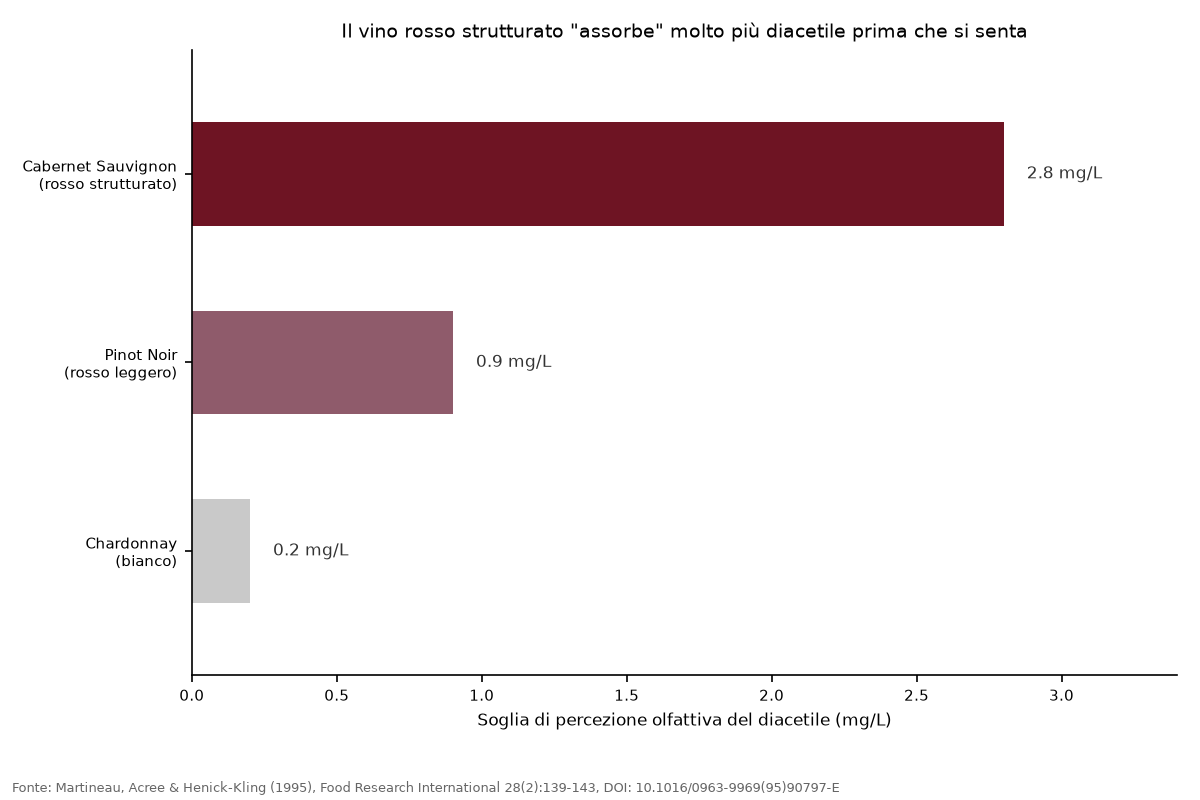 Source: Martineau, B., Acree, T.E., Henick-Kling, T. (1995), "Effect of wine type on the detection threshold for diacetyl", Food Research International 28(2): 139-143, DOI: 10.1016/0963-9969(95)90797-E.
In practical terms, the structured Cabernet Sauvignon in the study required a diacetyl concentration roughly 14 times higher than the Chardonnay before the buttery character became perceptible — a finding that helps explain why the same level of bacterial activity can pass unnoticed in a full-bodied red while standing out clearly in a delicate white.
What this means in practice for anyone assessing red wine quality
For a producer, knowing whether and how malolactic fermentation was conducted isn't a footnote on a technical data sheet — it speaks to style (roundness, complexity), risk (bottle stability), and winemaking precision (control of temperature, pH, SO2, and bacterial strain selection). An international buyer evaluating an Italian red for import looks at exactly these elements as a proxy for product reliability across the export supply chain.
How it's checked in the cellar: monitoring methods
Knowing whether malolactic fermentation is truly complete is not a matter of sensory perception but of analytical measurement — and it is a check that directly concerns anyone assessing a winery's technical reliability ahead of export. Paper chromatography remains the most common and inexpensive method: according to a Cornell University technical guide, the test is considered only qualitative, because its detection limit (100 mg/L) does not allow precise measurement of residual malic acid concentration, while malolactic fermentation is not considered safely complete until malic acid drops below 30 mg/L.
For this reason, most commercial wineries pair or replace paper chromatography with enzymatic analysis, which allows a precise quantitative reading via spectrophotometer. As an Australian Wine Research Institute (AWRI) guide describes, paper chromatography mainly detects the disappearance of malic acid and the appearance of lactic acid produced by malolactic fermentation, but a reliable quantitative measurement requires the enzymatic method or, in better-equipped labs, HPLC (high-performance liquid chromatography) or capillary electrophoresis, according to guidelines from the University of California, Davis.
For an Italian winery dealing with a foreign importer — especially in markets with strict quality controls such as the USA, Germany, or the UK — being able to document which method and what residual malic acid value were used to declare malolactic fermentation complete is an element of technical transparency that reinforces buyer trust, on a par with the temperature, pH, and SO₂ traceability already covered in this article.
In practical terms, many wineries today choose not to leave MLF to chance, inoculating selected, freeze-dried strains of Oenococcus oeni, often co-inoculated with yeast 24 hours after alcoholic fermentation begins. According to a technical article from Penn State Extension, the longer it takes to initiate malolactic fermentation, the greater the risk of Brettanomyces growth, the yeast responsible for unwanted aromatic defects (notes of "horse sweat", "band-aid"); co-inoculation, by controlling the microbial populations present, helps contain this risk. Alternatively, MLF can occur spontaneously, relying on lactic bacteria already present in the cellar: a choice that is less predictable in timing, but sometimes preferred for the sensory complexity it can add to the finished wine. For an exporting winery, the chosen method — inoculated or spontaneous — is technical information that an attentive importer may request, alongside the temperature and SO₂ data already covered in this article.
Want to see the real buyers for your wine?
Winemaking quality is the foundation, but exporting also means knowing who, in international markets, is actually looking for a wine like yours.
- Massal Selection for Resilient Vineyards
- Italian Wine Exports 2025: Which Markets Are Growing, Which Are Shrinking
- Exporting Natural Wines and Cured Meats: A Winery Guide
- How to Export Wine Abroad: An Operational Guide to the First Shipment
- Exporting Italian Wine: A Guide for Wineries
- How Long Does a Reliable Rootstock Trial Need to Run?