Italian Wine Exports 2025: Which Markets Are Growing, Which Are Shrinking
Wines Export Editorial · Last updated:

Wolfgang Weiser on Pexels
For a buyer sourcing Italian wine, a single headline figure on "the export market" hides more than it reveals. Country-level customs data reported to UN Comtrade — cross-referencing Italy's declared wine exports (HS code 2204) against its main destination markets — shows a two-speed picture through 2025: growth in Germany, near-flat performance in the UK, and a decline in the United States. For a buyer weighing supplier relationships or negotiating position for the year ahead, that country-level detail is more actionable than the world aggregate on its own.
What UN Comtrade measures, and why it's a useful reference
UN Comtrade is the United Nations' official international merchandise trade database, populated from the customs declarations each member country files annually. For wine, the relevant customs heading is HS 2204 (wine of fresh grapes, including fortified wines; grape must), and for every exporter/partner/year combination the database reports both a declared value in US dollars — typically FOB, i.e. before freight and insurance — and net weight in kilograms. It is country-level aggregated data, not broken down by producer or by specific wine style, but that is also its strength: it gives a consistent, independently verifiable basis for comparing markets, built from the same customs authorities that clear each shipment.
The world picture: exports roughly flat
Looking at Italy's declared wine exports to the world, total value (HS 2204, FOB USD) moved from $8,741.7 million in 2024 to $8,788.5 million in 2025 — a change of only +0.5%. On its own, that number reads as a quiet year. The chart below shows why it isn't: the aggregate masks sharper, opposing moves at the individual-market level.
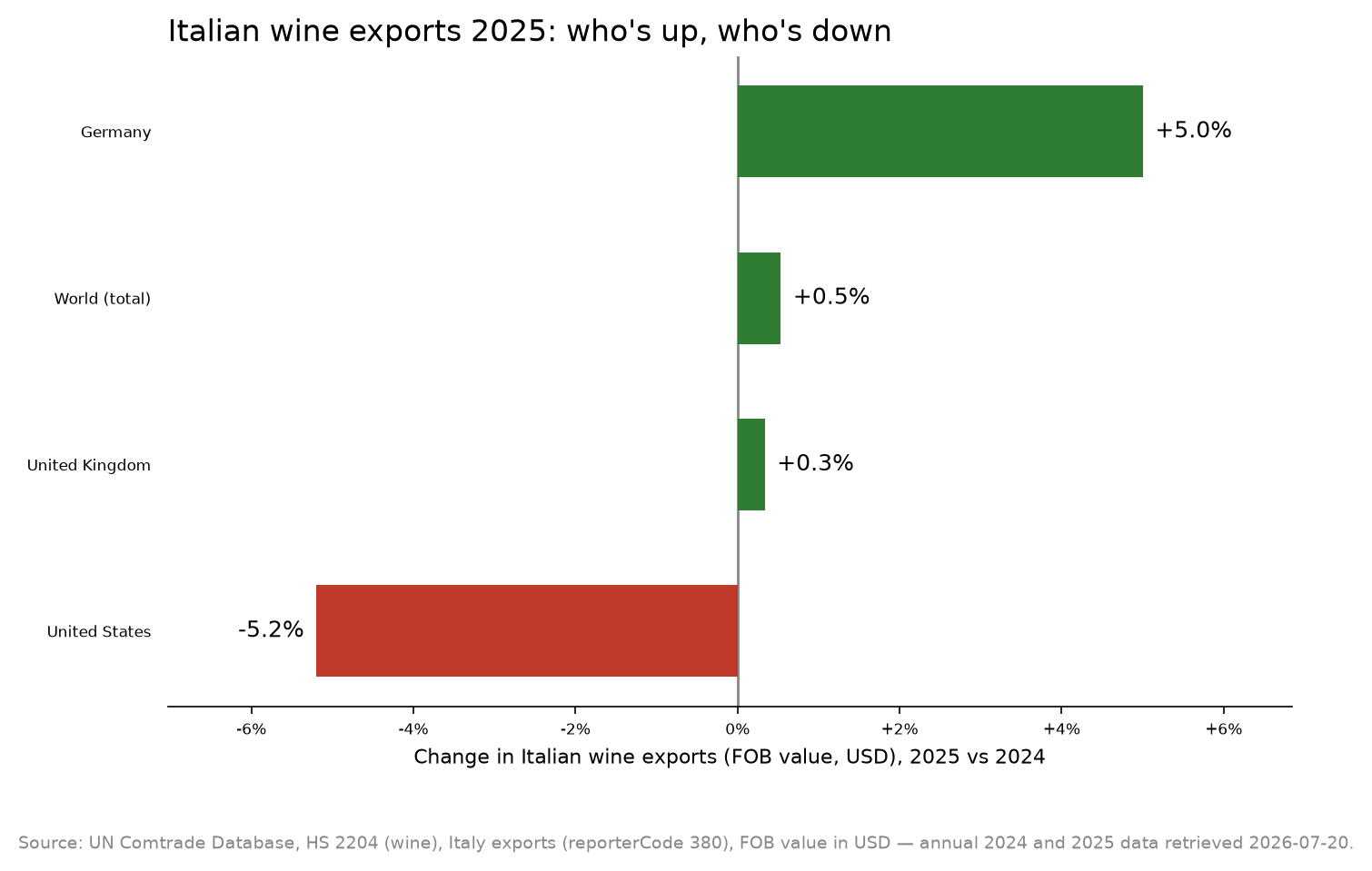
Source: UN Comtrade Database, HS 2204 (wine), Italy exports (reporterCode 380), FOB value in USD — annual 2024 and 2025 data, retrieved 2026-07-20.
Germany: the strongest performer
Of the three reference markets, Germany posted the best 2024-to-2025 comparison: the value of Italian wine exports to Germany rose from $1,227.3 million to $1,288.7 million, a +5.0% year-on-year gain according to Comtrade data. That is consistent with other trade reporting on a German market recovery through 2025 and into 2026, following a period of weaker domestic consumption tied to consumer-price pressure in prior years. For a buyer or an Italian supplier alike, Germany remains the largest of these three destination markets in absolute value, so a return to growth — even a moderate percentage gain — represents a meaningful volume of wine actually changing hands: five percentage points on a base above $1.2 billion works out to more than $60 million in additional trade value in a single year.
The UK: minimal growth, but stable
The UK shows a picture of essential stability: from $919.9 million to $923.0 million, +0.3% year-on-year. That is not a growth rate that reshapes commercial priorities on its own, but against a nearly flat world total and a sharp US decline, UK stability still carries relative weight — particularly for buyers and suppliers who have invested in direct importer and distributor relationships in a market that, since Brexit, typically requires longer lead times for labelling compliance and customs procedures. A modest but consistent year-on-year gain is often a more reliable signal of commercial stability than a single exceptional year followed by a correction.
The United States: the one market in decline, for a known reason
The US is the only one of the three reference markets in clear decline in the Comtrade 2024-2025 comparison: from $2,097.8 million to $1,988.8 million, a -5.2% year-on-year drop. The cause is not a mystery. As of August 1, 2025, EU wine exports to the United States have been subject to a 15% tariff, under the trade agreement reached on July 27, 2025 between European Commission President Ursula von der Leyen and President Donald Trump — an increase on the prior arrangement, though well below the 30% (and at one point up to 200%) tariff threatened in the weeks before the deal was struck. Multiple trade outlets have documented the economic impact of this measure on the broader European wine sector's US-bound exports through 2025, particularly on the margin US importers must absorb or pass down the supply chain.
For a buyer purchasing Italian wine in the US, the Comtrade figure confirms what the market has already been signalling: the drop in customs-declared value does not necessarily track a matching drop in end-consumer demand. Part of the decline reflects the effect of the new import cost on US importers' purchasing and inventory strategy — a number of buyers front-loaded orders ahead of the tariff's effective date, shifting volume between the two years in the customs statistics rather than reducing total consumption outright.
What this means for sourcing and supplier decisions
Put together, these three signals — Germany growing, the UK stable, the US declining for well-documented tariff reasons — give a more useful read than the flat world average alone, which by itself would have suggested a quiet year without flagging either the risk or the opportunity underneath it. A US market contracting under a tariff that has now been in force for close to a year (barring further negotiation) points toward renegotiating margin and pricing expectations with suppliers, not necessarily walking away from Italian wine sourcing there — the US remains, in absolute value, the largest of the three destination markets by far. Germany, conversely, is currently the strongest growth signal of the three, and merits sourcing attention in proportion to both its size and its current momentum.
What aggregated trade data can — and can't — tell a buyer
One limitation worth flagging: the Comtrade figures used here are aggregated by country and year — they don't break out wine category (still, sparkling, IGP/DOP), and they don't directly separate a price effect from a volume effect within the value change observed (the most consistently available figure is declared FOB value in dollars, not hectolitre volume for every country-year-category combination). Still, this is a solid, free, independently verifiable starting point for reading a market's direction before drilling into more granular category-level data — or into the actual commercial contacts active in a given country, where aggregate statistics give way to individual buyers with their own specific product, price, and volume requirements.
Sources
- UN Comtrade Database — aggregated Italy export data, HS 2204 (wine), reporterCode 380, retrieved 2026-07-20
- Reuters/Investing.com — EU wine, spirits to face 15% US tariff from Aug 1 (July 31, 2025)
- VinePair — 15% Tariffs on European Wine and Spirits Start August 1 (July 31, 2025)
Want to see the real buyers for your wine sourcing?
Aggregated trade data is useful for reading a market's direction, but sourcing decisions need to know who, in that market, is actually buying wine today — with verifiable contacts, not just customs statistics. Try the free demo of Wines Export and check which buyers are active in the markets you're evaluating.
- Malolactic Fermentation: What It Is and Why It's Critical for Red Wine Quality
- How to Export Wine Abroad: An Operational Guide to the First Shipment
- Massal Selection for Resilient Vineyards
- How Long Does a Reliable Rootstock Trial Need to Run?
- Exporting Natural Wines and Cured Meats: A Winery Guide
- Hottone: the Malavasi sparkling wine aged on the bottom of a lake