Exporting wine to Switzerland: importers, tariff quota, VAT, documents and labelling
Wines Export Editorial · Last updated:
To export wine to Switzerland, an Italian winery sells it to a Swiss importer that trades in wine, is registered with the Swiss Wine Trade Control and holds a general import licence (PGI, Generaleinfuhrbewilligung) from the Federal Office for Agriculture (FOAG), which businesses need from 20 kilograms gross upwards (FOAG, wine imports; Wine Ordinance, art. 34). In Italy the winery files the export declaration, and the proof of exit closes the sale without Italian VAT; in Switzerland the importer declares the wine in e-dec, which stays in use until 30 September 2027 before the switch to the new Passar system (FOCBS, Passar roadmap). Still red and white wine enters under the annual tariff quota of 1.7 million hectolitres, allocated in the order customs declarations are accepted and not exhausted in recent years: 126.6 million litres of it were used in 2025 (FOAG, "Das Weinjahr 2025"). Switzerland levies no excise duty on wine, but charges 8.1 percent import VAT (FOCBS, taxation of alcoholic beverages; VAT Act, art. 25), and the label follows the FDHA Beverages Ordinance, written in at least one official language of the Confederation, Italian included.
This is the full guide to the Swiss market. Each step has its own page: the tariff quota and out-of-quota duty, the label for Switzerland, channels and cantons of Swiss importers and shipping to private buyers and restaurants. Swiss buyers and the Italian denominations they carry are listed on wine importers in Switzerland.
How much Italian wine does Switzerland buy?
Italy is Switzerland's largest wine supplier, with 43.8 percent of imported volume in 2025. The federal statistics "Das Weinjahr 2025" from the FOAG count 155 million litres imported, 8 million fewer than in 2024 (−4.9 percent); among the top ten suppliers that declined, Italy fell least, by 3 percent.
| Country of origin | Wine imported into Switzerland in 2025 (hectolitres) | Share of total | Source |
|---|---|---|---|
| Italy | 679,420 | 43.8% | FOAG, Das Weinjahr 2025, table 3.2 |
| France | 359,102 | 23.1% | same |
| Spain | 229,432 | 14.8% | same |
| Portugal | 82,740 | 5.3% | same |
| United States | 49,909 | 3.2% | same |
| Total imports | 1,552,154 | 100% | same |
Of the 679,420 Italian hectolitres, 387,891 are red wine, 134,301 white and 143,080 sparkling: Italy alone supplies almost two thirds of the 225,445 hectolitres of sparkling wine imported (FOAG, tables 3.1 and 3.2). On the consumption side, Switzerland drank 211.2 million litres of wine in 2025, 3.3 percent less than the year before; Swiss wines account for 37.5 percent, foreign wines for 132 million litres (FOAG, Das Weinjahr 2025). The market is mature and slightly shrinking, but Italian wine is losing less than the others.
Who buys Italian wine in Switzerland?
The buyers are mainly wine importers and wholesalers, who sell on to wine shops, restaurants and chains, plus some retail chains that import directly. To import within the quota, importing must be a professional activity and the importer must meet the obligations of the wine trade control (FOAG, report on tariff measures 2025, chapter 3.13).
- Importers and wholesalers. Every business trading in wine must register with the Swiss Wine Trade Control (CSCV/SWK) before starting, keep cellar accounts and an inventory of stocks (Wine Ordinance, art. 34 and 34a). The CSCV inspects businesses at least every six years, every eight for those importing no more than 20 hectolitres a year of labelled bottles only (art. 35). The PGI is requested online through eKontingente, is free of charge and arrives within one or two working days, but CSCV registration comes first (FOAG, wine imports).
- Retail chains. Coop and Denner sell wine; Denner belongs to the Migros group, whose supermarkets do not sell alcohol: in June 2022 members of the ten regional cooperatives voted to keep the ban, while the group sells alcohol through Denner and migrolino (swissinfo.ch, 16 June 2022). How the chains work with foreign suppliers is covered on Swiss wine tenders at Coop, Denner and other chains.
- Restaurants, wine shops and private buyers. As a rule they buy from the importer. A private individual may receive up to 20 kilograms gross, about 17 bottles of 0.75 litres, without a PGI; above that threshold the PGI applies to them too, while CSCV registration is only required for resale (FOAG, wine imports). Direct sales are covered on shipping to private buyers and restaurants.
Ticino, German-speaking Switzerland and Romandy have different importers and habits: the map is on channels and cantons. If you are considering one partner for Germany, Austria and Switzerland, read a single DACH importer first: Switzerland has its own customs, tax system and quota.
How do the tariff quota and duties work?
Still white and red wine pays the in-quota rate as long as the annual global quota, 1,700,000 hectolitres per calendar year, remains open. Quota shares are allocated in the order import declarations are accepted (Wine Ordinance, art. 45; FOCBS, tariff quotas sheet, April 2026).
| Rule | What it provides | Source |
|---|---|---|
| Quota volume (no. 23, 24 and 25) | 1,700,000 hectolitres per calendar year for white and red wine | FOAG, wine imports; FOAG, 2025 report |
| Allocation | in order of acceptance of declarations, automatically in e-quota; once the quota is exhausted, no further imports at the in-quota rate | Wine Ordinance, art. 45; FOCBS, tariff quotas |
| Who can use it | only those importing professionally and meeting the obligations of art. 34 of the Wine Ordinance | FOAG, 2025 report, ch. 3.13 |
| General import licence (PGI) | for businesses from 20 kg gross; always for in-quota tariff lines | FOAG, wine imports; Agricultural Import Ordinance, annex 1 no. 19 |
| Sparkling wine (2204.1000) and sweet wines, specialities, mistelles (2204.2150) | no PGI needed | ICE Agency, wine export guide, Switzerland (February 2026) |
| Bottled wine tariff lines | white 2204.2121 in quota, 2204.2129 out of quota; red 2204.2141 in quota, 2204.2149 out of quota | FOAG, Das Weinjahr 2025, table 3.1 |
| Use in 2025 | 1,265,791 hectolitres imported within the quota; quota not exhausted, as in previous years | FOAG, Das Weinjahr 2025 |
The rates are in the Tares working tariff: the Agricultural Import Ordinance lists only those that differ from the general tariff and refers to Tares for the rest (annex 1 no. 19). The importer's forwarder calculates the duty on the exact tariff line; the mechanism and the lines are explained on the tariff quota and out-of-quota duty, classification on HS codes 2204.
The allocation rule may change. From 11 March to 18 June 2026 the Federal Council consulted on allocating the quota according to purchases and pressing of Swiss grapes; the proposal found no majority, and on 1 October 2026 the President of the Confederation announced that the 2027 agricultural ordinance package will propose auctioning the wine quota, with a consultation expected in January 2027 (FDFA, press release of 1 October 2026). Until a decision is taken, allocation by order of acceptance applies; it is still worth stating in the contract who pays the duty if a consignment ends up out of quota.
Does wine pay excise duty and VAT in Switzerland?
No excise: Switzerland taxes spirits and beer, while wine is exempt; natural grape wines up to 18 percent vol fall under food law, not alcohol law (FOCBS, taxation of alcoholic beverages). VAT, however, applies: customs collects it on import together with the duty (ICE Agency).
The rate is the standard 8.1 percent, in force since 1 January 2024; the reduced 2.6 percent rate applies to foodstuffs "except alcoholic beverages" (VAT Act, art. 25; Federal Tax Administration). The ICE sheet still quotes 8 percent, the rate before 2024. In Italy the sale is a zero-rated export under art. 8 of Presidential Decree 633/72, and the invoice must say so (ICE Agency). Who pays Swiss duty and VAT depends on the Incoterm: under DAP the importer pays, under DDP the winery; the comparison is on excise and VAT along the DAP and DDP chain, the effect on the final price on duties, VAT and margins in Switzerland.
Which documents are needed, from Italy to Swiss customs?
You need an export declaration in Italy, an import declaration in Switzerland and the supporting documents, including proof of origin. Certificates of analysis are not required (ICE Agency).
| Document | Purpose | Source |
|---|---|---|
| Export invoice in three originals | with the statement of VAT non-taxability under art. 8 DPR 633/72 | ICE Agency |
| Export declaration | filed electronically in AIDA at the customs office responsible for the exporter's premises or the place of loading | ADM, export procedure |
| Export accompanying document | issued by the export office; goods and document go to the office of exit within 90 days | ADM, export procedure |
| "Exit completed" message | proof that the wine has left the customs territory of the Union | ADM, export procedure |
| Proof of origin | invoice declaration up to 6,000 euros; above that, EUR.1 or a declaration by an approved exporter | ICE Agency; European Commission, Access2Markets |
| Packing list | if the shipment contains several types of wine | ICE Agency |
| Swiss import declaration | in e-dec import, with the importer's PGI; e-dec remains in use until 30 September 2027 | ICE Agency; FOCBS, Passar roadmap |
| Passar 2.0 import | the new customs system, open to pilot companies since the second quarter of 2026 | FOCBS, Passar import |
Proof of origin, the 6,000 euro threshold and REX registration are explained on EUR.1, preferential origin and REX. Swiss clearance is usually handled by the importer's forwarder: agree before shipping who files the declaration.
What must the wine label show for Switzerland?
The mandatory particulars are those of article 75 of the FDHA Beverages Ordinance (SR 817.022.12, version of 1 August 2026), plus the general ones in the Food Information Ordinance (LIV/OID) that the article refers to. They must be written in at least one official language of the Confederation (Foodstuffs and Utility Articles Ordinance, art. 36), so a label in Italian is valid throughout Switzerland.
| Particular | Rule | Source |
|---|---|---|
| Product name | for PDO, DOC and similar wines the rules of the country of origin apply; without a designation, "wine" with the country of production | Beverages, art. 75(1)(a) and art. 76 |
| Name and address | of the producer, winemaker, merchant, importer, bottler or seller | Beverages, art. 75(1)(b) |
| Country of production | unless it is clear from the name or the address | Beverages, art. 75(1)(c) |
| Alcohol content | in "% vol"; tolerance up to 0.8 percent vol for sparkling wines and PDO or PGI wines bottled for more than three years | Food Information Ordinance, art. 3 and 18 |
| Lot and GMO statement where relevant | mandatory | Food Information Ordinance, art. 3(1)(m) and (o) |
| Allergens (e.g. sulphites) | if detectable in the finished product; the pictograms of annex 10 may replace the words | Beverages, art. 75(1)(e) |
| Field of vision | all particulars in the same field of vision, except allergens and lot | Beverages, art. 75(2) |
| Grape variety and vintage | allowed only with at least 85 percent of grapes of the stated variety or vintage | Beverages, art. 75(6) and (7) |
| Sparkling wines | one of the terms from "extra-brut" to "dolce" according to residual sugar | Beverages, art. 75(3) |
| Ingredients and nutrition | if given voluntarily, may be provided electronically under the conditions of Regulation (EU) 1308/2013, art. 119 | Beverages, art. 75(8), in force since 1 July 2025 |
One point to correct against many guides: the federal text does not require the Swiss importer's address, but the name and address of one of the operators listed, the producer included. Many importers still add a sticker with their own details; agree this with them before printing. The detail is on the label for Switzerland.
Which offices deal with imported wine?
Imported wine passes through four different offices, each with a specific task.
| Office | Task | Source |
|---|---|---|
| Federal Office for Agriculture (FOAG/BLW) | quota, PGI, Wine Ordinance, wine statistics | FOAG, wine imports |
| Federal Office for Customs and Border Security (FOCBS/BAZG) | import declaration, duty, import VAT, e-quota, Passar | FOCBS, tariff quotas; Passar roadmap |
| Federal Food Safety and Veterinary Office (FSVO/BLV) | food law: Beverages Ordinance and food information | Beverages Ordinance |
| Swiss Wine Trade Control (CSCV/SWK) | registration of businesses, inspections of origin, quality and labelling | CSCV; Wine Ordinance, art. 34-35 |
Which Italian wines does the Swiss market know?
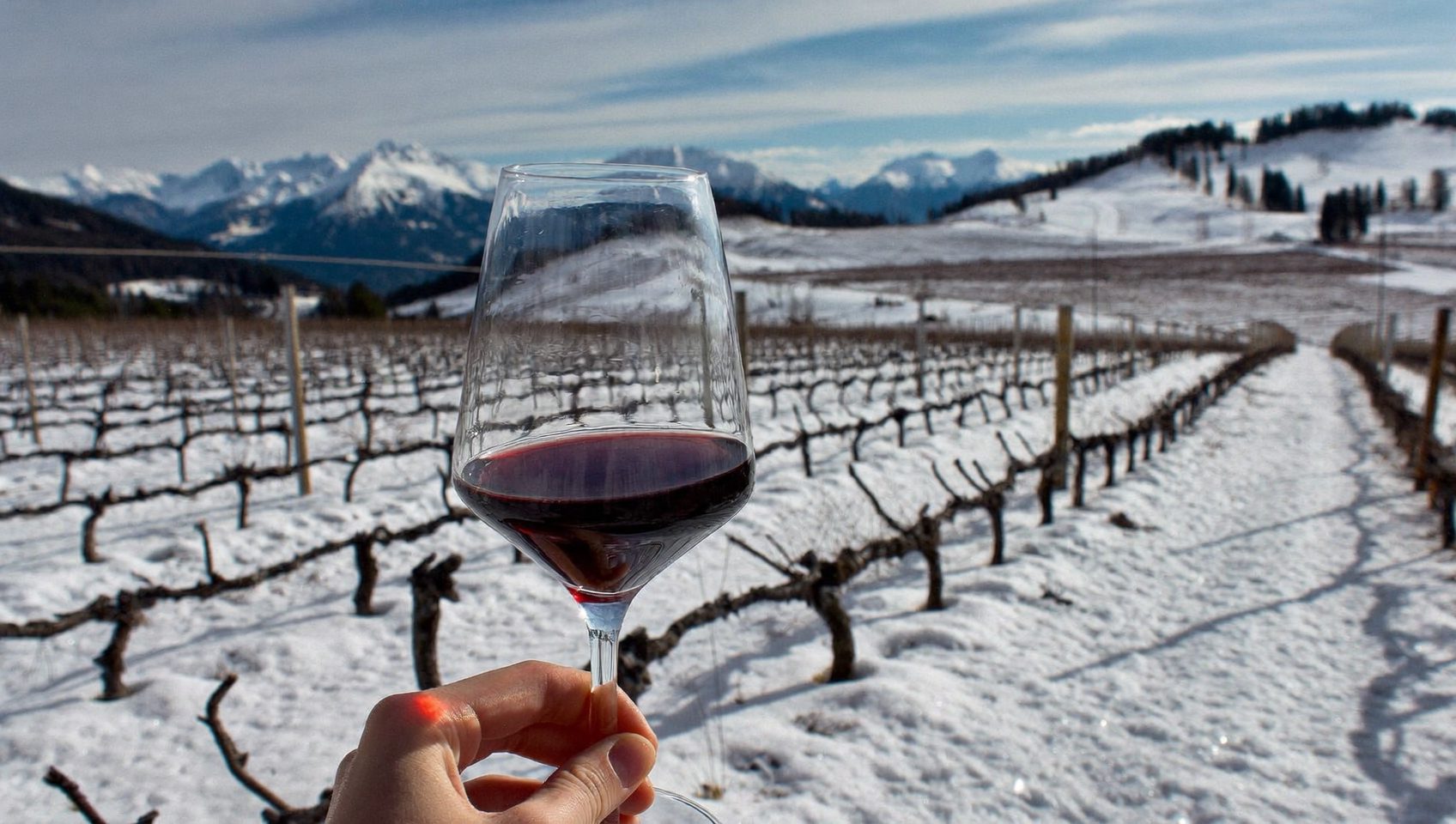
The closest ties are cross-border. The Valtellina Superiore DOCG rules allow the Ministry to authorise ageing in the Swiss municipalities of Brusio and Poschiavo, and permit the term "Stagafassli" only for wine bottled in Switzerland, without sub-zones or Riserva (Valtellina Superiore disciplinare, art. 5 and 6). The rules of the denominations Switzerland asks for most often are in our guides: Valtellina, Sforzato di Valtellina, Franciacorta, Amarone della Valpolicella and Bolgheri; the border region as a whole is covered in wine from Lombardy.
Frequently asked questions
Do you need an importer to sell wine in Switzerland?
In practice, yes. Importing within the quota requires a PGI and registration with the Swiss Wine Trade Control, and quota shares go only to those importing professionally (FOAG). An Italian winery usually does not meet these requirements and sells to the importer.
How much duty does Italian wine pay in Switzerland?
It depends on the Tares line and the quota: white and red wine declared within the quota pays the in-quota rate, out of quota a higher rate. The 1.7 million hectolitre quota was not exhausted in 2025 (FOAG, Das Weinjahr 2025).
Does wine pay excise duty in Switzerland?
No. Switzerland taxes spirits and beer; wine is exempt (FOCBS). Duty and 8.1 percent import VAT are payable.
Does an Italian label have to be translated into German or French?
No, if the mandatory particulars are in Italian: one official language of the Confederation is enough (Foodstuffs and Utility Articles Ordinance, art. 36). The importer may ask for a label in another language for its customers.
Is the importer's address mandatory on the label?
Not as such. The Beverages Ordinance requires the name and address of one operator among producer, winemaker, merchant, importer, bottler or seller (art. 75(1)(b)).
Will the wine quota change?
Possibly. The proposal to allocate it according to purchases of Swiss grapes did not win a majority in consultation; an auction will be proposed for the 2027 package, with a consultation expected in January 2027 (FDFA, 1 October 2026). Today allocation follows the order in which declarations are accepted.
Sources
- FOAG, Einfuhr von Wein und Trauben zum Keltern (quota, PGI, CSCV, private imports)
- FOAG, Das Weinjahr 2025, wine statistics (tables 3.1 and 3.2, consumption)
- FOAG, report on tariff measures adopted in 2025, ch. 3.13 (Italian)
- FOCBS, Tariff quotas (April 2026)
- Fedlex, Wine Ordinance (SR 916.140), version of 1 January 2026, art. 34, 34a, 35 and 45
- Agricultural Import Ordinance (SR 916.01), annex 1 no. 19
- FDFA, Bundespräsident Guy Parmelin trifft Akteure der Weinbranche, 1 October 2026
- Consultation on amending the Wine Ordinance, synoptic table of art. 45 (11 March 2026)
- FOCBS, Besteuerung alkoholischer Getränke in der Schweiz
- Fedlex, VAT Act (SR 641.20), art. 25 and Federal Tax Administration, VAT rates
- FOCBS, Passar Einfuhr and Passar 2 and 3 roadmap
- Fedlex, FDHA Beverages Ordinance (SR 817.022.12), version of 1 August 2026, art. 75 and 76
- Fedlex, FDHA Food Information Ordinance (SR 817.022.16), art. 3, 4 and 18
- Fedlex, Foodstuffs and Utility Articles Ordinance (SR 817.02), art. 36
- Swiss Wine Trade Control (CSCV/SWK)
- ICE Agency, wine export guide, Switzerland (February 2026) and ICE, Switzerland market, Bern office
- ADM, export procedure
- European Commission, Access2Markets, rules of origin
- swissinfo.ch, Swiss retail giant Migros votes to remain alcohol-free, 16 June 2022
- Valtellina Superiore DOCG disciplinare, art. 5 and 6 (Ministry of Agriculture, copy hosted by AIS)
Answer four questions about your winery: we will write back.
Who buys wine in Switzerland? A few names
According to the Wines Export Observatory (November 2026), the Italian denomination most carried by wine buyers in Switzerland is Prosecco: 34% of those whose Italian range we know carry it, followed by Primitivo (28%) and Amarone (20%).
The Wines Export database covers the whole wine trade in Switzerland: importers, distributors, wholesalers, wine shops and online stores, city by city, updated continuously (23 November 2026). The Italian denominations most carried by buyers in Switzerland, in order: Prosecco, Primitivo, Barolo, Valpolicella and Amarone.
Zürich
Vini Vergani · Supertoscano GmbH · Boucherville AG
Bern
La passion du vin · AJ Wein · Getränke-Center Bern
Basel
Nobilvino · Vini Donati · Vinenzo Weinhandel GmbH
- Exporting Wine to Ukraine: Duties, Excise, Licences, Stamps
- Exporting Wine to Sweden: Shipping, e-AD, MVV and Timelines
- Shipping wine to Hungary: e-AD, e-SAD, deposit and timing
- Shipping Wine to Czechia: e-AD, e-DAS, MVV and Deadlines
- Export Wine to Turkey: Importers, ÖTV Tax and Banderole
- Exporting Wine to the UK: Rules and Buyers