Yunnan wine (China): Deqin and Shangri-La on the Mekong, Mile, high-altitude vineyards, grapes, producers and how it compares with Italy
Wines Export Editorial · Last updated:
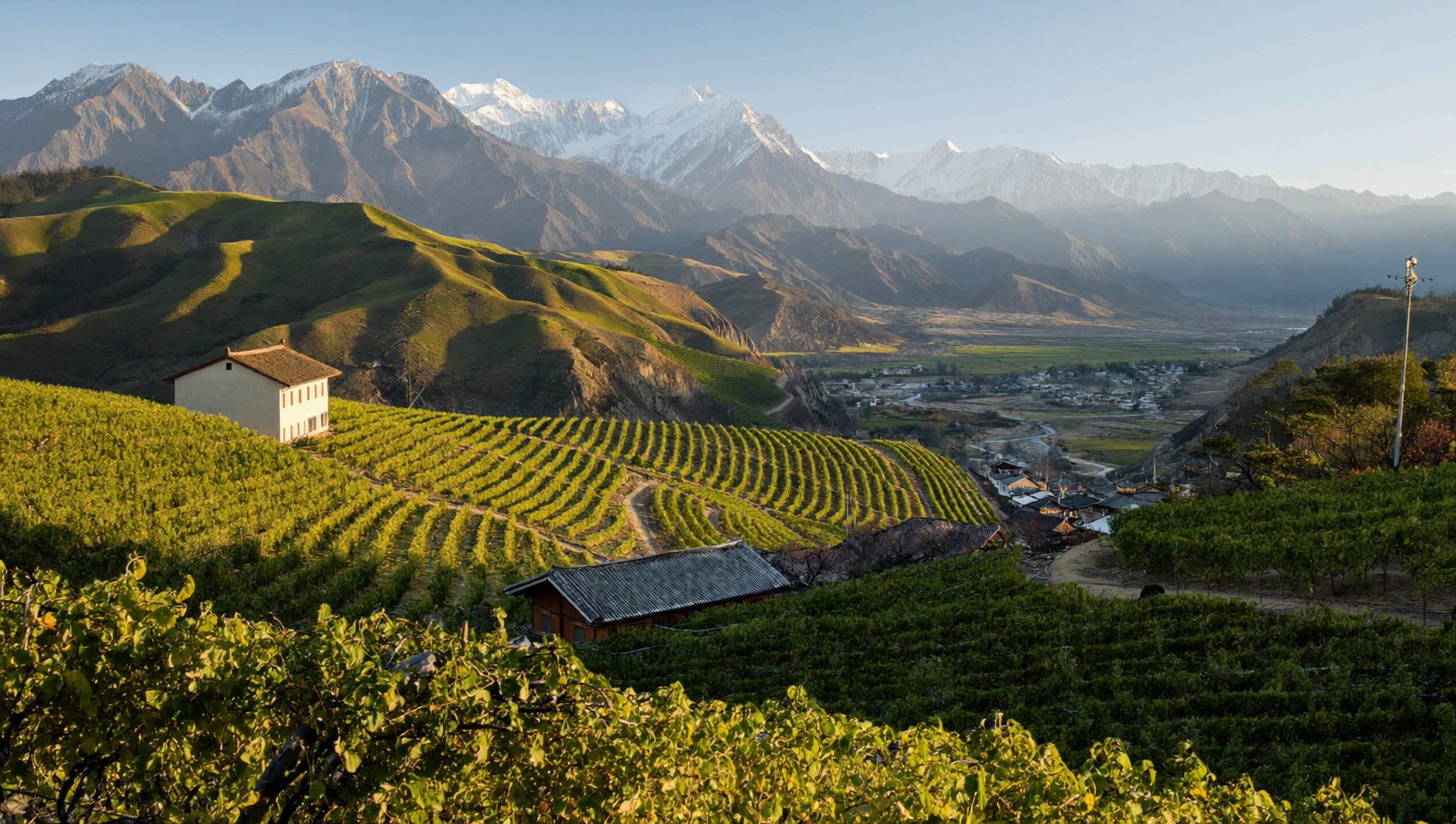
Yunnan is the province in south-west China where vines grow highest: on the plateau, vineyards sit between 1,500 and 2,900 metres above sea level, in a band between 28° and 30° north (Xing et al., South African Journal of Enology and Viticulture, 2015). The best-known areas for red wine are in Deqin County, in the north, on the banks of the Lancang (the Chinese name of the Mekong) near Shangri-La; in the south, around Mile, wine is made mostly from hybrids such as Rose Honey and Crystal (Meininger's Wine Business International, no. 2/2016). Yunnan has no wine geographical indication protected in the European Union: the four protected Chinese wine areas are in other provinces (EU eAmbrosia register).
This page covers Yunnan's areas, altitudes, climate, grapes, producers and rules, and compares the region with Italy only on verifiable facts. For anyone selling Italian wine in China, the starting point is how to export wine to China.
Where is wine made in Yunnan?
Yunnan wine comes from two very different areas: the high valleys of the north, along the Mekong, and the Mile area in the south. The north is the home of red wines from European grapes; the south of hybrids and volume wine.
| Area | Where it is | Vineyard altitude | What is grown | Source |
|---|---|---|---|---|
| Deqin, villages of Adong, Xidang, Sinong and Shuori | banks of the Mekong at the foot of Mount Meili, near Shangri-La | 2,200 to 2,600 m (Ao Yun vineyards) | Cabernet Sauvignon with Cabernet Franc, Syrah, Petit Verdot and Merlot | LVMH, Ao Yun page |
| Deqin, Shuori, Meilishi and Benzilan vineyards | same county, three commercial vineyards | about 2,900, 2,300 and 2,150 m | Cabernet Sauvignon | Xing et al., 2015 |
| Lancang (Mekong) valley | from south of Markam to the north of the Deqin section | suitable altitude estimated at 1,800 to 2,800 m | climate model for wine grapes | Wang et al., 2018 |
| Plateau near Shangri-La | ice wine project | 2,300 and 2,850 m | Vidal (30 hectares in 2016) | Meininger's WBI, 2016 |
| Mile, about two hours' drive south of Kunming | Yunnan Hong winery | about 1,600 m | Rose Honey, Crystal, French Wild, Yun Zhong Wu | Meininger's WBI, 2016 |
| Cizhong | village with the missionaries' church, some 600 km north of Mile | not stated | historic mission vineyard | Meininger's WBI, 2016 |
The Deqin area lies close to Tibet and Sichuan: Moët Hennessy chose the site for Ao Yun near the point where the three regions meet (Meininger's WBI, 2016). The climate study of the Hengduan Mountains, the range these valleys belong to, describes the area as one of the world's highest-altitude and lowest-latitude wine grape regions, and finds that suitable areas follow the dry warm and dry hot valleys (Wang et al., Spanish Journal of Agricultural Research, 2018).
Why do vines grow at 2,000 metres near the Tropic?
Because altitude offsets latitude: Yunnan is so far south that the Tropic of Cancer crosses it (Meininger's WBI, 2016), but at 2,000 to 2,900 metres the nights are cool and the gap between day and night lengthens ripening. On the plateau, according to the China Agricultural University study, average rainfall is about 350 mm a year, the dry season runs from October-November to June and ultraviolet radiation is high (Xing et al., 2015).
| Measure | Value | Source |
|---|---|---|
| Average growing-season temperature in Deqin | 13.5 °C in 2009, 13.0 °C in 2010 | Xing et al., 2015 |
| Average day-night temperature difference | 9.5 °C in 2009, 8.9 °C in 2010 | Xing et al., 2015 |
| Growing-season rainfall | 223.9 mm in 2009, 253.6 mm in 2010 | Xing et al., 2015 |
| Average temperature at Sidon (2,047 m) and Sinon (2,208 m) | stable at about 15 °C from 2012 to 2018 | Yin et al., Horticultural Plant Journal |
| Effect of altitude on Cabernet Sauvignon | more anthocyanins and flavonols in grapes from the highest vineyard | Xing et al., 2015 |
Yunnan has a practical advantage over northern China: in Ningxia or Hebei vines must be buried in autumn to protect them from winter and uncovered in spring, a job that according to Australian winemaker David Tyney can take one-third to one-half of a winery's budget; in Yunnan it is not needed (Meininger's WBI, 2016). In the south of the province the problem is different: in Mile the monsoon wet season overlaps the harvest, and about every five years excessive rain brings disease and low grape sugar (Meininger's WBI, 2016).
Which grape varieties are grown in Yunnan?
In the north, Bordeaux varieties dominate, led by Cabernet Sauvignon; in the south, hybrids brought by the missionaries and long used as table grapes.
| Variety | Type | Where and how it is used | Source |
|---|---|---|---|
| Cabernet Sauvignon | Vitis vinifera | main grape of Ao Yun; varietal in Shangri-La Holy Land from Deqin | LVMH; Decanter China, DWWA 2026 |
| Cabernet Franc, Syrah, Petit Verdot | Vitis vinifera | in the Ao Yun blend | LVMH |
| Merlot | Vitis vinifera | in the Ao Yun blend from the 2017 vintage | LVMH |
| Vidal | hybrid | ice wine near Shangri-La; grapes dehydrated on the vine | Meininger's WBI, 2016; Xu et al., Horticulturae, 2022 |
| Chardonnay, Pinot Noir | Vitis vinifera | lower-altitude project for cool-climate varieties | Meininger's WBI, 2016 |
| Rose Honey, Crystal | Vitis vinifera × Vitis labrusca crosses | wine, grappa and brandy in Mile; formerly table grapes | Meininger's WBI, 2016 |
| French Wild, Yun Zhong Wu | Vitis vinifera × Vitis labrusca crosses | Yunnan Hong's premium line | Meininger's WBI, 2016 |
Professor Ma Huiqin of China Agricultural University, quoted by Meininger's, describes Rose Honey, Crystal and French Wild as crosses of Vitis vinifera and Vitis labrusca made during the 19th-century phylloxera crisis: they give thinner, more acidic wines than vinifera, with the «foxy» note typical of labrusca. Trade sources disagree on the botanical identity of Rose Honey, and we could not read any published genetic proof.
Who makes wine in Yunnan?
Three names recur in every source: Ao Yun and Shangri-La in the north, Yunnan Hong in the south.
- Ao Yun (Moët Hennessy, LVMH group). The vineyards are in the villages of Adong, Xidang, Sinong and Shuori, between 2,200 and 2,600 metres; harvest and winemaking are done by hand. The first vintage is 2013; the 2017 came from 314 plots covering nearly 28 hectares (LVMH). The project began as a joint venture with the local VATS group (Meininger's WBI, 2016).
- Shangri-La (VATS group). By 2016 the group had been making wine in Deqin County for about 15 years under the Shangri-La brand, with a «plateau» series whose labels show vineyard elevations up to 2,800 metres (Meininger's WBI, 2016). Shangri-La Holy Land Cabernet Sauvignon 2019, sub-region Deqin, won a Platinum medal at the Decanter World Wine Awards 2026 (Decanter China).
- Yunnan Hong (Yunnan Red), in Mile. Founded in 1997 by businessman Wu Kegang on a site that was a pig farm in the 1960s, it works at about 1,600 metres; in 2016 it made 5 to 6 million bottles a year and was the province's best-known brand (Meininger's WBI, 2016).
Winemaking in Yunnan dates back at least to the second half of the 19th century, when European missionaries brought vines; the village of Cizhong, with its church, is seen as the root of this story and as one of the two origins of Mile's French Wild (Meininger's WBI, 2016).
Does Yunnan have an appellation or geographical indication?
Not in the European Union. The EU eAmbrosia register lists four Chinese wine geographical indications, all outside Yunnan: Helanshan Dong Lu (eastern foothills of the Helan Mountains, in Ningxia), Yantai (Shandong), Shacheng (Hebei) and Huanren ice wine (Liaoning), registered in EU Official Journal L 408I of 4 December 2020 under the EU-China agreement, which entered into force on 1 March 2021 (eAmbrosia; National Law Review, 4 March 2021).
Yunnan's areas are therefore recognised by the names of producers and villages, and by the altitudes wineries print on their labels, not by a production code. In Italy every DOC and DOCG has a disciplinare (production code) that sets the area, grapes, yields and cellar rules. Since 14 November 2024 China has been the 51st member state of the OIV, the International Organisation of Vine and Wine (OIV, 14 November 2024).
Yunnan and Italy: what can be compared?
The comparison holds on three points: vineyard altitude, Bordeaux varieties and each country's weight in world wine.
| Topic | Yunnan and China | Italy | Sources |
|---|---|---|---|
| Vineyard altitude | plateau 1,500 to 2,900 m; Ao Yun 2,200 to 2,600 m | Etna: vines between 300 and 900 m, up to 1,100 m; Valle d'Aosta DOC: area up to 1,000 m in some stretches; Valtellina Superiore DOCG: 300 to 700 m | Xing et al., 2015; LVMH; Etna DOC disciplinare art. 9, Valle d'Aosta DOC art. 3, Valtellina Superiore DOCG art. 9 |
| Bordeaux grapes | Ao Yun: Cabernet Sauvignon, Cabernet Franc, Syrah, Petit Verdot, Merlot | Bolgheri Rosso: Cabernet Sauvignon, Merlot and Cabernet Franc 0 to 100%, Syrah and Sangiovese up to 50% | LVMH; Bolgheri DOC disciplinare, art. 2 |
| Origin rules | no Yunnan geographical indication protected in the EU | every DOC and DOCG has a production code | eAmbrosia |
| Vineyard area 2024 (all uses, table grapes included) | China 753,000 hectares | Italy 728,000 hectares | OIV, report on 2024 |
| Wine production 2024 | China 2.6 million hectolitres, 17% less than in 2023 | Italy 44.1 million hectolitres | OIV, report on 2024 |
Italy's mountain areas have their own guides: Etna, Valtellina and Alto Adige and Trentino. For Italian Bordeaux blends, start with Bolgheri and Merlot.
For an Italian producer, Yunnan matters as a competitor at the top end, not on volume: in 2016 Moët Hennessy expected about 2,000 cases of Ao Yun (Meininger's WBI, 2016), and China's total wine production fell to 2.6 million hectolitres in 2024 (OIV). The rules for importing into China are in how to export wine to China.
Frequently asked questions
Where are Yunnan's vineyards?
The best known are in the north, in Deqin County, on the banks of the Mekong at the foot of Mount Meili and near Shangri-La. In the south the historic area is Mile, about two hours' drive from Kunming (LVMH; Meininger's WBI, 2016).
At what altitude are vines grown in Yunnan?
On the plateau between 1,500 and 2,900 metres; Ao Yun's vineyards are between 2,200 and 2,600 metres, and one of the vineyards studied in Deqin, Shuori, reaches about 2,900 metres. In Mile the altitude is about 1,600 metres (Xing et al., 2015; LVMH; Meininger's WBI, 2016).
Which grapes are grown in Yunnan?
In the north Cabernet Sauvignon, Cabernet Franc, Syrah, Petit Verdot and Merlot, plus Vidal for ice wine and Chardonnay and Pinot Noir in cooler spots. In the south the hybrids Rose Honey, Crystal, French Wild and Yun Zhong Wu (LVMH; Meininger's WBI, 2016).
What is Rose Honey?
A hybrid grape grown mainly in Mile, long used as a table grape and now also for wine, grappa and brandy. According to Professor Ma Huiqin it is a cross of Vitis vinifera and Vitis labrusca, but trade sources disagree on its identity (Meininger's WBI, 2016).
Does Yunnan have a DOC-style appellation or a geographical indication protected in Europe?
No. The four Chinese wine geographical indications protected in the EU are Helanshan Dong Lu, Yantai, Shacheng and Huanren ice wine, none of them in Yunnan (eAmbrosia register).
Who makes Ao Yun?
Moët Hennessy, the wines and spirits division of LVMH, which started it as a joint venture with the local VATS group. The first vintage is 2013 (LVMH; Meininger's WBI, 2016).
Sources
- LVMH, Ao Yun maison page
- Jim Boyce, «Winemaking in Shangri-La», Meininger's Wine Business International, no. 2/2016 (PDF hosted by Grape Wall of China)
- Xing R.-R., He F., Xiao H.-L., Duan C.-Q., Pan Q.-H., «Accumulation pattern of flavonoids in Cabernet Sauvignon grapes grown in a low-latitude and high-altitude region», South African Journal of Enology and Viticulture 36(1), 2015, DOI 10.21548/36-1-934
- Wang Y. et al., «Climatic regionalization of wine grapes in the Hengduan Mountain region of China», Spanish Journal of Agricultural Research 16(2), 2018, DOI 10.5424/sjar/2018162-12457
- Yin H. et al., «Effects of mesoclimate and microclimate variations mediated by high altitude and row orientation on sucrose metabolism and anthocyanin synthesis in grape berries», Horticultural Plant Journal, DOI 10.1016/j.hpj.2023.03.010
- Xu Q.-F. et al., «Volatile profiles of Vidal grapes in the Shangri-La high-altitude region during on-vine non-destructive dehydration», Horticulturae 8(11), 2022, DOI 10.3390/horticulturae8111029
- Decanter China, DWWA 2026, Shangri-La Holy Land Cabernet Sauvignon 2019, Deqin
- European Commission, eAmbrosia geographical indications register
- National Law Review, 4 March 2021, EU-China agreement on geographical indications in force from 1 March 2021
- OIV, State of the World Vine and Wine Sector in 2024, April 2025
- OIV, 14 November 2024, China's request for OIV membership accepted
- Production codes (disciplinari) of Etna DOC, Valle d'Aosta DOC, Valtellina Superiore DOCG and Bolgheri DOC (Italian Ministry of Agriculture)
Answer four questions about your winery: we will write back.
- Cava DO: Rules, Zones, Guarda and How It Compares to Italy
- Red wine maceration: pumping over, délestage and punch-downs
- Register Your Winery Trademark Abroad Before Export
- Rectified concentrated must enrichment: EU limits by zone
- Registered consignee excise: EU buyer, no bonded warehouse
- ProWein Düsseldorf stand costs, pavilions and German buyers