Wine deacidification agents: calcium carbonate, potassium bicarbonate, double salt and biological deacidification — what they do, when, dosages, EU limits and mistakes
Wines Export Editorial · Last updated:
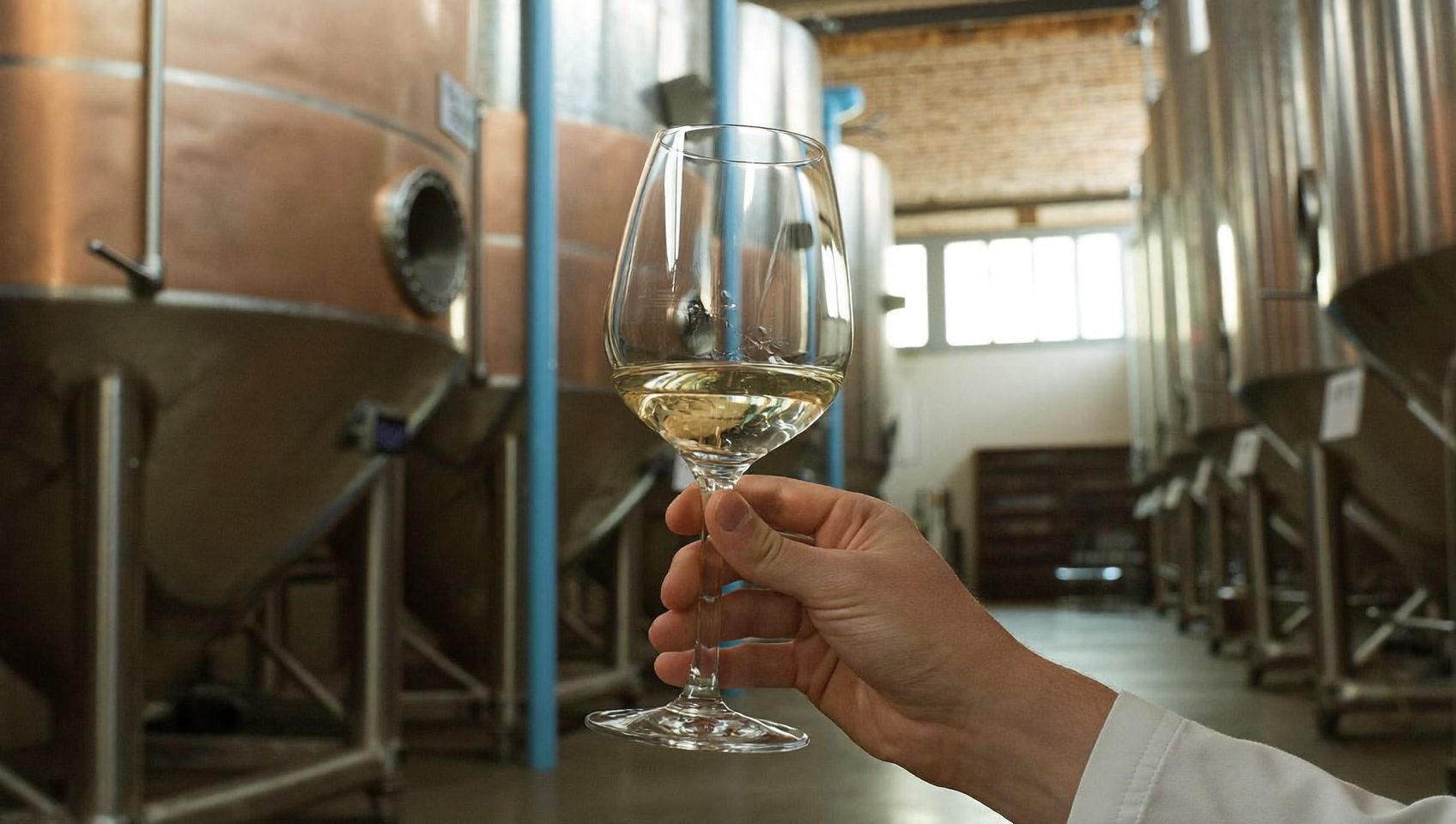
When a must or wine has too high an acidity, the winery can reduce it with a deacidifying agent. The most widely used products are calcium carbonate, potassium bicarbonate and double salt, which is based on calcium carbonate. They act chemically: they cause part of the tartaric acid to precipitate (with double salt, also part of the malic acid) and release carbon dioxide. There is also a biological route, in which lactic acid bacteria or certain yeasts transform malic acid. Before choosing, you need to know which acid is in excess and at which stage of the cycle to intervene.
When to deacidify: before touching the wine
The first question is not about the product, but about measurement. Before intervening, you need analyses of tartaric acid, malic acid and pH. A wine with high acidity and low pH may seem harsh, sour, not very harmonious. However, part of this sensation may come from tannin or alcohol, so the analysis should be read together with tasting.
The cause matters. In cold vintages, the grapes arrive at the winery with high acidity and little sugar, while in very hot ones acidity drops and pH rises. The two situations require different choices. If the problem comes from ripening, it is often advisable to wait for fermentation or the aging period before correcting, because the structure changes on its own.
The most common moment to intervene is the must. The OIV International Code of Oenological Practices distinguishes the treatment for correcting must acidity from practices on finished wine: the two entries have their own rules, products and controls. On must, precipitations have time to complete during fermentation, and deposits are removed through racking. On finished wine, however, the treatment requires more controls, because precipitations can continue even after the intervention.
Before deciding, always run a small-scale test on a representative sample. Dose small quantities, wait for the reaction to finish, filter or decant the sample and measure acidity again. Only then do you know how much the wine reacts and whether the precipitation remains stable.
Calcium carbonate, potassium bicarbonate and double salt compared
The three products have the same basic function but leave different ions in the wine. This changes the final result.
| Product | What it adds to the wine | What happens to acidity | Main risk |
|---|---|---|---|
| Calcium carbonate | Calcium | Causes part of the tartaric acid to precipitate as calcium tartrate and releases carbon dioxide | Chalky taste if too much is used, deposits over time |
| Potassium bicarbonate | Potassium | Causes part of the tartaric acid to precipitate as potassium bitartrate and releases carbon dioxide | Increase in potassium, effects on pH and stability |
| Double salt | Calcium | Causes tartaric and malic acid to precipitate together as a calcium double salt and releases carbon dioxide | Procedure to follow with precision, calcium contribution to be controlled |
Calcium carbonate has long been a reference in the winery. Calcium reacts with tartaric acid and forms a poorly soluble salt. The precipitate separates through decantation or filtration, but calcium left in the wine can give a chalky sensation if the dose was higher than necessary.
Potassium bicarbonate acts on the same acid, but brings potassium. Potassium is already present in wine in natural quantities, and a high dose can raise pH and alter the balance between salts. For this reason, bicarbonate must be used with more care when the wine needs to remain stable over time, for example in wines intended for aging.
Double salt is based on calcium carbonate, used with a specific procedure: part of the must or wine is treated with the product and then recombined with the rest. The advantage is that tartaric acid and malic acid precipitate together, as a calcium double salt, so malic acid is also reduced. The disadvantage is that the procedure must be followed with precision and the calcium contribution must still be controlled.
The same rule applies to all three. Precipitation is not always complete at the time of treatment. Even after filtration, the wine may continue to deposit crystals if tartaric stabilization has not been carried out. For this reason, the check should be repeated after a few weeks, not just the day after.

The biological route: malolactic fermentation and yeasts
There is a path different from chemistry. Malolactic fermentation, carried out by lactic acid bacteria, transforms malic acid into lactic acid. Lactic acid is softer, and the wine loses part of its green acidity sensation. It is a traditional practice in reds and many whites, and the OIV Code lists it among the forms of microbiological deacidification alongside yeast-based deacidification.
Some yeasts, such as certain strains of Schizosaccharomyces pombe, consume malic acid during alcoholic fermentation. Here too, the result depends on the strain, temperature and timing of inoculation. Not all yeasts are suitable for this purpose, and some produce unwanted aromas.
The biological route is not always available. If the wine has already fermented and the bacteria do not start, or if pH is too low for the bacteria to work, you must fall back on chemical treatment. If instead you want to avoid precipitations and leave the work to microbiology, malolactic fermentation must be monitored with regular malic acid analyses, because a block or a late restart can change the profile of the wine in bottle.
To learn more about malolactic fermentation and its control, read the entry malolactic fermentation. To understand how malic and tartaric acid change with ripening and season, the entry wine compounds: acids and sugars is the starting point.
Dosages, limits and controls: what to do before dosing
In this article we do not indicate dosages. The right quantity depends on the wine, pH, initial acidity and the goal, and it is established through the small-scale test. A number written here, without the context of your sample, can lead to wrong doses.
Legal limits are a different matter. The European Union rules on oenological practices state which treatments are permitted, under which conditions and with which limits. The OIV Code is the international technical reference for the same practices. Before any treatment, check the updated text of the EU rules and national legislation, and record the treatment in the winery register. For the general framework of permitted practices, consult the page authorised oenological practices.
Once the treatment has been chosen, the operational reference is the entry on corrections and remedies, which describes interventions on wine when something does not go as expected.
The most frequent mistakes
The first mistake is dosing on the wine without a test. Theoretical calculation does not account for the real composition of the wine, and an excess of calcium or potassium only becomes visible at the end of processing.
The second is using calcium carbonate in quantities higher than necessary, hoping to obtain a softer wine. The result can be a chalky sensation on the palate and a flat wine, along with a greater risk of instability linked to calcium.
The third is forgetting stabilization. A deacidified wine can precipitate crystals in bottle, especially if stored cold. Deposits are not a sanitary defect, but the customer sees them and reads them as a problem. For this reason, the check should be carried out several times, even after bottling.
The fourth is stacking treatments without a plan. Deacidifying with salts, then adding a stabilization treatment and then a pH correction can create a wine that is hard to read. Every treatment must be recorded with date, quantity and control analysis, so that the next step takes the previous one into account.
The fifth is waiting too long with malolactic fermentation. If malic acid does not drop and the wine remains acidic, the chemical choice should be evaluated early, before the wine is already in the final stabilization phase.
Frequently asked questions
Does calcium carbonate always give a chalky taste?
No, but the risk grows when the dose is high or when the wine is not checked after treatment. A small-scale test and analysis of residual calcium help to avoid it.
Is potassium bicarbonate better than calcium carbonate?
It depends on the wine. Bicarbonate brings potassium, which can raise pH, while carbonate brings calcium, which can give a chalky sensation. Neither is valid in every case: the choice is made on the analyses of your wine.
When is biological deacidification worthwhile?
When the wine still has malic acid to transform and pH and temperature allow it. If the bacteria do not start or pH is too low, chemical treatment may become the safer route.
Do I need to record deacidification?
Yes. Every treatment must be recorded with date, product, quantity and control analysis. The register allows you to reconstruct the wine and to respond in case of inspections.
Sources
- Wine defects: TCA, Brett, volatile acidity, oxidation
- Cellar sensory analysis: internal panel and score sheets
- Wine enzymes: pectolytic, extraction, fining and dosage
- Wine bacteria: useful lactic and spoilage types
- Wine filtration aids: diatomaceous earth, perlite, cellulose
- Wine analysis methods: OIV, FTIR, enzymatic kits compared