Wine fining agents: bentonite, PVPP, gelatin, plant proteins, chitosan — what they remove, dosages, fining trials, lees compaction, allergens on the label
Wines Export Editorial · Last updated:

Choosing the right fining agent means removing only the unstable fractions of proteins, polyphenols or metals, without depleting the aroma profile of your wine and without generating excessive volumes of lees. Fining does not only serve to give optical clarity: it also prepares the product to withstand the temperature swings of intercontinental transport and to pass through microfiltration without problems. Exporters must also match the winery's technical choice with the regulatory and commercial requirements of the destination markets. The use of animal derivatives such as albumin and casein triggers allergen declaration obligations and closes the doors to tenders from monopolies or distribution chains that require vegan certification.
When to fine and what you want to remove
Within the framework defined by the OIV International Code of Oenological Practices and by Delegated Regulation (EU) 2019/934 on authorized oenological practices and legal limits, fining agents fall under processing aids. Unlike additives, these substances are added to the must or wine to perform a physical or physico-chemical action — adsorption, flocculation and sedimentation — and are then removed by racking or filtration, without leaving intentional residues in the finished product.
Before intervening in the tank, you must isolate the specific defect or risk you want to correct. The intervention schedule distinguishes treatment on the must (often combined with flotation or static settling to immediately eliminate oxidizable catechins and bourbeux fractions) from treatment on the finished wine. If you are looking for an overview of the entire bottling process, you can consult the general guide on tartaric and protein stabilization and fining of wine; here, instead, we go into how individual molecules behave in the tank.
Each family of fining agents responds to a very specific mechanism of electrostatic interaction or chemical affinity:
- Removal of heat-unstable proteins in whites and rosés: at wine pH, grape proteins carry a positive electrical charge and require a negatively charged colloid such as bentonite or silica sol.
- Reduction of astringency and bitter tannins in reds: condensed polyphenols carry a negative charge or form hydrogen bonds with peptide chains; they therefore bind to positively charged proteins (gelatin, pea or potato proteins, albumin).
- Prevention and treatment of oxidative browning (maderization): requires adsorbent synthetic polymers such as PVPP or PVI/PVP copolymers, capable of capturing the monomeric and oligomeric forms of catechins and hydroxycinnamic acids.
- Removal of off-odors, excess color or contaminants: intervention is made with decolorizing or deodorizing oenological charcoal, or with chitosan and chitin-glucan to chelate heavy metals and reduce populations of unwanted microorganisms.
| Oenological fining agent | Chemical origin | Main target | Impact on lees | Allergen declaration / Vegan status |
|---|---|---|---|---|
| Bentonite (sodium / calcium) | Mineral montmorillonite clay | Heat-unstable proteins, colloidal copper | Lees from voluminous (sodium) to compact (calcium) | No allergen / Suitable for vegans |
| PVPP and PVI/PVP | Insoluble synthetic polymers | Oxidizable polyphenols, catechins, browning | Rapid sedimentation, very compact deposit | No allergen / Suitable for vegans |
| Gelatin and fish glue | Animal proteins (pork/beef, fish) | Aggressive tannins (gelatin), fine turbidity (isinglass) | Slow flocculation, often requires tannin or silica | Exempt in EU if no residues remain / Not vegan |
| Casein / Potassium caseinate | Milk protein | Oxidized polyphenols in whites, iron | Immediate flocculation on contact with acid | Mandatory allergen (milk) / Not vegan |
| Egg albumin | Egg protein | Astringent tannins in aging reds | Reasonably compact lees | Mandatory allergen (egg) / Not vegan |
| Plant proteins (pea, potato, wheat) | Plant protein extracts | Astringent tannins, oxidizable catechins, turbidity | Rapid flocculation and reduced lees | Wheat subject to gluten rules; pea and potato exempt in EU / Suitable for vegans |
| Chitosan and chitin-glucan | Polysaccharides from Aspergillus niger | Metals (iron, copper), proteins, Brettanomyces | Compact lees, low liquid retention | No allergen (if fungal) / Suitable for vegans |
Bentonite: proteins and dosages
Bentonite is a phyllosilicate belonging to the montmorillonite group. In aqueous solution and at the acidic pH of wine, its silicate lamellae expose a strong negative electrical charge, attracting by electrostatic means the positively charged proteins (thaumatin-like and chitinases) that would otherwise coagulate in the bottle as soon as the container passes through a hot zone or sits in an unclimatized warehouse.
In the winery you can choose among three main types, each with a different balance between protein-removing power and the volume of lees generated:
- Natural or activated sodium bentonite: has a very high swelling capacity in water. It exposes a wide active surface and removes proteins at low dosages, but produces an abundant, fluffy volume of lees that retains a significant percentage of wine and requires filtration of the lees.
- Calcium bentonite: swells much less than sodium bentonite and precipitates forming a much denser and more compact deposit on the bottom of the tank. On the other hand, for the same protein instability, it requires a higher dosage to reach heat stability.
- Pre-activated sodium-calcium or granular bentonites: combine a rapid reaction kinetics on unstable protein fractions with a cleaner sedimentation, reducing product losses during racking off the lees.
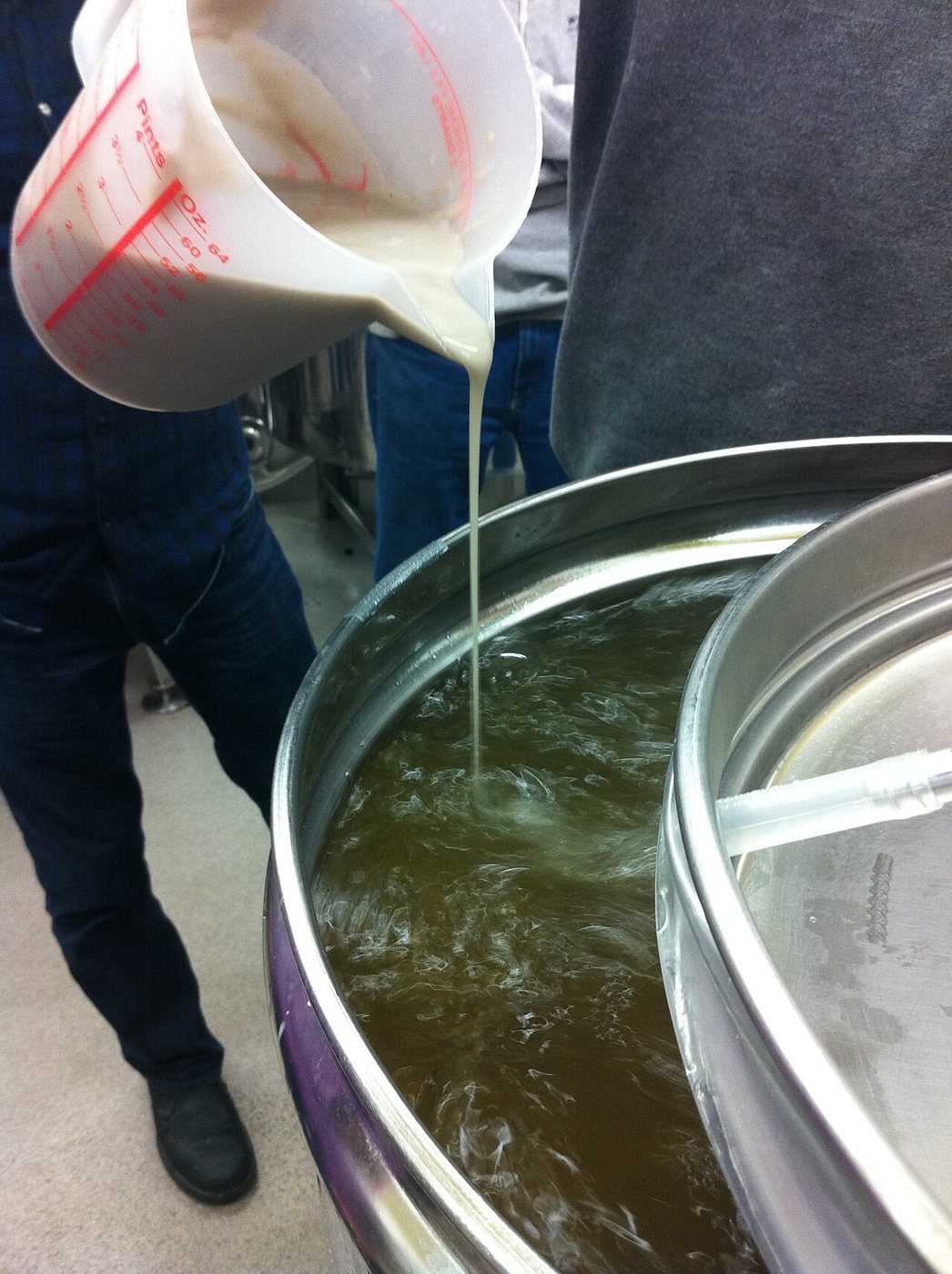
There is no fixed bentonite dose valid for every vintage. The real requirement is determined in the laboratory by subjecting wine samples (to which increasing amounts of a bentonite stock solution prepared in a known proportion have been added) to heat stability tests in an oven, or to chemical and turbidimetric tests. Once the minimum dose is identified that brings the turbidity variation (expressed in NTU after heating and cooling) below your winery's safety threshold, the rehydration protocol makes the difference. The clay must be slowly dispersed in lukewarm water under vigorous agitation and left to swell for the time indicated in the producer's technical data sheet before being injected in line during the pump-over. Hasty hydration forms inactive lumps: you waste product, you do not stabilize the wine, and you risk having to repeat the treatment, depleting the varietal aromatic profile.
In recent years, the OIV and Delegated Regulation (EU) 2019/934 have added alternative solutions for the protein stabilization of musts to bentonite, such as treatment with acid proteases (aspergillopepsin I) combined with brief heating, which hydrolyzes proteins upstream, reducing or eliminating the use of clays on the finished wine.
PVPP and charcoal: color and oxidation
When the target is not proteins but low-molecular-weight phenolic molecules, bentonite is not enough. To understand how the different phenolic families evolve during aging, you can refer to the article on polyphenols, tannins, anthocyanins and color stability. In white wines and rosés intended for export, the main danger is the oxidation of catechins and leucoanthocyanidins, which leads to early yellowing (pinking or browning) and the appearance of bitter and stewed notes.
Polyvinylpolypyrrolidone (PVPP) is a cross-linked synthetic polymer, insoluble in wine and water, which forms selective hydrogen bonds with the aromatic rings of monomeric and dimeric polyphenols. Unlike fining proteins (which react better with more polymerized tannins), PVPP removes from the medium the precursors of browning and the compounds responsible for the sensation of bitterness on the finish, leaving the acid and polysaccharide structure intact. Being heavy and non-swellable, it sediments in a short time or can be retained directly on a diatomaceous earth or cartridge filter after a brief contact time under agitation.
Even more targeted is the PVI/PVP copolymer (polyvinylimidazole-polyvinylpyrrolidone), authorized both by the OIV code and by European legislation. In addition to adsorbing oxidizable polyphenols like PVPP, the imidazole fraction binds divalent metal ions by complexation — in particular copper and iron — which act as catalysts for chemical oxidation reactions. Reducing the content of free iron and copper extends the commercial life of still whites and preserves varietal thiols without having to raise the free sulfur dioxide content at bottling.
Oenological charcoal (obtained from the carbonization of selected wood and activated by physical or chemical means), on the other hand, operates by non-specific physical adsorption within its dense network of micropores. It is distinguished into decolorizing charcoal — used on white musts obtained from black-skinned grapes or on stained white wines to remove residual anthocyanins — and deodorizing charcoal, useful for reducing mold notes (geosmin), volatile phenols or residues of phytosanitary products and mycotoxins such as ochratoxin A. Since the porosity of charcoal also easily retains ethyl esters and terpenes, it must be dosed on the basis of rigorous scalar trials and preferably used at the must stage or at the beginning of fermentation, when the secondary aromatic heritage has yet to form.
Gelatin, fish glue, plant proteins, chitosan
To soften red wines rich in aggressive tannins or to refine the clarity of whites without using synthetic polymers, winemaking practice has historically relied on animal protein glues, today joined or replaced by fining agents of plant and fungal origin.
- Oenological gelatin: obtained from the partial hydrolysis of animal collagen, it is classified according to the degree of hydrolysis and the gelling strength (Bloom grades). Gelatins with low degree of hydrolysis (high molecular weight) react energetically with the most astringent and reactive tannins, but carry the risk of "overfining" if there is not enough tannin in the wine to neutralize all the added protein, leaving residual turbidity in suspension. For whites or wines poor in polyphenols, it is always combined with silica sol (colloidal silicon dioxide with a negative charge), which causes a clean flocculation and carries the suspended particles to the bottom.
- Fish glue (isinglass): obtained from the swim bladder of certain fish species, it has long protein chains that form a light network in white wines and sparkling wine bases. It requires reduced doses, enhances brilliance without stripping the structure, but generates light flakes that fear high cellar temperatures and need adequate settling times or the aid of silica sol.
- Casein and potassium caseinate: derived from milk, they flocculate instantly as soon as they come into contact with the acidic pH of wine, with no risk of overfining. They are effective for refreshing oxidized white wines and removing excess iron, but require an in-line injection system with high turbulence (such as a Venturi tube) to prevent them from coagulating at the very point of injection before mixing with the entire mass.
- Egg albumin (ovalbumin): the classic fining agent for great aging red wines. Its globular proteins soften green and dry tannins while respecting stable tannin-anthocyanin complexes and polysaccharides.
- Plant-derived proteins (pea, potato, wheat): codified by the OIV and by Delegated Regulation (EU) 2019/934, they have transformed the work of export-oriented wineries. Proteins isolated from pea (Pisum sativum) and potato (Solanum tuberosum) show a high affinity for oxidized catechins and bitter tannins, with a flocculation speed and sediment compaction often superior to those of gelatin and casein. In white musts treated by flotation, they allow oxidizable polyphenols to be removed right away without introducing milk or fish derivatives.
- Chitosan and chitin-glucan: polysaccharides extracted from the cell wall of the fungus Aspergillus niger (the only source authorized in oenology to avoid crustacean allergens). Chitin-glucan promotes the settling of musts and adsorbs metals and mycotoxins; pre-activated chitosan also has a powerful antiseptic action against contaminating yeasts of the genus Brettanomyces and against lactic and acetic bacteria, allowing a fining that is at the same time a microbiological clean-up of the mass.
Fining trials and lees compaction
No fining agent should be added to a tank based on the average doses reported on commercial bags. Each wine has its own pH, its own ionic strength, a different endowment of protective colloids (mannoproteins, natural gums, residual pectins) and a cellar temperature that conditions the flocculation kinetics.
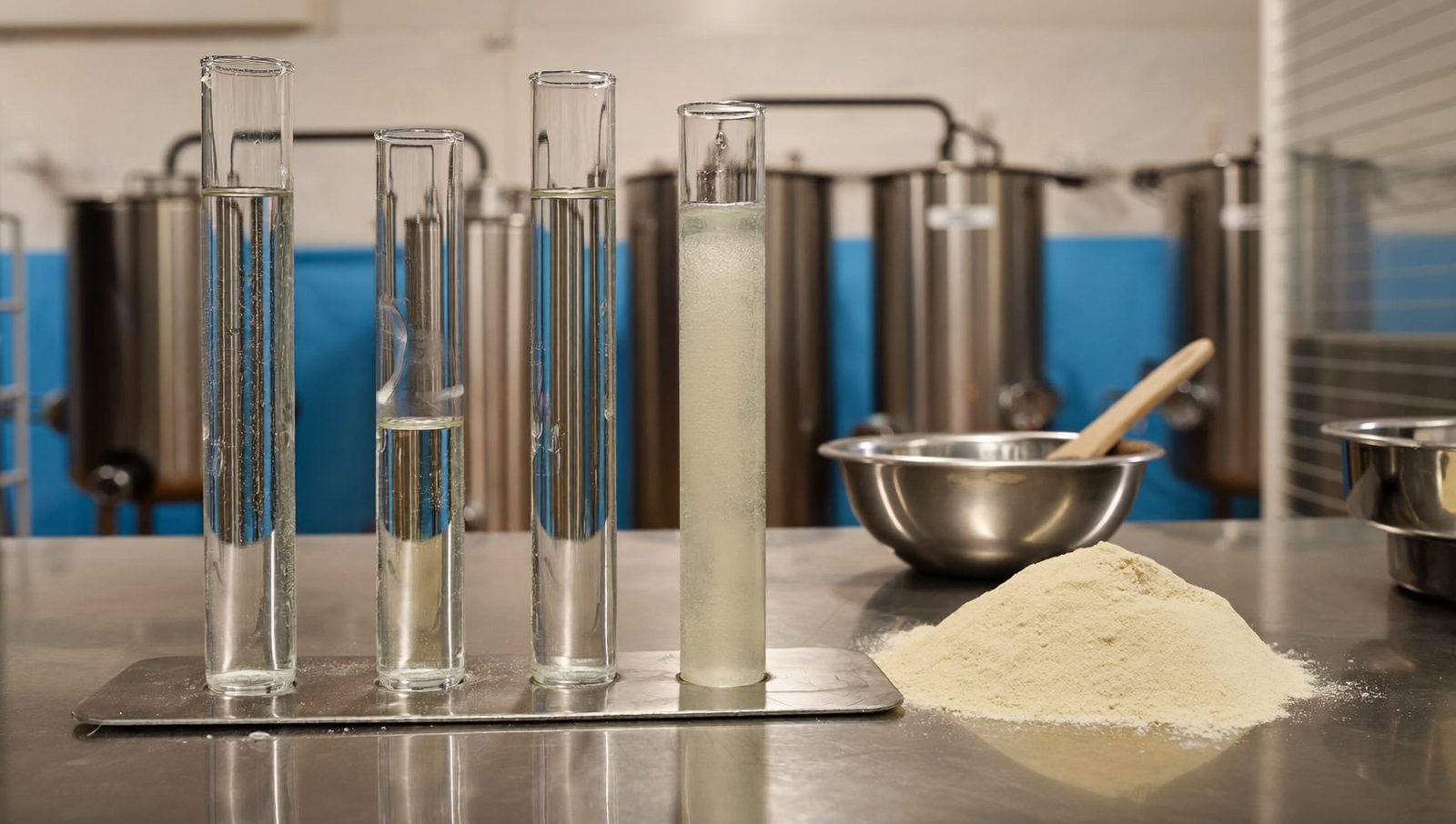
To set up laboratory fining trials in graduated cylinders of 100 or 250 ml, you must reproduce the real conditions of the tank you are going to treat:
- Preliminary pectolysis: first check with an alcohol test that the wine does not contain undegraded residual pectins. Pectins act as protective colloids and prevent the fining flakes from aggregating and precipitating, leaving the wine hazy and making the lees voluminous and not filterable. If the test is positive, treat with a specific pectolytic enzyme before starting the fining.
- Sequence of addition and mixing: when using binary or ternary combinations (for example tannin + gelatin + silica sol, or plant protein + bentonite), respect the order of addition into the cylinders, homogenizing after each individual ingredient without incorporating oxygen.
- Test temperature: run the test at the same temperature at which the tank is located in the cellar. A fish glue or gelatin tested on the laboratory bench at room temperature behaves very differently when added to a refrigerated tank.
- Reading lees compaction: after the established rest time (from a few hours to a couple of days), do not limit yourself to tasting the clear supernatant. Read on the graduations of the cylinder the percentage of lees deposited on the bottom and assess the cohesion of the sediment by gently tilting the cylinder.
The compaction of fining lees directly affects the winery's bottom line. Fluffy lees that occupy a high fraction of the cylinder's volume mean that in the cellar you must stop the racking off the lees very high to avoid drawing up cloudy wine, sending a large quantity of noble wine to the vacuum filter or to the lees press (with consequent oxidation and downgrading of the filtrate). To compact the lees and obtain a clean interface between clear wine and sediment, you can combine protein fining agents with a fraction of silica sol (which weighs down the protein flake and accelerates its fall) or a tail of calcium or sodium-calcium bentonite, which carries the last suspended particles to the bottom and presses the lees bed onto the conical bottom of the tank.
A well-executed fining and well-compacted lees reduce the clogging index of the clear wine: this allows you to reach the stage of filtration and bottling preparation without prematurely clogging the roughing filter layers and membrane cartridges.
Allergens and vegan status: what changes for export
For a winery that sells abroad, the choice of fining agent is not a question confined between the oenologist and the cellar worker: it changes the mandatory back-label declarations and determines the eligibility of the wine on international markets. On this aspect we also refer you to the operational guide on how to prevent label errors for export on lot, allergens, organic and sulfites.
On the European regulatory front, Regulation (EU) No 1169/2011 (Annex II) and Delegated Regulation (EU) 2019/934 establish the obligation to indicate on the label the substances that cause allergies or intolerances when they are used in production and are still present in the finished product. For wine fining agents, precise distinctions apply:
- Casein, milk caseinates and egg albumin (in addition to lysozyme): must be declared on the label (with the regulatory terms in the language of the destination country and the possibility of adding the relevant pictograms) whenever their presence is detectable in the bottled wine according to the official OIV analysis methods. Since the risk of analytically detectable traces or of customs disputes is real, many foreign importers contractually ask to avoid casein and ovalbumin altogether.
- Fish glue (isinglass): within the European Union it benefits from a permanent exemption from the labeling requirement when used as a fining agent in beer and wine. Be careful, however, with non-EU markets: in several third countries, local food allergen rules do not automatically incorporate the Community derogation for fish derivatives, or they require precautionary declarations during label registration.
- Pea and potato plant proteins, bentonite, PVPP, fungal chitosan: are not included in the lists of allergens subject to mandatory declaration in the EU (unlike wheat proteins, which fall within the scope of cereals containing gluten).
There is also the commercial aspect linked to Vegan and Vegetarian certifications. The state monopolies of Northern Europe (Systembolaget in Sweden, Vinmonopolet in Norway, Alko in Finland), the Canadian monopolies (LCBO, SAQ) and the major retail chains in the United Kingdom, Germany and the United States regularly include in their purchasing specifications a request for wines suitable for vegan consumers. A wine treated with pork or beef gelatin, fish glue, casein or egg albumin — even if perfectly filtered and free of chemically measurable residues — cannot obtain vegan certification, because during the production process it came into contact with fining agents of animal origin.
Permanently replacing animal glues in the cellar with pea or potato proteins, bentonite, silica sol, PVPP and chitosan from Aspergillus niger allows you to unify the production line: you avoid having to manage separate lots for different markets, eliminate the risk of errors on multilingual back labels, and respond affirmatively right away to the technical sheets requested by international buyers.
Further reading: 'contains sulfites' label rules by country.
Frequently asked questions
Does bentonite also remove color or structure from red wines?
Yes, if used at high doses. Although it is targeted at the proteins of whites and rosés, the negative charge of bentonite also binds the fraction of free anthocyanins with a positive charge (flavylium ion) in young red wines. In reds it is used only at reduced doses to facilitate the sedimentation of protein glues or to eliminate a colloidal instability of the coloring substance.
Can I label a wine "Vegan" if I only used bentonite, PVPP and pea proteins?
Yes, provided that throughout the entire process of winemaking, aging and bottling no other fining agents or additives of animal origin were used (such as gelatin, casein, egg albumin, fish glue or egg lysozyme) and that the tanks and filtration lines were sanitized to exclude cross-contamination.
How do you avoid overfining when fining a white wine with gelatin?
Overfining occurs when the quantity of positively charged protein exceeds the polyphenols or negative colloids available to neutralize it, leaving the wine turbid. In whites, which are poor in natural tannins, it is prevented by always combining the gelatin with an appropriate dose of silica sol (colloidal silicon dioxide) and by verifying the exact ratio in laboratory cylinders before treatment in the tank.
What is the difference between oenological chitosan and chitosan extracted from crustaceans?
In the oenological sector, Delegated Regulation (EU) 2019/934 and the OIV code authorize exclusively chitosan and chitin-glucan of fungal origin, extracted from Aspergillus niger. This specific biotechnological origin guarantees the absence of tropomyosin and other allergens typical of crustaceans, making the product exempt from allergen labeling obligations and compatible with vegan specifications.
Sources
- OIV — International Code of Oenological Practices
- EUR-Lex — Delegated Regulation (EU) 2019/934 of the Commission on authorized oenological practices
- EUR-Lex — Regulation (EU) No 1169/2011 on the provision of food information to consumers (Annex II - Allergens)
- CREA — Council for Agricultural Research and Economics
- Wine polysaccharides and mannoproteins: uses in winemaking
- Wine filtration: roughing, fining and sterile filtration
- Wine stabilisers: CMC, gum arabic, mannoproteins
- Wine filtration aids: diatomaceous earth, perlite, cellulose
- Wine team building Rome: corporate tastings for groups
- Wine enzymes: pectolytic, extraction, fining and dosage