Pallets, cartons and containers for wine export: bottles per pallet, weights, EUR or American pallet, 20' and 40', groupage
Wines Export Editorial · Last updated:
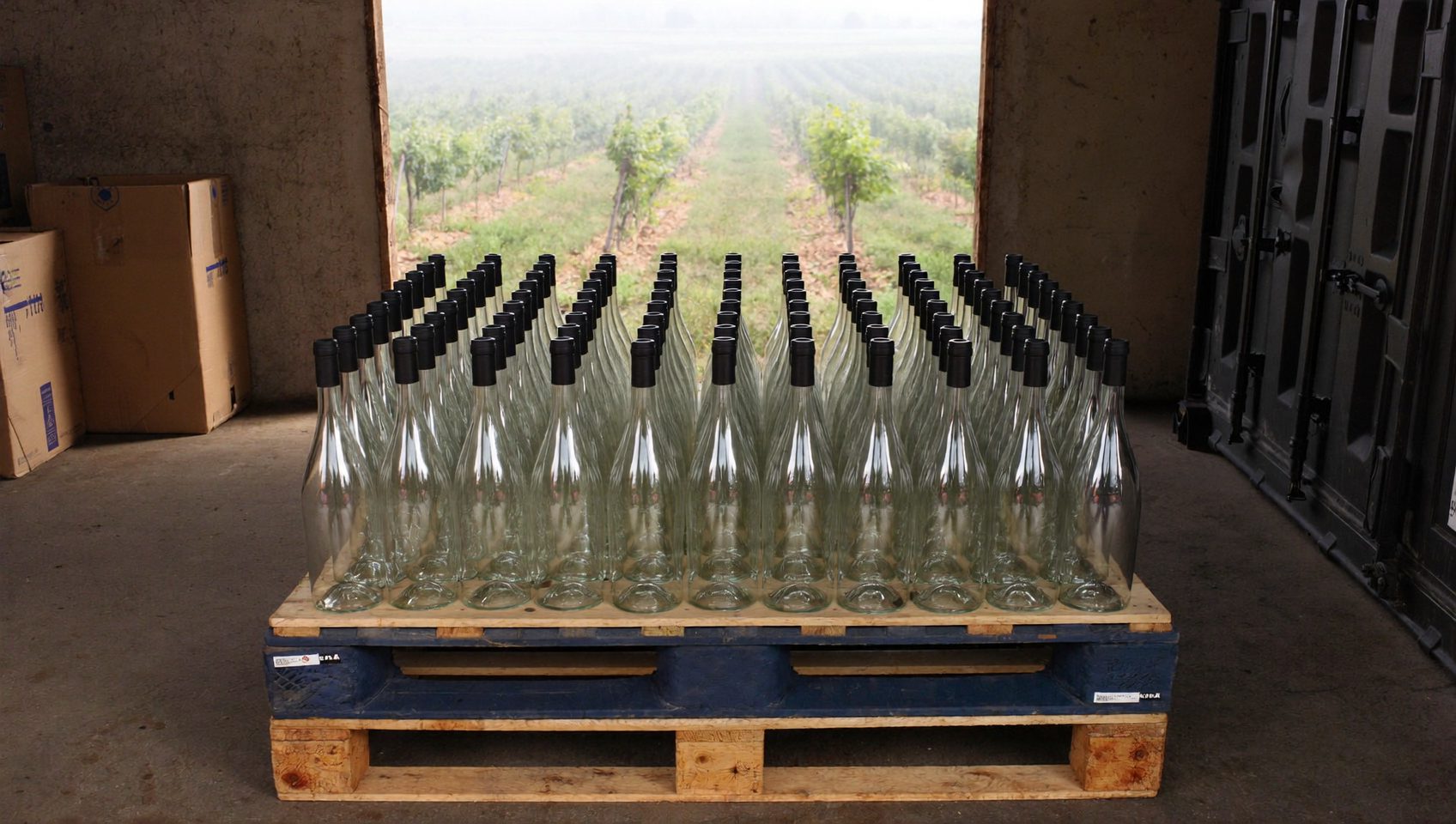
A 20-foot container holds about 9,600 bottles of 0.75 litres on pallets (1,600 cartons of 6) and up to 13,200 bottles loaded loose on the floor; a 40-foot container on pallets holds about 18,000 bottles (3,000 cartons of 6). These are the reference figures published by Kuehne+Nagel for wine in cartons. The actual value depends on carton format, pallet height and the container's weight limit, which on the 40-foot is reached before the volume limit. This guide sets out the data you need to quote a shipment: weights of bottles and cartons, EUR and American pallets, container capacities, when groupage makes sense and what the ISPM 15 mark requires on wood. For choosing a forwarder and for FCL versus LCL, see the guide on wine forwarders and the page on wine logistics and transport.
Cartons of 6 and 12: weights and dimensions
The weight starts with the glass. An standard 75 cl Bordeaux bottle weighs, empty, around 550 grams according to the price list of a European glass distributor, with a height of 314 mm and a diameter of 75 mm. There are lightweight and heavy Bordeaux bottles, and your glassmaker will give you the exact weight from the technical drawing. The wine weighs about 750 grams per 0.75-litre bottle. A full bottle, with cork and capsule, therefore comes to about 1.3 kg. With 400-gram glass it drops towards 1.2 kg; with bottles of 700-800 grams it rises towards 1.5 kg.
The carton of 6, the standard format in Europe, weighs about 930 grams on its own in the case of the horizontal carton described by an Italian courier; vertical cartons with internal dividers vary. The carton of 12 is the usual format in the United States, as Hillebrand Gori notes, and it changes how the pallet is stacked.
| Unit | Indicative weight | Basis of calculation |
|---|---|---|
| 0.75 l bottle, full, 550 g glass | about 1.3 kg | Univerre (glass) + 0.75 kg of wine |
| Carton of 6, empty | about 0.93 kg | In3giorni |
| Carton of 6, full | about 8.7 kg | Calculated from the two figures above |
| Carton of 12, full | about 16.5 kg | Calculated, carton estimated at double |
| EUR pallet, empty | about 25 kg | EPAL |
| VMF 100x120 pallet, empty | 28-30 kg | Hillebrand Gori |
| GMA 48x40 inch pallet, empty | at least 16 kg | Hillebrand Gori |
The rows marked "calculated" are sums of the source data. Use them as an order of magnitude and replace them with the actual weights of your materials before compiling the packing list. There are two dedicated pages on the bottle format and its logistical consequences: the Bordeaux bottle and bottle height and pallets.
How many bottles on a EUR pallet and on an American one
The three pallets you will encounter are the EUR pallet at 80x120 cm (EPAL), the VMF pallet at 100x120 cm, developed in France for transporting glass, and the American GMA pallet at 48x40 inches, or about 122x102 cm. The EPAL has a payload of 1,500 kg and, stacked on a flat surface, the bottom pallet must not carry more than 5,500 kg. It weighs about 25 kg and, since 1 January 2010, has been produced only with ISPM 15 heat treatment, with the IPPC mark on the central blocks.
The number of bottles per pallet depends on three variables: the size of the carton, the number of cartons per layer and the number of layers. Hillebrand Gori indicates as standard practice a loaded pallet height of no more than 1.7 metres, for safety and to fit inside the container. It cites the case of 56 cases per pallet over four layers on a 1 x 1.2 metre pallet. With European cartons of 6 on EUR pallets, typical packing list counts fall between 100 and 120 cartons, that is 600-720 bottles, but the correct number comes from your carton maker's palletisation plan. A check figure: the 9,600 bottles of the palletised 20-foot container from Kuehne+Nagel, divided by the 9-11 pallets that the same forwarder indicates, give between 870 and 1,070 bottles per pallet, which means tall pallets and compact cartons.
The weight of the loaded pallet matters more than the number of bottles. 100 cartons of 6 at 8.7 kg make 870 kg plus 25 kg of wood, within the EPAL limit; 120 cartons bring it to about 1,070 kg. A warehouse forklift moves them without difficulty, but the floor of a container or trailer has a load-per-axle limit that must be respected.
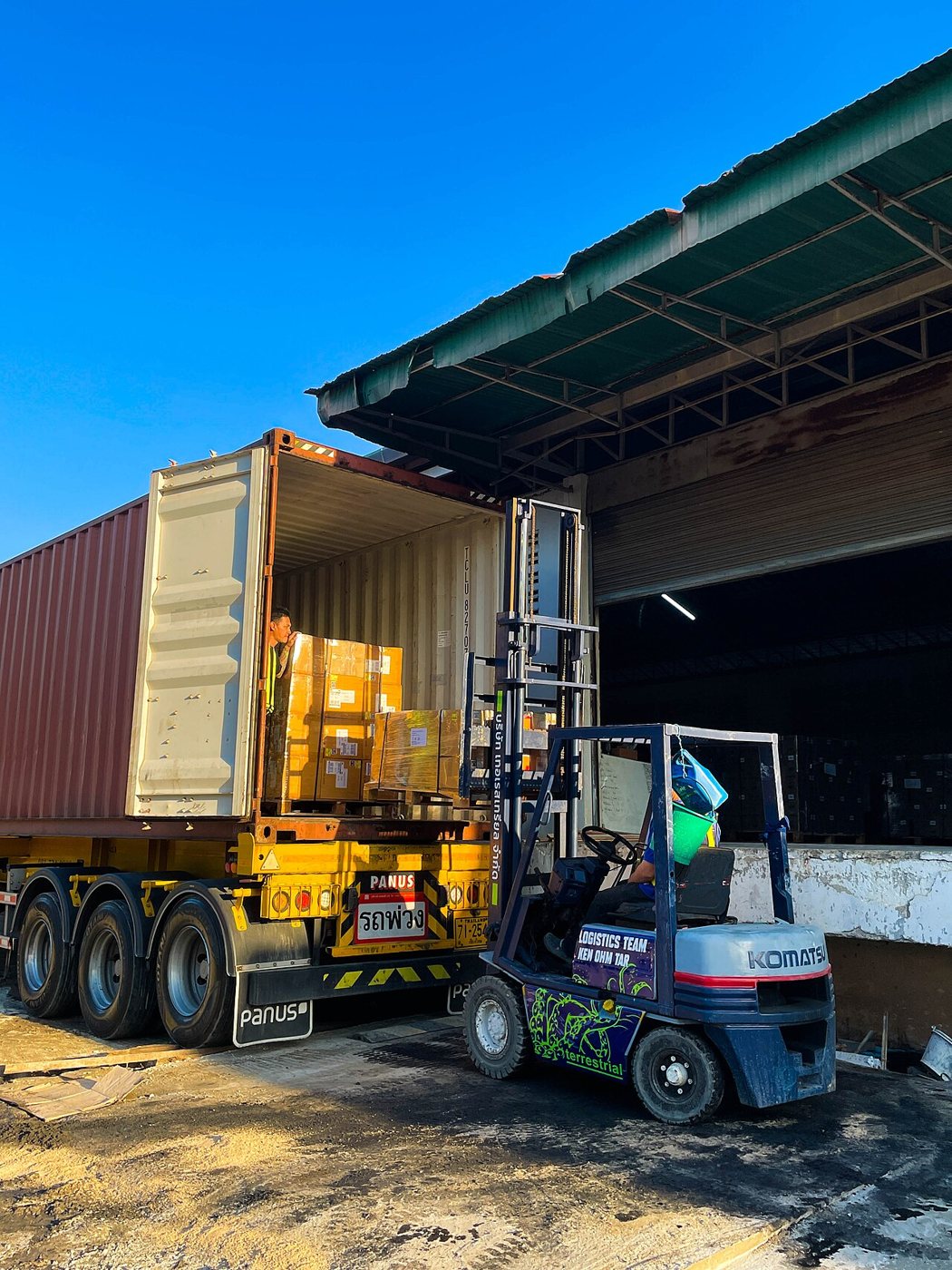
20' and 40' containers: how many cases
The internal dimensions and payloads of standard containers, published in the manual of the German insurers (TIS-GDV) based on Hapag-Lloyd data, are as follows:
| 20-foot | 40-foot | |
|---|---|---|
| Internal length | 5,895 mm | 12,029 mm |
| Internal width | 2,350 mm | 2,350 mm |
| Internal height | 2,392 mm | 2,392 mm |
| Door opening (width x height) | 2,340 x 2,292 mm | 2,340 x 2,292 mm |
| Tare weight | 2,250 kg | 3,780 kg |
| Maximum payload | 28,230 kg (21,750 kg in the lighter variant) | 26,700 kg |
| Volume | 33.2 m³ | 67.7 m³ |
Source: TIS-GDV, standard containers.
How many pallets fit: Hillebrand Gori indicates 11 EUR or 10 VMF/GMA pallets in a 20-foot dry container, and 24 EUR or 21 VMF/GMA in a 40-foot dry container; in reefers the numbers drop to 10 and 23 EUR. Kuehne+Nagel gives a range of 9-11 pallets for the 20-foot and 21-25 for the 40-foot.
How many bottles, according to Kuehne+Nagel (0.75 l, cartons of 6):
| Container | Mode | Bottles | Cartons of 6 |
|---|---|---|---|
| 20-foot | Palletised | 9,600 | 1,600 |
| 20-foot | Loose on floor | 13,200 | 2,200 |
| 20-foot reefer | Loose on floor | 12,000 | 2,000 |
| 40-foot | Palletised | 18,000 | 3,000 |
| 45-foot | Palletised | 19,800 | 3,300 |
Source: Kuehne+Nagel, VinLog FAQ.
Checking the weight is the step many wineries skip. With the data on this page, 9,600 bottles at 1.3 kg make 12.5 tonnes, plus 1.5 tonnes of carton and 0.3 of pallets: about 14.3 tonnes, well within the payload of a 20-foot container. A 40-foot with 18,000 bottles, by contrast, comes to 23.4 tonnes of bottles plus 2.8 of cartons and 0.6 of wood, about 26.8 tonnes: above the 26.7-tonne payload of a standard 40-foot. In practice a 40-foot of wine fills up by weight before it fills up by volume. In countries with strict road limits (Hillebrand Gori notes the US limit of 80,000 lb, or 36,287 kg, for the complete vehicle, of which about 15,875 kg is already the tractor and empty trailer), the load must be reduced further. Ask your forwarder for the maximum permitted weight on the route before promising a full container to the importer.
Groupage: when you do not fill a container
Groupage, or LCL, is space shared in a container consolidated by several forwarders. It makes sense when the order is one, two or a few pallets: an importer's first trial order is almost always groupage. You pay by volume or by weight, with a minimum, and accept longer times for consolidation and deconsolidation at both ends. A pallet of wine in groupage must be stretch-wrapped, strapped and fitted with corner protectors, because it travels alongside goods of every kind and is handled several times. Above a certain number of pallets, which depends on the route, the full container costs less than groupage. The FCL versus LCL comparison is explained in the guide on wine forwarders.
For groupage, the pallet format matters more than it does for a container: an 80x120 EUR pallet fits in with the others, while an oversized pallet pays for the space it wastes. For North American markets, ask your importer whether they prefer the 48x40-inch GMA, since many racked warehouses are set up for it.
ISPM 15 and treated pallets
Untreated wood in packaging (pallets, cases, crates, dunnage, wooden blocks) can carry insects and nematodes that threaten the forests of the destination country. The international standard ISPM 15 of the International Plant Protection Convention (IPPC, FAO) requires these materials to be treated and marked before they travel. The approved treatments are heat treatment, with the core of the wood brought to at least 56 °C for at least 30 minutes, and fumigation with methyl bromide. The mark shows the IPPC symbol, the country's ISO code, the producer number assigned by the national plant health service and the treatment code (HT or MB). It must be legible and permanent, preferably on two opposite sides, and not in red or orange. Repaired or rebuilt wood must be treated and marked again.
Materials made of wood glued, heated and pressed together (plywood, particleboard, OSB, veneer) are excluded, as is thin wood up to 6 mm. Hillebrand Gori notes that compressed-wood pallets, plastic pallets and Euroblock blocks are also exempt. A new EPAL pallet is already compliant. A reconditioned pallet without a mark, or with an illegible mark, can cause the entire container to be held at the border, with treatment, destruction or rejection at your expense. Also take care with wooden cases for special formats and with barrels: Hillebrand Gori points out that barrels made from North American wood and processed in the EU must be heat-treated to enter the United Kingdom.
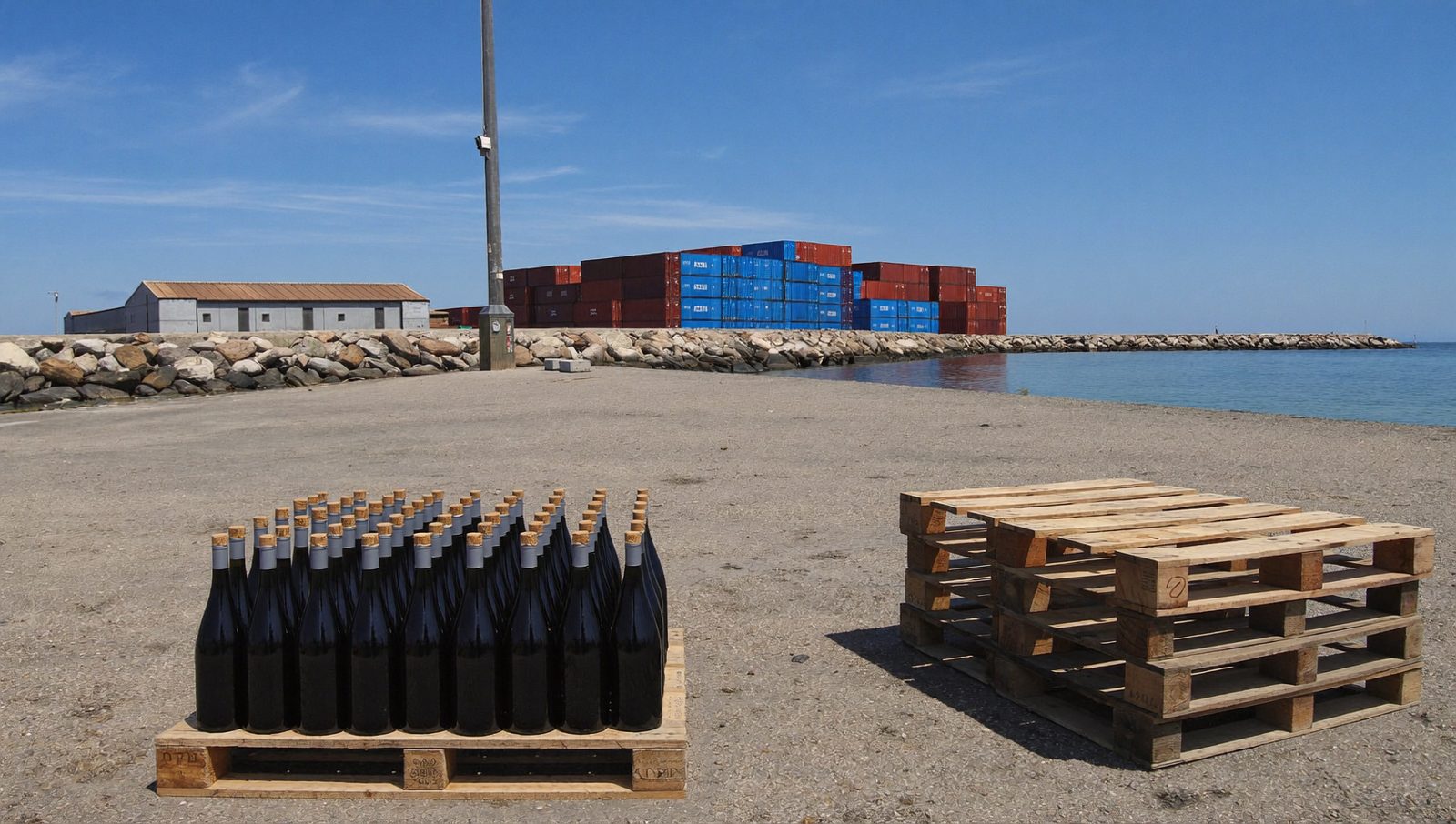
Summary table
| Item | Reference value | Source |
|---|---|---|
| 0.75 l bottle, full | about 1.3 kg (550 g glass) | Univerre + calculation |
| Carton of 6, full | about 8.7 kg | In3giorni + calculation |
| EUR pallet 80x120 | 25 kg, payload 1,500 kg, recommended load height 1.7 m | EPAL, Hillebrand Gori |
| 20-foot, palletised | 9,600 bottles, 9-11 pallets, payload 21.75-28.23 t | Kuehne+Nagel, TIS-GDV |
| 20-foot, loose on floor | 13,200 bottles | Kuehne+Nagel |
| 40-foot, palletised | 18,000 bottles, 21-25 pallets, payload 26.7 t | Kuehne+Nagel, TIS-GDV |
| Groupage | from 1 to a few pallets, EUR pallet stretch-wrapped and strapped | Standard practice |
| Wood | ISPM 15: 56 °C for 30 minutes at the core, IPPC mark | FAO/IPPC |
Before confirming an order, send the importer a packing list with bottles per carton, cartons per layer, layers per pallet, gross weight per pallet and pallet type. It is the document that their forwarder and their customs office read first.
Further reading: choosing a freight forwarder for wine.
Frequently asked questions
How many bottles of wine fit on a pallet?
It depends on carton, layers and height. With cartons of 6 on EUR pallets, packing lists typically come to between 600 and 720 bottles. Forwarders' counts for a full container, such as Kuehne+Nagel's 9,600 bottles across 9-11 pallets, imply taller and denser pallets. The palletisation plan from your carton maker is the only figure to write into the contract.
How many bottles fit in a 20-foot container?
About 9,600 on pallets and up to 13,200 loose on the floor, according to Kuehne+Nagel, for 0.75-litre bottles in cartons of 6. In a loose-loaded reefer the figure drops to 12,000.
Is a EUR pallet or an American pallet better?
For Europe, the EUR 80x120 pallet. For North America, ask your importer, since many warehouses are set up for the 48x40-inch GMA. For a full container, the number of pallets that fit matters most: 11 EUR against 10 GMA in a 20-foot.
What is the ISPM 15 mark and is it always required?
It is the IPPC mark certifying the treatment of untreated wood (heat treatment at 56 °C for 30 minutes, or fumigation). It applies to every pallet, case or block of untreated wood leaving the European Union. Plywood, particleboard, compressed wood and plastic are exempt.
Why does a 40-foot container of wine never reach full volume?
Because weight comes first. 18,000 bottles at 1.3 kg, plus cartons and pallets, exceed the 26.7-tonne payload of the container, and road limits in many countries are lower still. You load by weight, not by volume.
Sources
- Kuehne+Nagel, VinLog drinks logistics FAQ: bottles per container
- TIS-GDV (German insurers), standard 20' and 40' containers: dimensions and loads
- EPAL, EPAL Euro pallet: dimensions, loads, ISPM 15
- Hillebrand Gori, Optimising pallet types and Freight containers in the wine industry
- FAO/IPPC, ISPM 15: text and annexes (treatments and mark)
- Univerre, Bordeaux bottle weights and In3giorni, how many bottles of wine in a container
- Wine Filtration: DE vs Crossflow, When Each Pays Off
- Wine Export Documents from Italy: EU and Non-EU Checklist
- Wine grape price by appellation: how to read ISMEA
- Wine export certificate: VI-1 and analysis by country
- Wine export logistics: courier, pallet or container?
- Dealcoholised wine: EU rules, techniques and labelling