Wine Logistics for Export: Courier, Groupage Pallet or Container
Wines Export Editorial · Last updated:

There are three ways to ship wine abroad: express courier for a few cases, groupage pallet for a medium-sized load, and container for a full load destined to a single importer. The right choice depends on volume, destination, and who bears the cost and risk of transport, that is, on the Incoterms term written in the contract. Couriers usually charge per package, groupage shares the cost with other shipments, and a container is dedicated to a single journey. Before deciding, compare the three routes in the table in the next section and read the operational pages on packaging and pallets for export and on couriers that accept wine.
Three shipping routes: how courier, pallet and container work
The express courier collects the cases from your winery, takes them to a hub, and delivers them to the destination with a single shipping document. It is the fastest route for samples, small orders and urgent shipments, and the simplest to manage for those without a structured export office. The limitation is the cost per package, which rises quickly when orders become full loads, and the weight and size limits applied to each package.
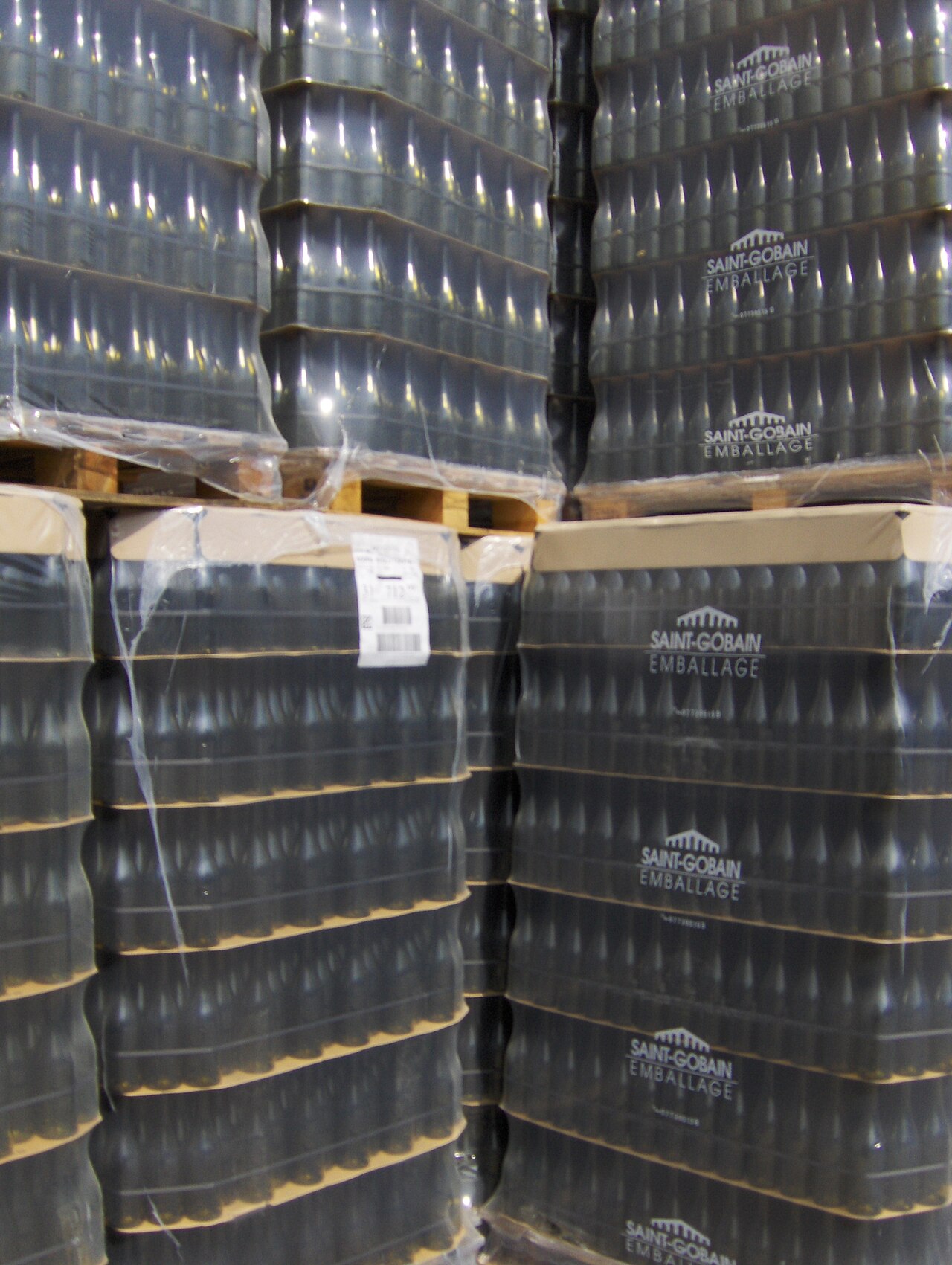
Groupage pallet means your goods travel together with those of other exporters using the same freight forwarder, on the same vehicle. The pallet must be packed and documented so that it withstands several loading and unloading operations. The advantage is that the cost is shared among several customers; the drawback is that timing depends on the groupage collection points and the carrier's schedule.
The container is the route for a full load, usually destined to a single importer or a single delivery. It can be a full container load, where all the capacity is yours, or a shared container load, where the space is divided with other goods. For wine, the container is the choice when the volume justifies a dedicated journey and when the importer wants to concentrate arrivals at a single time.
Which route for which volume and destination
The table compares the three routes on the criteria that really matter in the decision. There are no numerical thresholds, because the point at which one route becomes preferable to another changes with the country, the carrier and the schedule. The indications are qualitative and serve to set the order of magnitude before requesting a quote.
| Criterion | Express courier | Groupage pallet | Container |
|---|---|---|---|
| Typical quantity | A few cases, samples | A medium load, several cases on one pallet | A full load |
| How it is paid | Rate per package, weight and dimensions | Shared cost of the pallet | Rate per container, almost always at full load |
| Timing | The fastest and most predictable | Depends on the groupage schedule | Depends on the vessel and the port |
| Suited to destinations | Countries served by express networks | European and neighbouring countries served by regular lines | Non-European destinations and single-customer loads |
| Document handling | Simple, often handled by the courier | Requires a forwarder and complete transport documents | Requires a forwarder, customs documents and often a customs broker |
| Breakage risk | More handling, packaging must be carefully done | More loading operations, packaging must withstand them | Fewer handling operations, but long transit times |
The decisive criterion is the destination. For a European Union country, groupage pallet by road may be the most balanced route. For a country outside the Union, such as the United Kingdom or Switzerland, the customs step changes the work to be done, and the choice should be checked with the forwarder. For the United States or Asia, the container becomes the natural route, because sea transport is the most widely used option for full volumes.
Incoterms 2020: who pays for transport and who bears the risk
The Incoterms term determines who pays for what and where the risk of the goods passes. There are eleven Incoterms 2020 rules, and the ICC website presents them as a tool for clearly allocating costs, risks and obligations, in use in commercial contracts since 1936. For wine, the most frequent choices are FCA, when the winery hands the goods over to the buyer's carrier or forwarder, and CIF or CIP, when the winery arranges transport to the port or to the agreed destination. FCA has been revised for sea transport: the parties may agree that the buyer instructs the carrier to issue a bill of lading with an on-board notation, a detail that matters when payment goes through banks.
Under CIF terms, insurance remains at the minimum level of the Institute Cargo Clauses (C), unless a higher cover is agreed. Under CIP terms, the required cover is higher and corresponds to the Institute Cargo Clauses (A) or similar clauses. For a winery selling to a foreign importer, this difference translates into a different insurance cost, so it must be stated in the quote.
The DPU term, which replaces the former DAT, indicates that delivery takes place at a named destination and that the seller unloads the goods. The change of name serves to clarify that the place is not necessarily a terminal. Security obligations are described in items A4 and A7 of each rule, while all costs are listed in items A9 and B9. Reading these items before signing is the quickest way to avoid surprises. Stating the Incoterms term in the quote prevents two offers from appearing identical when they cover different costs. The comparison of the most used terms for wine is on the page dedicated to Incoterms 2020 for wine.
The documents that accompany outgoing wine
Every shipping route requires a set of documents, and the courier, the pallet and the container each require different quantities. The common minimum is the commercial invoice, the packing list with the number of cases and the weight, the transport document for the chosen route, and the collection instructions. When the shipment crosses a customs border, the file expands, and the forwarder or customs broker must know exactly what each package contains.
The tax side must always be checked. The European Commission explains that the EU sets harmonised minimum rates for alcoholic beverages and that member states may apply higher rates. For still and sparkling wine the minimum is stated as 0 euros per hectolitre, but the actual rates depend on the destination country and its national rules. Directive 92/83/EEC sets the structure of excise duties, Directive 92/84/EEC fixes the minimums, and Directive 2020/1151 amends the first one and has applied since 1 January 2022.
For countries outside the EU, the source to consult is the customs authority of the destination country. The ICE website organises the Markets section by country and by overseas office, and from there you can start to identify the market of interest. The winery's or the importer's customs broker verifies the required documents, while the winery prepares the correct data for the invoice and the packing list.
Temperature, breakage and theft: the three risks and who covers them
Wine travels better at a stable temperature and away from impacts. The thermal risk is higher in the hot months, on long transits and in containers that stop in ports, and for this reason refrigerated containers exist. When the route or the period requires it, the choice of a reefer should be assessed with the carrier before accepting the price, as explained on the page about temperature-controlled wine transport.
Breakage depends on the packaging and the number of handling operations. A groupage pallet has more loading and unloading steps than a full container, and the courier has many for each package. Packaging designed for the chosen route reduces breakage more than any claim made afterwards.
Theft and loss during transport depend on transport insurance. Under CIF and CIP terms, insurance is part of the contract according to the Institute Cargo Clauses indicated in the section on Incoterms, but the minimum level of the Institute Cargo Clauses (C) foreseen for CIF covers only listed events and does not include theft: check with the insurer whether theft risk is included. The carrier is liable for damage within the limits of the transport contract, and the winery must read those limits before shipping. Ask in writing who covers what, because the answer varies from one contract to another.
Who does what: forwarder, customs broker, carrier, importer
In wine shipping each party has a specific role. The forwarder organises the route, books the space, prepares the documents and coordinates the steps. The carrier performs the physical transport, by road, sea or air, and is liable for the cargo within the limits of its contract. The customs broker handles export and import formalities, and on non-EU shipments is often the person who avoids the most costly delays. The importer receives the goods, pays the taxes of its country and manages distribution.
The most frequent point of confusion concerns who chooses the route. If the contract is FCA, the choice of carrier may rest with the importer; if it is CIF or CIP, the choice rests with the winery. For this reason, the term should be agreed before requesting quotes. For a winery, the right forwarder is the one who explains in writing which services are included, and the page on forwarders for wine gathers the questions to ask.
How to read a quote and calculate the cost per bottle
A transport quote is never a single price. Typical items include the main transport, the customs formalities, any excise duties or guarantees, the documentary handling, insurance, loading and unloading costs, and storage charges at port or customs. Each item must have a responsible party, and the Incoterms term indicates which one. If the quote does not split the items, ask for the detailed version.
The cost per bottle is calculated as follows: add up the total transport cost with all the accessory items and divide by the number of bottles shipped. The result should be compared with the ex-cellar price of the wine, because transport weighs more heavily on low-priced wines. The same calculation should be done for each route, using the same number of bottles, to compare courier, pallet and container correctly. For the comparison, ask all three suppliers for the same basis: same number of packages, same weight, same destination and same Incoterms term. Without this common basis the quotes cannot be compared.
A detail often overlooked is package size. An oversized or poorly filled package takes up more volume than necessary and may cost more on any route. The page on couriers that accept wine and how to pack it shows how to reduce weight and volume without compromising protection.
Further reading: how to choose a freight forwarder for wine exports.
Further reading: Shipping wine to Asia: containers, ports and transit times.
Further reading: Courier for Shipping Wine: How to Choose the Carrier.
Frequently asked questions
Is a courier or a pallet better for a few bottles?
For a few cases and samples, express courier is usually the simplest and fastest route, because the document handling is reduced. Groupage pallet becomes advantageous when the quantity grows and the cost is shared with other shipments. Compare the cost per bottle of the two routes before deciding.
Is a container always cheaper?
No. A container is advantageous when the load is full and destined to a single customer, but for small volumes the empty space weighs on the cost. The waiting time for departure may also make a container unsuitable for an urgent order.
Who pays for transport in the contract with the importer?
It depends on the Incoterms term chosen. Under FCA the cost of the main transport passes to the buyer from the moment of handover to the carrier, while under CIF or CIP the seller arranges transport to the agreed point. The cost items are listed in items A9 and B9 of each rule.
Are wine excise duties a cost the winery must calculate?
It depends on the destination country. The EU sets minimum rates and leaves member states free to apply higher rates, so the winery should ask the importer or the customs broker which rules apply in the country of arrival before setting the price.
Sources
- Wine Pallet Label GS1-128 and SSCC for Retail and Monopolies
- Wine grape price by appellation: how to read ISMEA
- Wine sustainability certification: Equalitas, VIVA, SQNPI
- Wine Filtration: DE vs Crossflow, When Each Pays Off
- Wine Technical Sheet for Importers: What It Must Contain
- Wine export pallets: bottles per pallet and container