Taurasi DOCG explained: disciplinare, 17 Irpinian municipalities, Aglianico, ageing of Taurasi and Riserva, comparisons and export
Wines Export Editorial · Last updated:
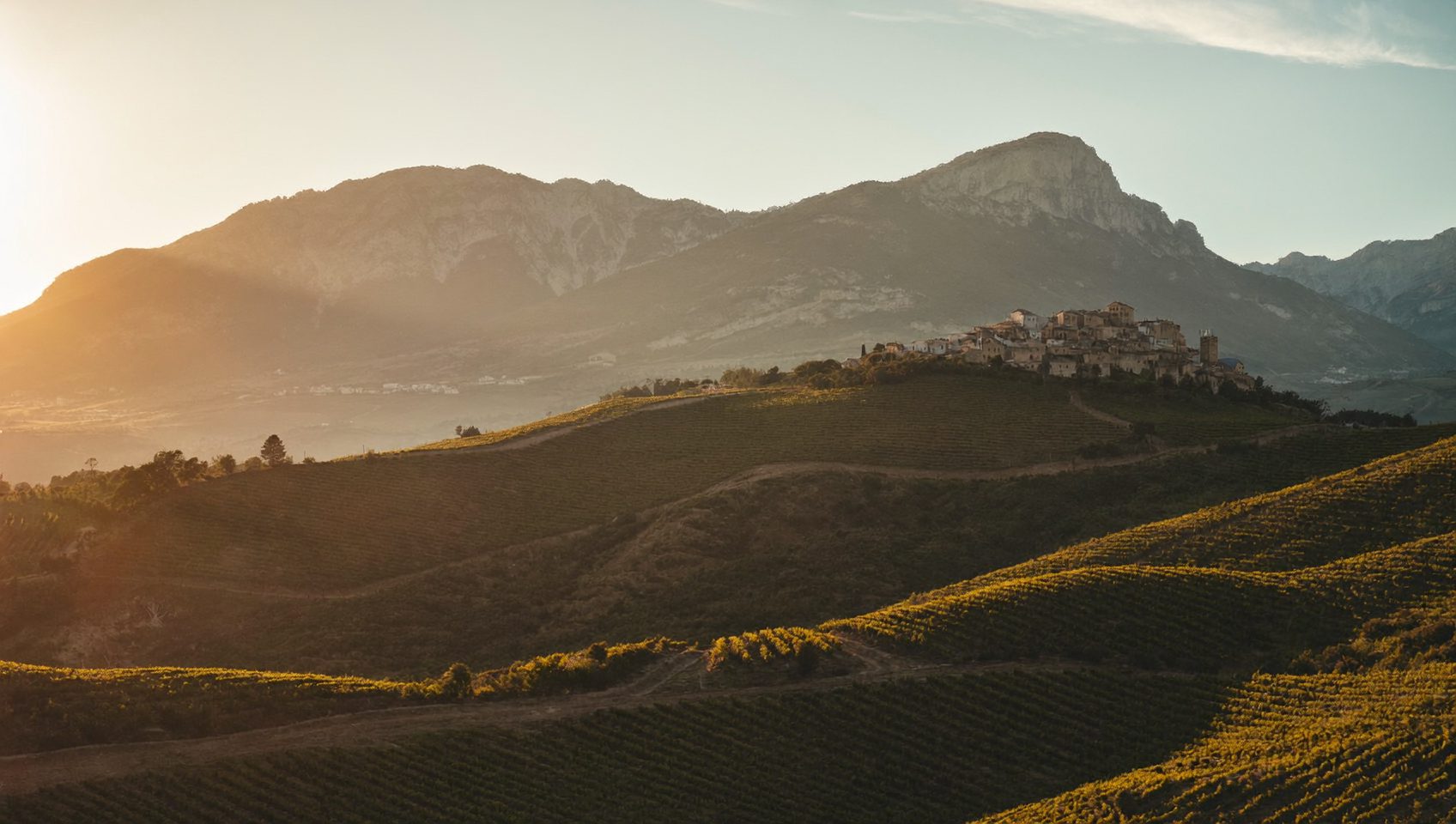
Taurasi DOCG is a dry red wine from Irpinia, in the province of Avellino, made from Aglianico grapes with up to 15 percent of other non-aromatic red varieties authorised in the province. The grapes come from 17 municipalities around the Calore river: Taurasi, Bonito, Castelfranci, Castelvetere sul Calore, Fontanarosa, Lapio, Luogosano, Mirabella Eclano, Montefalcione, Montemarano, Montemiletto, Paternopoli, Pietradefusi, Sant'Angelo all'Esca, San Mango sul Calore, Torre le Nocelle and Venticano (Taurasi DOCG disciplinare, art. 2 and 3). There are two types: Taurasi ages for at least three years, at least one of them in wooden casks, with at least 12 percent alcohol; Taurasi Riserva ages for at least four years, eighteen months in wood, with at least 12.5 percent; the period runs from 1 December of the harvest year (disciplinare, art. 1, 5 and 6). Taurasi became a DOC in 1970 and a DOCG in 1993; the latest amendment is the ministerial decree of 13 October 2020 (Gazzetta Ufficiale n. 266, 26 October 2020).
This page is the full guide to the denomination, including what a buyer abroad should check before listing it. The grape and all its denominations are covered in Aglianico: Taurasi, Taburno, Vulture, rules and export; the village that gives the wine its name in wine in Taurasi, province of Avellino; the other wines of the province in exporting wine from Avellino and those of the region in Campania wine.
What Taurasi DOCG is and where it comes from
Taurasi is the age-worthy red of Irpinia, and the rules want it almost entirely Aglianico. The name comes from the ancient arx Taurasia of the Irpini, a people allied with the Samnites; the disciplinare quotes Livy describing a "Taurasia of rich vineyards", and a document from 1167 in which the vine grown at Taurasi is called "Aglianica" (art. 9).
In the 19th century the province of Avellino produced more than a million hectolitres of wine, much of it exported, and the first railway in Irpinia became known as the "wine railway": from the stations of Taurasi and Lapio wine left for northern Italy and for Bordeaux, where phylloxera had destroyed the vineyards. In 1878 Francesco De Sanctis promoted the founding of the oenology school in Avellino, which the disciplinare credits with safeguarding the local grape heritage (art. 9).
The controlled designation of origin came with the presidential decree of 26 March 1970, the controlled and guaranteed one with the ministerial decree of 11 March 1993. According to the disciplinare, Taurasi remained the only DOCG of central and southern Italy until 2003, when Fiano di Avellino and Greco di Tufo also became DOCGs, and over the same period the number of wineries bottling it rose from 10 to about 80 (art. 9). The text was amended in 2011, 2013, 2014, 2018 and 2020; the 2020 decree was requested by the Consorzio tutela vini d'Irpinia, based in Avellino (Gazzetta Ufficiale n. 266, 26 October 2020).
The zone: 17 municipalities around the Calore
All 17 municipalities are included with their entire territory, and all are in the province of Avellino (disciplinare, art. 3).
The disciplinare divides the zone, broadly, into three sectors by subsoil, and describes Fontanarosa and Taurasi separately (art. 9):
| Sector | Municipalities | Main soils |
|---|---|---|
| Western | Venticano, Pietradefusi, Montemiletto, Torre le Nocelle, Lapio, Montefalcione | varicoloured clays, with calcarenites; at Torre le Nocelle also the Campanian Ignimbrite |
| Eastern | Luogosano, Paternopoli, San Mango sul Calore, Castelvetere sul Calore, Montemarano, Castelfranci | conglomerates with sandy and clayey layers; weakly cemented sandstones |
| North-eastern | Bonito, Mirabella Eclano, Sant'Angelo all'Esca | sandstones and sands with pudding-stone layers; at Sant'Angelo all'Esca a cover containing heavily weathered volcanic material |
| Described separately | Fontanarosa, Taurasi | at Fontanarosa sandstones and clayey sands above the varicoloured clays; at Taurasi covers, sometimes extensive, of ash, lapilli and weathered volcanic material |
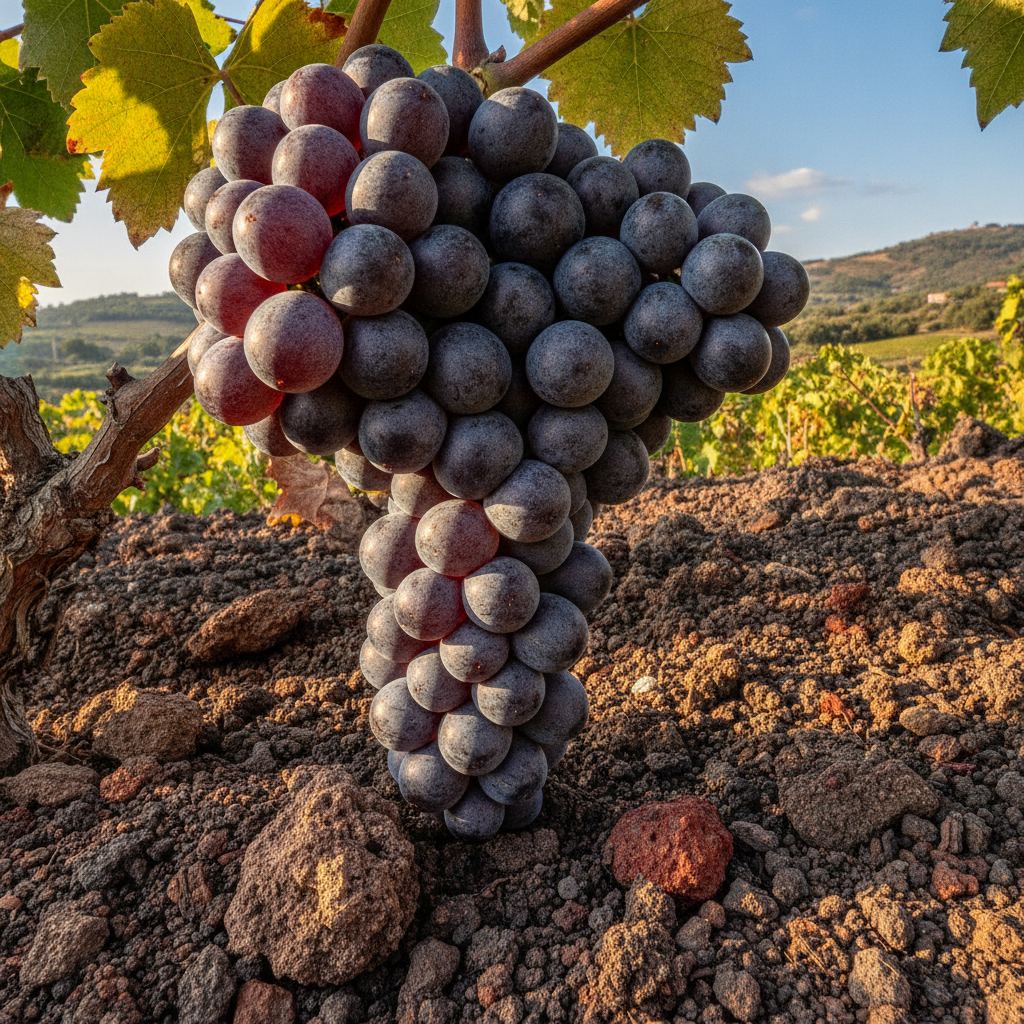
The soils are rich in clay and limestone, neutral to sub-alkaline, and well supplied with potassium and magnesium; for the disciplinare the clay holds water through dry summers and helps the grapes ripen steadily while keeping their acidity. Lapio and Montefalcione also fall within the Fiano di Avellino zone (art. 9). Vineyards lie between 400 and 700 metres, facing mainly south-east and south-west.
The climate is inland, with wide swings between day and night from July to September, harsh winters, and spring frosts that are fairly frequent and sometimes late. The disciplinare reports historical rainfall of 600 to 800 mm a year, more than 70 percent of it in autumn and winter and on average 6 percent in summer (art. 9).
The historic training system was the "alberata taurasina", with high festoons; today vertical trellis with Guyot or spur-pruned cordon prevails, with spacings such as 2.40 by 1.00 metres, and the disciplinare puts real yields at around 50 quintals per hectare, half the permitted maximum (art. 9). The lead village is described in wine in Taurasi, one of the villages shared with Fiano in wine in Lapio.
The grape: at least 85 percent Aglianico
| Grape | Share allowed | Source |
|---|---|---|
| Aglianico | the vineyard must consist of it; in practice at least 85 percent | art. 2 |
| Other non-aromatic red grapes authorised in the province of Avellino | up to 15 percent | art. 2 |
The 1970 rules already required Aglianico alone, with small allowances of up to 15 percent for other minor local grapes such as Piedirosso (art. 9). On the origin of the variety the text gives two hypotheses: the city of Elea on the Tyrrhenian coast of Lucania, or a corruption of "Ellenico" (Hellenic) that became Aglianico under Aragonese rule in the 15th century (art. 9). The grape's profile is in the Aglianico guide.
Taurasi and Taurasi Riserva: ageing, wood, alcohol, yields
Same grapes and same zone; the Riserva asks for riper grapes, one more year of ageing and six more months in wood.
| Requirement | Taurasi | Taurasi Riserva | Source |
|---|---|---|---|
| Minimum total ageing | 3 years | 4 years | art. 5 |
| Of which in wooden casks | at least 1 year | at least 18 months | art. 5 |
| Counted from | 1 December of the harvest year | 1 December of the harvest year | art. 5 |
| Minimum natural alcohol of the grapes | 11.5 percent | 12 percent | art. 4 |
| Minimum total alcohol | 12.00 percent | 12.50 percent | art. 6 |
| Maximum grape yield | 10 tonnes per hectare | 10 tonnes per hectare | art. 4 |
| Yield in wine | 70 percent at first racking, 65 percent after ageing | 70 percent at first racking, 65 percent after ageing | art. 5 |
| Minimum total acidity | 5.0 g/l | 5.0 g/l | art. 6 |
| Minimum dry extract | 22.0 g/l | 22.0 g/l | art. 6 |
In practice a 2021 Taurasi completes its three years on 1 December 2024 and a 2021 Riserva its four years on 1 December 2025. The rules set no minimum time in bottle and no type or size of cask: they say only "wooden casks" (art. 5). The disciplinare does record that from the 1997 vintage some producers began to use barriques, alone or alongside large Slavonian oak casks (art. 9).
Other cellar rules: winemaking and the compulsory ageing must take place in the province of Avellino; enrichment is allowed only with concentrated must from the zone or rectified concentrated must; up to 15 percent of younger Taurasi may be added to an older one, or the other way round, and the label then carries the vintage of the larger share (art. 5). In very generous years, grapes above 10 tonnes must be brought back to the limit by selection, provided total production does not exceed the maximum by more than 20 percent; the Campania Region, on a proposal from the Consorzio, may lower the claimable yield each year (art. 4). How these limits are calculated is explained in grape-to-wine yield limits in the disciplinari.
Vineyards must be on hillsides or otherwise well exposed, excluding damp, poorly lit valley floors; any forcing is banned, while emergency irrigation is allowed (art. 4).
Label, bottle and closure
| Rule | What the disciplinare requires | Source |
|---|---|---|
| Vintage | compulsory, truthful and documented | art. 7 |
| Riserva | below the words "denominazione di origine controllata e garantita", in letters no larger than "Taurasi" | art. 7 |
| Banned adjectives | "superiore", "extra", "fine", "selezionato" and similar | art. 7 |
| "Vigna" | allowed with the place name or traditional name, if the wine is made and kept separately, the mention appears in the harvest declaration, registers and documents, and the vineyard is in the regional list | art. 7 |
| Containers | glass, no more than 5 litres, with the State seal | art. 8 |
| Shape and colour | Bordeaux or Burgundy shape, dark glass | art. 8 |
| Closure | cork stopper | art. 8 |
The text does not require bottling inside the zone or the province: it requires winemaking and ageing in the province of Avellino (art. 5). How the State seal works is explained in the DOCG and DOC State seal: obligations and numbering.
What Taurasi tastes like
The legal description, the same for both types: intense ruby red, turning towards garnet and taking on orange tints with age; a characteristic, ethereal, pleasant nose of varying intensity; a dry, full, harmonious, balanced palate with a persistent finish (disciplinare, art. 6). In its historical section the disciplinare sums up the wine's canon as structured, very tannic, closed when young and suited to very long ageing, and quotes a 1923 ministry publication saying it could "rival the best Piedmontese wines" (art. 9). The nickname "Barolo of the South" does not appear in the disciplinare; the Barolo rules are in Barolo DOCG.
The vintages the disciplinare remembers
The disciplinare lists the harvests that shaped the wine's history (art. 9):
| Vintage | What happened | Source |
|---|---|---|
| 1928 | phylloxera had not yet reached Taurasi; whole wagonloads of Aglianico left for Tuscany, Piedmont and Bordeaux | art. 9 |
| 1968 | cited as the reference vintage of the Mastroberardino family's production | art. 9 |
| 1985, 1987, 1988 | a run of vintages rated five stars | art. 9 |
| 1993 | a great vintage, the year of the DOCG | art. 9 |
| 1999 | presented at the first Anteprima Taurasi | art. 9 |
| 2001 | a late spring frost drastically cut yields | art. 9 |
| 2002 | among the worst vintages in fifty years: almost all producers declassified to Irpinia Aglianico | art. 9 |
| 2003 | a very hot, dry summer, with results varying from area to area | art. 9 |
Taurasi, Irpinia Campi Taurasini, Irpinia Aglianico and Aglianico del Vulture
Taurasi has two "younger siblings" in the same province, both types of the Irpinia DOC, and a direct rival in Basilicata.
| Taurasi DOCG | Irpinia Campi Taurasini DOC | Irpinia Aglianico DOC | Aglianico del Vulture DOC | Aglianico del Vulture Superiore DOCG | |
|---|---|---|---|---|---|
| Grapes | Aglianico, other reds up to 15 percent | Aglianico at least 85 percent | Aglianico at least 85 percent | Aglianico only | Aglianico only |
| Zone | 17 municipalities | the 17 of Taurasi plus Gesualdo, Villamaina, Torella dei Lombardi, Grottaminarda, Melito Irpino, Nusco and Chiusano San Domenico | the whole province of Avellino | 15 municipalities of the Vulture, in Basilicata | the same 15 municipalities |
| Maximum grape yield | 10 t/ha | 11 t/ha | 12 t/ha | 10 t/ha | 8 t/ha |
| Minimum alcohol in the wine | 12.00 percent; Riserva 12.50 | 12.00 percent | 11.50 percent | 12.50 percent | 13.50 percent |
| Ageing or release | 3 years, 1 in wood; Riserva 4 years, 18 months in wood | from 1 September of the year after harvest | no period set | from 1 September of the year after harvest | from 1 November of the third year, after at least 12 months in wood and 12 in bottle; Riserva from 1 November of the fifth year, 24 months in wood and 12 in bottle |
| Bottling | not restricted | not restricted | not restricted | in the zone | in the zone |
Sources: Taurasi DOCG (art. 2 to 6), Irpinia DOC (art. 2 to 6), Aglianico del Vulture DOC and Aglianico del Vulture Superiore DOCG (art. 2 to 6) disciplinari.
What matters for a buyer. Campi Taurasini comes from a zone that contains the Taurasi zone, but with more grapes per hectare and no compulsory ageing: it is the red sold a year after harvest. Irpinia Aglianico covers the whole province and, like Campi Taurasini, may also be off-dry (Irpinia disciplinare, art. 6). When a vintage falls short, Taurasi can be declassified to Irpinia Aglianico, as happened in 2002 (Taurasi disciplinare, art. 9). Aglianico del Vulture allows no other grapes and must be bottled in the zone; the Superiore requires more alcohol and a year in bottle. The full comparison with the Vulture is in Aglianico del Vulture DOC and Superiore DOCG; the other two Irpinian DOCGs, both white, in Fiano di Avellino DOCG and Greco di Tufo DOCG.
Buying Taurasi abroad: what the data say
No public export figures are available for Taurasi alone. The available data cover all Irpinian wine. According to an analysis of Istat data by the Irpinia Sannio Chamber of Commerce, in 2024 the United States was the leading destination by value for Irpinian wines, with 7 million euros of exports, 25.9 percent more than the year before and 30.8 percent of the province's wine exports (Giornale dell'Irpinia, 4 April 2025). In the same article the president of the Consorzio tutela vini d'Irpinia, Teresa Bruno, named Japan among the alternative markets to pursue after the US tariffs.
For an importer this points to two main routes. The United States, the first market for Irpinian wine: wine importers in the United States and US wine importers and what they need. Japan, named by the Consorzio: wine importers in Japan and exporting wine to Japan. The weight of the DOCG label in negotiations is covered in exporting DOCG wines, and the list of markets in the wine importers by country hub.
Before listing a Taurasi, check five points on the technical sheet, all set by the disciplinare:
- Vintage and ageing. Three years from 1 December of the harvest for Taurasi, four for the Riserva (art. 5).
- Wood. At least one year in cask, eighteen months for the Riserva (art. 5).
- Alcohol. At least 12 percent, 12.5 for the Riserva (art. 6).
- Label. No "superiore", "extra" or "selezionato"; "vigna" only with the place name and a registered vineyard (art. 7).
- Format and closure. Dark glass, Bordeaux or Burgundy shape, up to 5 litres, cork stopper and State seal (art. 8).
Frequently asked questions
What grapes is Taurasi made from?
Aglianico, with up to 15 percent of other non-aromatic red grapes authorised in the province of Avellino (Taurasi DOCG disciplinare, art. 2).
How long must Taurasi age?
At least three years, at least one of them in wooden casks, counted from 1 December of the harvest year (disciplinare, art. 5).
What is the difference between Taurasi and Taurasi Riserva?
Same grapes and same zone. The Riserva ages at least four years instead of three, with eighteen months in wood instead of twelve, and needs at least 12.5 percent alcohol instead of 12 (disciplinare, art. 4, 5 and 6).
Which municipalities produce Taurasi?
Seventeen municipalities in the province of Avellino: Taurasi, Bonito, Castelfranci, Castelvetere sul Calore, Fontanarosa, Lapio, Luogosano, Mirabella Eclano, Montefalcione, Montemarano, Montemiletto, Paternopoli, Pietradefusi, Sant'Angelo all'Esca, San Mango sul Calore, Torre le Nocelle and Venticano (disciplinare, art. 3).
What is the difference between Taurasi and Irpinia Campi Taurasini?
Campi Taurasini is a sub-zone of the Irpinia DOC: 24 municipalities instead of 17, up to 11 tonnes of grapes per hectare instead of 10, no compulsory ageing, and release from 1 September of the year after harvest (Irpinia DOC disciplinare, art. 3 to 5).
What is the difference between Taurasi and Aglianico del Vulture?
Taurasi is in Campania and allows up to 15 percent of other grapes; Aglianico del Vulture is in Basilicata, is Aglianico only and must be bottled in the zone. The Vulture Superiore DOCG is released from 1 November of the third year after harvest, after 12 months in wood and 12 in bottle (Aglianico del Vulture DOC and Superiore DOCG disciplinari, art. 2 and 5).
Where is Taurasi exported?
There are no public figures for Taurasi alone. For all Irpinian wine, the United States was the leading market by value in 2024, with 30.8 percent of exports (Irpinia Sannio Chamber of Commerce on Istat data, Giornale dell'Irpinia, 4 April 2025).
Sources
- Taurasi DOCG disciplinare, consolidated text after the DM of 13 October 2020 (copy hosted by AIS)
- Gazzetta Ufficiale n. 266 of 26 October 2020, DM of 13 October 2020 amending the Taurasi disciplinare, with the consolidated text
- Italian Ministry of Agriculture, list of PDO and PGI wine disciplinari
- Irpinia DOC disciplinare (copy hosted by AIS)
- Aglianico del Vulture DOC disciplinare and Aglianico del Vulture Superiore DOCG disciplinare (copies hosted by AIS)
- Giornale dell'Irpinia, 4 April 2025, Irpinia and Sannio wine producers' fears over tariffs
Who produces Taurasi?
According to the Wines Export Observatory (November 2026), among the retailer and online-shop lists we read worldwide, the countries where Taurasi weighs most are the United States (20%), Germany (9%) and the United Kingdom (6%).
The towns where the wineries declaring Taurasi are concentrated, with a few names for each.
Montemarano (Campania)
Azienda Vitivinicola Salvatore Molettieri · Cortecorbo · Rosa Boccella · Cantina Giovanni Molettieri · Azienda Agricola Adelina Molettieri
Taurasi (Campania)
Sella delle Spine · Cantina Antica Hirpinia · Cantine Lonardo Contrade Di Taurasi · Vigne Guadagno · Cantina Antonio Caggiano
Paternopoli (Campania)
Azienda Agricola Fiorentino · Fonzone · Nativ Azienda Vinicola · Le Masciare · Cantina Paterno
Luogosano (Campania)
Tenuta Cavalier Pepe – Un Sogno nel cuore dell'Irpinia · Azienda Agricola " La Molara " Srl · Russo Taurasi - Cantine · Tenuta Ponte · Tenuta Cavalier Pepe
Tufo (Campania)
Cantine di Marzo · Terre d'Aione · Azienda Agricola Torricino · Azienda Agricola Benito Ferrara · Cantina Le Otto Terre
Montefalcione (Campania)
Donnachiara · Sertura · Kapemort · SCILLICAMPANA - Società Agricola Baldassarre
Castelfranci (Campania)
Cantina Antonio Molettieri · Cantina Perillo · Azienda Agricola Boccella · Cantine Gerardo Perillo
Montemiletto (Campania)
Tenuta Donna Elvira · Macchie Santa Maria Cantine · Tenuta del Meriggio · Masseria Della Porta
Who buys Taurasi abroad?
Importers and distributors that say they carry Taurasi, in the countries where we count the most, in order. Each company's profile, with the contact, is in the Wines Export directory.
The United States
Grand Cru Selections (New York) · thepawineroom.com (Palo Alto) · Ikavina Wine and Spirits (Connecticut) · Paradise Wine (Buffalo)
Hong Kong
Cheese Meets Wine · winecouple.hk
The United Kingdom
LA MIA ITALIA LTD (Brentwood) · Cellers Wine Merchants (Brentwood)
The Czech Republic
dios.cz
Greece
Materia Prima (Αθήνα)
Japan
Vino Hayashi
Hungary
Radovin bor nagykereskedés
Where is Taurasi sold around the world?
Retailers and online shops with at least one Taurasi on their list, in the countries where we find the most, in order. A snapshot of the price lists read from the database on 23 November 2026: it changes every week.
The United States
Chambers Street Wines · Bottle of Italy · SommSelect · SORRISO VINO NEEDHAM LLC (DBA Sorriso Imports) · Walker Wine Co. · Chigazola Merchants, DONALD CHIGAZOLA
Italy
saywine.it · ENOTECA MAGGIOLINI · Tannico · Enoteca Rocchi Enoteche e Distribuzione · Land of Wines · si-wine.it
Germany
Bottle Hero · Castello Vini · Watthof Weinhandel · Weinkelter · WineSolutions GmbH · che-vino
The Netherlands
Tannico · Bottle Hero · L'ARCO Shop · wineinblack.nl · Pandora's Bottle · Vinopronto
The United Kingdom
Tannico · wine-ta.co.uk · clubvini.co.uk · Campania Wines · Eurowines Limited · Fine Wine Company
Mexico
Italian Wine Selection · Vinopolis - Intrepid Wine Collection · La Cav · La Cava Del Marqués · la cubiella · AlcornoqueMX
Switzerland
Tannico · Weinvogel SA · wine-in-black.ch · DM Vini · Sapori di Napoli · Hofer Wine & Spirits
Belgium
Tannico · Belgium Wine Watchers · A.G. WINES · Il Sodo · Crombé Winehouse · VDA
Names read from the Wines Export database (company registers, websites, customs data, retailers' price lists). No contacts on this page.
- Teroldego Rotaliano DOC: Zone, Grape, Superiore, Riserva
- St. Magdalener (Santa Maddalena): Schiava, Classico, Rules
- Etna Rosso DOC: Export Guide for Wineries
- Prosecco DOP: Production Rules and What Buyers Look For
- Terre Siciliane IGP: grapes, rules and Sicilia DOC
- Asti Spumante DOCG: Method, Sweetness, Rosé, Markets