Fiano di Avellino DOCG explained: production rules, 26 villages, grapes, Apianum, Riserva, sparkling and export
Wines Export Editorial · Last updated:
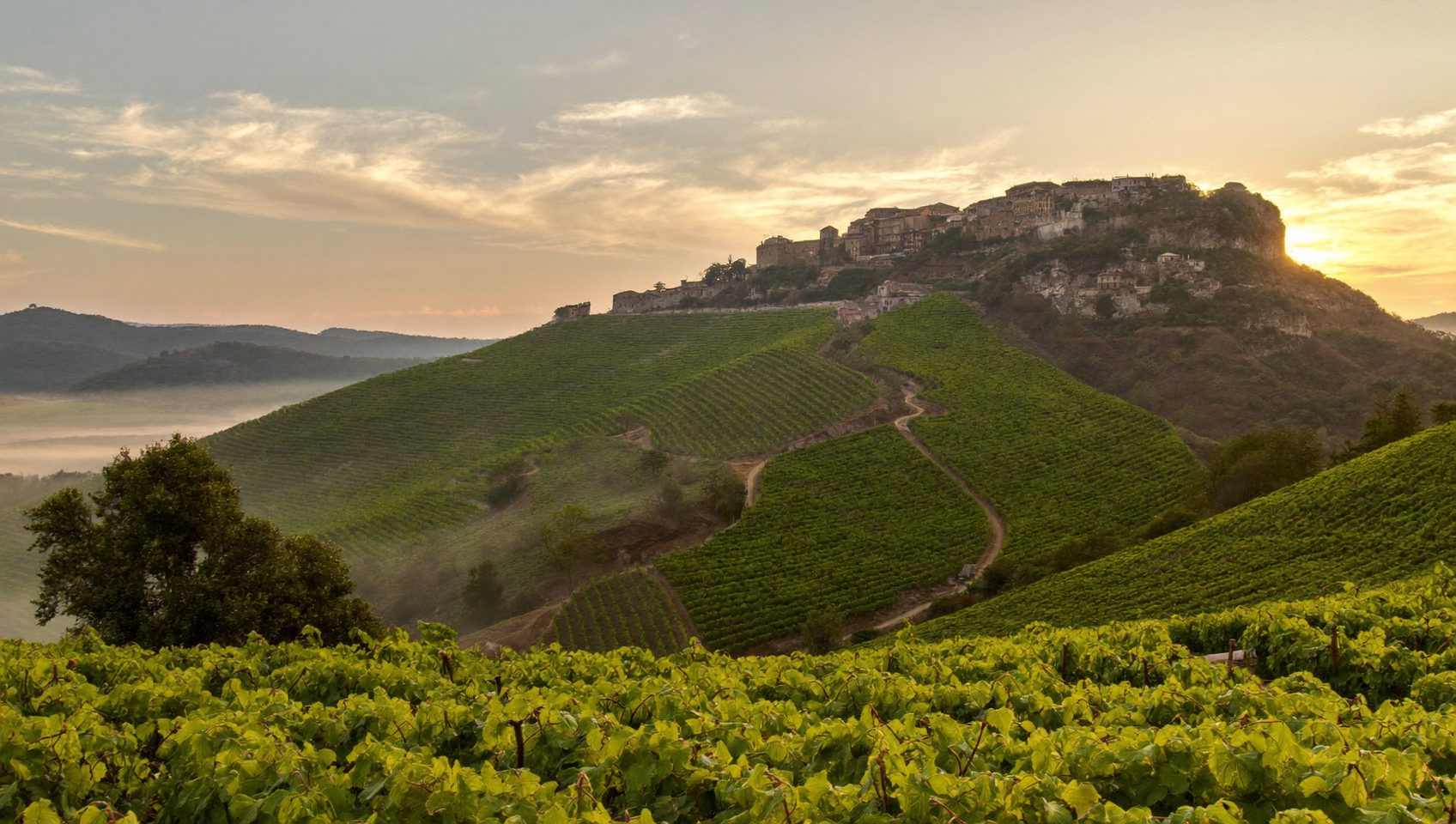
Fiano di Avellino DOCG is a white wine from Irpinia made from at least 85 percent Fiano, with Greco, Coda di Volpe and Trebbiano Toscano allowed up to 15 percent, grown in 26 municipalities of the province of Avellino (Fiano di Avellino DOCG disciplinare, art. 2 and 3). It comes in four types: Fiano di Avellino, the Riserva with at least 12 months of ageing, and the Spumante and Spumante Riserva, both made only by the metodo classico; the label may carry the traditional term «Apianum», the ancient name of the wine (disciplinare, art. 1, 5 and 7). Recognised as a DOC by the presidential decree of 27 April 1978 and as a DOCG by the ministerial decree of 18 July 2003, the disciplinare was last amended by Commission Implementing Regulation (EU) 2025/1086 of 2 June 2025, which added the two sparkling types (disciplinare, header; EUR-Lex).
This page is the full guide to the denomination, including what a buyer abroad should check before listing it. The regional picture is in the Campania wine export guide, the other wines of the province in exporting wine from Avellino, and the village that gives the Apianum mention its name in the wines of Lapio.
What Fiano di Avellino is and where it comes from
Fiano di Avellino is a hill white made almost entirely from one grape, Fiano, in a compact area around the Irpinian capital. The disciplinare describes it as dry, fresh and harmonious, with an intense, fine and characteristic nose (disciplinare, art. 6).
The official history is in article 8 of the disciplinare. In his «Ragguagli della città di Avellino» of 1642, the friar Scipione Bellabona writes that in the area called Apia, today's Lapio, a wine called Apiano was made, a name that over time became Afiano and then Fiano; the disciplinare gives two explanations of the name, the place name Apia and the bees drawn to the sweet berries. The same article cites an order by Frederick II for loads of Greco and Fiano, and King Charles II of Anjou's request for 1,600 Fiano vines to plant on his estates at Manfredonia. After phylloxera the variety almost disappeared: in 1950 Violante and Ciarimboli counted 2 hectares of specialised vineyard and 53 in mixed cultivation, and the 1970 vineyard register recorded 17 specialised and 10 mixed (disciplinare, art. 8).
The denomination is protected by the Consorzio Tutela Vini d'Irpinia, founded on 24 April 2003, which also represents Greco di Tufo DOCG, Taurasi DOCG and Irpinia DOC and presents Fiano di Avellino as one of the longest-lived whites of southern Italy (Consorzio Tutela Vini d'Irpinia). Annual checks are carried out by the body named in article 9 of the disciplinare, Agroqualità.
The zone: 26 municipalities in the province of Avellino
Grapes may come from the entire territory of 26 municipalities: Avellino, Lapio, Atripalda, Cesinali, Aiello del Sabato, Santo Stefano del Sole, Sorbo Serpico, Salza Irpina, Parolise, San Potito Ultra, Candida, Manocalzati, Pratola Serra, Montefredane, Grottolella, Capriglia Irpina, Sant'Angelo a Scala, Summonte, Mercogliano, Forino, Contrada, Monteforte Irpino, Ospedaletto d'Alpinolo, Montefalcione, Santa Lucia di Serino and San Michele di Serino (disciplinare, art. 3). The area stretches north of Avellino to the border with the province of Benevento, covers 276 square kilometres and lies partly inside the Partenio regional park (disciplinare, art. 8).
It is a band of hills between the Monte Vergine and Monti di Avella group to the west and the Terminio-Tuoro group to the east; the highest hills reach about 600 metres and Lapio sits at 590 metres. Soils are young and rich in clay, up to 50 percent of the fine earth, with volcanic ash and pumice in the central band, ash over varicoloured clays at Lapio and Atripalda, and varicoloured clays alone at Montefalcione, Parolise and San Potito Ultra. Rainfall is just over 1,100 mm a year, more than 70 percent of it in autumn and winter and on average 6 percent in summer; winters are harsh, sometimes with snow, spring frosts are frequent and day-night temperature swings between July and September are marked (disciplinare, art. 8).
The disciplinare recognises four favoured areas, each with its own character (art. 8):
| Area | What the disciplinare says |
|---|---|
| Lapio | structured wines with unusual acidity and minerality, often resembling mountain wines |
| Summonte | soils that are hard to work; concentrated, powerful wines with plenty of fruit and little minerality |
| Montefredane | a clay and chalky-clay hill that brings out mineral notes; wines of proven longevity |
| hills east of Avellino | sandy soils, notes of toasted hazelnut and a smoky character that is not mineral; wines ready in the medium term |
None of these areas is a geographical mention for the label: the disciplinare has no subzones. A single vineyard name is allowed, with the term «vigna» followed by the place name, if the wine is made and stored in separate vessels, if the name appears in the grape declaration, registers and accompanying documents, and if it is entered in the regional list set by Law 238/2016 (disciplinare, art. 7).
The grape: at least 85 percent Fiano
The blend is calculated on the estate's vineyards, not on each bottle.
| Variety | Share allowed | Source |
|---|---|---|
| Fiano | at least 85 percent | disciplinare, art. 2 |
| Greco, Coda di Volpe and Trebbiano Toscano, alone or together | up to 15 percent | disciplinare, art. 2 |
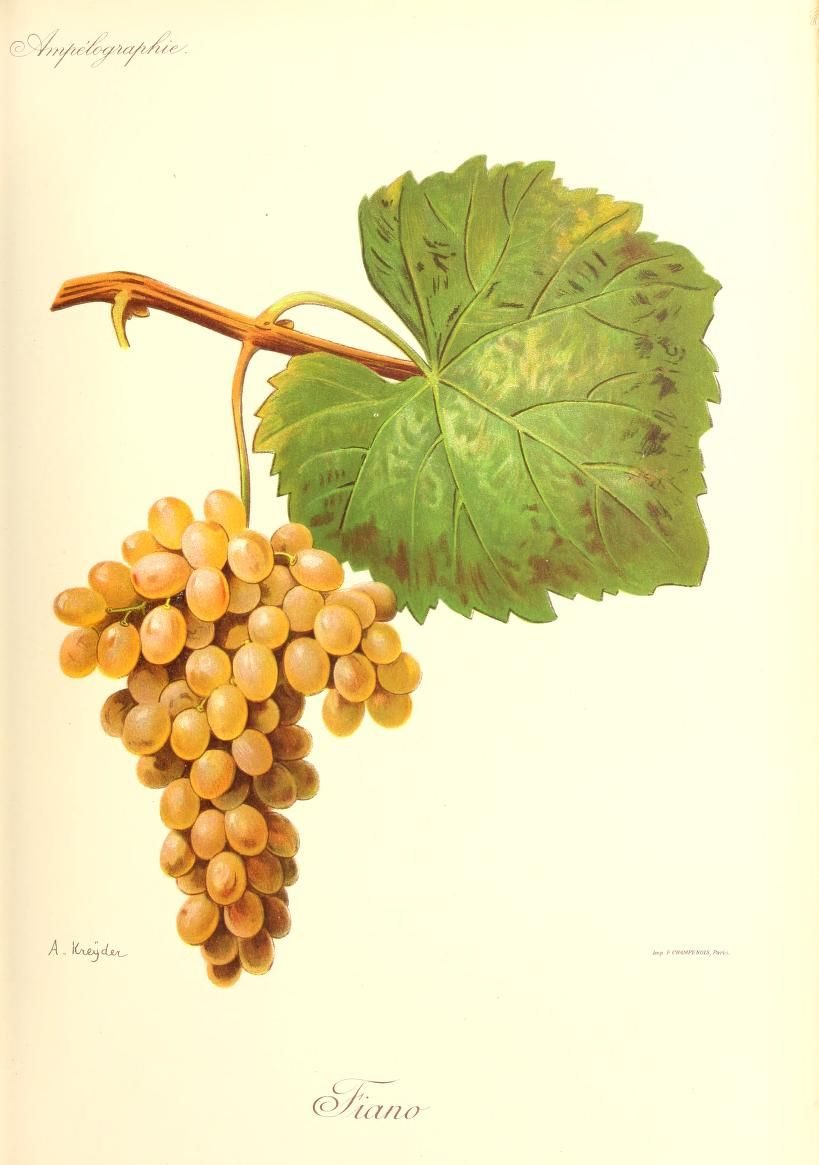
No other variety is allowed. The disciplinare notes that Fiano is a shy cropper: as early as 1950 ampelographers named its very low yield in wine, 60 to 63 percent, as the reason it was being abandoned (disciplinare, art. 8). According to the Consorzio, Fiano has firm flesh and thick skins and is usually picked between late September and October (Consorzio Tutela Vini d'Irpinia, Fiano di Avellino DOCG page). The variety outside this denomination is covered in Italian white grape varieties for importers.
Types and requirements: what the disciplinare demands
Vineyard rules apply to all four types. Only hillside, well-exposed vineyards can be registered, excluding damp, poorly lit valley floors; new plantings must use vertical training and at least 2,500 vines per hectare; forcing is banned and emergency irrigation is allowed (disciplinare, art. 4). Winemaking and elaboration must take place in the province of Avellino (art. 5).
| Requirement | Fiano di Avellino | Riserva | Spumante | Spumante Riserva | Source |
|---|---|---|---|---|---|
| Maximum grape yield | 10 t/ha | 10 t/ha | 10 t/ha | 10 t/ha | art. 4 |
| Minimum natural alcohol of the grapes | 11.00 percent | 11.00 percent | 11.00 percent | 11.00 percent | art. 4 |
| Maximum grape-to-wine yield | 70 percent | 70 percent | 70 percent | 70 percent | art. 5 |
| Method | still wine | still wine | bottle refermentation only, metodo classico | bottle refermentation only, metodo classico | art. 5 |
| Minimum ageing | none set | 12 months from 1 November of the harvest year | 18 months in bottle from tirage | 36 months in bottle from tirage | art. 5 |
| Minimum total alcohol | 11.50 percent | 12.00 percent | 12.00 percent | 12.00 percent | art. 6 |
| Minimum total acidity | 5.0 g/l | 5.0 g/l | 6.0 g/l | 6.0 g/l | art. 6 |
| Minimum non-reducing extract | 16.0 g/l | 17.0 g/l | 16.0 g/l | 16.0 g/l | art. 6 |
| Vintage on the label | mandatory | mandatory | only if vintage-dated | only if vintage-dated | art. 7 |
| Closure | cork flush with the bottle mouth | cork flush with the bottle mouth | mushroom cork | mushroom cork | art. 7 |
In generous years production must be brought back to the 10-tonne limit, provided it does not exceed it by more than 20 percent; each year the Campania Region, on the Consorzio's proposal, may lower the amount of grapes that can be claimed (art. 4). Above the 70 percent yield the whole batch loses the DOCG (art. 5). With 10 tonnes and 70 percent, one hectare yields at most 70 hectolitres of Fiano di Avellino; how to read these limits is explained in grape and wine yields in DOC and DOCG rules.
In practice, a Fiano di Avellino can be released right after winemaking, while a Riserva from the 2024 harvest could not go on sale before 1 November 2025. The sparkling wine may range from zero dosage to sweet (art. 6). The two sparkling types came with an amendment requested in January 2022 by the Consorzio di Tutela dei vini d'Irpinia and the Consorzio Tutela Vini DOC e DOCG, published in the Official Journal of the European Union on 10 January 2025 (file PDO-IT-A0232-AM03) and approved on 2 June 2025; the applicants cited the local tradition of sparkling wine and said the 18 months on the lees came from technical trials in the area (Official Journal of the EU, C/2025/298).
The label: Apianum, vigna, bottle and closure
«Apianum» is a traditional term of classical origin and may accompany the denomination on all types, but in letters no larger than half the size of those used for «Fiano di Avellino» (disciplinare, art. 7). It is not a subzone and does not mean a different wine: it recalls the Apiano wine of the ancient sources (art. 8).
The other rules of article 7:
- adjectives such as superiore, scelto, selezionato and similar are banned; names, company names and private brands are allowed if they are neither laudatory nor misleading;
- the vintage is mandatory, except for non-vintage sparkling wines;
- the wine may be sold only in glass bottles or containers of up to 6 litres, with the state DOCG strip;
- still wines are closed with a cork flush with the bottle mouth; any closure allowed by law is permitted only up to 0.187 litres;
- sparkling wines are closed with a mushroom cork, with no plastic above 0.200 litres.
The closure rule matters for exporters: a 0.75-litre still Fiano di Avellino cannot have a screw cap. The sizes accepted in destination markets are in wine bottle sizes allowed in the USA, Canada and Japan.
What it tastes like and how long it ages
The legal description: straw yellow of varying intensity; pleasant, intense, fine, characteristic nose; dry, fresh, harmonious palate. The sparkling wine has a fine, persistent mousse, greenish highlights and a delicate hint of yeast (disciplinare, art. 6). According to the disciplinare, the clay in the soils helps hold acidity through dry summers, and potassium and magnesium give aromatic intensity and structure; the wine combines acidity and finesse with a marked capacity to age (art. 8).
The Consorzio describes a young wine as fresh, with herbal notes, gaining salinity, body and softness with time and moving from greenish yellow to gold; its FAQ say the standard type usually lasts 5 to 8 years and the Riserva 10 to 15 years or more. Most wines ferment and mature in temperature-controlled stainless steel, some in wood. For food, the Consorzio suggests pasta with seafood and baked fish for young wines, buffalo mozzarella and pizza, and fried seafood or fried pizza for the Riserva (Consorzio Tutela Vini d'Irpinia, Fiano di Avellino DOCG page).
Fiano di Avellino and Greco di Tufo compared
The two white DOCGs of Irpinia have almost twin rules: the grape and the zone change.
| Fiano di Avellino DOCG | Greco di Tufo DOCG | |
|---|---|---|
| Main grape | Fiano at least 85 percent | Greco at least 85 percent |
| Other grapes | Greco, Coda di Volpe, Trebbiano Toscano up to 15 percent | only Coda di Volpe up to 15 percent |
| Zone | 26 municipalities around Avellino | 8 municipalities: Tufo, Altavilla Irpina, Chianche, Montefusco, Prata di Principato Ultra, Petruro Irpino, Santa Paolina and Torrioni |
| Grape yield and natural alcohol | 10 t/ha, 11.00 percent | 10 t/ha, 11.00 percent |
| Riserva | 12 months from 1 November | 12 months from 1 November |
| Sparkling | metodo classico, 18 months; Riserva 36 months | metodo classico, 18 months; Riserva 36 months |
| Sparkling, dosage | zero dosage to sweet | extra brut to extra dry |
| Traditional term | Apianum | none |
Sources: Fiano di Avellino DOCG and Greco di Tufo DOCG disciplinari, art. 1-7.
The Fiano disciplinare notes that the central band of its zone has the same volcanic deposits, with rare tuff layers and small pumice, as the Greco di Tufo area (art. 8). The guide to the other white DOCG is Greco di Tufo DOCG, the red of the province is Taurasi DOCG, and the white of neighbouring Sannio is Falanghina del Sannio DOC.
Fiano outside the DOCG: Irpinia, Cilento, Sicily, Puglia
Fiano is also grown outside these 26 municipalities, and the grape name appears on labels under other denominations. The differences in the rules:
| Denomination | Minimum Fiano | Maximum grape yield | Minimum total alcohol | Style allowed | Source |
|---|---|---|---|---|---|
| Fiano di Avellino DOCG | 85 percent | 10 t/ha | 11.50 percent | dry | disciplinare, art. 2, 4, 6 |
| Irpinia DOC Fiano (whole province of Avellino) | 85 percent | 12 t/ha | 11.00 percent | dry or off-dry | Irpinia DOC disciplinare |
| Cilento DOC Fiano (province of Salerno) | 85 percent | 10 t/ha | 12.00 percent | dry | Cilento DOC disciplinare |
| Sicilia DOC Fiano | 85 percent | 13 t/ha | 11.50 percent | dry to off-dry | Sicilia DOC disciplinare |
| Salice Salentino DOC Fiano (Puglia) | 85 percent | 12 t/ha | 11.00 percent | dry or off-dry | Salice Salentino DOC disciplinare |
The most useful difference for a buyer is with Irpinia DOC: same province, but grapes from the whole province, a higher yield, and off-dry and passito versions allowed. They are two separate denominations: an Irpinia Fiano does not carry the zone, yield and style limits of the DOCG. The other denominations are covered in Salice Salentino DOC and Sicilian wine for export.
Selling Fiano di Avellino abroad
There is no recent public data on exports of Fiano di Avellino alone. The disciplinare gives an area of more than 560 hectares, a potential output of 39,000 hectolitres and an actual output of about 23,000, without saying which year these figures refer to (disciplinare, art. 8).
For Irpinian wines as a whole, an analysis by the Irpinia Sannio Chamber of Commerce based on Istat data put total exports at 22.7 million euros, with the United States the first market: 7 million in 2024, up 25.9 percent on the previous year and 30.8 percent of the total. In the same article the Consorzio's president, Teresa Bruno, named Japan among the alternative markets to develop (Giornale dell'Irpinia, 4 April 2025). At Vinitaly 2025 the Consorzio held a guided tasting on the ageing potential of Fiano di Avellino (same source).
For your winery there are two routes. The United States is the first market for Irpinian wines: wine importers in the United States and buyers and importers in the United States. Japan is the market the Consorzio pointed to: wine importers in Japan and exporting wine to Japan: zero duty, documents, labelling. For the sparkling wine, see sparkling wine importers abroad.
Before sending a technical sheet to an importer, check five points: at least 85 percent Fiano, with only Greco, Coda di Volpe or Trebbiano Toscano in the rest; winemaking in the province of Avellino; the vintage on every still wine; Apianum, if used, no more than half the height of the denomination; a cork flush with the mouth on every still bottle above 0.187 litres. For the Riserva add the date from which ageing is counted, for the sparkling wine the tirage date.
Frequently asked questions
What grapes is Fiano di Avellino made from?
At least 85 percent Fiano; the rest, up to 15 percent, may come only from Greco, Coda di Volpe and Trebbiano Toscano grown on the estate (Fiano di Avellino DOCG disciplinare, art. 2).
Where is Fiano di Avellino produced?
In 26 municipalities of the province of Avellino, including Avellino, Lapio, Atripalda, Montefredane, Summonte, Montefalcione and Manocalzati; winemaking must take place in the province of Avellino (disciplinare, art. 3 and 5).
What does Apianum mean on the label?
It is the traditional term that recalls the Apiano wine made in ancient Apia, today's Lapio. It is optional and must be printed in letters no larger than half those of the denomination (disciplinare, art. 7 and 8).
What is the difference between Fiano di Avellino and Fiano di Avellino Riserva?
Same grapes and same zone. The Riserva ages at least 12 months from 1 November of the harvest year and has at least 12 percent alcohol and 17 g/l of extract, against 11.50 percent and 16 g/l for the standard type, which has no minimum ageing (disciplinare, art. 5 and 6).
Is there a sparkling Fiano di Avellino?
Yes, since 2025: Spumante with at least 18 months in bottle from tirage and Spumante Riserva with at least 36, made only by the metodo classico (disciplinare, art. 5; Implementing Regulation (EU) 2025/1086).
What is the difference between Fiano di Avellino DOCG and Irpinia Fiano DOC?
Fiano di Avellino comes from 26 municipalities with a yield of 10 tonnes per hectare and only as a dry wine; Irpinia DOC Fiano may come from the whole province, with 12 tonnes, and may also be off-dry or passito (Fiano di Avellino DOCG and Irpinia DOC disciplinari).
Sources
- Fiano di Avellino DOCG disciplinare, text updated to Regulation (EU) 2025/1086 (Italian Ministry of Agriculture, list of PDO and PGI specifications)
- Commission Implementing Regulation (EU) 2025/1086 of 2 June 2025, Union amendment to the Fiano di Avellino specification (EUR-Lex)
- Official Journal of the European Union C/2025/298, 10 January 2025, amendment application PDO-IT-A0232-AM03 (EUR-Lex)
- Greco di Tufo DOCG, Irpinia DOC, Cilento DOC, Sicilia DOC and Salice Salentino DOC disciplinari (Italian Ministry of Agriculture, list of PDO and PGI specifications)
- Consorzio Tutela Vini d'Irpinia, Fiano di Avellino DOCG page and Consorzio home page
- Giornale dell'Irpinia, 4 April 2025, US tariffs and the fears of Irpinia and Sannio wine producers
- Fortified Wine Production: Added Alcohol, EU Rules, Excise
- Wine Closures for Export: Cork, Technical or Screw Cap
- Fragolino: Meaning, Grape and Why It Is Not Wine in the EU
- Dolcetto: Dogliani, Diano d'Alba, Ovada DOCs and export
- Friuli passito wine: Ramandolo, Picolit, Verduzzo
- Tannins in Wine: Origin, Astringency, Oak and Ageing