Tasting notes for importers: structure, vocabulary and words to avoid
Wines Export Editorial · Last updated:
A wine tasting note in English is the text an importer reads before deciding whether to taste your wine, and it is often the same text that ends up in the price list or the spec sheet. A buyer looks for four pieces of information: how the wine appears in the glass, what can be smelled, how it behaves on the palate, and how long the taste lasts after swallowing. Whoever writes the note needs a shared vocabulary, short sentences and no claim that the destination market could challenge. The sections below cover the structure, the WSET terminology, the useful length for each document, the expressions to avoid and three rewritten examples. For what the rest of the spec sheet should contain, see what a wine spec sheet for importers should include.
What buyers read in a tasting note and what they skip
The buyer reads the note with a precise goal: to understand whether the wine fits a price band, a channel and a style that their catalogue already covers. For this reason the first lines matter more than everything else. Colour and aroma profile tell them whether the wine is light, spicy or fruity, while the palate tells them whether it can enter a restaurant wine list or a wine shop shelf.
They skip poetic phrases, long metaphors and adjectives that describe nothing verifiable, such as "exciting" or "harmonious" on their own. A useful note says what is seen, what is smelled and what happens in the mouth, in the order the reader will use it.
The buyer also checks consistency: a note that describes a dry wine next to a spec sheet showing high sweetness makes them doubt the whole document, so the note should be written after the spec sheet.
Structure: appearance, nose, palate, finish, service, pairing
The structure most used in professional notes follows the sequence of the tasting: the eye, the nose, the palate, the finish. It is the same logic that WSET presents with its Systematic Approach to Tasting, known as SAT, a method that leads the taster to describe the wine step by step instead of relying on a general judgement. At the end of the sequence two practical lines are added, service and pairing, which the buyer uses for the menu or the shelf.
The table below indicates what to write in each part and which English vocabulary is most common for each. The terms are indicative and should be chosen according to the actual wine, not copied in bulk.
| Note section | What to write | Typical English terms |
|---|---|---|
| Appearance | colour, clarity, intensity | pale straw, brilliant, deep ruby, clear |
| Nose | intensity, aroma families, any evolved notes | intense, citrus, red berries, dried herbs, oak |
| Palate | sweetness, acidity, tannin, body, alcohol | dry, crisp acidity, medium body, firm tannins |
| Finish | length and quality of the aftertaste | short, medium finish, long finish, clean |
| Service | temperature and type of glass | serve chilled, serve at cellar temperature |
| Pairing | types of dish or cheese, not recipes | pairs with grilled fish, roast meat, soft cheese |
The nose section is where most mistakes happen. Writing "rich in fruit" does not help, because it does not say which fruit. Writing "black cherry and liquorice" gives the buyer a precise image and lets them compare the wine with others in their catalogue. The palate also needs terms with a shared meaning: body is indicated as light, medium or full, and tannin as soft, fine or astringent.
For tannin, which is the most technical palate term and the one buyers most often ask to have clarified, see the page on tannins and wine culture, where the concept is explained without jargon.
Vocabulary: WSET method, aroma wheel and Italian false friends
The most reliable vocabulary for an English note is the one the trade already uses. The WSET website also publishes a guide to the pronunciation of key wine terms. The vocabulary of the note should not, however, be an exercise in style: it should match the language used in the internal tasting sheets.
The aroma wheel is a widely used tool for finding nose terms. The Wine Aroma Wheel was created by Dr Ann Noble at the University of California, Davis, and is available in eight languages, including Italian. Its use follows a practical logic: you start from the most general categories of the wheel and move towards the most specific note only when you are sure. A note that says "fruity" and then "black cherry" is more useful than one that says only "black cherry" without a shared basis.
When writing in English from a language that uses other terms, the risk is false friends. Writers tend to translate word for word, and the result sounds odd to a native reader. Some frequent examples:
- "sapido" is rendered as savoury or with a description of the saline sensation, not as tasty;
- "corposo" is rendered as full-bodied, not with terms meaning corpulent;
- "sentori" is rendered as aromas or notes, not as sentiments;
- "frutta secca", meaning walnuts, hazelnuts and almonds, is rendered as nuts or with the name of the fruit, while dried fruit indicates dried fruit such as dried figs, raisins or prunes;
- "vegetale" is rendered as vegetal only for notes of herbs or green pepper, not as vegetable, which indicates the vegetable itself.
If the winery already has an internal panel that tastes with sheets and thresholds, the vocabulary of the note should be the same. To understand how to organise that work, see sensory analysis in the winery with an internal panel, sheets and thresholds.
Length and tone: how much to write for the spec sheet, price list and back label
The length depends on the document. In the price list a few sentences are enough, stating the style of the wine, its main aroma profile and the simplest pairing. In the spec sheet you can go up to a short paragraph, with appearance, nose, palate and finish in a readable sequence. On the back label space is very limited and the rules of the importing country decide what is permitted, so the note should be cut down to two or three descriptors and one service sentence; for the most demanding markets it is worth consulting back label guidance for importers in the USA, Canada, Japan and China.
The tone must be neutral and descriptive. A sentence such as "a pale straw colour, with citrus and green apple on the nose and a dry, crisp palate" does its job without effort, while a sentence that anticipates the judgement on the product should be removed.
For the general reading of tasting, with the basic criteria that help write a complete note, see the page on tasting in wine culture. From an organisational point of view, the International Organisation of Vine and Wine (OIV) also gathers in its standards section the regulatory corpus and technical documents of the sector: it does not provide a note template, but it is the official reference for the technical terms the spec sheet refers to.
Words to avoid: health, "natural", comparisons, superlatives
Some words cause problems even when they describe the wine well. The first group concerns health. Phrases such as "good for you", "heart-healthy", "helps digestion" or "detox" must never appear in a note, because they attribute to the wine a health effect that no spec sheet can demonstrate and that many markets regulate strictly.
The second group concerns terms with a regulated meaning or that the importing country may challenge. The most common case is "natural", which is widely used in marketing but does not carry the same meaning in every market. The same applies to "organic" and other similar wording. Before using them, check the rules of the destination country, and in most cases it is better to describe the method concretely, for example by stating that the wine was made without filtration, if this is true and documented.
The third group concerns comparisons, such as "better than" or "like a Burgundy", which the buyer cannot verify. The fourth is absolute superlatives, such as "the finest" or "unique": the buyer reads them as noise.
Awards should also be cited only if the buyer can verify them, with the competition and the body that awarded them.
| Expression to avoid | Why it causes problems | Descriptive alternative |
|---|---|---|
| good for you, heart-healthy | health effect that cannot be demonstrated | describe the pairing at the table |
| natural, organic | regulated meaning in some markets | describe the method actually used |
| better than, like a Burgundy | comparison that cannot be verified | describe the wine's descriptors |
| the finest, unique | absolute superlative, noise for the buyer | a measurable adjective, such as crisp or long |
Three examples rewritten from Italian into professional English
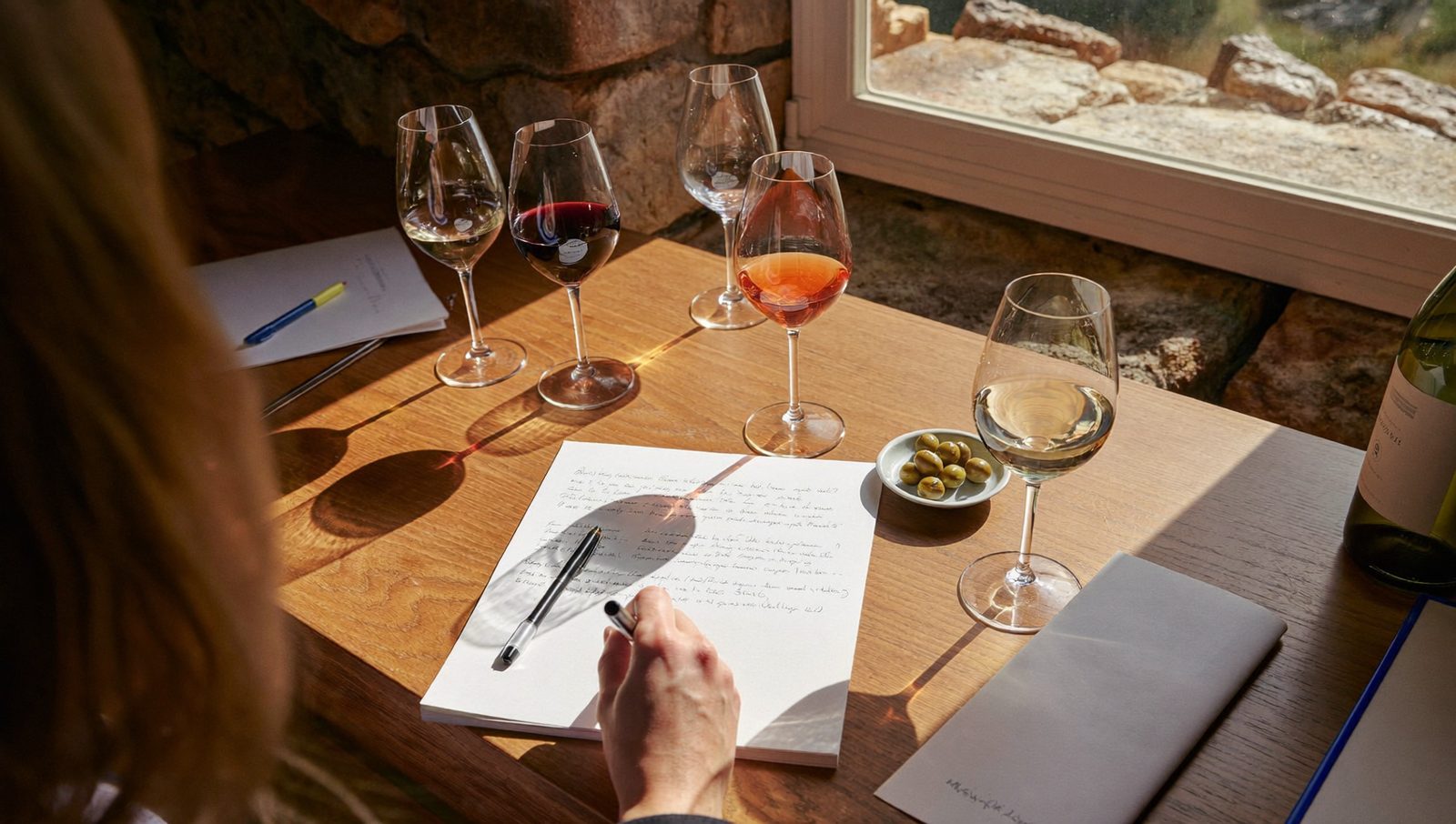
The examples below are illustrative and do not describe real wines. They show the shift from the Italian promotional sentence to the note a buyer can use.
The first example concerns a spec sheet for a red. The Italian sentence "un rosso potente, che conquista al primo naso" contains a judgement and no information. The English version becomes: Deep ruby. Intense aromas of black cherry, plum and dried herbs. Medium-plus body, firm tannins and a long finish. Pairs with roast meat and aged cheese. The judgement has disappeared and in its place there are colour, nose, palate, finish and pairing.
The second example concerns a white for the price list. The sentence "il bianco naturale più fresco della cantina, perfetto con il pesce" contains two problematic words, "naturale" and "perfetto", as well as an implicit superlative. The correct version is: Pale straw. Citrus zest, green apple and a light saline note. Dry, with lively acidity and a clean finish. Serve chilled with grilled fish or raw shellfish. The method is not declared as natural, because it is not a fact the note should have to support.
The third example concerns a sparkling red for the back label. The Italian sentence "vino che fa bene alla salute, da bere ogni giorno" cannot pass as a description in any market. The English version is: Bright red, with a light sparkle. Red berries and violet on the nose. Off-dry, soft tannins and a fresh finish. Serve lightly chilled with cured meats. The health sentence disappears and what remains is a note the buyer can read and the end consumer can understand.
Frequently asked questions
How do you write a tasting note in English for a spec sheet?
Start from the sequence appearance, nose, palate, finish, service and pairing, using standard terms such as pale straw, black cherry or firm tannins. The note should describe the wine without judging it and match the data in the spec sheet. It is advisable to write it after the spec sheet and not before.
How long should a tasting note be?
It depends on the document. For the price list a few sentences are enough, for the spec sheet a short paragraph, and for the back label two or three descriptors with one service sentence. The destination country may limit the space available on the label, so it is worth checking the rules before writing.
Can terms such as natural be used in tasting notes?
It is better to avoid them, because in some markets they have a regulated meaning and the buyer may ask for proof. If the production method is real and documented, it is better to describe it concretely rather than use a generic label. In any case, the rules of the importing country must be checked.
Do you need to know the WSET method to write notes in English?
It is not essential, but it helps. The method offers a shared vocabulary and a tasting sequence that the buyer recognises immediately. Writers can learn the most-used terms even without a course, provided they use them consistently with the winery's internal sheets.
Sources
- Trebbiano Varieties: Toscano, Abruzzo, Romagnolo, Turbiana
- Tartaric Stabilization of White Wine: Cold and Methods
- Triveneto: what it includes and what it produces for export
- Supertuscan Wines: IGT Toscana vs Bolgheri DOC for Importers
- Valpolicella production and sales: the Amarone pyramid
- SO2 in the winery: dosing by stage, EU limits, alternatives