Primitivo: Discover its Peculiarities and International Sales Strategies for Wineries
Primitivo is a black grape of significant Italian value, with an ancient history and growing international appreciation. For Italian wineries seeking to expand their presence in foreign markets, a thorough understanding of its characteristics, historical evolution, and market potential is essential. This article explores the key aspects of Primitivo, offering strategic insights for an effective export strategy.
What are the historical origins of the Primitivo grape?
The origins of Primitivo are ancient, with hypotheses linking it to Dalmatia, from where it is believed to have arrived in Puglia over two thousand years ago. DNA analyses suggest a genetic link with Croatian grape varieties like Plavac Mali and, significantly, with Zinfandel. Its name derives from the early ripening of the grape, a characteristic that made it valuable in Southern Italy.
Deeper Dive into Origins and History
The first ampelographic traces date back to the 19th century, but its roots are much deeper. Some researchers hypothesize that the grape variety is native to Dalmatia, from where it was allegedly imported to Puglia by the Illyrians over two thousand years ago. This theory is supported by DNA analyses that suggest a genetic identity with Croatian grape varieties such as Plavac Mali and, even more significantly, with Zinfandel, which originated in Croatia and later spread to California and Australia.
The name "Primitivo" derives from its distinctive characteristic: the early ripening of the grape. This trait made it particularly valuable in the regions of Southern Italy, where early harvesting allowed for wines with good alcohol content and structure. Historically, Primitivo has been widely cultivated in Puglia, particularly in the provinces of Taranto and Bari, where it represents a significant percentage of local wine production. In Manduria and Gioia del Colle, the grape has given rise to renowned Denominations of Controlled Origin (D.O.C.), such as "Primitivo di Manduria" and "Primitivo di Gioia del Colle."
Despite its ancient history, Primitivo has experienced a true renaissance in recent years. Thanks to enhancement efforts by quality-conscious producers and support from European funds, this grape has transitioned from being primarily used to increase the alcohol content and color intensity of weaker wines, to becoming the base for prized wines that are conquering international markets.
What is the agronomic profile of the Primitivo grape?
Primitivo is a vigorous grape that prefers cool, deep soils, but requires careful management due to its sensitivity to frost and high temperatures. It suffers from drought and exhibits medium resistance to common fungal diseases. Long pruning and vertical shoot positioning (espalier) are generally recommended.
Details on Ampelographic and Agronomic Characteristics
Primitivo is a vigorous grape variety characterized by exuberant vegetative development, preferring cool, fertile, and deep soils, but it also adapts to humid climates. Its sensitivity to spring frosts and high summer temperatures necessitates careful agronomic management. It suffers from drought, which can lead to berry shriveling and sunburn, but it shows average resistance to powdery mildew and downy mildew.
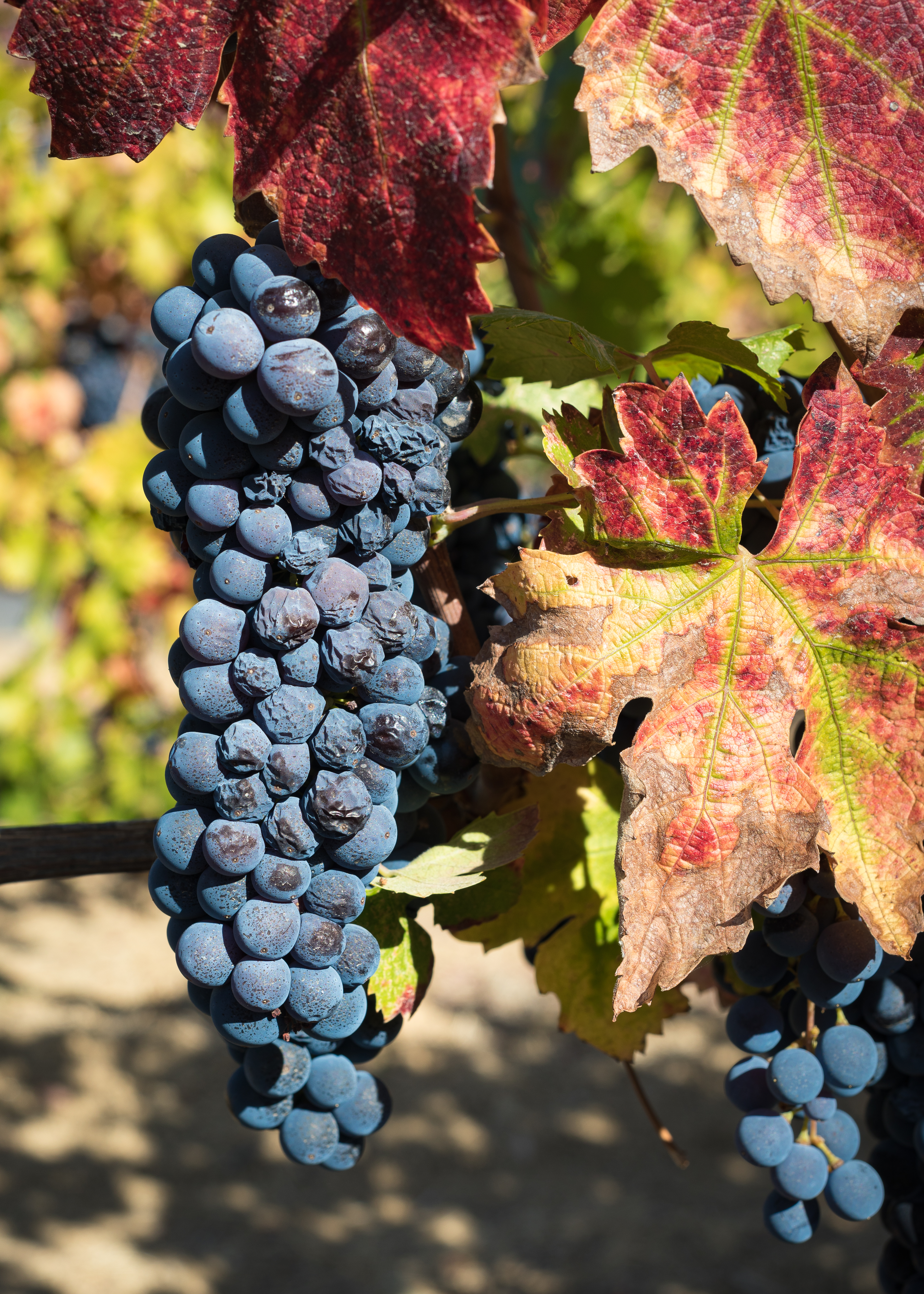
From an ampelographic perspective, the budshoots have an open apex, are downy, and have a greenish-yellow color with a reddish-violet margin. The adult leaf is medium-sized, pentagonal, and quinquelobate, with closed lyre-shaped petiolar sinuses and converging lateral sinuses. The bunch is generally small, conical-cylindrical in shape, simple or winged, and moderately compact. The berry is medium, spherical, with a pruinose, medium-thickness skin and an intense blue color.
Bud fertility is good, but the presence of a high number of female flowers may require artificial pollination or the presence of pollinating cultivars. Long pruning and vertical shoot positioning (espalier) training systems are generally recommended to optimize fruition and vegetative development, especially when supported by irrigation practices.
What is the chemical and sensory profile of Primitivo wines?
Primitivo musts exhibit high sugar content (20-28° Brix) and moderate acidity (4.5-7.5 g/l). The wines are characterized by intense color, full body, remarkable structure, and spicy and fruity aromas, with high alcohol content that can exceed 14% vol. Aging enhances their complexity.
Deep Dive into Chemical and Sensory Profile
Primitivo musts are characterized by high sugar content, typically ranging between 20° and 28° Brix (corresponding to approximately 20-28% sugars). Acidity generally stands between 4.5 and 7.5 g/l, with a pH around 3.3-3.4.
Wines produced from Primitivo are known for their intense color, ranging from deep ruby red to purplish, with orange reflections that can emerge with aging. They exhibit medium acidity, a full body, and notable structure. On the nose, they are distinguished by particular aromas, often described as spicy and fruity, with notes of ripe red berries. On the palate, they are smooth, structured, and characterized by high alcohol content, which can exceed 14% vol.
Aging significantly improves the quality of Primitivo wine, bestowing greater complexity and harmony. Its high alcohol content and anthocyanin intensity historically made it an ideal grape for "cutting" other wines, but in recent years, its recognition as a quality wine in its own right has led to international acclaim. Primitivo di Manduria and Gioia del Colle wines, in particular, have seen extraordinary sales, reaching significant market value.
Which are the most promising foreign markets for Primitivo?
Primitivo has strong export potential thanks to its growing recognition. Key markets include the United States, Germany, the United Kingdom, Scandinavia, Eastern Europe, and emerging markets in Asia and South America. Its history and D.O.C. designations are success factors.
Analysis of Export Potential and Key Markets
Primitivo represents an excellent export opportunity for Italian wineries, thanks to its growing recognition and appreciation in international markets. Its millennia-long history, combined with its ability to produce wines of character, intensity, and pleasantness, makes it an ideal candidate for conquering new consumers.
Historical Markets and New Horizons:
- United States: The historical link with Zinfandel makes Primitivo a familiar grape to many American consumers. Its characteristics of body, fruit, and spice align well with the market's tastes.
- Europe: Countries like Germany, the United Kingdom, Scandinavia (Sweden, Norway, Finland), and Eastern Europe (Poland, Czech Republic, Hungary, Ukraine) show increasing interest in quality Italian wines. Primitivo, with its distinct identity, can easily stand out.
- Asia: Emerging markets such as China and India, while requiring a targeted approach, offer significant growth potential for wines with compelling stories and distinctive flavor profiles.
- Oceania: Australia and New Zealand, with their strong wine culture and openness to international varietals, represent a receptive market for Primitivo.
- South America: Brazil and Ecuador, with growing demand for European wines, can be interesting markets to explore.
Success Factors for Export:
- Quality and Consistency: Maintaining high quality standards and ensuring product consistency is crucial for building trust with foreign buyers.
- Storytelling: Primitivo's rich history, its Puglian origins, and its link to Zinfandel offer powerful narrative material for marketing.
- Recognized Designations: Leveraging the notoriety of D.O.C.s like Primitivo di Manduria and Primitivo di Gioia del Colle can facilitate market access.
- Adaptability: Primitivo's ability to produce various types of wine (from dry to fortified, still to sparkling) allows it to meet a wider range of international consumer preferences.
- Positioning: Positioning Primitivo not just as a blending wine, but as a protagonist of high quality capable of competing with other international grape varieties, is fundamental to maximizing its export potential.
Frequently Asked Questions about Primitivo Export
Is Primitivo suitable for all international markets?
Primitivo has demonstrated strong potential for appreciation in various markets, including the United States, Europe (Germany, UK, Scandinavia, Eastern Europe), and emerging markets in Asia and South America, thanks to its history and distinctive flavor profile.
What are the most well-known Italian Primitivo designations abroad?
The Denominations of Controlled Origin (D.O.C.) such as "Primitivo di Manduria" and "Primitivo di Gioia del Colle" are renowned and can facilitate access to international markets due to their notoriety.
What are the main success factors for exporting Primitivo wines?
Key factors include maintaining high quality standards and consistency, effectively utilizing storytelling related to the grape's history, leveraging recognized designations, and strategic positioning as a high-quality wine.
The Primitivo grape embodies the resilience and evolutionary capacity of Italian viticulture. From a humble grape to the star of world-renowned wines, its journey is a testament to the richness of Southern Italy's oenological heritage. For Italian wineries, investing in the promotion and export of Primitivo-based wines means offering the global market an authentic taste of the passion, history, and quality that distinguish Italian wine.