Grignolino: Enhancing and Promoting Italian Wine in Foreign Markets
Grignolino is an indigenous Piedmontese grape variety with centuries of history, offering a unique opportunity for Italian wineries aiming to expand their presence in international markets. Although still little known outside national borders, its ampelographic, agronomic, and organoleptic peculiarities make it an ideal candidate to conquer market niches seeking authenticity and diversity. This article explores the characteristics of Grignolino and its export potential, providing strategic guidance for its enhancement. Read more: MASAF — National Register of Vine Varieties.
What are the origins and history of the Grignolino grape variety?
The exact origins of Grignolino are uncertain, but its presence in Piedmont has been documented for centuries, historically linked to the provinces of Asti and Alessandria. The name might derive from the dialectal "grignòla" (berry) or "grignare" (to bite), referring to the size of the berries or its pronounced acidity and tannins. Its cultivation, though niche, has preserved its genetic purity and winemaking traditions.
What are the ampelographic characteristics of the Grignolino grape variety?
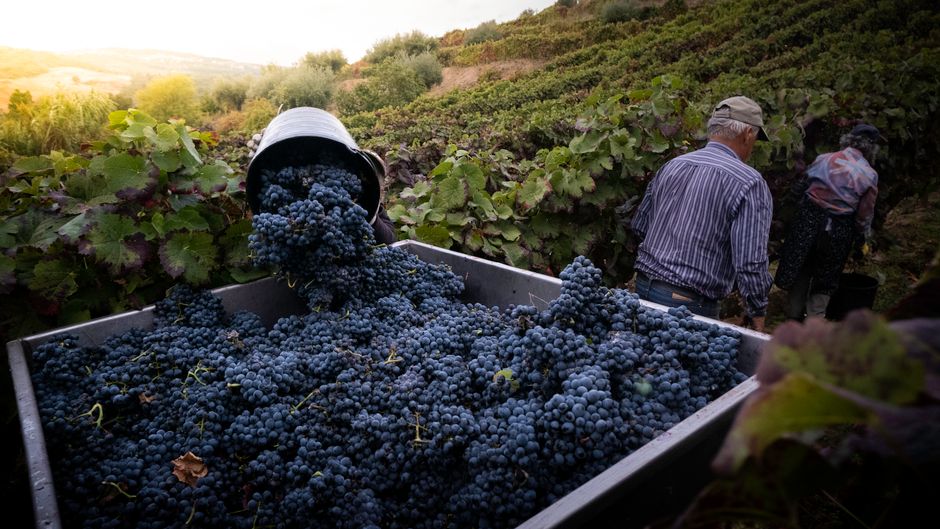
Grignolino presents adult leaves of medium size, orbicular and lobed, with the blade slightly folded. The shoot has a downy apex, yellow-bronze with pinkish margins. The bunch is medium in size, conical or cylindrical, of medium compactness, and often winged. The berry is medium, rounded, with a thick and resistant yellow-greenish skin.
What are the environmental and cultivation needs of Grignolino?
This grape variety prefers fresh, fertile, and deep soils, but also adapts to dry clay soils or alluvial soils with sufficient water availability. It favors expanded training systems with long prunings to encourage ripening. Irrigation can increase production, but at the expense of wine quality.
To which diseases and adversities is Grignolino susceptible?
Grignolino is susceptible to downy mildew and powdery mildew, but shows fair resistance to noble rot and acetic rot. It is also sensitive to phylloxera. Careful agronomic management is essential to minimize risks associated with these adversities.
What are the characteristics of Grignolino must?
Grignolino must typically shows acidity values between 7.0 and 10.0 g/l and a sugar content generally ranging from 17.0 to 20.0% Brix. These values can vary depending on the vintage and ripening conditions.
What is the Grignolino wine like?
Wine obtained from Grignolino is medium-bodied, harmonious, and fresh due to its pronounced acidity. The color is intense ruby red, sometimes with purplish hues, tending towards garnet with aging. On the nose, it presents subtle hints of blackberry and sour cherry, but above all an intense aroma of spices. The tannins provide structure, making it interesting for aging as well.
What is the use and enological potential of Grignolino?
Traditionally, Grignolino is vinified in purity or in blend, for example with Refosco dal Peduncolo Rosso, to add aromatic complexity. It can be vinified as a young and fresh wine, table wine, base for sparkling wines thanks to its acidity, or as an aging wine if managed correctly. Some sources suggest its use in maceration or as a base for spirits, though less common.
What are Grignolino's strengths for export?
Grignolino offers uniqueness and authenticity, responding to the demand for wines tied to their territory. Its niche potential attracts consumers seeking novelty. Its versatility allows for the production of wines with different styles, adaptable to various market segments. Its characteristics make it an excellent partner for various food pairings.
What are the challenges and market strategies for Grignolino abroad?
The main challenge is the limited knowledge of the grape variety in international markets, which requires investment in marketing and communication. It is crucial to define a clear positioning, emphasizing uniqueness and origin. Identifying receptive markets, such as Northern European or North American ones, is vital. Collaboration among wineries producing Grignolino could increase its visibility.
Frequently Asked Questions
How does Grignolino differ from other Italian grape varieties?
Grignolino stands out for its unique spicy aromatic profile and pronounced acidity, setting it apart from more common grape varieties.
What are the most promising foreign markets for Grignolino?
Northern European and North American markets are considered more receptive to indigenous and niche wines like Grignolino.
Is it possible to vinify Grignolino into different types of wine?
Yes, Grignolino can be vinified as a young wine, table wine, base for sparkling wines, or for aging, thanks to its versatility.
Grignolino represents an excellence of the Italian wine heritage, with significant potential for wineries wishing to stand out in international markets. Its uniqueness, authenticity, and versatility make it a wine capable of surprising and captivating new consumers.