Ancellotta: The Italian Grape Variety Ready for the Global Market
Ancellotta, a native grape variety from Northern Italy, offers Italian wineries an opportunity for diversification and conquest of new foreign markets. Its unique characteristics, its deep-rooted history in the territory, and its enological potential make it an ideal candidate for export, responding to the growing demand for distinctive, high-quality Italian wines. This article explores its profile, from its territorial ties to its market potential. In-depth look: MASAF — National Register of Vine Varieties.
Where Does Ancellotta Originate and Spread?
Ancellotta has its origins in Northern Italy, with a strong historical presence in Emilia-Romagna and Lombardy. It may have ties to the Lambrusco family of grape varieties. Its cultivation dates back to antiquity, favored by its resistance to climate change.
Cultivation has remained predominantly Italian, with small presences in Switzerland and Brazil. In Italy, it serves as a supporting grape in various DOCs such as Colli di Faenza, Colli di Rimini, Lambrusco Reggiano, and Reggiano Rosso. It is recommended in Emilia-Romagna (Modena, Reggio Emilia) and Lombardy (Cremona, Mantua, Milan), and authorized in Piedmont, Veneto, Friuli, Tuscany, and Sardinia. In 1998, the cultivated area in Italy was approximately 4,700 hectares.

What are the Ampelographic Characteristics and Technological Potential of Ancellotta?
Ancellotta exhibits a young, downy, and whitish shoot. Adult leaves are five-lobed, with deep lateral sinuses and an open U-shaped petiolar sinus. The upper surface is pubescent with orange veins, and the lower surface is slightly lanate. The vine is robust and vigorous, adapting well to clay-limestone soils and favoring sunny exposures. Maturity occurs in the third vintage period.
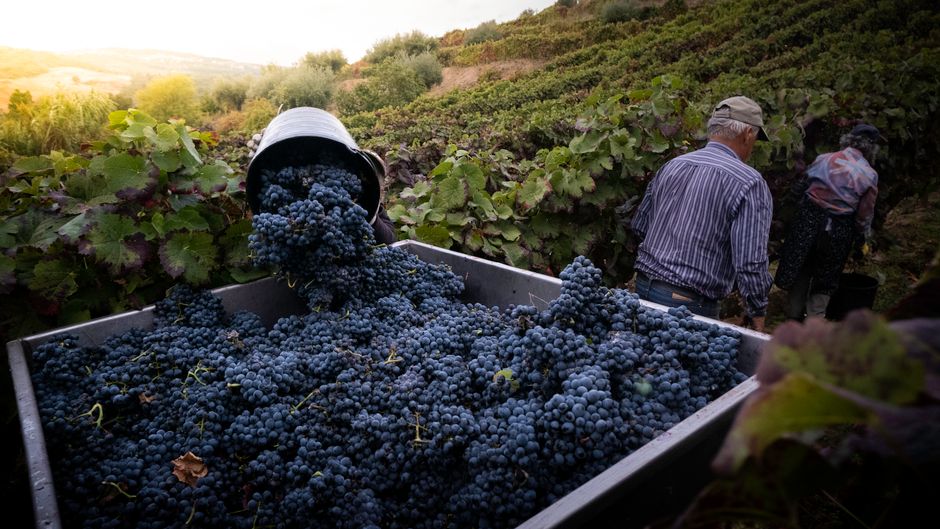
From a technological standpoint, Ancellotta produces medium-sized clusters and berries. Its strength lies in its ability to impart a very intense color to wines, making it valuable for blending. The resulting wines are highly colored but tend to be lacking in acidity, making them ideal for coupage. It is recognized as an excellent "tinting grape" for enhancing the chromatic depth of red wines. It is also suitable for producing intensely colored, fruity sweet grape juice.
How is Ancellotta Used in Enology and Blends?
Ancellotta finds its primary application in winemaking, either as a single varietal or, more often, in blends with other black grape varieties. Its ability to add color and structure makes it an ideal partner for grapes like Sangiovese, Frappato di Vittoria, or Nerello Mascalese.
In Emilia-Romagna, it is crucial for certain Lambruscos. It is used as a secondary grape to provide a sweeter tone and greater chromatic intensity to Lambrusco Salamino di Santa Croce (DOC) (up to 10%) and in the versions of Lambrusco from the DOC Reggiano (up to 15%). In the provinces of Forlì-Cesena and Ravenna, it is permitted for the red wine DOC Colli di Faenza, in combination with Sangiovese. In the province of Rimini, it contributes to the wines of the DOC Colli di Rimini. In the Canton of Ticino (Switzerland), it is included among the recommended varieties for red wines of the DOC Ticino, used in small quantities as a blending partner.
What is the Export Potential of Ancellotta for Italian Wineries?
Ancellotta represents an opportunity for Italian wineries aiming to expand their presence in international markets. Its capacity to produce intensely colored wines and its suitability for blending make it a valuable component for cuvées that meet the demands of foreign consumers seeking wines with character and depth.
Wineries cultivating Ancellotta can position their products as an authentic expression of the Italian territory, highlighting its history and traditions. Its relative rarity outside Italy can be a strength, offering a new and distinctive enological experience.
To fully leverage its export potential, wineries should consider:
- Targeted Marketing: Emphasize the unique characteristics of the grape variety, such as its intense color and its Northern Italian heritage.
- Strategic Blends: Create cuvées that balance Ancellotta's chromatic richness with the acidity and complexity of other grape varieties.
- Exploring New Markets: Identify countries and regions where full-bodied, colorful red wines are appreciated.
- Valorizing Grape Juice: Consider producing Ancellotta grape juice as a complementary product for a broader audience.
While not among the most globally recognized Italian grape varieties, Ancellotta possesses the qualities to become an ambassador for Italian wine in discerning markets. Its history, characteristics, and enological potential offer Italian wineries a concrete opportunity to stand out in the competitive landscape of wine export.
Frequently Asked Questions
Is Ancellotta only grown in Italy?
Ancellotta originates and is primarily cultivated in Italy, especially in the northern regions like Emilia-Romagna and Lombardy. However, small cultivations are also registered in Switzerland and Brazil.
What are the main enological characteristics of Ancellotta?
Ancellotta is known for imparting a very intense color to wines. Wines produced from this grape variety are described as highly colored but tending to be lacking in acidity, making them ideal for blending with other grape varieties.
In which Italian DOCs is Ancellotta present?
Ancellotta is present as a supporting grape in several Italian Denominations of Origin Controlled (DOCs), including Colli di Faenza, Colli di Rimini, Lambrusco Reggiano, and Reggiano Rosso.
Wineries that cultivate and vinify Ancellotta are available, offering partnership potential for importers interested in this specific grape variety.
If your winery is interested in exploring new export opportunities for indigenous grape varieties like Ancellotta, or if you are an importer seeking unique Italian wines, contact us for a personalized demo. Request a personalized demo