Albana Grape Variety: Potential and Strategies for the International Market
Italy boasts a heritage of indigenous grape varieties of inestimable value, and Albana stands out for its ancient history, unique characteristics, and growth potential in the international market. Primarily originating from Emilia-Romagna, this white grape variety is the star of wines that have earned the Denominazione di Origine Controllata e Garantita (DOCG) status, testifying to its qualitative excellence and export value.
What are the historical origins of the Albana grape variety?
The roots of Albana run deep into the past, with probable origins dating back to Roman times. Its very name might derive from the Latin "Albus," meaning white. The first written mentions are found in agricultural treatises between 1304 and 1309, where it was already praised for producing excellent wines.
Historically, Albana was cultivated in small plots, often intercropped with other crops. Its presence was also documented in Sicily in the 18th century, where it was considered a wine of great prestige, albeit rare and expensive. Cultivation in Sicily remained limited to the province of Syracuse, where it is gradually disappearing today.
Where is the Albana grape variety primarily grown?
The true homeland of Albana is Emilia-Romagna, where it has found the ideal terroir to fully express its potential. Here, the grape variety has become the symbol of local viticulture, culminating in the recognition of the "Albana di Romagna" DOCG in 1987, the first Italian DOCG for an indigenous white wine.
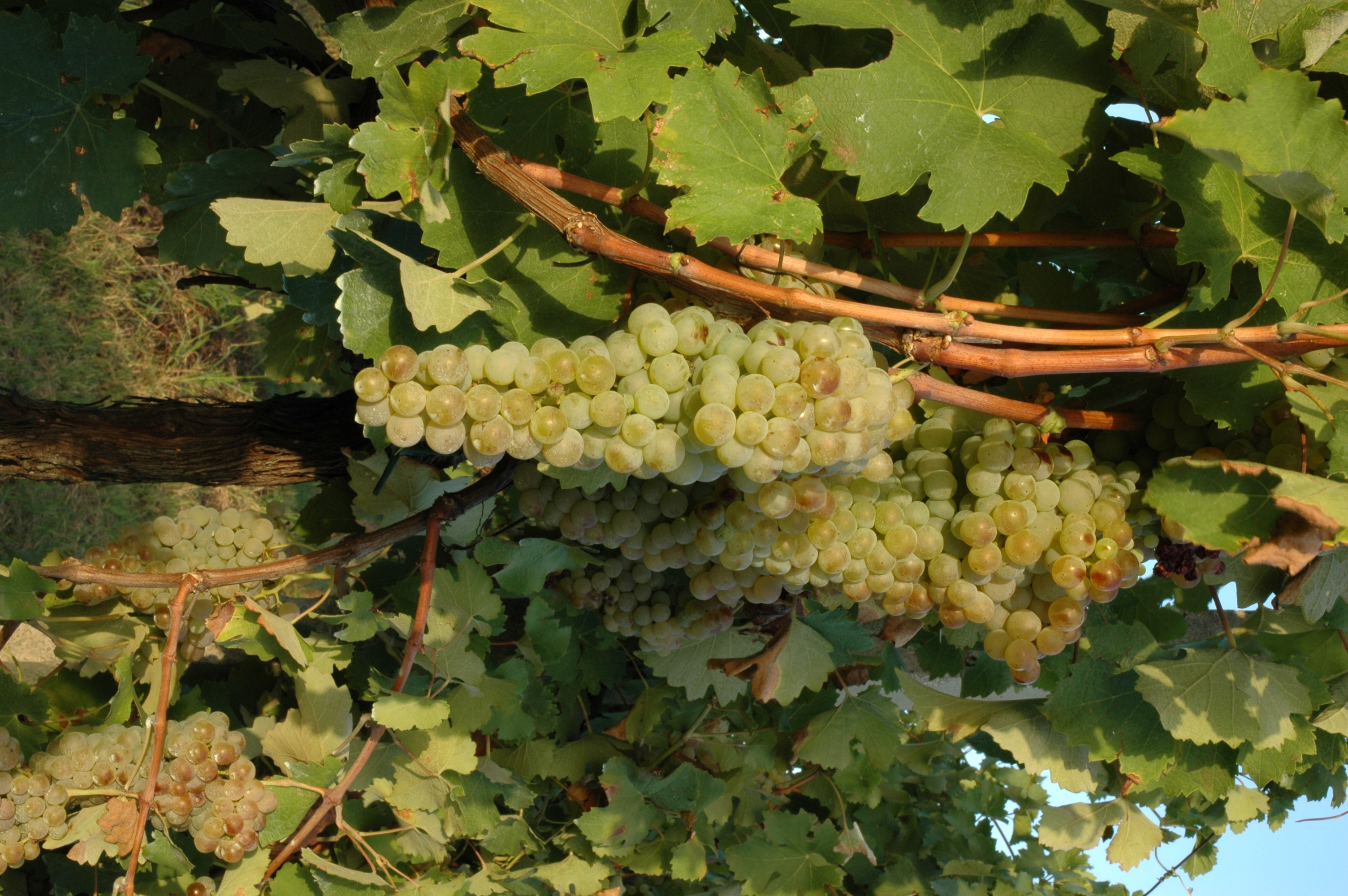
What are the ampelographic characteristics of Albana?
Albana exhibits distinctive characteristics. The shoot has a cottony, whitish tip with carmine hues. Young leaves are slightly hairy and copper-colored. Mature leaves are medium to large, orbicular, and pentagonal. The bunch is medium-sized, medium-short, cylindrical or conical-truncated, with medium-tight berries. The berry is medium-sized, roundish, and golden-yellow in color.
How does the Albana grape variety perform in the vineyard, and what are its enological characteristics?
Albana is a vigorous variety that buds late and ripens about 30 days after Gutedel, falling into the late-ripening category. It is susceptible to diseases such as downy mildew and grey mold but shows good resistance to powdery mildew. Its yield can be irregular. Enologically, it is a "good sugar accumulator" and ripens mid-season.
Traditionally, it was used to increase the sugar content of weaker, later-ripening grape varieties like Trebbiano and Pagadebit, for the production of semi-sparkling and sparkling wines. Albana must could serve as a "liqueur de tirage." In recent years, the production of semi-sparkling and sparkling wines, both white and rosé, based on Albana has been perfected and enhanced.
What are the characteristics of Albana di Romagna DOCG wine?
Albana di Romagna DOCG, recognized since 1987, embodies the essence of the Emilian-Romagnolo territory. The color is straw yellow. The aroma is slightly perfumed, characteristic, with notes reminiscent of almond, peach, and citrus. The flavor is dry, harmonious, with a slight tannic note. It is best enjoyed at a temperature of 8-10 °C and can be aged for 1-2 years.
Where does the production area of Albana di Romagna DOCG extend?
The vineyards authorized for the production of Albana di Romagna DOCG extend across the provinces of Bologna, Forlì-Cesena, and Ravenna. The area includes several municipalities, such as Borgo Tossignano, Casalfiumanese, Castel San Pietro Terme, Dozza, Fontanelice, Castrocaro Terme and Terra del Sole, Longiano, Meldola, Montiano, Roncofreddo, Brisighella, Casola Valsenio, and Riolo Terme, as well as parts of Imola, Ozzano dell'Emilia, Cesena, Forlì, Forlimpopoli, Savignano sul Rubicone, Castel Bolognese, and Faenza. The vineyard area is approximately 2,150 hectares. The provinces of Bologna, Forlì, and Ravenna recorded significant production volumes, as highlighted by data from 1996/97.
What is the export potential of the Albana grape variety?
The international wine market is constantly evolving, and high-quality indigenous grape varieties like Albana have considerable growth potential. The "Albana di Romagna" DOCG is a fundamental mark of guarantee for foreign markets. Its long history and ancient origins offer a compelling narrative for consumers seeking authenticity. Its versatility, capable of producing dry, semi-sparkling, sparkling, sweet, and passito wines, makes it suitable for diverse preferences. The global appreciation for Italian wines creates fertile ground for the introduction of high-quality grape varieties.
The specific export of the Albana grape variety remains a largely unexplored area. Albania (a country distinct from the grape variety) presents a market with growth potential for wine, despite a significant trade deficit and a modest export supply. In Albania, there is an increasing preference for wine, and the growth of tourism is expected to further contribute to demand.
For Albana, European markets, particularly Germany, Switzerland, Austria, and the Nordic markets, could be interested in its uniqueness. Emerging markets, where curiosity about Italian wines is high, could also represent opportunities. The presence of producers who cultivate and vinify Albana would be a significant strength in promoting this grape variety in international markets.
- Unpaywall OA
- Historical Source (archive.org)
- Wikipedia - de
- Wikipedia - fr
- Historical Source (archive.org)
- Wikipedia - ru
- Wikipedia - fr Albana di Romagna
If your winery is interested in exploring new export opportunities for indigenous Italian grape varieties like Albana, or wishes to delve deeper into strategies for penetrating foreign markets, discover how Wines Export can support you.
Frequently Asked Questions
What are the Italian provinces where the Albana grape variety is mainly cultivated, and where is it recognized as DOCG?
The Albana grape variety is mainly cultivated in Emilia-Romagna, with the Denominazione di Origine Controllata e Garantita (DOCG) "Albana di Romagna" extending across the provinces of Bologna, Forlì-Cesena, and Ravenna.
What are the typical organoleptic characteristics of Albana di Romagna DOCG wine?
Albana di Romagna DOCG wine presents a straw-yellow color, a slightly perfumed and characteristic aroma with notes of almond, peach, and citrus, and a dry, harmonious flavor with a slight tannic note.
Which foreign markets might be interested in the Albana grape variety, and why?
European markets, such as Germany, Switzerland, Austria, and the Nordic markets, might be interested in Albana's uniqueness. Emerging markets with high curiosity for Italian wines also represent potential opportunities.