Cagnina: Enhancing and Promoting Italian Wine Abroad
The Cagnina grape variety, also known as Terrano, represents a diversification opportunity for Italian wineries aiming for export. With its historical roots and a distinctive organoleptic profile, this native grape offers an authentic alternative to international varietals, capable of attracting consumers seeking unique gastronomic experiences. Its versatility allows for the production of different wine types, making it suitable for various foreign markets. Learn more: MASAF — National Register of Vine Varieties.
What is the Identity and History of the Cagnina Grape Variety?
Cagnina is a local name for the Terrano grape variety, belonging to the Refosco family, with synonyms including Terrano del Carso and Magnacan. Its origins are debated, with hypotheses linking it to ancient varieties, but documented information about its cultivation dates back to historical records. Its diffusion extends across various regions, reflecting a complex and regional history.
In-depth: Synonyms and Origins
Sources indicate that Cagnina is a local name for Terrano, a grape belonging to the Refosco family. Other associated synonyms include Terrano del Carso, Terrano d'Istria, Refosco del Carso, Refosco d'Istria, Magnacan, and Crodarina. This nominal multiplicity reflects its historical spread and diverse regional interpretations.
Some scholars hypothesize a lineage from Pliny's mentioned "Pucino," although this theory is controversial. Other research places its origins in southern Russia and Ukraine, with subsequent spread to regions like Rostov and Kamenski. In the 19th century, Klausen hypothesized an identity between Cagnina and the Ciorni vibnii variety, but these are distinct varieties with phenotypic similarities due to genetic variability. Verified information about its cultivation can be found in the Annals of Manzano.
What are the Ampelographic Characteristics of Cagnina?
Cagnina is a vigorous and rustic grape variety, with an erect growth habit and good bud fertility. It adapts to various soil types, preferring cool, fertile, and deep soils, but also thrives in light, mixed clay, and tuffaceous soils. It requires well-exposed, sunny locations and shows good resistance to winter cold and fungal diseases.
In-depth: Leaf, Bunch, and Berry
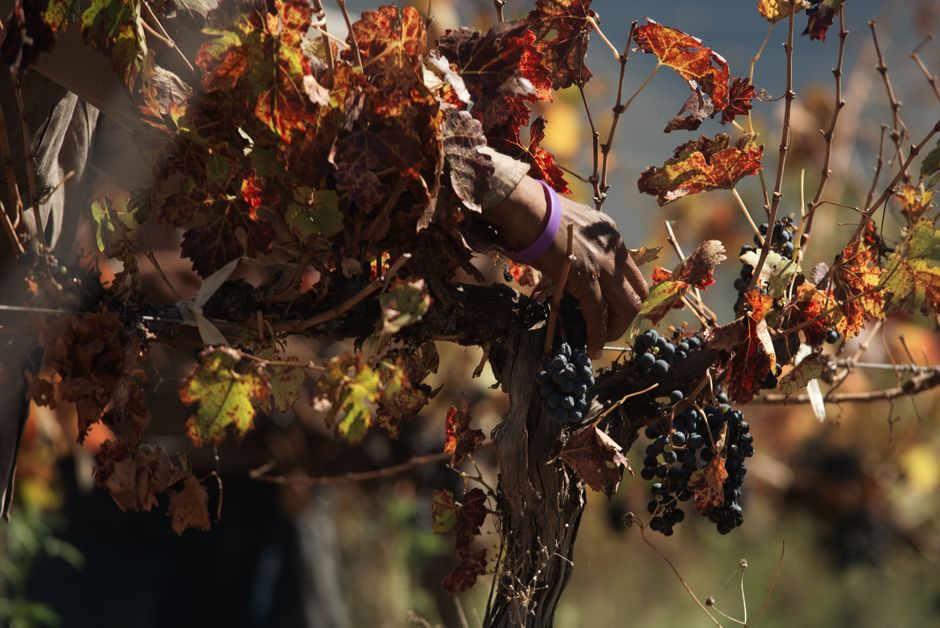
The adult leaf is medium-sized, orbicular, and generally quinquelobate, with the leaf blade slightly folded. Lateral sinuses can be open or closed, with a V or lyre-shaped base. The upper surface shows undulations between the veins, while the lower surface may be downy.
The bunch, upon ripening, is medium-sized, compact or sometimes winged, conical or cylindrical in shape. The berry is medium or small, circular or flattened, with a blue-black epidermis, thin and pruinose skin. The pulp is juicy, soft, and non-colored.
How do Cagnina Must and Wine Present Themselves?
Cagnina must exhibits a sugar content between 17.0 and 20.0% (up to 19.0 °Brix) and an acidity between 7.0-10.0%o (minimum 5 g/l as tartaric acid). The wine, particularly the "Romagna Cagnina" DOC, has a purplish-red color, with an intense characteristic vinous aroma, notes of marasca cherry, and raspberry. On the palate, it is sweet, slightly tannic, and with a pleasant acidic vein.
In-depth: Wine Characteristics and DOC Requirements
The wine can be described as medium-bodied, full-bodied, harmonious, slightly acidic, fresh, and neutral, or fruity, soft, slightly sweet, low in alcohol, and easy to drink. The minimum requirements for the "Romagna Cagnina" DOC are:
Frequently Asked Questions
What are the synonyms and possible origins of the Cagnina grape variety?
Cagnina is a local name for the Terrano grape variety, belonging to the Refosco family, with synonyms such as Terrano del Carso and Magnacan. Its origins are debated, with hypotheses linking it to ancient varieties or regions like southern Russia and Ukraine.
What are the ampelographic characteristics and resistance of the Cagnina grape variety?
Cagnina is a vigorous and rustic grape variety with an erect growth habit and good fertility. It adapts to various soil types, preferring cool, fertile, and deep soils, and shows good resistance to winter cold and fungal diseases.
How does the wine produced from the Cagnina grape variety present itself, particularly the "Romagna Cagnina" DOC?
Cagnina wine has a purplish-red color, with an intense characteristic vinous aroma and notes of marasca cherry and raspberry. On the palate, it is sweet, slightly tannic, and with a pleasant acidic vein, potentially being medium-bodied, full-bodied, and harmonious, or fruity, soft, and easy to drink.