Pinot Bianco or Weissburgunder: what it is, what the label says, the Italian DOCs, sparkling wines, the Chardonnay mix-up and export
Wines Export Editorial · Last updated:
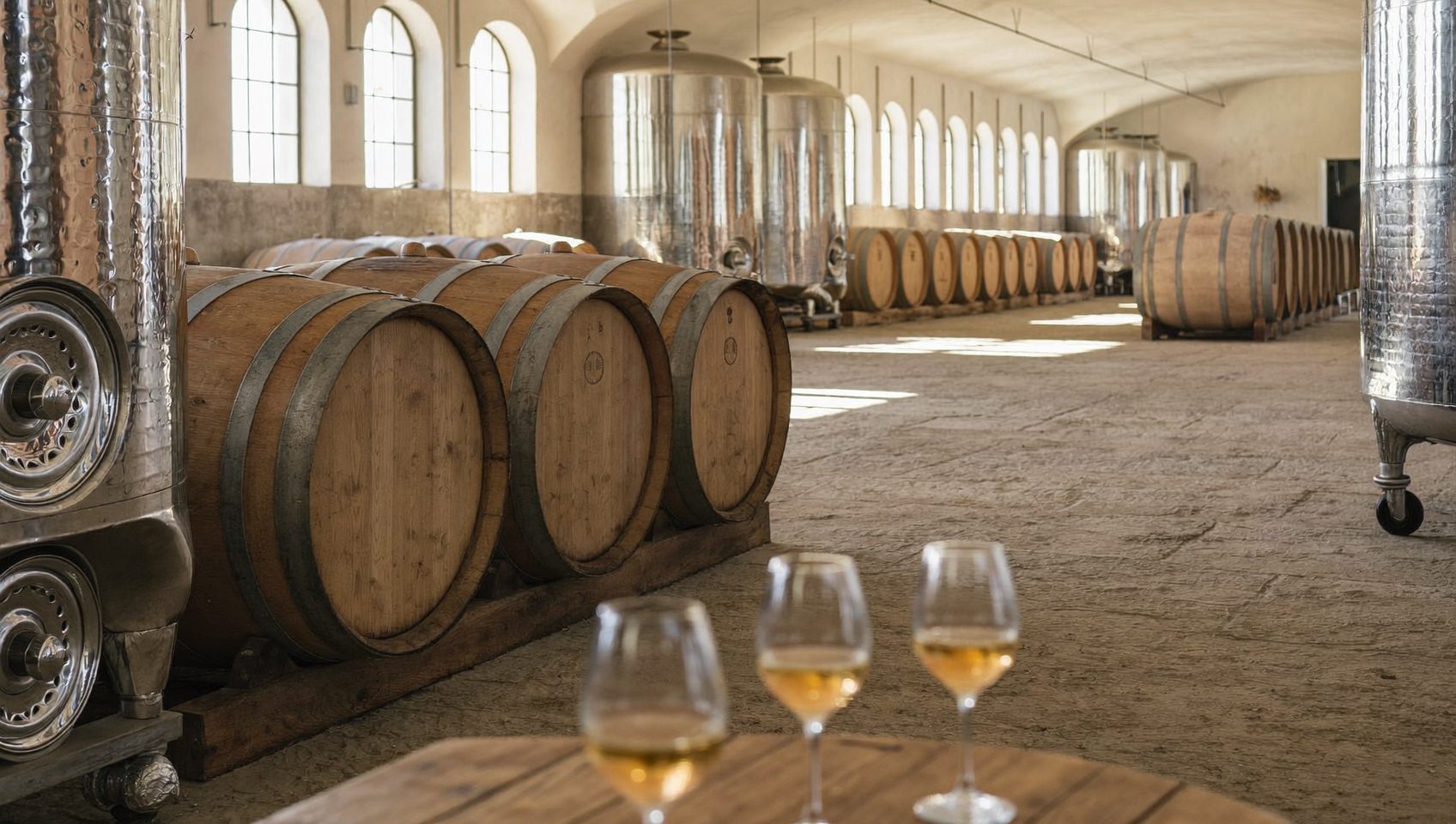
Pinot Bianco is a white grape listed in the Italian National Register of Vine Varieties as "Pinot bianco B." under code 193: it is a variant of Pinot, like Pinot Nero and Pinot Grigio, and the Register records the German synonym Weissburgunder (National Register of Vine Varieties; Italian Vitis Database). A varietal wine needs at least 85 percent of the grape in the Alto Adige, Trentino, Collio, Friuli Colli Orientali, Friuli, Breganze, Colli Berici and Colli Euganei DOCs, and the grape may make up to 50 percent of Franciacorta DOCG and enter the base of Trento DOC and Alto Adige sparkling wines (disciplinari, art. 2). In Alto Adige, its best-known area, it covered 609.7 of 5,833.1 hectares in 2024, the fifth white grape by area (IRE, Bolzano Chamber of Commerce, October 2025). Until the 1980s it was confused with Chardonnay in Italy, and only then did official ampelography clearly separate the two (Franciacorta DOCG disciplinare, art. 9).
This page is the full guide to the grape, including what a buyer abroad should check before listing it. The sparkling appellations it goes into are in Franciacorta DOCG and Trento DOC; the Gorizia whites in Collio DOC white wines for importers; the other major Alto Adige white in Traminer aromatico or Gewürztraminer.
What Pinot Bianco is
Pinot Bianco is one of the somatic variants of Pinot, one of the oldest vines, propagated by cuttings for centuries: the best known are Pinot Nero, Pinot Grigio and Pinot Bianco (Italian Vitis Database, Pinot entry). The Consorzio Vini Alto Adige describes it as a mutation of Pinot Nero, grown in Alsace since the 18th century under the name "Clevner" and spread from there into the Palatinate and Baden (Consorzio Vini Alto Adige, Pinot Bianco fact sheet).
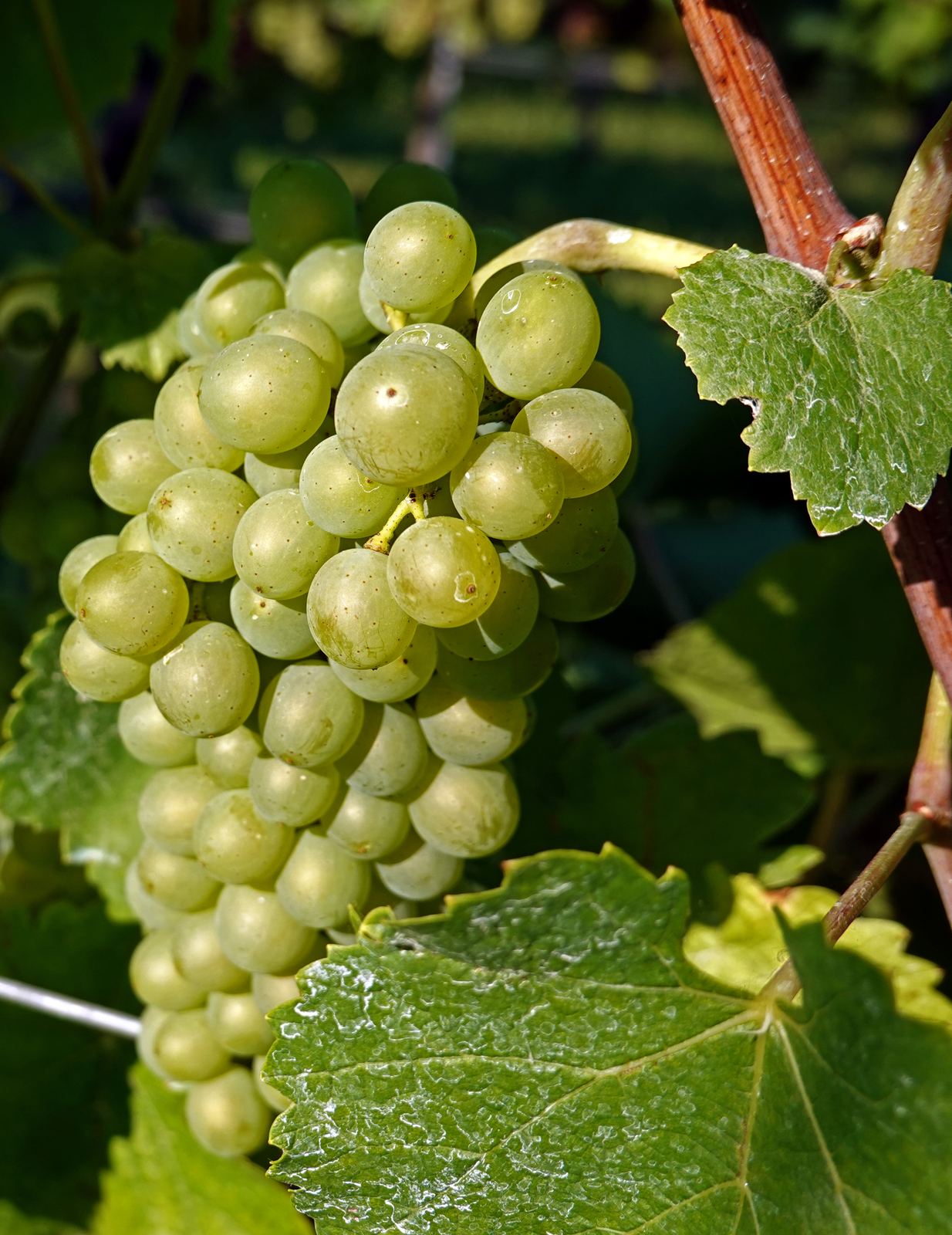
In Italy it has been on the National Register since 25 May 1970 (Gazzetta Ufficiale n. 149, 17 June 1970) and has ten approved clones (National Register, export of the wine-grape section, 13 November 2026). The Ministry of Agriculture monograph published on the Register website describes a small, cylindrical, fairly compact and often winged bunch, with small berries and a thin, tender golden-yellow skin; early budbreak and ripening around mid-September; good vigour, moderate and regular yields, normal resistance to powdery and downy mildew and some sensitivity to rot (Cosmo and Polsinelli, 1960, on the Register website).
What the label says: Pinot Bianco, Weissburgunder or Pinot Blanc
The name on the label depends on the appellation.
| Where | Name | Source |
|---|---|---|
| National Register of Vine Varieties | "Pinot bianco B.", code 193; synonym Weissburgunder | National Register; Italian Vitis Database |
| Alto Adige DOC | "Pinot Bianco"; label terms may be written in Italian and/or German under the bilingualism rules of the Province of Bolzano | Alto Adige disciplinare, art. 1 and 7.1 |
| Friuli Colli Orientali DOC | "Pinot bianco o Pinot blanc" | Friuli Colli Orientali disciplinare, art. 2 |
| Friuli DOC | "Pinot bianco o Pinot blanc" | Friuli disciplinare, art. 1 and 2 |
| Collio, Friuli Isonzo, Trentino, Breganze, Colli Berici, Colli Euganei | "Pinot bianco" | disciplinari, art. 1 and 2 |
The monograph on the Register website gives Weissburgunder as the name used in Alto Adige and in German-speaking countries. That is why Alto Adige bottles carry either name, while in Friuli the disciplinare allows the French Pinot blanc.
Where it is made in Italy: the Pinot Bianco DOCs
In every appellation read, a wine labelled with the grape needs at least 85 percent Pinot Bianco; yields and alcohol vary.
| Appellation | Minimum Pinot Bianco | Maximum grape yield | Minimum natural alcohol of the grapes | Minimum alcohol at release | Source |
|---|---|---|---|---|---|
| Alto Adige | 85 percent | 13 t/ha | 10.5 percent | 11 percent | art. 2.1, 4.4 and 6 |
| Alto Adige with an additional geographical unit | 85 percent, all grapes from the named locality | 9.8 t/ha | 11 percent | 11 percent | art. 2.6, 4.4 and 6 |
| Alto Adige Terlano | 85 percent | 12.5 t/ha | 10.5 percent | 11 percent | art. 2.3, 4.4 and 6 |
| Alto Adige Valle Isarco | 85 percent | 12 t/ha | 11 percent | 11 percent | art. 2.4, 4.4 and 6 |
| Alto Adige Valle Venosta | 85 percent | 11 t/ha | 10 percent | 10.50 percent | art. 2.5, 4.4 and 6 |
| Trentino | 85 percent | 15 t/ha (105 hl) | 10.5 percent | 11 percent | art. 2, 4 and 6 |
| Trentino Superiore | 85 percent | 10 t/ha (70 hl) | 11 percent | 12.50 percent | Title II, art. 2, 4 and 6 |
| Collio | 85 percent | 11 t/ha | 10.50 percent | 11.5 percent | art. 2, 4, 5 and 6 |
| Friuli Colli Orientali | 85 percent | 11 t/ha | 10 percent | 11 percent | art. 2, 4, 5 and 6 |
| Friuli Isonzo | grapes of the variety; blending in the cellar up to 15 percent with other Isonzo wines of the same colour | 12 t/ha | 9.5 percent | 11 percent | art. 2, 4, 5 and 6 |
| Friuli | 85 percent | 14 t/ha | 10 percent | 10.5 percent | art. 2, 4 and 6 |
| Breganze | 85 percent | 12 t/ha | 10 percent; 11 for Superiore | 11 percent; 12 for Superiore | art. 2, 4 and 6 |
| Colli Berici | 85 percent | 12 t/ha | 10.50 percent | 11 percent | art. 2, 4 and 6 |
| Colli Euganei | 85 percent | 12 t/ha | 10.50 percent | 11 percent | art. 2, 4 and 6 |
Sources: Alto Adige, Trentino, Collio, Friuli Colli Orientali, Friuli Isonzo, Friuli, Breganze, Colli Berici and Colli Euganei disciplinari, texts of the Italian Ministry of Agriculture.
Aged versions have their own rules. In Alto Adige every white can become Riserva after at least two years of ageing from 1 October of the harvest, with grapes of at least 11.5 percent natural alcohol (Alto Adige disciplinare, art. 5.5). In Collio, Riserva requires grapes with at least 12 percent natural alcohol, 18 g/l of extract, no enrichment and 20 months of ageing from 1 November (Collio disciplinare, art. 7). Friuli Colli Orientali requires two years from 1 November (art. 7). In Trentino a white Riserva needs one year from 1 November, grapes with half a degree more natural alcohol than the standard wine, and at least 11.50 percent at release (Trentino disciplinare, art. 5 and 6). Trentino Superiore Pinot Bianco ages at least 10 months from 1 November and must be closed with a flush-fitting natural cork (Title II, art. 5 and 8).
The disciplinari describe similar but not identical wines: in Alto Adige straw yellow tending to greenish, dry, "pleasantly bitterish, rightly acidic, savoury"; in Collio dry, full and harmonious; in the Friuli DOC fruity, delicate and velvety; in Trentino dry and slightly bitterish (disciplinari, art. 6). The Friuli disciplinare calls the Pinot Bianco of the Friulian plain fragrant and refined, with aromatic traits enhanced by loose soils (art. 9).
The wines of each region are in wine from Friuli-Venezia Giulia, Trentino-Alto Adige export guide, exporting wine from Bolzano and exporting wine from Trento.
Alto Adige: Terlano, passito and additional geographical units
In the province of Bolzano Pinot Bianco has its widest range: it is allowed in the Alto Adige DOC without a subzone and in the Terlano, Valle Isarco and Valle Venosta subzones, in each also as passito, late harvest and Riserva (Alto Adige disciplinare, art. 1).
| Rule | What the Alto Adige disciplinare says | Source |
|---|---|---|
| Two-variety wines | Chardonnay-Pinot Bianco and Pinot Bianco-Pinot Grigio, each variety above 15 percent | art. 1 and 2.1 |
| Terlano without a variety | Pinot Bianco and/or Chardonnay at least 50 percent | art. 2.3 |
| Passito | drying on the vine or after picking to at least 16 percent, no more than 40 hl/ha, concentrated musts banned; on sale from 1 June of the year after the harvest | art. 5.3 |
| Late harvest | grapes with at least 13.5 percent natural alcohol, no more than 50 hl/ha, no correction of alcohol | art. 5.3 |
| Grape-to-wine yield | no more than 70 percent | art. 5.4 |
| Where it is made | only in the Autonomous Province of Bolzano, except for exemptions already granted | art. 5.1 |
| At release | minimum total acidity 4.0 g/l, minimum non-reducing extract 16.0 g/l | art. 6 |
| Adjectives | extra, fine, scelto, selezionato, vecchio and similar banned | art. 7.1 |
Pinot Bianco appears in 28 of the additional geographical units in the disciplinare, official locality names that can be added to the DOC when 100 percent of the grapes come from that locality. Two are reserved for Pinot Bianco alone: Eppan-Berg-Schulthaus, in Appiano, and Penon-Hofstatt, in Cortaccia (art. 2.6 and 7.2). The text in force is the one amended by DM of 8 October 2024 (Gazzetta Ufficiale n. 244, 17 October 2024); checks are carried out by the Bolzano Chamber of Commerce (art. 10).
The disciplinare dates the arrival of the Pinots in Alto Adige to the 19th century, from Burgundy (art. 9). According to the Consorzio Vini Alto Adige the first documented planting was in 1852 in a vineyard in Bressanone, followed by Nalles, Appiano, Terlano and Marlengo; today the grape favours high sites, up to 800 metres, and the municipalities where it is most planted are Appiano, Caldaro, Terlano and Renon (Consorzio Vini Alto Adige, Pinot Bianco fact sheet).
Pinot Bianco in sparkling wines: Franciacorta, Trento, Alto Adige, Oltrepò
In classic-method sparkling wines Pinot Bianco is a supporting grape: each disciplinare sets how much of it may go in.
| Appellation | How much Pinot Bianco | Source |
|---|---|---|
| Franciacorta DOCG and Franciacorta Rosé | up to 50 percent, alongside Chardonnay and Pinot Nero (Rosé: Pinot Nero at least 35 percent) | art. 2.1 and 2.2 |
| Franciacorta Satèn | up to 50 percent, with Chardonnay at least 50 percent | art. 2.3 |
| Trento DOC | allowed with Chardonnay, Pinot Nero and Meunier, with no minimum or maximum share | art. 2 |
| Alto Adige Spumante | allowed with Pinot Nero and Chardonnay; a Spumante Pinot Bianco also exists; at least 15 months in bottle and no release before 20 months from 1 October of the harvest | art. 1, 2.1 and 5.3 |
| Friuli Spumante | allowed with Chardonnay, Pinot Grigio and Pinot Nero vinified white | art. 2 |
| Oltrepò Pavese Metodo Classico DOCG | with Chardonnay and Pinot Grigio up to 30 percent in total; up to 15 percent in the Pinot Nero version | art. 2 |
| Alta Langa DOCG | not allowed: Pinot Nero and/or Chardonnay from 90 to 100 percent | art. 2 |
Sources: Franciacorta DOCG (amended by DM of 7 May 2024, GU n. 114, 17 May 2024), Trento DOC, Alto Adige DOC, Friuli DOC, Oltrepò Pavese Metodo Classico DOCG and Alta Langa DOCG disciplinari.
In Franciacorta the minimum natural alcohol of Pinot Bianco grapes is 9.5 percent and the maximum yield 10 tonnes per hectare (Franciacorta disciplinare, art. 4). The rules of each appellation are in Franciacorta DOCG, Trento DOC, Alta Langa DOCG and Oltrepò Pavese.
Pinot Bianco and Chardonnay: why they were confused
For decades Pinot Bianco and Chardonnay were treated as one grape in Italy. The Franciacorta disciplinare recalls that when the DOC was created the grape chosen for sparkling wine was "Pinot", also known as Pinot chardonnay, and that only in the 1980s did official ampelography clearly separate Pinot Bianco and Chardonnay (art. 9). The Consorzio Vini Alto Adige writes that Chardonnay had been described as a separate variety as early as 1872, that the distinction took hold worldwide after 1970, and that in Alto Adige so-called "green" and "yellow" Pinot Bianco grew side by side in the same vineyards until 1985; the 1965 census counted 445 hectares of Pinot Bianco, then the leading white grape of the province (Consorzio Vini Alto Adige, Pinot Bianco fact sheet). Chardonnay is covered in Chardonnay: grape and export, Pinot Nero in Pinot Nero export guide.
For a buyer the consequence is practical: in old vintages and historical statistics, "Pinot Bianco" may also mean Chardonnay.
What the wine is like and what to pair it with
The Consorzio Vini Alto Adige describes a wine with lively acidity, aromas of apple, pear and lemon and notes of hazelnut and hay flowers, to be served at 10 to 12 degrees; it suggests it as an aperitif and with starters, fish and Alto Adige dishes (Consorzio Vini Alto Adige). The same fact sheet notes that Pinot Bianco is still used, in ever smaller quantities, for sparkling wine, in Alto Adige and elsewhere in Italy.
Style depends on the type: the young white, a Riserva aged at least two years in Alto Adige or twenty months in Collio, the passito and the late harvest call for different pairings. The technical sheet should state the exact type and the ageing period.
Selling Pinot Bianco abroad
There are no published export statistics for Italian Pinot Bianco alone; the most useful figures are those for Alto Adige. Between 2018 and 2024 the area under Pinot Bianco in Alto Adige rose from 557.9 to 609.7 hectares, up 9.3 percent (IRE, October 2025). In 2024 the 19 largest producers, more than 80 percent of DOC bottling, sold 2.534 million bottles of Alto Adige Pinot Bianco DOC, 7.8 percent of their sales, against 2.697 million in 2018 (IRE, table A-3).
For all the wines of those producers, the 2024 markets were Alto Adige itself (27.4 percent), the rest of Italy (39.0), Germany (9.1) and the United States (8.3), with Switzerland growing; producers saw the greatest potential in Japan and Canada, and among other countries in Sweden and the Far East. Restaurants and bars took 55.4 percent of bottles (IRE, October 2025). According to the Consorzio Vini Alto Adige, the country with the most Pinot Bianco in the world is Germany, where it is called Weißburgunder, followed by Italy (Pinot Bianco fact sheet).
These figures point to the channels to look at: wine importers in Germany and exporting wine to Germany, wine importers in the United States, wine importers in Switzerland, wine importers in Japan and exporting wine to Japan, wine importers in Canada and exporting wine to Canada, and the list of wine importers by country.
Before sending the technical sheet, check four points: a label name consistent with the appellation (Weissburgunder in Alto Adige, Pinot blanc allowed in Friuli); the type, because Riserva, passito and late harvest have different thresholds from DOC to DOC; for an Alto Adige additional geographical unit, 100 percent of the grapes from the locality; for a sparkling wine, the share of Pinot Bianco the disciplinare allows.
Frequently asked questions
Are Pinot Bianco and Weissburgunder the same thing?
Yes. Pinot Bianco is the official name in the National Register of Vine Varieties (code 193), Weissburgunder the German synonym recorded in the Register and used in Alto Adige (Italian Vitis Database; monograph on the Register website). In Friuli the disciplinari also allow Pinot blanc (Friuli and Friuli Colli Orientali disciplinari, art. 2).
Are Pinot Bianco and Chardonnay the same grape?
No. They are two different varieties, long confused in Italy: official ampelography clearly separated them in the 1980s (Franciacorta DOCG disciplinare, art. 9), and in Alto Adige the two grew in the same vineyards until 1985 (Consorzio Vini Alto Adige).
Where is Pinot Bianco made in Italy?
In Alto Adige, where it covered 609.7 hectares in 2024 (IRE, October 2025), and under the grape name in the Trentino, Collio, Friuli Colli Orientali, Friuli Isonzo, Friuli, Breganze, Colli Berici and Colli Euganei DOCs, among others (disciplinari, art. 2).
How much Pinot Bianco can go into Franciacorta?
Up to 50 percent in Franciacorta, Rosé and Satèn (Franciacorta DOCG disciplinare, art. 2). In Trento DOC it is allowed with no set share; in Alta Langa it is not allowed.
Can Pinot Bianco age?
The disciplinari provide for Riserva: at least two years from 1 October in Alto Adige, 20 months from 1 November in Collio, two years from 1 November in Friuli Colli Orientali, one year in Trentino (disciplinari, art. 5 and 7).
What does Pinot Bianco pair with?
The Consorzio Vini Alto Adige suggests it as an aperitif and with starters, fish and Alto Adige dishes, served at 10 to 12 degrees.
Sources
- Alto Adige DOC disciplinare, text of the Italian Ministry of Agriculture, amended by DM of 8 October 2024 (GU n. 244, 17 October 2024), list of PDO and PGI disciplinari
- Trentino DOC, Collio DOC, Friuli Colli Orientali DOC (amended by DM of 7 July 2025), Friuli Isonzo DOC, Friuli DOC, Breganze DOC, Colli Berici DOC, Colli Euganei DOC, Franciacorta DOCG (amended by DM of 7 May 2024), Trento DOC, Oltrepò Pavese Metodo Classico DOCG and Alta Langa DOCG disciplinari, texts of the Italian Ministry of Agriculture, in the same list
- National Register of Vine Varieties, Pinot Bianco entry (code 193), monograph by I. Cosmo and M. Polsinelli, 1960 (Italian)
- National Register of Vine Varieties, catalogue and export of the wine-grape section
- Italian Vitis Database, Pinot entry (Pinot Nero, Pinot Grigio and Pinot Bianco, codes 195, 194 and 193)
- Consorzio Vini Alto Adige, Pinot Bianco and Pinot Bianco fact sheet (Italian)
- IRE, Bolzano Chamber of Commerce, The large wine producers of Alto Adige 2018-2024, October 2025 (Italian)
- Chardonnay Grape Characteristics: Vine, Soils, Wine Styles
- Pecorino Grape and Wine: Taste, Origin, Offida and Abruzzo
- Pinot Nero, Grigio, Bianco, Meunier: names and Italian DOCs
- Negroamaro Salento: Export Guide for Wineries
- Italian Pinot Nero: Synonyms, Appellations, Rules, Export
- Negroamaro: Salento DOCs, rosato, IGT and export