Vernaccia explained: the four varieties in Italy's national register, San Gimignano, Oristano and Vernaccia Nera, their rules and what to check for export
Wines Export Editorial · Last updated:
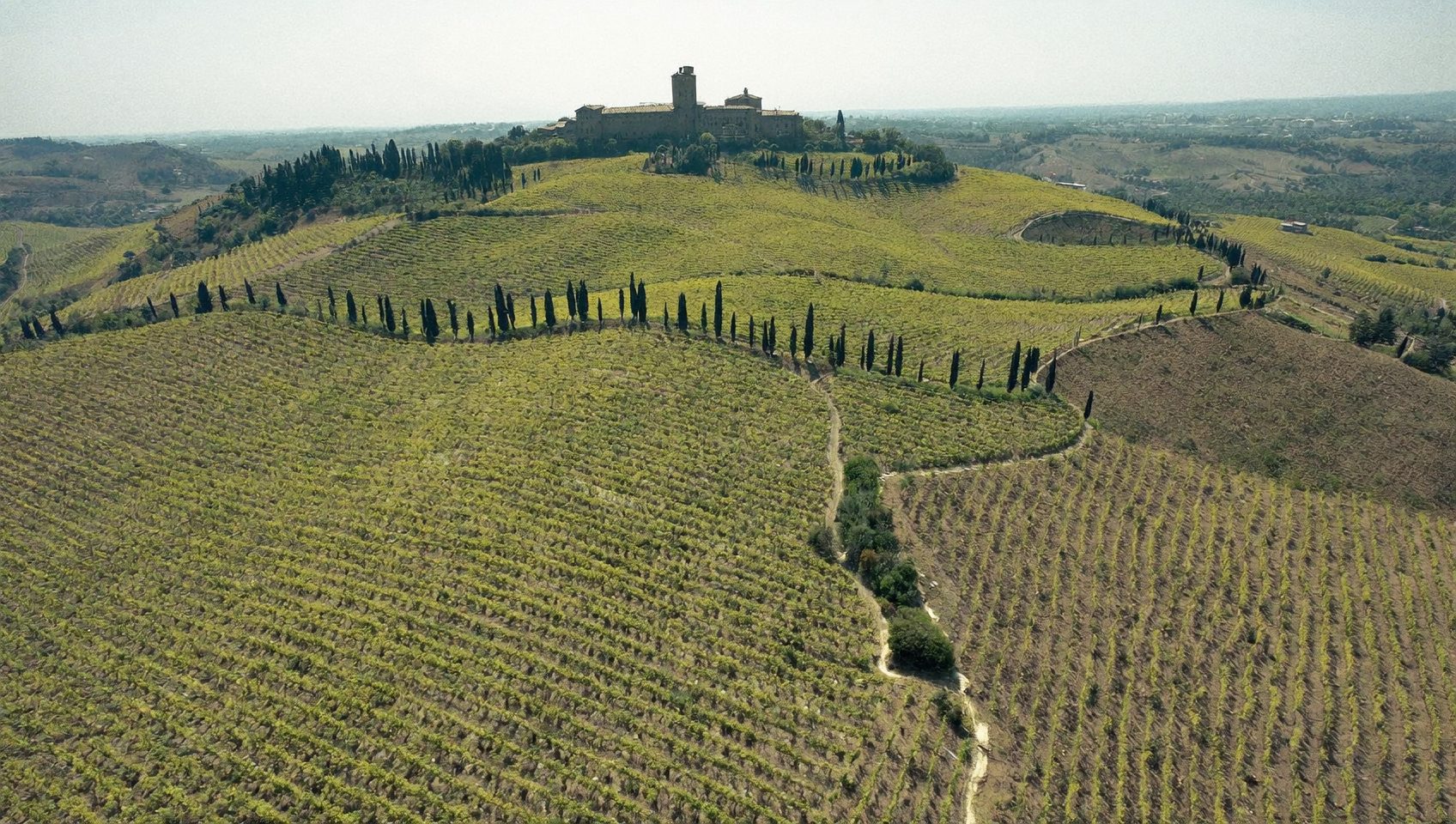
Vernaccia is not one grape but a name that Italy's National Register of Grapevine Varieties gives to four different varieties: two white, Vernaccia di San Gimignano and Vernaccia di Oristano, and two black, Vernaccia Nera and Vernaccia Nera Grossa (National Register, search of 14 November 2026). Each has its own reference wine, and the three wines are nothing alike: Vernaccia di San Gimignano DOCG is a dry white from the province of Siena, Vernaccia di Oristano DOC a white aged in cask under a film of yeast, with at least 15 percent alcohol, and Vernaccia di Serrapetrona DOCG a red sparkling wine from the Marche, dry or sweet (disciplinari of the three denominations, art. 1, 2 and 6). The San Gimignano disciplinare itself offers the explanation: the name may come from the Latin "vernaculum", local, which would account for Vernaccia being used for "totally different" vines such as those of Oristano and Serrapetrona (Vernaccia di San Gimignano DOCG disciplinare, art. 9).
This page is the orientation guide to the Vernaccias, including what a buyer abroad should check. The red sparkling wine of the Marche has a guide of its own, Vernaccia di Serrapetrona DOCG, and the village that gives it its name is covered in wine from Serrapetrona and Vernaccia Nera. A similar case of one name for many varieties is Malvasia.
What Vernaccia is: one name, different varieties
Vernaccia is a group of varieties sharing a name, not a single grape with different clones. The Register lists them as separate varieties, each with its own code, and none is recorded as a synonym of another Vernaccia (National Register, entries 260, 261, 262 and 415).
On the origin of the name, the official sources give different hypotheses. The San Gimignano disciplinare reports that the vine is said to have come from Liguria, from Vernazza, around 1200, brought by one Vieri de' Bardi, but says the origin is uncertain and also cites the Latin "vernaculum" (art. 9). The Oristano disciplinare says that the Romans, finding on the island a vine they did not know, called it "vernaculum", the local vine (art. 9). The Serrapetrona disciplinare suggests the Latin "ver", spring, because with the long drying of the bunches the wine was not ready before spring (Vernaccia di Serrapetrona DOCG disciplinare, art. 9). The Italian Vitis Database entry for Vernaccia di San Gimignano adds that, as with the Malvasias, the wine may have given its name to the grape (Italian Vitis Database, University of Pisa).
The four varieties in the National Register
The Register was searched on 14 November 2026 for "vernaccia" among wine-grape varieties, in names and synonyms; the site gives the ministerial decree of 2 July 2024 as its latest update. The letter after the name gives the skin colour: B. white, N. black.
| Code | Variety | Registered | Official synonyms | DOCGs and DOCs where it is allowed |
|---|---|---|---|---|
| 261 | Vernaccia di S. Gimignano B. | 25 May 1970 | Bervedino B. (code 024) | DOCG Vernaccia di San Gimignano; DOC San Gimignano; and 36 IGTs, from Tuscany to Umbria, Lazio, Sicily and Sardinia |
| 260 | Vernaccia di Oristano B. | 25 May 1970 | none | DOC Vernaccia di Oristano; and 15 Sardinian IGTs, including Valle del Tirso, Tharros and Planargia |
| 262 | Vernaccia Nera N. | 25 May 1970 | Vernaccia, for wine designation only | DOCG Vernaccia di Serrapetrona; DOCs Colli Maceratesi, Colli Martani, I Terreni di Sanseverino, San Ginesio, Serrapetrona; IGTs Marche, Umbria, Allerona, Bettona, Cannara, Narni, Spello |
| 415 | Vernaccia Nera Grossa N. | 23 June 2008, proposed by ASSAM Marche | none | IGT Marche only |
Sources: National Register of Grapevine Varieties, list of wine-grape varieties and individual variety entries.
Two practical consequences. First, only Vernaccia Nera has an official short name, "Vernaccia", that may be used on the label to designate the wine; for the two white varieties the variety name stays in full. Second, the Register lists Bervedino, a variety allowed in the Colli Piacentini DOC, as an official synonym of Vernaccia di San Gimignano, and vice versa (National Register, entries 024 and 261).
A historic name that is not a Vernaccia: "Vernaccia di Pergola". The disciplinare of the Pergola DOC, in the Marche, states that according to scientific research the vine is not a variety in its own right but a clone of Aleatico, and the DOC indeed uses it under the name Aleatico, at least 85 percent in Pergola Aleatico (Pergola DOC disciplinare, art. 2 and 9). The grape is covered in Aleatico: the grape variety.
How much Vernaccia each disciplinare requires
The share is calculated on the estate's vineyards, not on the individual bottle.
| Denomination | Region | Variety | Share | Types with Vernaccia | Source |
|---|---|---|---|---|---|
| Vernaccia di San Gimignano DOCG | Tuscany, province of Siena | Vernaccia di S. Gimignano | at least 85 percent; up to 15 percent of other non-aromatic white grapes suitable in Tuscany, with Sauvignon and Riesling together at most 10 | white, also riserva | art. 1 and 2 |
| San Gimignano DOC Vin Santo | Tuscany | Vernaccia di S. Gimignano | up to 20 percent, alongside at least 30 percent Trebbiano Toscano | Vin Santo | art. 2 |
| Vernaccia di Oristano DOC | Sardinia, province of Oristano | Vernaccia di Oristano | 100 percent ("exclusively") | base, superiore, riserva, liquoroso | art. 2 and 7 |
| Vernaccia di Serrapetrona DOCG | Marche, province of Macerata | Vernaccia Nera | at least 85 percent | sparkling, dry and sweet | art. 1 and 2 |
| Serrapetrona DOC | Marche | Vernaccia Nera | at least 85 percent | still red | art. 2 |
| San Ginesio DOC spumante | Marche | Vernaccia Nera | at least 85 percent | sparkling, dry or sweet | art. 2 |
| Colli Martani DOC Vernaccia | Umbria, province of Perugia | Vernaccia Nera | at least 85 percent; with the mention Cannara if the grapes come from that municipality's zone | Vernaccia, a sweet red from dried grapes | art. 1 and 2 |
| I Terreni di Sanseverino DOC rosso | Marche | Vernaccia Nera | at least 50 percent | rosso, superiore, passito | art. 2 |
| San Ginesio DOC rosso | Marche | Vernaccia Nera | no minimum of its own: with Cabernet, Merlot and Ciliegiolo at least 35 percent, alongside at least 50 percent Sangiovese | red | art. 2 |
| Colli Maceratesi DOC rosso | Marche | Vernaccia Nera | no minimum: among the grapes that together may reach 50 percent, alongside at least 50 percent Sangiovese | red, also riserva | art. 2 |
Sources: the disciplinari of the individual denominations, in the text published by the Italian Ministry of Agriculture. The general 85 percent rule for naming a grape on the label is explained in vintage and grape variety on the label.
Vernaccia di San Gimignano DOCG: Tuscany's white
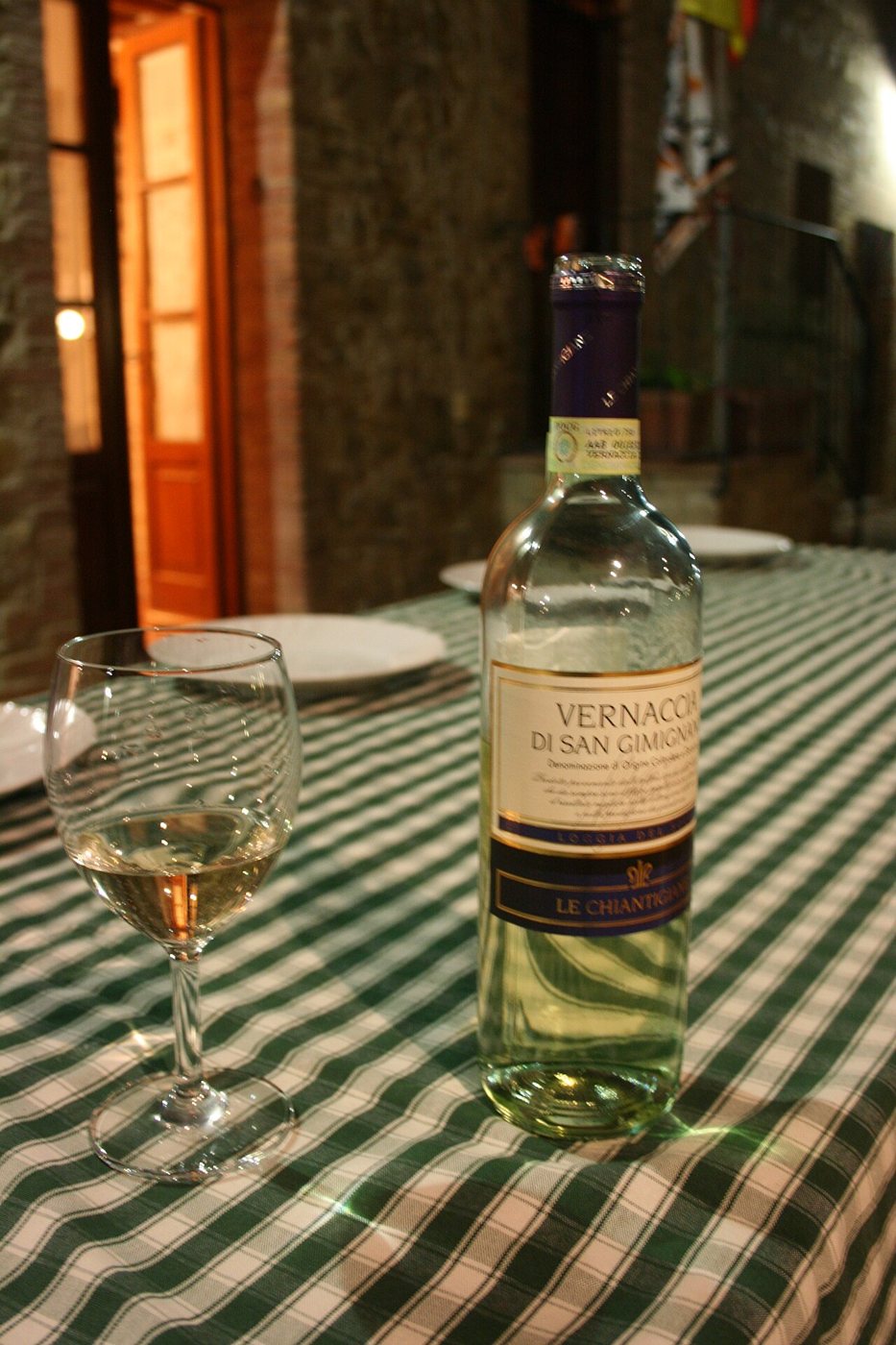
It is a dry white wine, also made as riserva, from at least 85 percent Vernaccia di S. Gimignano grown on the hillsides of the single municipality of San Gimignano, in the province of Siena (disciplinare, art. 1, 2 and 3). The disciplinare excludes from the complementary 15 percent Traminer, Moscato Bianco, Müller Thurgau, Malvasia di Candia, Malvasia Istriana and Incrocio Bruni 54 (art. 2).
The denomination became a DOC by presidential decree of 3 March 1966 and a DOCG by ministerial decree of 9 July 1993; the latest amendment is the decree of 15 October 2024 (Gazzetta Ufficiale n. 249, 23 October 2024), corrected on 30 October 2024 (disciplinare, heading). The disciplinare describes it as the first Italian wine to be awarded the DOC (art. 9).
The vineyards lie on hills up to 500 metres, on Pliocene soils of yellow sands and sandy clays; the climate is sub-Mediterranean, with about 700 millimetres of rain a year; new plantings must have at least 4,000 vines per hectare and the overhead tendone system is banned (art. 4 and 9). The written record begins with the municipal tax regulations of 1276, which levied a duty on every load of Vernaccia sold outside the town's territory; Dante mentions it in Canto XXIV of Purgatory, where Pope Martin IV atones for the eels of Bolsena drowned in Vernaccia (art. 9). A genetic study commissioned by the Consorzio from Sergè Genomics, a spin-off of the University of Siena, found substantial genetic uniformity among the vines in production today (art. 9).
| Requirement | Vernaccia di San Gimignano | Riserva | Source |
|---|---|---|---|
| Maximum grape yield | 9 t/ha, at most 3 kg per vine in new plantings | as the base wine | art. 4 |
| Minimum natural alcohol of the grapes | 10.50 percent | 12.00 percent, with grapes declared for riserva | art. 4 |
| Grape-to-wine ratio | 70 percent | 70 percent | art. 5 |
| Minimum total alcohol at release | 11.50 percent | 12.50 percent | art. 6 |
| Residual sugar | at most 4.0 g/l | at most 4.0 g/l | art. 6 |
| Ageing | no minimum | at least 11 months from 1 January after the harvest, plus three months in bottle before sale | art. 5 |
| Winemaking and bottling | within the municipality of San Gimignano, except for historic authorisations | as the base wine | art. 5 |
| Label | vintage compulsory; "Toscana" compulsory below the denomination; "vigna" with the place name allowed | "Riserva" below the DOCG wording | art. 7 |
| Bottles | glass, Bordeaux shape, from 0.187 to 3 litres | as the base wine | art. 8 |
The "Toscana" rule is new: it comes with the 2024 amendment and must appear in the sequence Vernaccia di San Gimignano, DOCG, Riserva where applicable, Toscana, in characters of the same type and no more than two thirds the height of the name; labels without "Toscana" for the 2024 and earlier vintages may be used until stocks run out (art. 7). Adjectives such as "extra", "fine", "scelto", "superiore" or "vecchio" are banned (art. 7).
According to the disciplinare the wine is straw yellow with golden highlights that grow with age; delicate and fine on the nose, with initial fruity notes that may develop into mineral notes with ageing; dry, harmonious and sapid on the palate, sometimes with a characteristic almond finish (art. 6). In 2025, 147 wineries, 81 of them members of the Consorzio, released 4,207,057 bottles, against 3,489,725 in 2024; Vernaccia DOCG vineyards cover about 750 of the denomination's 2,000 hectares (WineNews, 1 June 2026). The other wines of the province are in exporting wine from Siena, those of the region in Tuscan wine: an export guide; the main grape of San Gimignano Vin Santo is covered in Trebbiano Toscano.
Vernaccia di Oristano DOC: the white under a film of yeast
It is a white wine from Vernaccia di Oristano alone, grown in the lower Tirso valley, in the province of Oristano: the zone covers all or part of the municipalities of Cabras, Baratili San Pietro, Milis, Narbolia, Ollastra, Nurachi, Oristano, Palmas Arborea, Riola Sardo, San Vero Milis, Santa Giusta, Siamaggiore, Simaxis, Solarussa, Tramatza, Zeddiani and Zerfaliu (Vernaccia di Oristano DOC disciplinare, art. 2, 3 and 9). It was Sardinia's first DOC, by presidential decree of 11 August 1971; the text published by the Ministry gives the decree of 7 March 2014 as its latest amendment (disciplinare, heading and art. 9).
What sets it apart is the ageing. After gentle pressing and a natural fermentation, the wine goes into chestnut or oak casks filled to 75-80 percent; with the air left in the cask a film of yeast, the flor, forms on the surface, protecting the wine and producing acetaldehyde, the precursor of its typical aromas. Alcohol rises by 0.5-0.8 percent a year, because water evaporates through the staves faster than alcohol, and vintages more than ten years old can exceed 20 percent (art. 9). The disciplinare calls the bouquet of the best vintages "Murruai", a bitterish yet balanced taste with aromas of peach and almond blossom (art. 9).
| Requirement | Vernaccia di Oristano | Superiore | Riserva | Liquoroso | Source |
|---|---|---|---|---|---|
| Maximum grape yield | 8 t/ha | 8 t/ha | 8 t/ha | 8 t/ha | art. 4 |
| Grape-to-wine ratio | 65 percent | 65 percent | 65 percent | 65 percent | art. 4 |
| Minimum natural alcohol of the grapes | 14.00 percent | 15.00 percent | 15.00 percent | 14.00 percent | art. 5 and 7 |
| Minimum alcohol at release | 15.00 percent actual | 15.50 percent actual | 15.50 percent | 16.50 percent | art. 6 and 7 |
| Ageing in chestnut or oak casks | at least two years from the March racking after the harvest | at least three years | at least four actual years in cask | wine alcohol or wine brandy added after the first racking, then at least two years | art. 5 and 7 |
| Vintage on the label | compulsory | compulsory | compulsory | not compulsory | art. 8 |
Source: Vernaccia di Oristano DOC disciplinare. The name may be preceded by "Sardegna", and adjectives such as "extra", "fine" or "scelto" are banned (art. 7). Ageing and racking take place in cellars within the municipalities of the zone, ventilated and exposed to outside temperatures (art. 5).
The legal description: golden yellow, amber; delicate, alcoholic nose with hints of almond blossom; fine, subtle, warm palate with a light finish of bitter almonds; the liquoroso has an intense, complex nose and ranges from dry to sweet (art. 6). According to the Italian Vitis Database, Vernaccia wine first appears on the island in 1327, in the "Breve" of Villa di Chiesa (Italian Vitis Database, Vernaccia di Oristano entry, Agris Sardegna). The province is covered in exporting wine from Oristano, the island in Sardinian wine: an export guide and Sardinian wines and denominations.
Vernaccia Nera: Serrapetrona and the reds of the Marche and Umbria
Vernaccia Nera is the only black Vernaccia with a DOCG, and it appears in five DOCs in the provinces of Macerata and Perugia (National Register, entry 262). The best-known wine is Vernaccia di Serrapetrona DOCG, a red sparkling wine, dry or sweet: at least 40 percent of the grapes, all Vernaccia Nera, must be dried until the must reaches at least 13 percent potential alcohol, and the wine may not be released before 30 June of the year after the harvest (Vernaccia di Serrapetrona DOCG disciplinare, art. 5). The full rules, the three fermentations and the comparison with Serrapetrona DOC are in the guide to Vernaccia di Serrapetrona.
| Wine | Maximum grape yield | Minimum natural alcohol of the grapes | Grape-to-wine ratio | Minimum alcohol at release | Release or ageing | Source |
|---|---|---|---|---|---|---|
| Vernaccia di Serrapetrona DOCG | 10 t/ha | 9.5 percent before drying; 13 percent for the must of the dried grapes | 58 percent | 11.50 percent | not before 30 June of the year after the harvest | art. 4, 5 and 6 |
| Serrapetrona DOC | 10 t/ha | 10.00 percent | 70 percent | 12.00 percent | at least 10 months from 1 December of the harvest year | art. 4, 5 and 6 |
| Colli Martani Vernaccia | 6 t/ha | 11.00 percent at harvest, 17.00 after drying | 40 percent | 17.00 percent, of which at least 11.50 actual | no minimum; bottles from 0.375 to 0.750 litres | art. 4, 5, 6 and 7 |
| San Ginesio spumante | 11 t/ha | 9.50 percent | 70 percent | 11.00 percent; dry 17-35 g/l sugar, sweet at least 50 g/l | no minimum | art. 4 and 6 |
| I Terreni di Sanseverino rosso | 9 t/ha | 11.50 percent | 70 percent | 12.00 percent | 18 months from 1 December after the harvest | art. 4, 5 and 6 |
| I Terreni di Sanseverino rosso superiore | 8 t/ha | 12.00 percent | 70 percent | 12.50 percent | 24 months from 1 December after the harvest | art. 4, 5 and 6 |
| I Terreni di Sanseverino rosso passito | 8 t/ha | 12.00 percent; grapes dried to at least 260 g/l sugar | 43 percent | 15.50 percent, of which at least 12.50 actual | 24 months from 1 December; at least two years in wood of up to 500 litres | art. 4, 5 and 6 |
Sources: disciplinari of Vernaccia di Serrapetrona DOCG, Serrapetrona DOC, Colli Martani DOC, San Ginesio DOC and I Terreni di Sanseverino DOC.
The zones: Vernaccia di Serrapetrona and Serrapetrona DOC come from the municipality of Serrapetrona and parts of Belforte del Chienti and San Severino Marche; I Terreni di Sanseverino from the whole municipality of San Severino Marche; San Ginesio from nine municipalities in the upper Macerata hills, from San Ginesio to Loro Piceno (disciplinari, art. 3). Colli Martani is in the province of Perugia, around Todi, Montefalco, Bevagna, Cannara and other municipalities; its Vernaccia is a sweet red from grapes dried on the vine or in suitable rooms, with no sweetening allowed (Colli Martani DOC disciplinare, art. 3 and 5). The other wines of the two provinces are in exporting wine from Macerata and from Perugia, those of the regions in Marche wine and Umbrian wine.
What the wines are like: three Vernaccias compared
| Vernaccia di San Gimignano DOCG | Vernaccia di Oristano DOC | Vernaccia di Serrapetrona DOCG | |
|---|---|---|---|
| Variety | Vernaccia di S. Gimignano, white | Vernaccia di Oristano, white | Vernaccia Nera |
| Minimum share | 85 percent | 100 percent | 85 percent |
| Style | dry still white, at most 4 g/l sugar | white aged under flor; liquoroso from dry to sweet | red sparkling, dry or sweet |
| Colour | straw yellow with golden highlights | golden yellow, amber | from garnet to ruby |
| Nose and palate | fruity, then mineral; dry, sapid, almond finish | almond blossom; warm, bitter-almond finish | vinous; dry to sweet, pleasantly bitterish finish |
| Minimum alcohol | 11.50 percent; riserva 12.50 | 15.00 percent; liquoroso 16.50 | 11.50 percent |
| Minimum time before sale | riserva: 11 months from 1 January plus three in bottle | two years in cask; superiore three, riserva four | until 30 June of the year after the harvest |
| DOC since | 1966 (DOCG 1993) | 1971 | 1971 (DOCG 2004) |
Sources: disciplinari of the three denominations, art. 1, 2, 5, 6 and heading.
Selling Vernaccia abroad: what to check
Vernaccia is not a single denomination, and public figures, where they exist, cover Vernaccia di San Gimignano only. For that wine, an article in Quotidiano.net of 6 March 2026 reports that 52 percent of the bottles go abroad, led by the United States and the markets of Central and Northern Europe; in March 2025 the president of Coldiretti Toscana, herself a producer in the area, named the United States as the denomination's second market (Quotidiano.net, 6 March 2026; La Nazione, 19 March 2025). For Vernaccia di Oristano and the Vernaccia Nera wines we found no public export figures.
Buyers abroad always face the same difficulty: working out which Vernaccia is in the glass. Before sending a technical sheet to an importer, check six points:
- The exact variety. The Register name: Vernaccia di S. Gimignano, Vernaccia di Oristano or Vernaccia Nera. Only Vernaccia Nera may appear on the label under the short name "Vernaccia" (National Register).
- The share. At least 85 percent in San Gimignano, Serrapetrona, San Ginesio spumante and Colli Martani Vernaccia; 100 percent in Oristano; at least 50 percent in I Terreni di Sanseverino (disciplinari, art. 2).
- The style. Dry white, oxidative white under flor, red sparkling or sweet red from dried grapes: these are different wines and should be presented as such, with the style written on the sheet (disciplinari, art. 6).
- The label. On Vernaccia di San Gimignano "Toscana" has been compulsory since the 2024 amendment; on Vernaccia di Oristano "Sardegna" is optional, and the vintage is compulsory except on the liquoroso (disciplinari, art. 7 and 8).
- The release date. San Gimignano riserva at least 11 months from 1 January after the harvest plus three months in bottle; Oristano at least two years in cask, three for the superiore, four for the riserva; Serrapetrona from 30 June of the year after the harvest (disciplinari, art. 5 and 7).
- The format. San Gimignano only in Bordeaux-shaped bottles from 0.187 to 3 litres; Serrapetrona up to 3 litres; Colli Martani Vernaccia from 0.375 to 0.750 litres (disciplinari, art. 7 and 8).
For export channels: wine importers in the United States, in Germany and the list of wine importers by country.
Frequently asked questions
Is Vernaccia a single grape?
No. Italy's National Register of Grapevine Varieties lists four varieties named Vernaccia: Vernaccia di S. Gimignano and Vernaccia di Oristano, both white, and Vernaccia Nera and Vernaccia Nera Grossa, both black. None is a synonym of another (National Register, search of 14 November 2026).
Are Vernaccia di San Gimignano and Vernaccia di Oristano the same grape?
No. They are two separate varieties in the Register, codes 261 and 260, and they make different wines: a dry Tuscan white and a Sardinian white aged in cask under flor. The San Gimignano disciplinare explains the shared name with the Latin "vernaculum", local, used for local vines even when "totally different" (Vernaccia di San Gimignano DOCG disciplinare, art. 9).
How much Vernaccia is in Vernaccia di San Gimignano?
At least 85 percent. The rest, up to 15 percent, may come from other non-aromatic white grapes suitable in Tuscany, with Sauvignon and Riesling together at most 10 percent; Traminer, Moscato Bianco and the Malvasias di Candia and Istriana are among the grapes excluded (disciplinare, art. 2).
What kind of wine is Vernaccia di Oristano?
A dry white from Vernaccia di Oristano alone, aged at least two years in chestnut or oak casks that are not filled to the top, where a film of yeast, the flor, forms. It has at least 15 percent alcohol; there are also superiore, riserva and liquoroso versions (Vernaccia di Oristano DOC disciplinare, art. 5, 6 and 9).
Is there a red Vernaccia?
Yes: Vernaccia Nera, the grape of Vernaccia di Serrapetrona DOCG, a dry or sweet red sparkling wine, and of some red DOCs of the Marche and Umbria such as Serrapetrona, I Terreni di Sanseverino and Colli Martani Vernaccia. "Vernaccia di Pergola", on the other hand, is a clone of Aleatico according to the Pergola DOC disciplinare (National Register, entry 262; Pergola DOC disciplinare, art. 9).
Why does the Vernaccia di San Gimignano label say Toscana?
Because the amendment to the disciplinare approved in 2024 makes it compulsory, below the DOCG wording and Riserva where applicable, in characters no more than two thirds the height of the name; labels without "Toscana" for vintages up to 2024 may be used until stocks run out (Vernaccia di San Gimignano DOCG disciplinare, art. 7).
Sources
- National Register of Grapevine Varieties, list of wine-grape varieties (search "vernaccia" in names and synonyms, 14 November 2026) and entries for Vernaccia di S. Gimignano (261), Vernaccia di Oristano (260), Vernaccia Nera (262), Vernaccia Nera Grossa (415) and Bervedino (024)
- PDO and PGI production rules (disciplinari), Italian Ministry of Agriculture: Vernaccia di San Gimignano DOCG (text including the amendment of the decree of 15 October 2024), San Gimignano DOC, Vernaccia di Oristano DOC, Vernaccia di Serrapetrona DOCG, Serrapetrona DOC, Colli Martani DOC, San Ginesio DOC, I Terreni di Sanseverino DOC, Colli Maceratesi DOC and Pergola DOC
- Vernaccia di Oristano DOC disciplinare (copy hosted by AIS) and Vernaccia di Serrapetrona DOCG disciplinare (copy hosted by AIS)
- Italian Vitis Database, Vernaccia di S. Gimignano entry (University of Pisa) and Vernaccia di Oristano entry (Agris Sardegna)
- WineNews, 1 June 2026, 750 years of Vernaccia di San Gimignano
- Quotidiano.net, 6 March 2026, Regina ribelle. San Gimignano e la sua Vernaccia (in Italian)
- La Nazione, 19 March 2025, Vernaccia "sotto minaccia": tariffs (in Italian)
- Vespaiolo and Torcolato: the Vespaiola Grape of Breganze
- Verduzzo Friulano: grape, DOCs, dry and sweet
- Vespolina Grape: Ughetta, DOC Rules and Nebbiolo Blends
- Verdeca Grape: Locorotondo, Martina Franca, DOCs, Export
- Visciola Is Not a Grape: Sour Cherry Wine and Visner
- Trebbiano Toscano: Synonyms, Orvieto, Vin Santo, Rules