Verdicchio dei Castelli di Jesi: Uncover its Potential for the International Market
Verdicchio dei Castelli di Jesi is an Italian white wine that offers an interesting combination of freshness and aging potential, making it increasingly attractive to international markets. This article explores its production regulations, organoleptic characteristics, and market opportunities, providing essential information for Italian wineries looking to export and for foreign buyers seeking quality. Learn more: Federdoc — National Confederation of Italian Wine Protection Consortia.
Why is Verdicchio dei Castelli di Jesi an interesting wine for export?
Verdicchio dei Castelli di Jesi meets the demands of international markets seeking wines with a good quality-price ratio, a strong territorial identity, and aging potential. Its versatility, evolutionary capacity, and distinctive organoleptic profile make it an ideal candidate for export, offering an authentic narrative tied to the Marche region.
What are the historical origins and denominations of Verdicchio?
Verdicchio's roots lie in the Marche region, with a precise identity established in the 20th century. A qualitative renaissance since the 1980s has improved vineyard and cellar practices. The main denominations are Verdicchio dei Castelli di Jesi and Verdicchio di Matelica, geographically close but with distinct peculiarities reflected in the wines. The name "Verdicchio" refers to the green-yellow hue of the grapes.
How does the production regulation reinforce the identity of Verdicchio dei Castelli di Jesi?
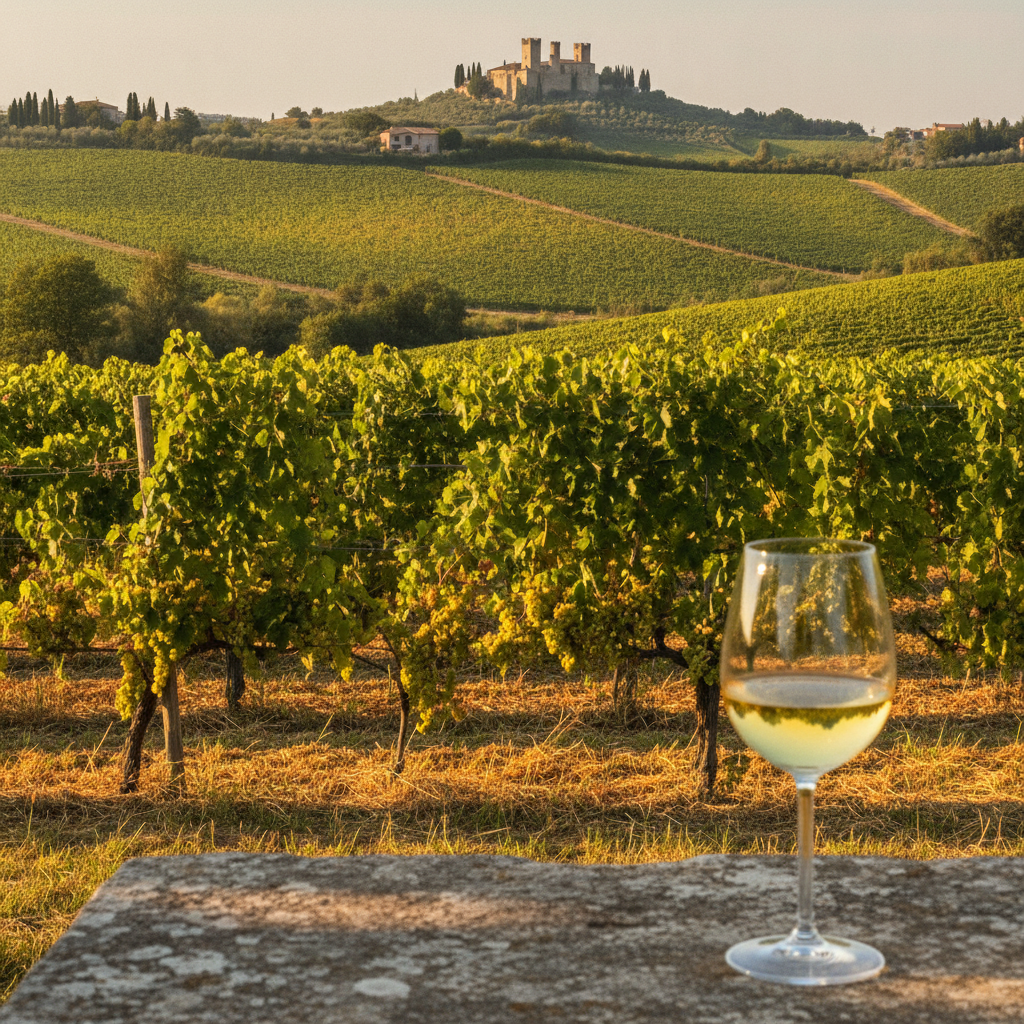
The production regulations guarantee the authenticity and quality of the wines under appellation. For Verdicchio dei Castelli di Jesi, amendments aim to strengthen the link with the territory, emphasizing the geographic nuances of the Castelli di Jesi area, as highlighted by Michele Bernetti of the Istituto Marchigiano di Tutela Vini (IMT). European legislation (CELEX:32013R1308, CELEX:32008R0479, CELEX:32014R1143) defines essential elements such as the name, categories, and characteristics of the wine.
What are the distinctive organoleptic characteristics of Verdicchio?
Verdicchio is distinguished by fresh notes of green apple, citrus, and white flowers, with a characteristic almond nuance on the finish. On the palate, it presents good structure, pronounced acidity, and sapidity that extend its persistence. Its aging potential leads to the development of complex aromas of honey, hydrocarbons, dried fruit, and spices with time.
What are the more ambitious versions of Verdicchio, like the Riservas, like?
Riserva versions, which can carry the DOCG designation, further enhance Verdicchio's qualities, showing greater structure, depth, and significant aging potential. They can exhibit a brilliant golden color, clear aromas of summer and tropical fruit, aromatic herbs, anise, and a subtle honeyed background, with a seductive sip that is agile yet rich in flavor.
What are foreign buyers looking for in Verdicchio dei Castelli di Jesi?
Foreign buyers seek wines with a good quality-price ratio, a distinct territorial identity, and aging potential. Verdicchio dei Castelli di Jesi meets these needs thanks to its versatility, evolutionary capacity, and distinctive organoleptic profile. Its history and connection to the Marche territory are strong narratives appreciated internationally.
How does the mention "Castelli di Jesi" add value to the wine in foreign markets?
The "Castelli di Jesi" designation strengthens the connection to a specific and historically relevant geographical area, a factor that international buyers tend to value. This territorial approach, as highlighted by the amendments to the regulations, promotes the idea of an area dedicated to the production of high-quality whites, increasing perceived authenticity and typicity.
How does supply management affect the Verdicchio dei Castelli di Jesi market?
Strategic measures such as supply containment are crucial in scenarios of economic uncertainty. The proposal by the Istituto Marchigiano di Tutela Vini (IMT) for containment measures, such as product storage or a freeze on new plantings, aims to stabilize prices and protect the denomination's value. The maximum yield per hectare, set at 140 quintals for Verdicchio Castelli di Jesi Doc, with storage activation at 110 quintals, demonstrates attention to quality and volume management.
Frequently Asked Questions
What are the main characteristics that make Verdicchio dei Castelli di Jesi attractive to foreign buyers?
Foreign buyers appreciate Verdicchio dei Castelli di Jesi's good quality-price ratio, distinct territorial identity, and aging potential, in addition to its versatility and distinctive organoleptic profile.
How does the production regulation for Verdicchio dei Castelli di Jesi support its export?
The regulations, with their amendments aimed at strengthening the link to the territory, help to highlight the geographical specificity of the Castelli di Jesi area, a factor appreciated by international consumers seeking authenticity.
What are the typical aromatic notes of Verdicchio dei Castelli di Jesi that can appeal to international markets?
Typical aromatic notes include citrus and green apple freshness, floral hints, and a distinctive almond nuance, which evolve with aging into more complex notes such as honey and hydrocarbons.
Verdicchio dei Castelli di Jesi is a wine with a strong territorial identity and significant enological potential, ideal for export. Italian wineries focusing on this product, by communicating its history and peculiarities, can find success in international markets.